
Game-series visual reference · retrofuturistic post-apocalyptic design
Fallout’s visual identity places atomic-age optimism inside a damaged future: rounded machines, cheerful consumer design, heavy infrastructure and improvised survival.
A visual introduction
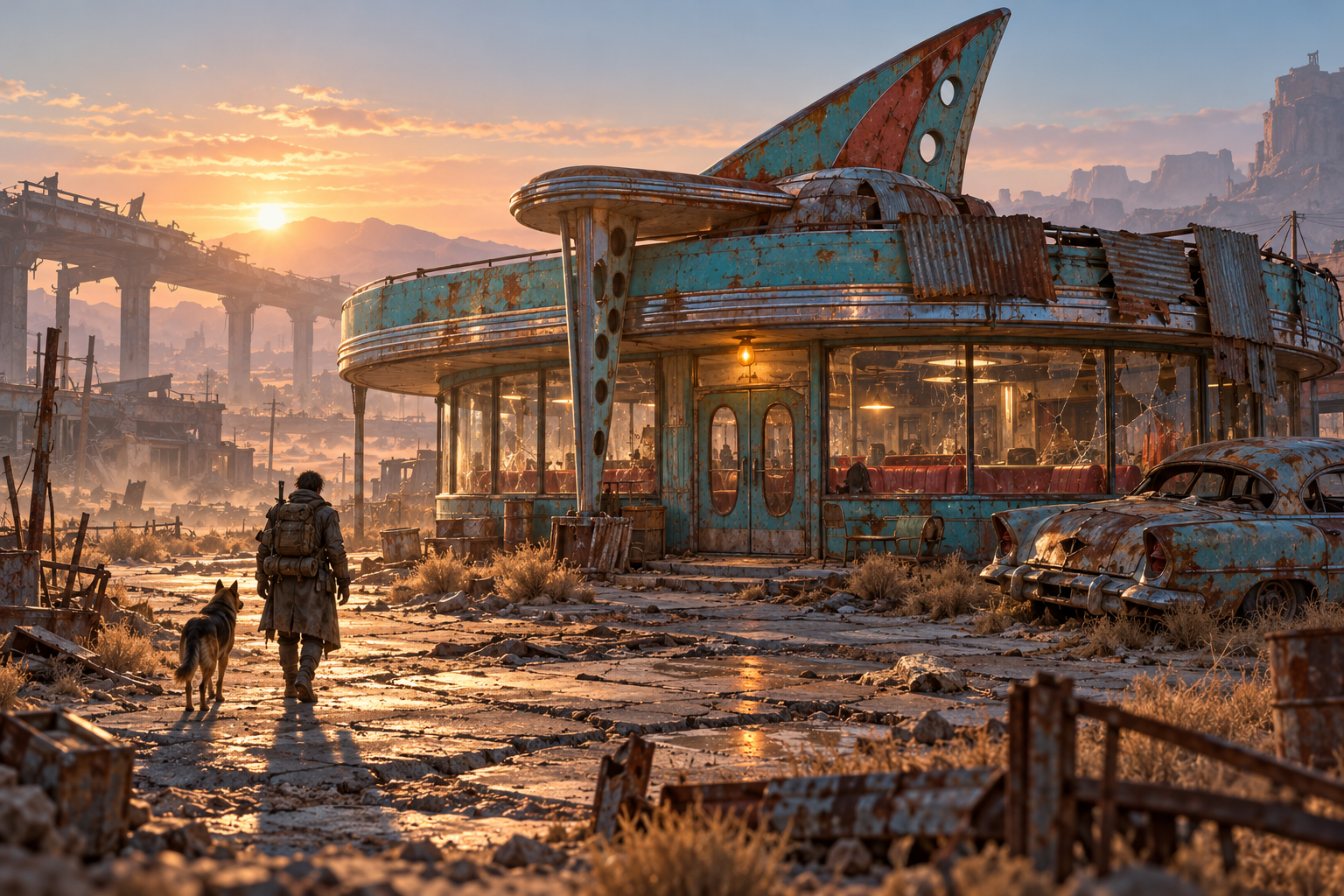
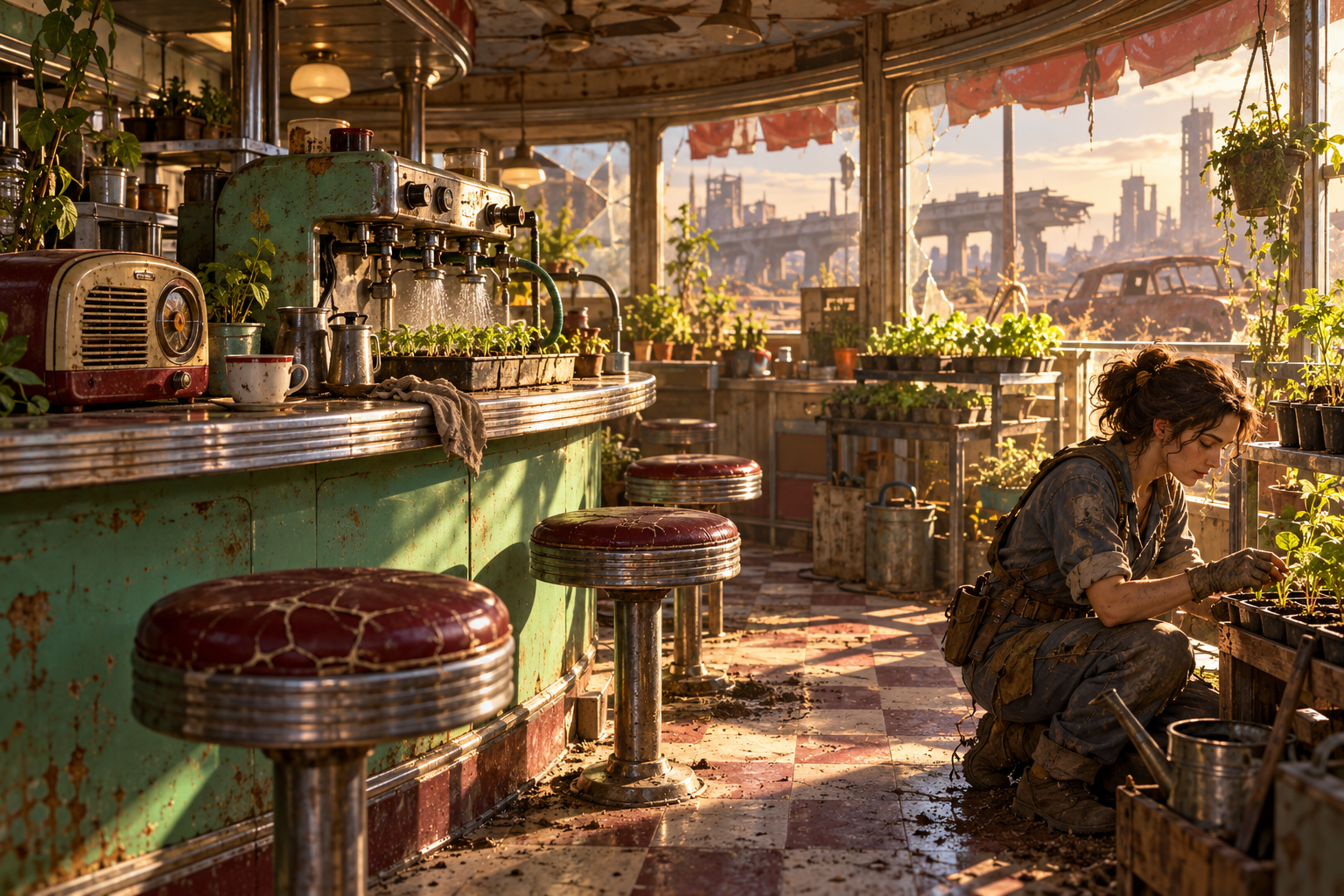
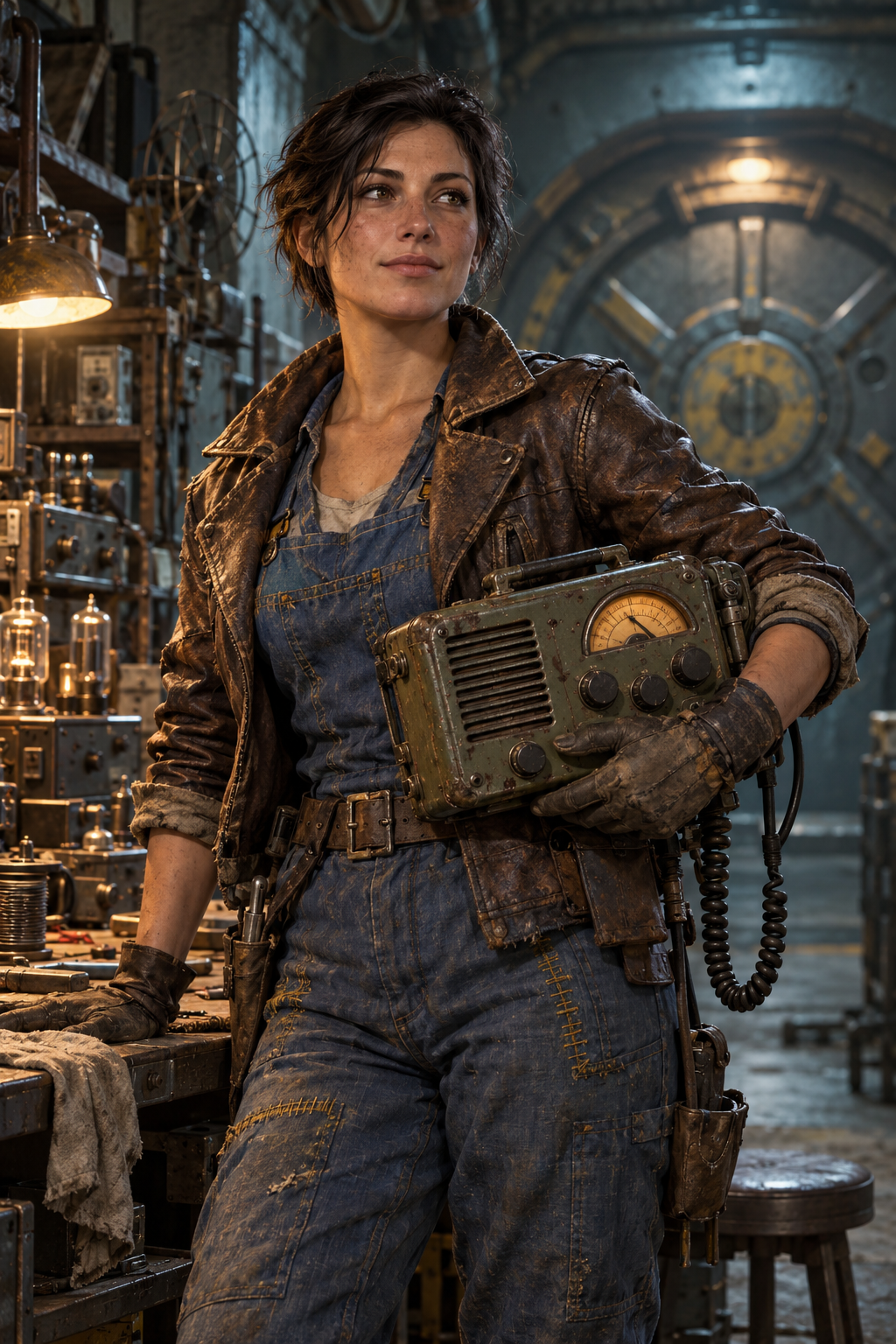
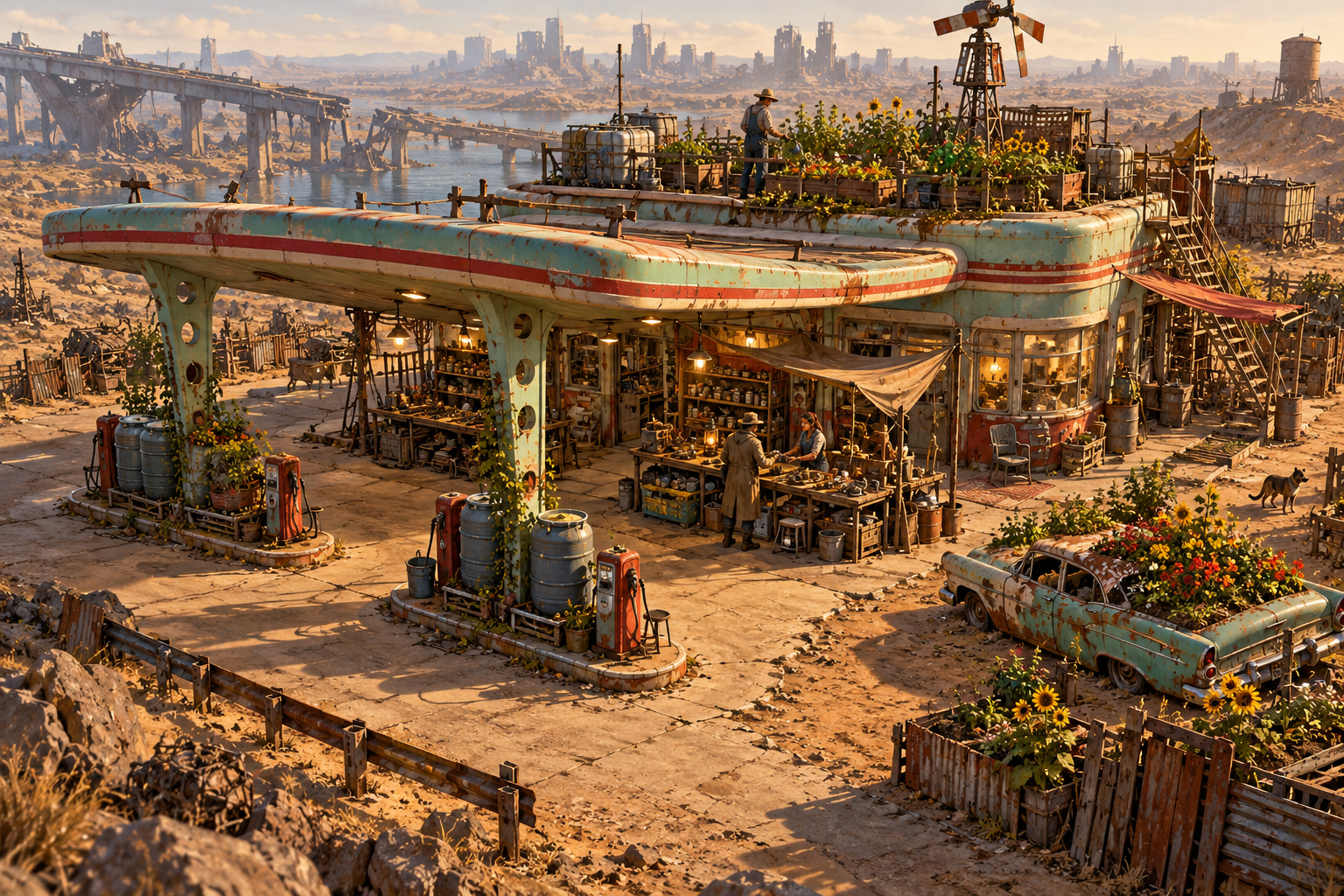
Four original AI-generated AOI interpretations: a dedicated roadside banner and three standalone studies of a reused diner, a radio technician and a surviving community. These are fictional scenes exploring Fallout’s visual language, not official game artwork.
Select an image for a closer look. Use the thumbnails, arrow keys or a swipe to compare examples. Zoom in to inspect details, or share the image that inspires you.
Creative toolbox · take this style further
Choose an input and a destination. Search sends your words to the chosen site; Copy & open puts them on your clipboard to paste there.
Create with AI
Turn your chosen input into an image prompt or a new creative direction.
ChatGPT
Copy your input and paste it into a ChatGPT conversation or image request.
Copy & open ChatGPT (new tab)Claude · Anthropic
Develop an image prompt or explore the style in a new Claude conversation.
Copy & open Claude · Anthropic (new tab)Midjourney
Paste your input into the Imagine bar on the Create page.
Copy & open Midjourney (new tab)Adobe Firefly
Copy your input, open Firefly, and paste it into the prompt field.
Copy & open Adobe Firefly (new tab)Leonardo.Ai
Copy your input, open Leonardo, and paste it into the generation field.
Copy & open Leonardo.Ai (new tab)Image search
Find visual references. Short, concrete keywords usually work best.
Lexica
Search AI images and prompts using your selected input.
Search with this input Lexica (new tab)Pexels
Search the photo and video library. Short keywords often work best.
Search with this input Pexels (new tab)Pixabay
Search photos, illustrations and other images.
Search with this input Pixabay (new tab)Unsplash
Search photographs using the style name or your own keywords.
Search with this input Unsplash (new tab)Wikimedia Commons
Search photographs, artworks and historical images. Check each file for its source and reuse terms.
Search with this input Wikimedia Commons (new tab)Art & research
Explore artists, collections and the ideas behind a style.
Wikipedia
Search for background reading. A style may not have its own article.
Search with this input Wikipedia (new tab)WikiArt
Copy your input into WikiArt’s search to explore artists and artworks.
Copy & open WikiArt (new tab)Europeana
Paste your keywords into the search to explore European museum, library and archive collections.
Copy & open Europeana (new tab)Inspiration
Discover portfolios and visual ideas from creative communities.
Instagram hashtags
Search a hashtag made from your input: spaces and punctuation are removed. Instagram may require sign-in.
Search with this input Instagram hashtags (new tab)ArtStation
Paste your input into artwork search for concept art, environments, characters and visual development.
Copy & open ArtStation (new tab)Behance
Paste your input into project search for illustration, design and visual storytelling.
Copy & open Behance (new tab)A closer look
Streamlined silhouettes and analog controls meet cracked enamel, oxidized steel, worn fabric and improvised repairs. Faded turquoise, cream and red survive among earth tones; warm human activity interrupts cold industrial spaces.
A fictional world with a recognizable design language
Here, Fallout means the visual aesthetic of the game series: a franchise reference, rather than a historical art movement or a synonym for nuclear art. Its central tension is temporal. Objects promise a comfortable technological tomorrow, while their damaged surroundings show what happened to that promise. A rounded refrigerator, a heavy bunker door and a cheerful advertising panel can belong to the same image because they share a world of oversized mechanisms and manufactured reassurance.
In a contemporary interview reproduced from Edge’s 2007 Fallout 3 preview, lead artist Istvan Pely described the combination of futuristic technology and a 1950s sensibility. The accompanying discussion connects the series’ upbeat instructional imagery with its ironic treatment of catastrophe. That contrast is more useful for image making than a checklist of famous props: decide what the old world promised, then show how an inhabitant must now adapt it.
Production art, variation and authorship
Fallout’s appearance is collaborative and varies across its games. Bethesda’s Art of Fallout 4 introduction names concept artists Adam Adamowicz, Ray Lederer, Ilya Nazarov and John Gravato, and describes a process moving from loose drawings to refined designs, models and repeated revisions. These are production contributions to particular games, not a claim that one artist invented every aspect of the franchise.
Bethesda’s Fallout 76 concept-art selection offers another useful comparison: it includes Appalachia, the emergence from Vault 76 and the industrial remains of Pittsburgh. Environment and atmosphere are active choices, not a compulsory brown filter. Study a specific installment when accuracy matters. The original AOI illustrations here explore the broader design language; they are not official concept art, screenshots or depictions of documented locations.
Build the image in three layers
First establish the manufactured ideal. Give a building a confident curve, a machine a generous rounded casing, or a room a coordinated enamel palette. Second establish failure with causes: rain streaks below a seam, chipped paint at handles, broken glass beneath a damaged frame. Third introduce reuse. A counter can shelter seedlings; a pump island can support water storage; an old radio can become someone’s most carefully maintained possession. Those layers make the scene legible as a history rather than a pile of distressed assets.
Use scale to organize the story. A large vault door or canopy can frame a small person, while a familiar cup or chair makes the architecture feel inhabitable. Keep the main silhouette clear and concentrate hard edges around the focal object. Let haze, dust and softer background edges reduce competing information. Texture should describe material: rust belongs on exposed ferrous metal, upholstery cracks differently from enamel, and polished contact areas can remain bright even in an old room.
Color, characters and the useful limits of imitation
Pair surviving commercial colors with a quieter environment: faded turquoise against warm dust, cream against dark steel, a small red accent near a human activity. Green instrument light can direct attention, but bathing everything in green flattens the difference between a screen and a landscape. For a portrait, communicate occupation through construction and repair: patched workwear, a believable carrying strap, replacement knobs and the handling of a useful object. Dirt alone does not establish a character.
This vocabulary is effective for environmental storytelling, speculative product design and character studies. It becomes shallow when every image is a ruined diner, every surface has identical corrosion, or recognition depends entirely on a logo. Change the emotional temperature as well as the subject. An abandoned roadside scene, a working greenhouse and a repaired radio can express loss, persistence and care within the same visual family. The creative prompts below are interpretive exercises, not instructions for reproducing a particular game asset.
A small poetic detour
Original words from the AOI studio.
Poetry
The future came in turquoise, cream and chrome,
a rounded promise bolted to the floor.
It sold the tired traveler a home,
then left the wind to answer at the door.
A dial remembers stations lost to rain;
a cup collects the light beneath a seam.
Someone has taught the counter spring again:
small leaves replace the advertised machine.
Beyond the glass, the broken road runs west.
Inside, a hand repairs a fraying wire.
Tomorrow is no longer guaranteed;
it needs a chair, a seed, a little fire.
The prompt workshop
Original creative exercises. These prompts create new illustrations, not documentary evidence.
Start with a readable roadside scene
An original Fallout-inspired retrofuturistic roadside diner at dawn, curved turquoise enamel and chrome rocket-fin canopy, selective rust and practical sheet-metal repairs, one traveler and dog for scale, warm doorway light against cool distant ruins, clear focal silhouette, no text or logos.
Give the building an original purpose before adding decay. Preserve a clear shape at thumbnail size.
Tell a story through reuse
An abandoned atomic-age diner converted into a seedling nursery, curved mint counter, cracked burgundy stools, old espresso machine repurposed to water plants, warm afternoon light through damaged windows, one adult gardener tending a tray, credible materials and restrained environmental storytelling, original Fallout-inspired concept art, no lettering.
The new function should be visible in the arrangement and objects. Leave working space around the person.
Make a character through maintenance
Portrait of an original adult wasteland radio technician in repaired workwear, carrying a restored chunky analog radio, yellow stitching and replacement knobs, cool steel workshop behind a warmly lit face, controlled wear at contact points, Fallout-inspired retrofuturistic concept art, coherent hands and straps, no logos.
Contrast well-maintained equipment with a worn environment. This is an invented character, not a named game protagonist.
Your next inspiration
Discover another art style
Follow a visual thread to the next subject.

A smile from the studio
Jokes
The surviving diner robot announced that the future had never looked brighter. Penny pointed out that the roof was missing. “Complimentary panoramic dining,” it replied. The coffee machine had become a seedling irrigator, the jukebox powered a water pump, and the chrome executive lounge now housed three extremely confident tomatoes. Could she at least get breakfast? The robot consulted a green screen, adjusted its immaculate bow tie and offered the Premium Tomorrow Experience: one warm chair, a cup of filtered water and an optimistic estimate. Penny paid with a replacement fuse. For the first time in two centuries, customer service lit up.
Sources and further exploration
Bethesda — Fallout 76 concept art: compare wilderness, vault emergence and industrial environments