
Retrofuturist aesthetic · imagined spaceflight and space-age engineering
Rocketpunk imagines a world organized around travel beyond Earth. Tall rockets, orbital stations, analogue controls and ambitious outposts turn earlier dreams of the space age into coherent speculative images.
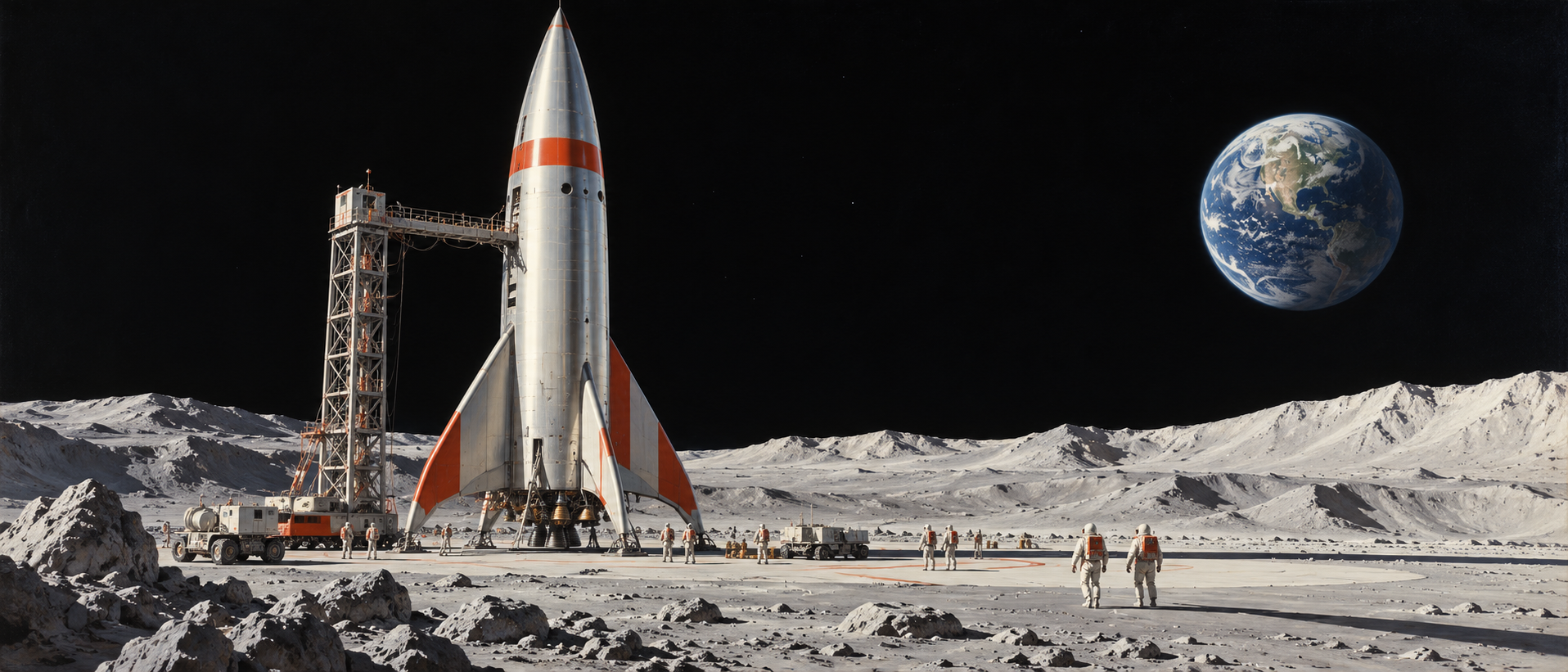
A visual introduction
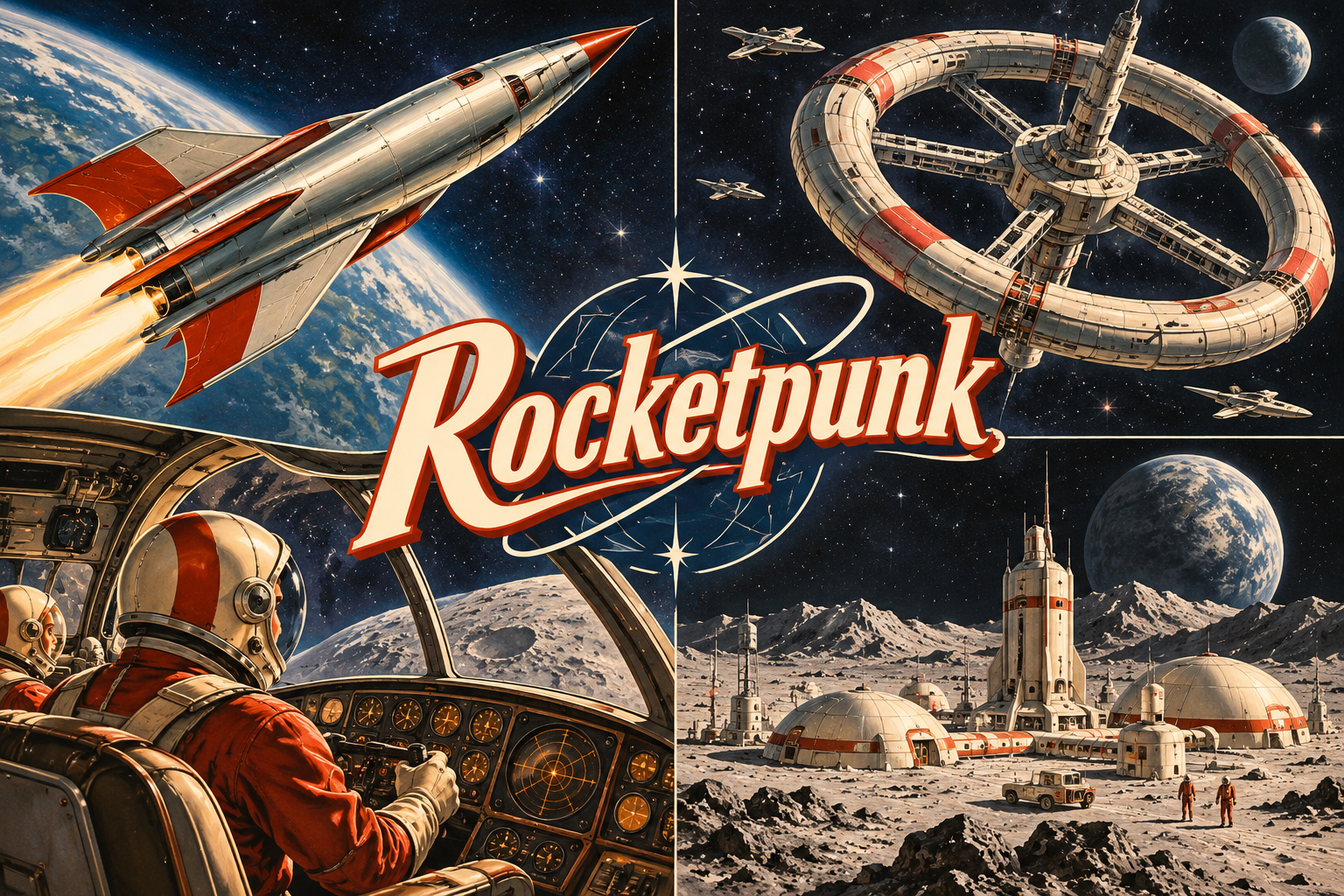
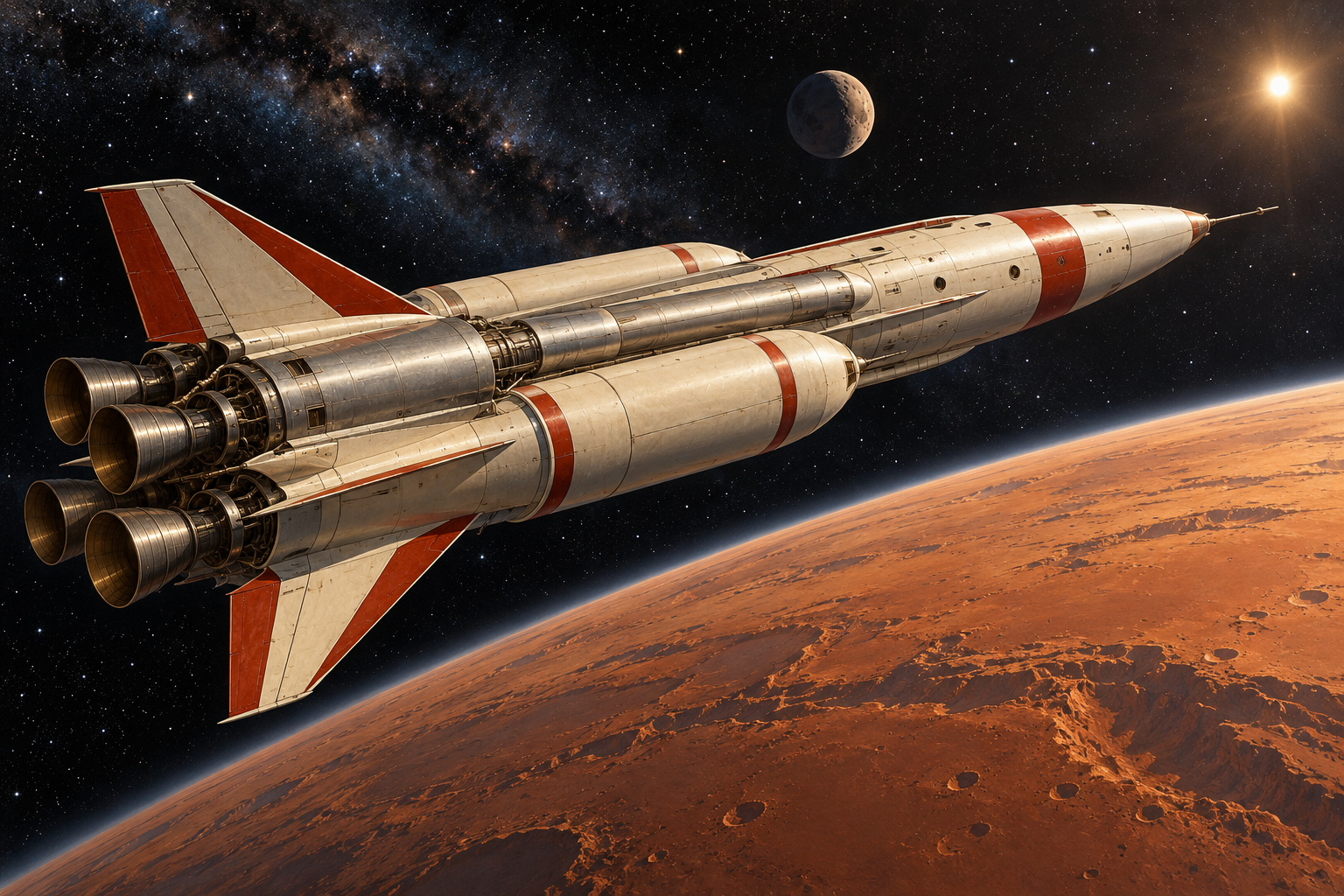
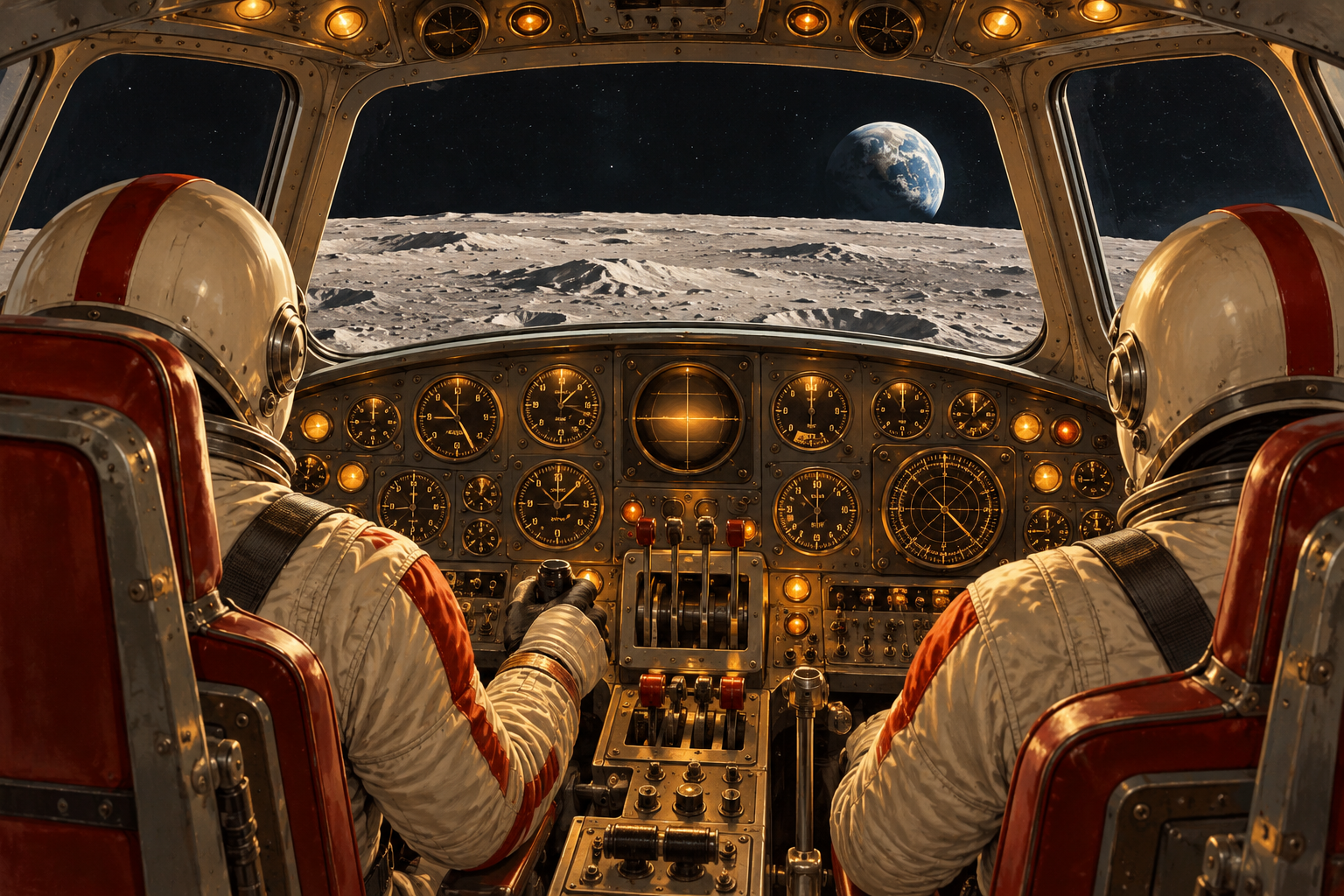
Five original AI-generated AOI interpretations: a dedicated banner, centrally titled collage and three standalone studies. These are illustrative concepts, not historical objects or commercial products.
Select an image for a closer look. Use the thumbnails, arrow keys or a swipe to compare examples. Zoom in to inspect details, or share the image that inspires you.
Creative toolbox · take this style further
Choose an input and a destination. Search sends your words to the chosen site; Copy & open puts them on your clipboard to paste there.
Create with AI
Turn your chosen input into an image prompt or a new creative direction.
ChatGPT
Copy your input and paste it into a ChatGPT conversation or image request.
Copy & open ChatGPT (new tab)Claude · Anthropic
Develop an image prompt or explore the style in a new Claude conversation.
Copy & open Claude · Anthropic (new tab)Midjourney
Paste your input into the Imagine bar on the Create page.
Copy & open Midjourney (new tab)Adobe Firefly
Copy your input, open Firefly, and paste it into the prompt field.
Copy & open Adobe Firefly (new tab)Leonardo.Ai
Copy your input, open Leonardo, and paste it into the generation field.
Copy & open Leonardo.Ai (new tab)Image search
Find visual references. Short, concrete keywords usually work best.
Lexica
Search AI images and prompts using your selected input.
Search with this input Lexica (new tab)Pexels
Search the photo and video library. Short keywords often work best.
Search with this input Pexels (new tab)Pixabay
Search photos, illustrations and other images.
Search with this input Pixabay (new tab)Unsplash
Search photographs using the style name or your own keywords.
Search with this input Unsplash (new tab)Wikimedia Commons
Search photographs, artworks and historical images. Check each file for its source and reuse terms.
Search with this input Wikimedia Commons (new tab)Art & research
Explore artists, collections and the ideas behind a style.
Wikipedia
Search for background reading. A style may not have its own article.
Search with this input Wikipedia (new tab)WikiArt
Copy your input into WikiArt’s search to explore artists and artworks.
Copy & open WikiArt (new tab)Europeana
Paste your keywords into the search to explore European museum, library and archive collections.
Copy & open Europeana (new tab)Inspiration
Discover portfolios and visual ideas from creative communities.
Instagram hashtags
Search a hashtag made from your input: spaces and punctuation are removed. Instagram may require sign-in.
Search with this input Instagram hashtags (new tab)ArtStation
Paste your input into artwork search for concept art, environments, characters and visual development.
Copy & open ArtStation (new tab)Behance
Paste your input into project search for illustration, design and visual storytelling.
Copy & open Behance (new tab)A closer look
Silver hulls, clear engine and tank shapes, compact windows and dramatic changes of scale combine with painted cosmic vistas. Retro controls and streamlined silhouettes suggest a future imagined through an earlier technological vocabulary.
An imagined future with a visible past
Rocketpunk is used for a family of speculative and retrofuturist spaceflight visions. Its boundaries are loose: some examples lean toward polished mid-century rockets, while others emphasize plausible transport, logistics and settlement. This entry focuses on the visual connection between ambitious space travel and an earlier technological imagination.
Rick Robinson's spacecraft designs, reproduced with attribution by Atomic Rockets, illustrate an engineering-minded strand of the discussion. They include defined functions, tanks, payloads and scale references. That is a useful counterweight to treating Rocketpunk as any silver object with decorative fins.
Learn from space art without inventing a movement
Chesley Bonestell is an important historical reference for space visualization. Adler Planetarium describes how his imagined cosmic landscapes helped shape public pictures of space travel. His work provides context for the power of a carefully rendered speculative scene; it does not establish that he belonged to a formally organized Rocketpunk movement.
Historical future visions combine observation, extrapolation and assumptions that later knowledge may change. Study how an image makes a proposal feel tangible: viewpoint, scale, light and structural continuity. Preserve the distinction between persuasive illustration and validated science.
Give each machine a job
Choose a mission before adding detail. A lunar lander, deep-space transport and orbital station need different silhouettes. Even a stylized concept becomes more convincing when engines, crew spaces, tanks and docking areas have readable relationships. Small service vehicles or suited figures can establish scale.
The AOI ship study emphasizes a continuous hull and identifiable propulsion area above a planetary curve. The lunar banner uses a tall finned silhouette and nearby ground equipment. These are deliberately retrospective design choices, not claims that every fin or window would be appropriate to a real spacecraft.
Avoid meaningless mechanical noise. A few comprehensible parts often communicate more than hundreds of panels. Preserve clear joins and an understandable main axis before adding surface texture.
Use light to explain size and material
A bright hull against a dark sky creates an immediate silhouette. Broad highlights can reveal a cylindrical tank, while deeper shadow separates a nozzle or recessed docking area. In a lunar-style scene, strong directional light and long ground shadows help describe terrain and scale.
Keep environmental assumptions consistent. A vacuum scene should not casually acquire aircraft-like cloud trails. A painted starfield is an illustrative convention, not a guarantee of what a particular camera exposure would record. Where the image is intentionally theatrical, describe that choice rather than presenting it as a simulation.
The cockpit tells a different story
Analogue dials, physical switches and compact windows suggest a technological path different from today's familiar touchscreens. They can make the crew's work tactile and legible. Use groups of controls with clear purposes instead of filling every surface with random glowing marks.
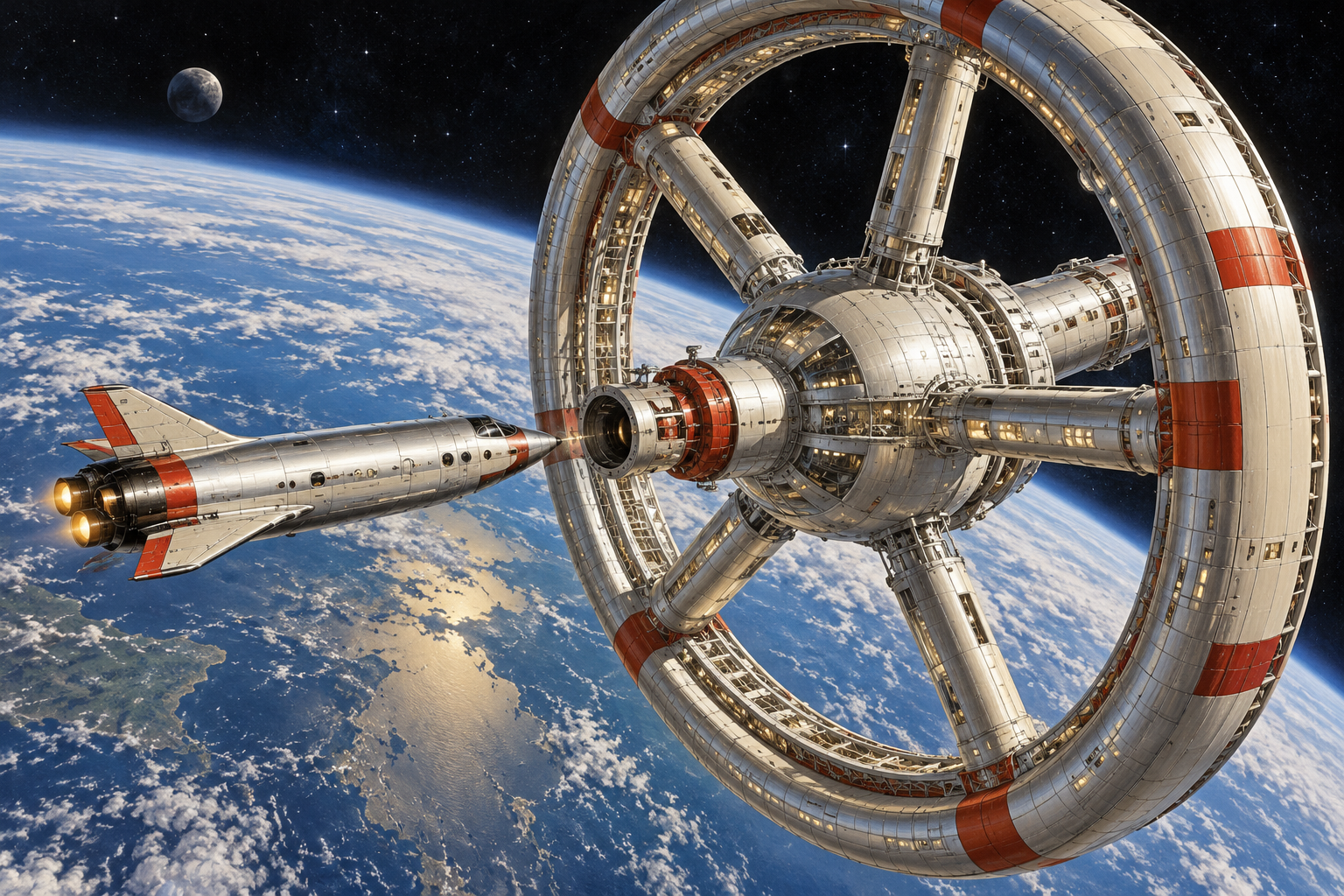
The station study changes the scale again: a wheel, spokes and central hub organize the whole image. Rotation can suggest a familiar speculative approach to artificial gravity, but the drawing alone establishes no performance, structural or safety calculation. Its value here is visual and narrative.
Rocketpunk overlaps with broader space-age retrofuturism. Raygun-centered fantasy may give priority to exuberant inventions; engineering-minded Rocketpunk can instead foreground travel time, maintenance and life aboard. The suffix does not require every story to share one politics or mood.
An exercise in believable ambition
Sketch a vessel as five major masses and identify their roles. Place a human-scale reference nearby. Then render it twice: once with optimistic clean surfaces, once with repairs and accumulated service wear. The difference can suggest an entire history of use.
This approach suits speculative covers, worldbuilding and concept illustration. For technical communication, consult actual engineering references and make assumptions explicit. The strongest Rocketpunk image invites the viewer to imagine a journey while giving that journey enough structure to be interesting.
A small poetic detour
Original words from the AOI studio.
Poetry
Departure board
The silver tower gathers dawn;
the gantry keeps its patient height.
A small blue world is painted on
the window of a future night.
We check the seals, the charts, the bread,
the spare parts packed beneath the floor.
The stars are waiting overhead;
the checklist asks for one thing more.
Then through the dial-lit hush we hear
a human voice say: all is clear.
The prompt workshop
Original creative exercises. These prompts create new illustrations, not documentary evidence.
Design a mission before a silhouette
Illustrate an original retrofuturist lunar lander with a clear crew section, tanks, engines and landing supports. Add a small suited figure for scale, strong directional light and restrained silver, cream and red.
This is speculative concept art; make the major parts readable.
Show the work inside the ship
Create an imagined spacecraft cockpit with physical switches, grouped analogue dials and two suited adults seen from behind. Use amber instrument light and a small window framing a lunar horizon.
Controls should feel organized rather than randomly decorative.
Make orbital scale visible
Paint a wheel-shaped orbital station with coherent spokes, central hub and approaching shuttle above Earth. Use broad metallic highlights and a clear docking relationship.
Let the small shuttle establish the station's scale.
Your next inspiration
Discover another art style
Follow a visual thread to the next subject.
A smile from the studio
Jokes
The Rocketpunk travel brochure promised breakfast on Earth and dinner among the stars. The engineer added a footnote about transfer windows, propellant, life support and whether the dining room had a floor. Marketing asked if the footnote could be smaller. “Certainly,” said the engineer, “but it will still weigh more than the dessert.”
Sources and further exploration
Atomic Rockets — attributed Rick Robinson spacecraft concepts, functions and scale relationships
Adler Planetarium — Chesley Bonestell and the historical influence of speculative space art
Museum of Pop Culture — Bonestell's role in making imagined space travel feel possible