
AOI creative concept
An AOI-created interpretation that joins precise diamond-like facets with imagined cosmic depth. Learn its three-scale composition, restrained palette and limits as artistic—not scientific—imagery.
An A⊕I –[-.+] creαt¡ve c⊕ncept, n⊕t αn estαbl¡she∂ h¡st⊕r¡cαl m⊕vement.
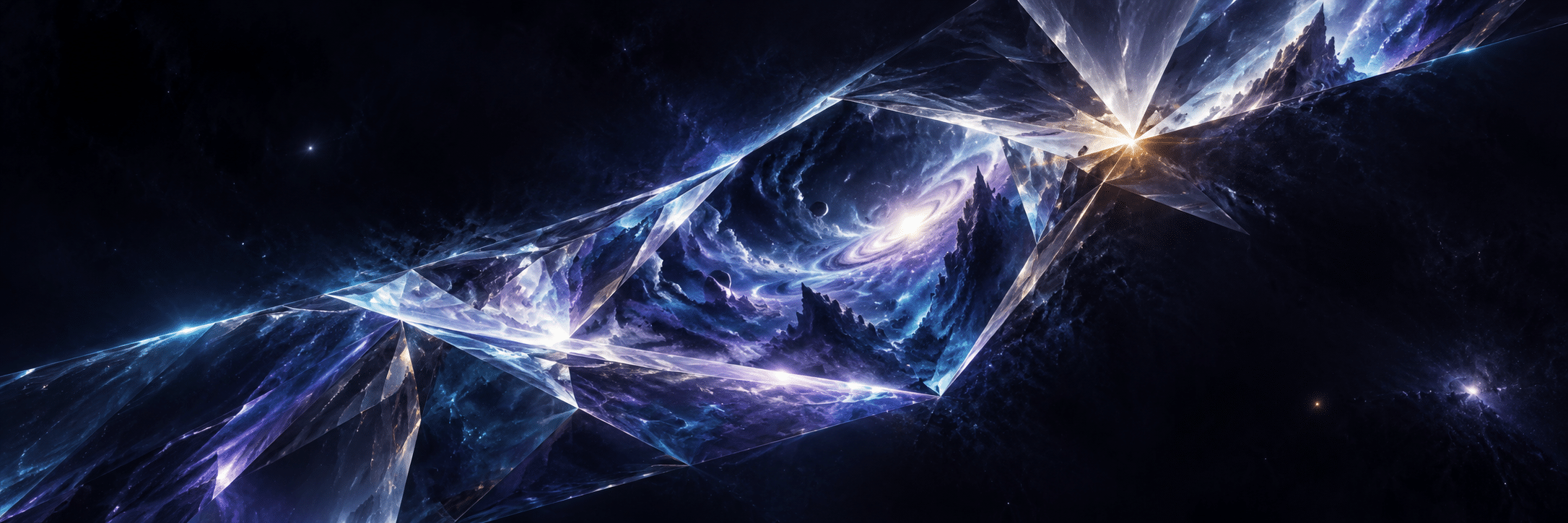
A visual introduction
Select an image for a closer look. Use the thumbnails, arrow keys or a swipe to compare examples. Zoom in to inspect details, or share the image that inspires you.


Creative toolbox · take this style further
Choose an input and a destination. Search sends your words to the chosen site; Copy & open puts them on your clipboard to paste there.
Create with AI
Turn your chosen input into an image prompt or a new creative direction.
ChatGPT
Copy your input and paste it into a ChatGPT conversation or image request.
Copy & open ChatGPT (new tab)Claude · Anthropic
Develop an image prompt or explore the style in a new Claude conversation.
Copy & open Claude · Anthropic (new tab)Midjourney
Paste your input into the Imagine bar on the Create page.
Copy & open Midjourney (new tab)Adobe Firefly
Copy your input, open Firefly, and paste it into the prompt field.
Copy & open Adobe Firefly (new tab)Leonardo.Ai
Copy your input, open Leonardo, and paste it into the generation field.
Copy & open Leonardo.Ai (new tab)Image search
Find visual references. Short, concrete keywords usually work best.
Lexica
Search AI images and prompts using your selected input.
Search with this input Lexica (new tab)Pexels
Search the photo and video library. Short keywords often work best.
Search with this input Pexels (new tab)Pixabay
Search photos, illustrations and other images.
Search with this input Pixabay (new tab)Unsplash
Search photographs using the style name or your own keywords.
Search with this input Unsplash (new tab)Wikimedia Commons
Search photographs, artworks and historical images. Check each file for its source and reuse terms.
Search with this input Wikimedia Commons (new tab)Art & research
Explore artists, collections and the ideas behind a style.
Wikipedia
Search for background reading. A style may not have its own article.
Search with this input Wikipedia (new tab)WikiArt
Copy your input into WikiArt’s search to explore artists and artworks.
Copy & open WikiArt (new tab)Europeana
Paste your keywords into the search to explore European museum, library and archive collections.
Copy & open Europeana (new tab)Inspiration
Discover portfolios and visual ideas from creative communities.
Instagram hashtags
Search a hashtag made from your input: spaces and punctuation are removed. Instagram may require sign-in.
Search with this input Instagram hashtags (new tab)ArtStation
Paste your input into artwork search for concept art, environments, characters and visual development.
Copy & open ArtStation (new tab)Behance
Paste your input into project search for illustration, design and visual storytelling.
Copy & open Behance (new tab)A closer look
Large dark fields, one continuous luminous structure, selectively sharp facets, restrained white flashes and a small cool-to-warm palette. Crystalline geometry must organise the space rather than decorate it.
A new interpretation of cosmic scale and cut light
Diamond Space Galaxy Art is developed here as an AOI creative concept: cosmic depth organised through a limited system of sharp, diamond-like facets. Its defining contrast is between soft, apparently distant luminous matter and precise near edges that redirect the eye. The facets should structure space, not merely add glitter to a galaxy background. This is an imaginative visual proposal, not an established historical movement or an astronomical discovery.
The earlier catalogue’s supposed pioneers and exhibition history are not supported and are not part of this interpretation. The proposal has no claimed scientific status, legal registration or proven worldwide exclusivity. Its value must come from a clear method and persuasive images. It is also distinct from the craft commonly called diamond painting, which assembles small decorative pieces on a prepared surface.
The visual rule: one space, three scales
Build the composition at three scales. At the largest scale, reserve a dark field that establishes depth and breathing room. At the middle scale, introduce one continuous luminous structure—a cloud, ring, channel or horizon. At the smallest scale, place a restrained set of facets and bright points whose directions relate to that structure. The eye should travel through these scales without encountering a new focal point at every turn.
Choose a small family of facet angles and repeat them selectively. Let some edges disappear into the luminous material while others remain sharp. This creates a readable passage between crystalline order and atmospheric uncertainty. If every surface is equally sharp, the image becomes a mosaic; if every edge dissolves, the crystalline principle disappears. The useful territory lies in their controlled exchange.
Colour and sparkle are different jobs
A practical palette begins with near-black indigo, a cool luminous range such as cyan or violet, and one limited warm accent. Use bright white sparingly at decisive facet intersections. A rainbow on every edge weakens both scale and hierarchy. Broad dark areas make small flashes effective; they are active parts of the composition rather than unfinished background.
GIA distinguishes white-light brightness, coloured flashes called fire, and the changing light-and-dark effects associated with scintillation in diamonds. Those terms provide useful visual questions, but these artworks are not gemological simulations. A still image can suggest flashes through contrast; it cannot demonstrate how a real stone behaves when moved. Label imagined materials as diamond-like rather than identifying a generated object as an actual diamond.
Astronomical reference is not astronomical evidence
NASA explains that Webb’s infrared observations are processed into visible-colour images by assigning filter data to colour channels. The colour relationships communicate measured information through a considered imaging process. That is different from inventing a violet cloud for an artwork. A generated galaxy should not be presented as telescope data, a newly observed object or a scientifically accurate view from an impossible location.
For reference study, notice large-scale structure, gradients of density and the balance of luminous matter against darkness. Then identify what your artwork deliberately changes. The gallery uses imagined spaces and optical effects, with no claim to reproduce a named galaxy or nebula. Its crystalline forms are compositional devices, not assertions that space is literally filled with cut gemstones.
Five ways to develop the idea
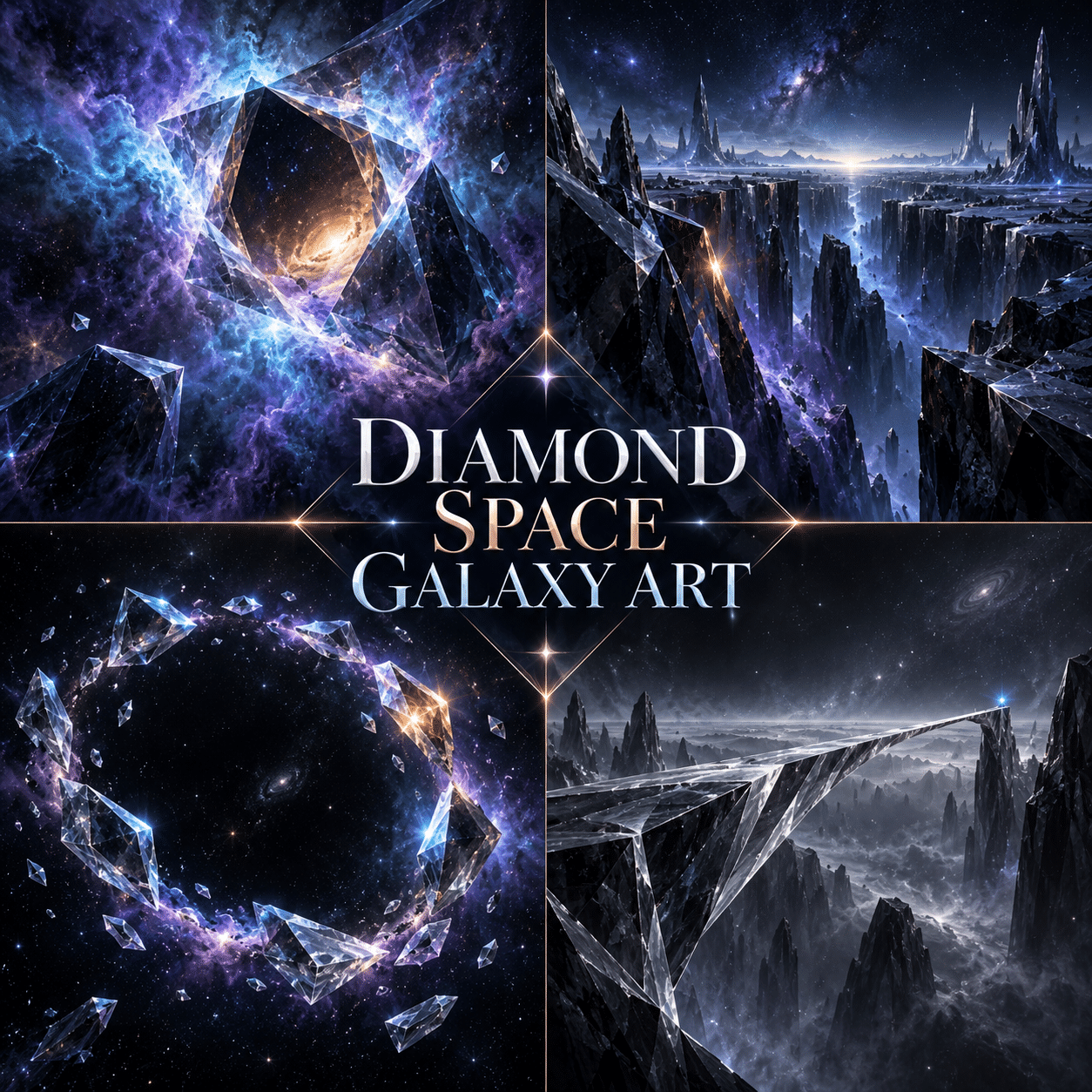
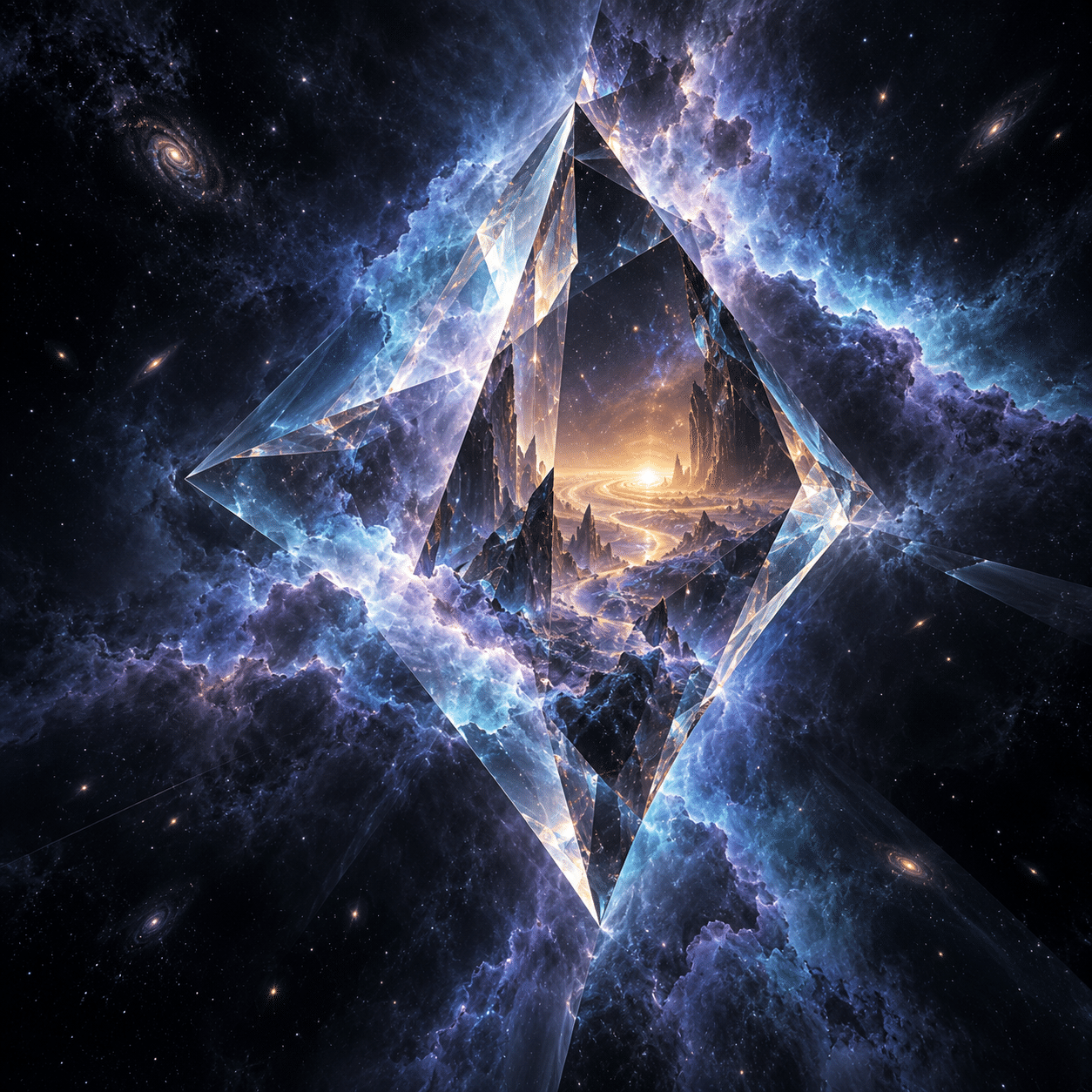
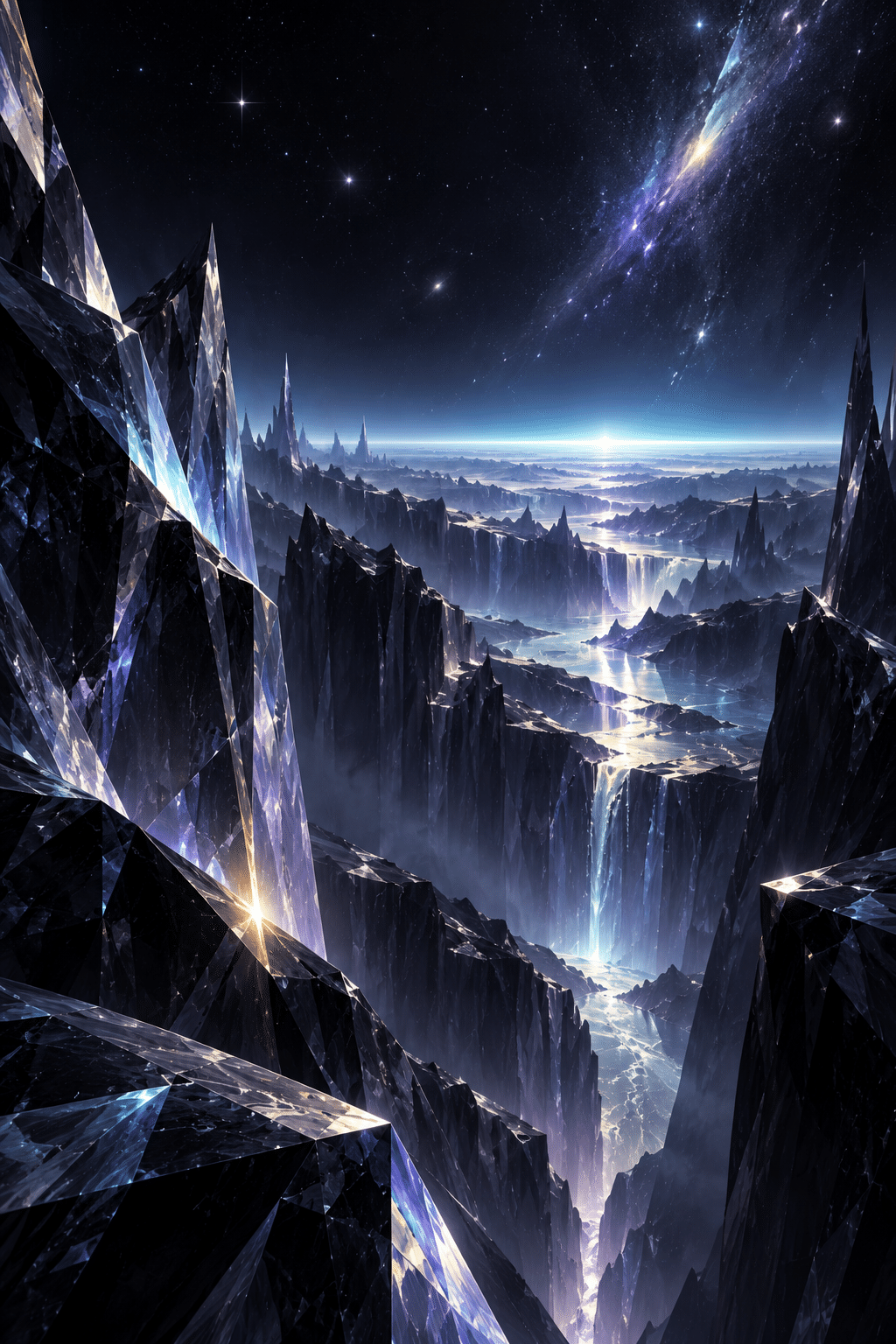
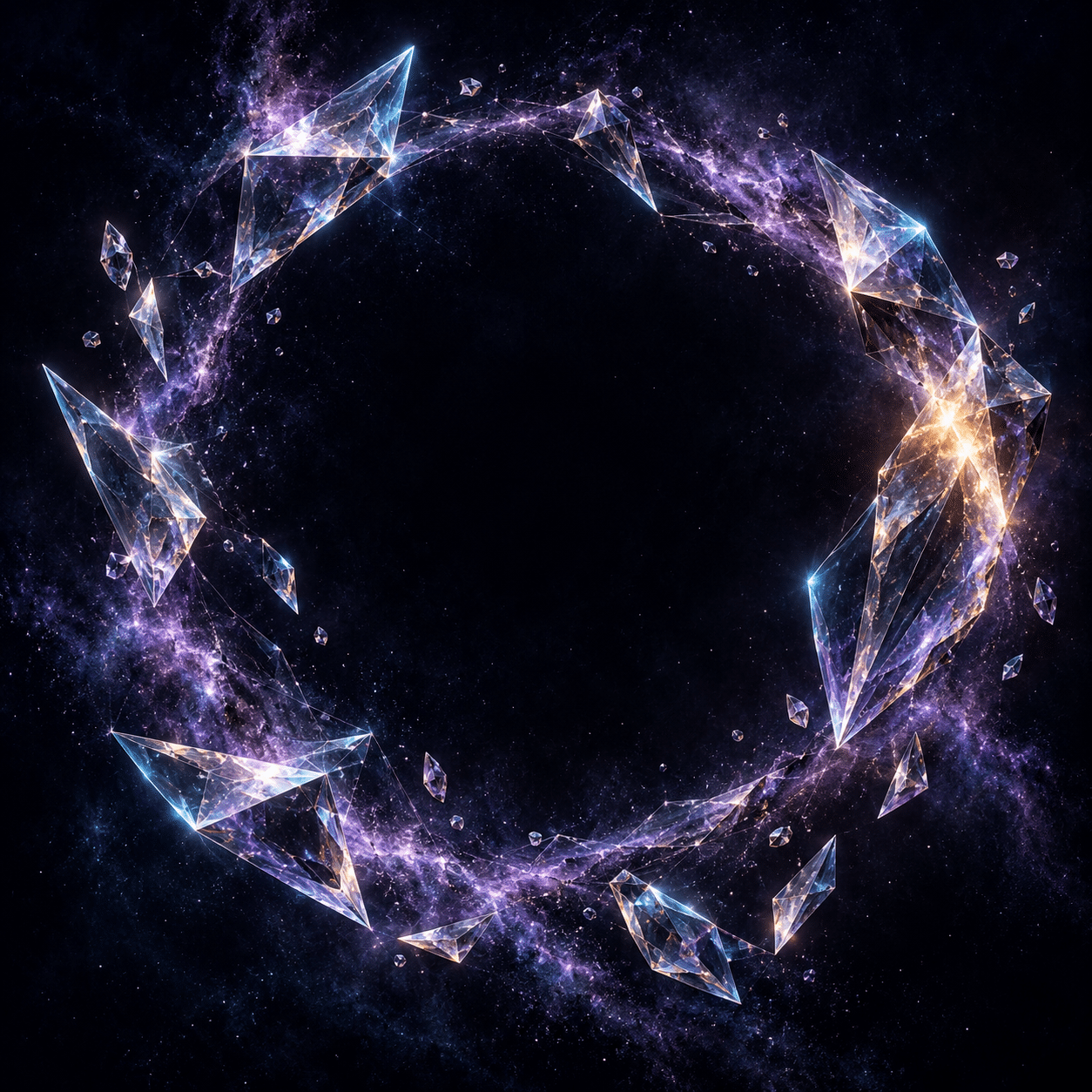
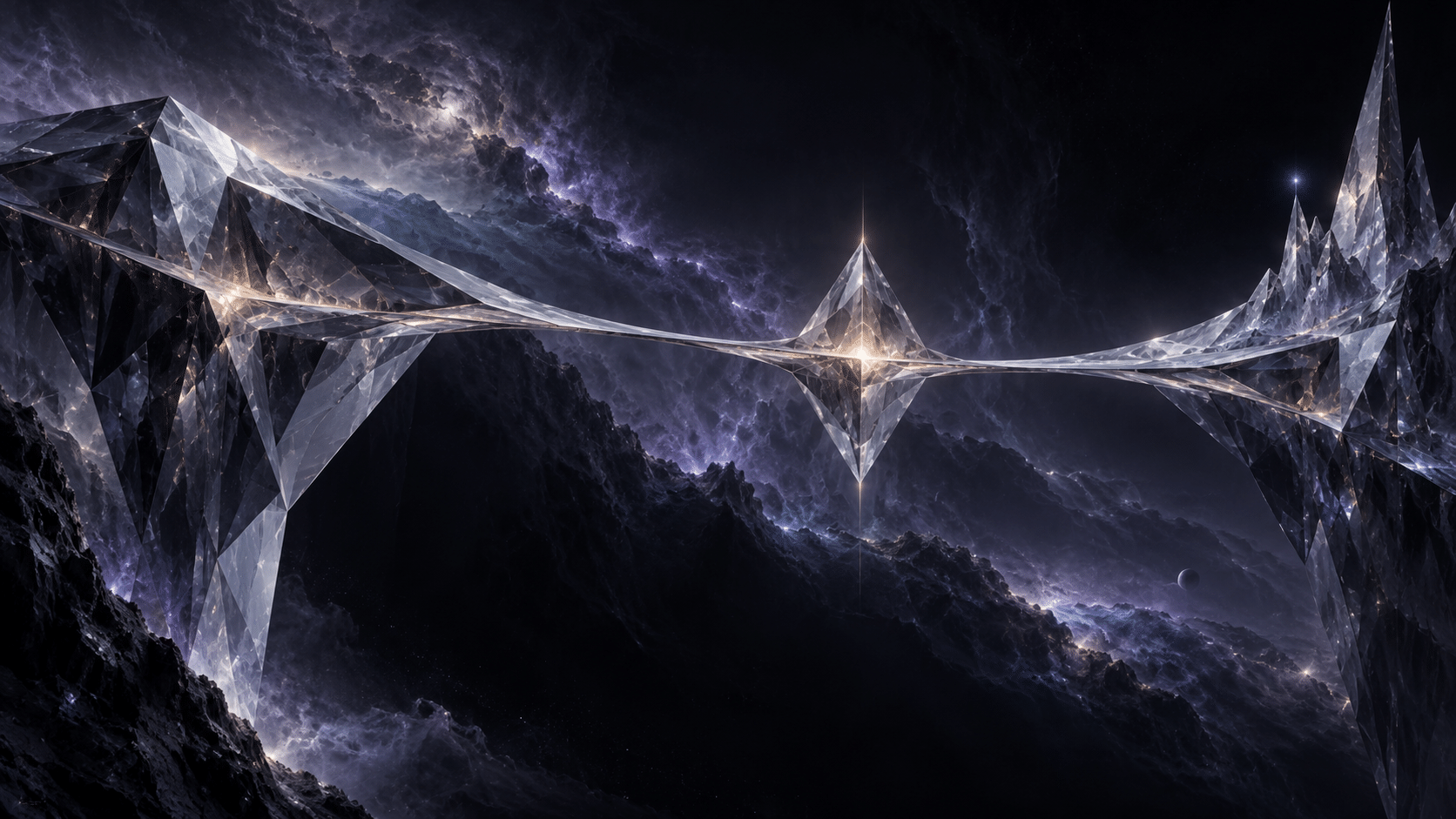
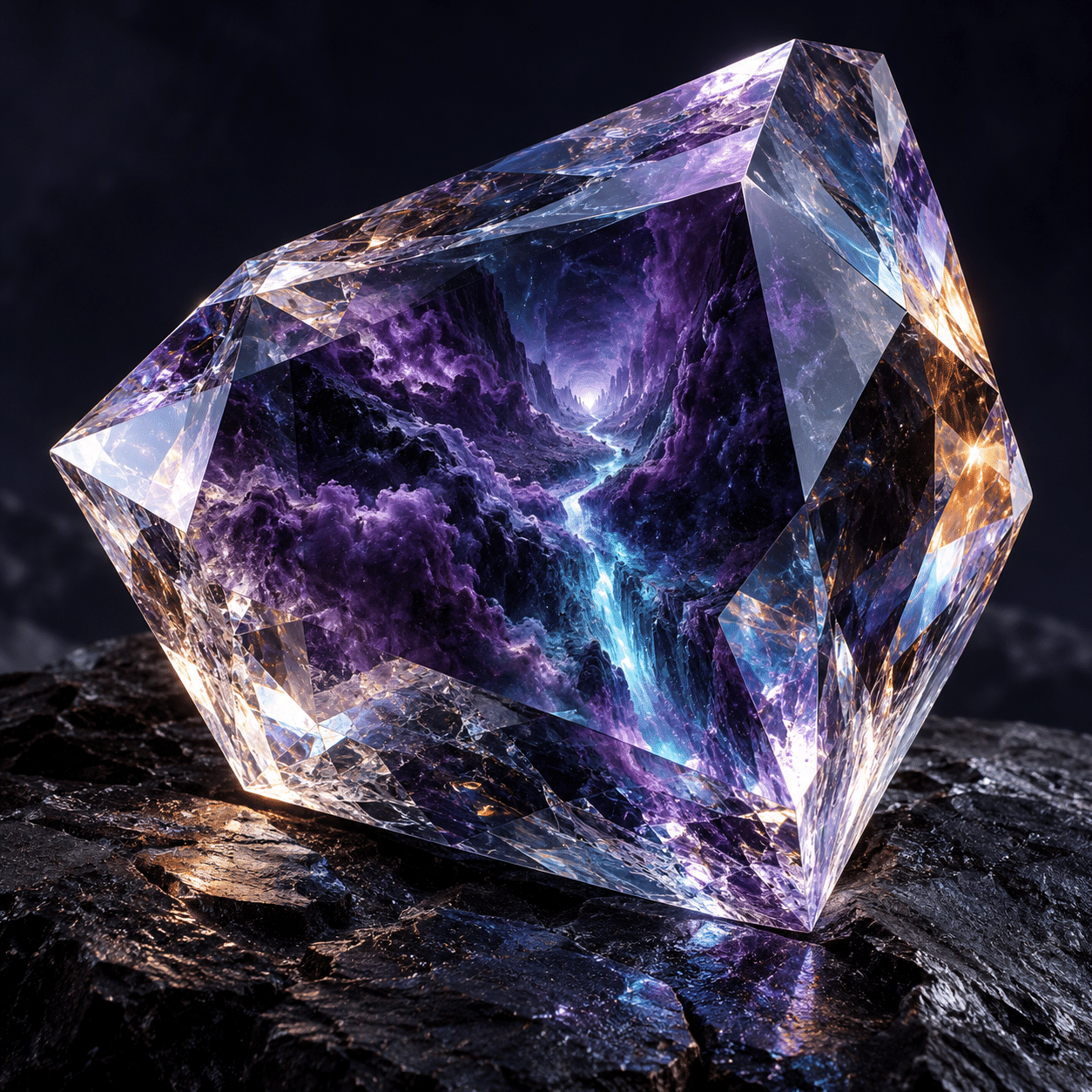
The new studies vary the spatial problem: a faceted opening through a luminous cloud, a crystalline canyon under an invented star field, an orbital ring whose fragments organise a dark centre, a restrained near-monochrome bridge of planes, and a close material study containing an imagined depth. They should not be read as five views of one repeated jewel. Each asks where sharpness belongs and how much darkness the image needs.
A banner must communicate the relationship at a glance, while a larger standalone image can reward inspection of surface and light. Keep the principal form inside a sensible crop-safe area. A centrally titled collage is an educational overview; its panels are not additional standalone works. The actual gallery captions identify every image as an AI-generated interpretation.
A repeatable making and review sequence
Sketch the large dark field first, then the luminous structure, and only then the facets. Check the image in three values before adding small stars. Inspect intersections for contradictory edges, accidental tangencies and forms that appear to melt without purpose. Remove bright points that compete with the main route through the image. The final question is whether the crystalline geometry changes the experience of space; if it can be removed without consequence, it is probably decoration.
Positive perspective — AI-authored editorial assessment
The proposal can make immensity feel precise without reducing it to a diagram. Soft depth and hard edges give the viewer two different ways to read distance, while restrained flashes reward close looking. Its strongest applications include speculative environments, atmospheric cover art and abstract studies of scale.
Critical perspective — AI-authored editorial assessment
The obvious failure is a generic space wallpaper with a shiny gem pasted over it. Excessive bloom, uniform star noise and rainbow edges can erase hierarchy. The concept becomes more distinctive when it commits to a small facet vocabulary, one luminous route and substantial quiet darkness. Scientific-sounding captions cannot compensate for weak structure.
Neutral perspective — AI-authored editorial assessment
Diamond Space Galaxy Art is an AOI visual experiment informed by optical vocabulary and astronomical imagery. Its images are artistic constructions rather than measurements, physical objects or evidence of a historical school. Assess them through composition, material consistency and meaningful variation, while consulting the cited scientific sources for actual optics and imaging methods.
A small poetic detour
Original words from the AOI studio.
Poetry
A cut of light divides the deep,
A cloud refuses to be still.
The smallest edge can hold a night,
The darkest field can make it spill.
No chart has named this silver shore,
No telescope has proved its sea;
We shape a window in the dark
And let the distance disagree.
The prompt workshop
Original creative exercises. These prompts create new illustrations, not documentary evidence.
One opening in the dark
Original AOI Diamond Space Galaxy Art: a single angular crystalline opening through a soft cyan-violet cloud, large indigo dark field, sparse stars and one warm internal glow. Repeat a small family of facet angles, preserve a clear luminous path, no text. Imagined cosmic artwork, not telescope data.
Make a ring carry the composition
Invented orbital ring made of sparse diamond-like planes around a large quiet dark centre, soft luminous dust connecting fragments, cyan ivory and one amber accent, deliberate asymmetry, restrained sparkle. Artistic concept rather than physical astronomy.
Reduce the palette and keep the depth
Near-monochrome speculative landscape of faceted planes bridging a dark void, soft silver atmospheric layers behind sharp foreground edges, one tiny blue light, no rainbow glitter. Three distinct scales of form, coherent light direction, no labels or claim of a real place.
A smile from the studio
Jokes
The galaxy asked for one tasteful highlight. The diamond arrived with a lighting department.