
Digital technique · Compression, motion and broken continuity
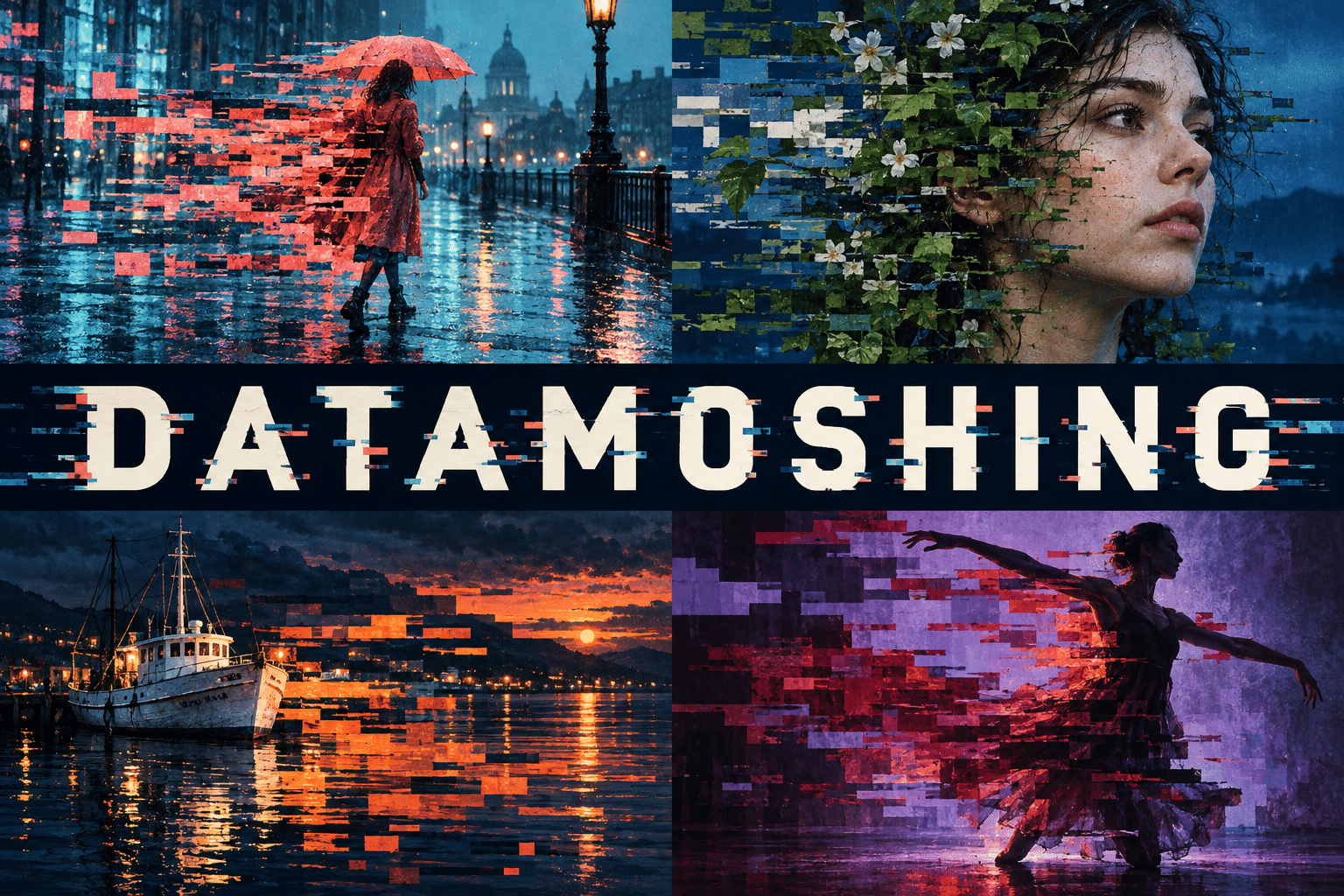
Datamoshing turns the dependencies inside compressed video into visible material. One shot seems to leak into another: a face becomes a moving field, a street drags its colors behind a passing figure, or an old image survives beneath new motion. Its distinctive tension is between something recognizable and an image that can no longer settle.
A visual introduction
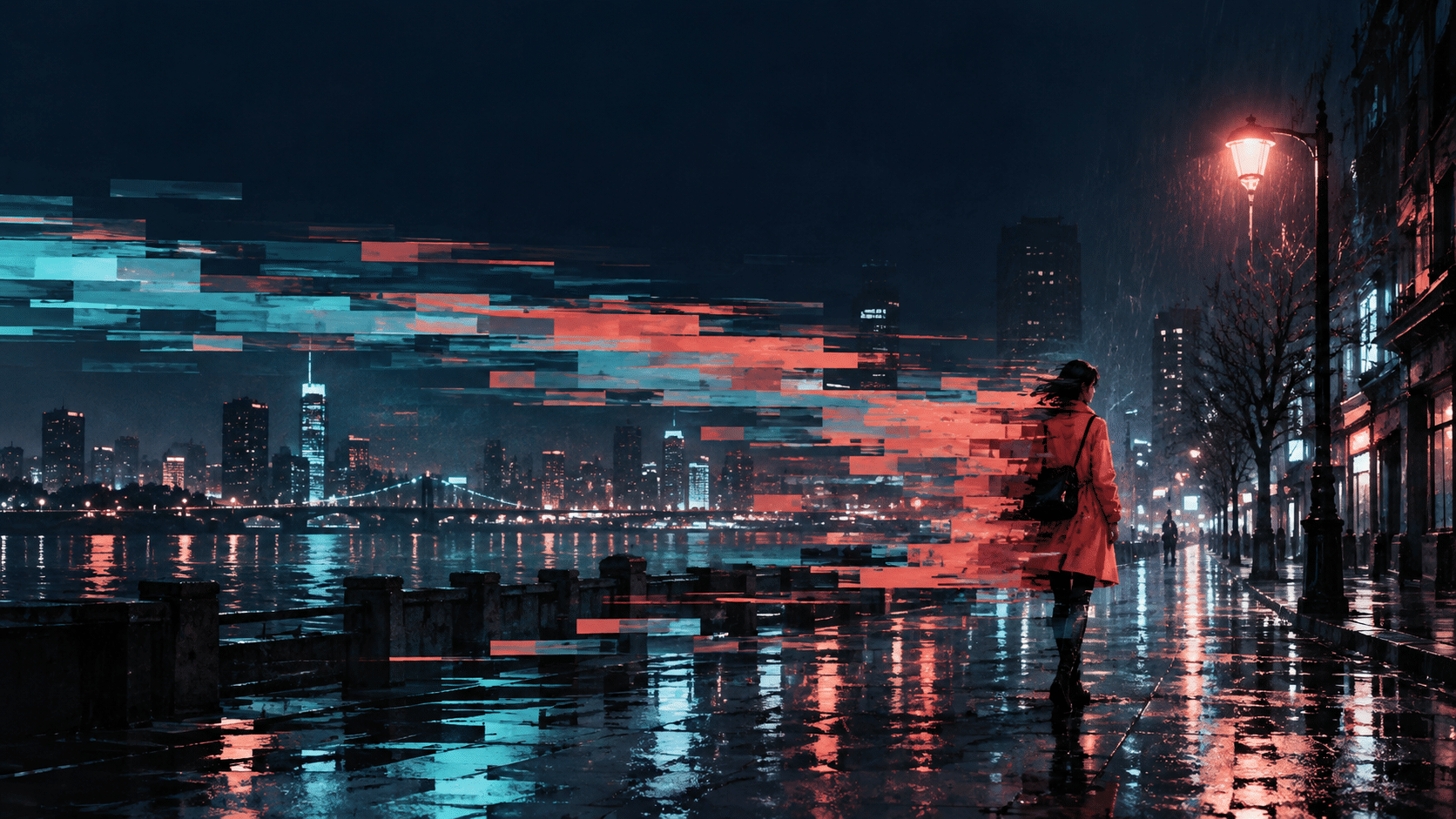
Two original AI-generated still simulations: a focused example and a centrally titled collage. They illustrate visual traits rather than demonstrate a video-processing workflow.
Select an image for a closer look. Use the thumbnails, arrow keys or a swipe to compare examples. Zoom in to inspect details, or share the image that inspires you.
Creative toolbox · take this style further
Choose an input and a destination. Search sends your words to the chosen site; Copy & open puts them on your clipboard to paste there.
Create with AI
Turn your chosen input into an image prompt or a new creative direction.
ChatGPT
Copy your input and paste it into a ChatGPT conversation or image request.
Copy & open ChatGPT (new tab)Claude · Anthropic
Develop an image prompt or explore the style in a new Claude conversation.
Copy & open Claude · Anthropic (new tab)Midjourney
Paste your input into the Imagine bar on the Create page.
Copy & open Midjourney (new tab)Adobe Firefly
Copy your input, open Firefly, and paste it into the prompt field.
Copy & open Adobe Firefly (new tab)Leonardo.Ai
Copy your input, open Leonardo, and paste it into the generation field.
Copy & open Leonardo.Ai (new tab)Image search
Find visual references. Short, concrete keywords usually work best.
Lexica
Search AI images and prompts using your selected input.
Search with this input Lexica (new tab)Pexels
Search the photo and video library. Short keywords often work best.
Search with this input Pexels (new tab)Pixabay
Search photos, illustrations and other images.
Search with this input Pixabay (new tab)Unsplash
Search photographs using the style name or your own keywords.
Search with this input Unsplash (new tab)Wikimedia Commons
Search photographs, artworks and historical images. Check each file for its source and reuse terms.
Search with this input Wikimedia Commons (new tab)Art & research
Explore artists, collections and the ideas behind a style.
Wikipedia
Search for background reading. A style may not have its own article.
Search with this input Wikipedia (new tab)WikiArt
Copy your input into WikiArt’s search to explore artists and artworks.
Copy & open WikiArt (new tab)Europeana
Paste your keywords into the search to explore European museum, library and archive collections.
Copy & open Europeana (new tab)Inspiration
Discover portfolios and visual ideas from creative communities.
Instagram hashtags
Search a hashtag made from your input: spaces and punctuation are removed. Instagram may require sign-in.
Search with this input Instagram hashtags (new tab)ArtStation
Paste your input into artwork search for concept art, environments, characters and visual development.
Copy & open ArtStation (new tab)Behance
Paste your input into project search for illustration, design and visual storytelling.
Copy & open Behance (new tab)A closer look
Directional blocks, stretched color patches, persistent fragments and abrupt returns to clarity. Preserve one readable focal area and let disruption follow a dominant movement. A still image can suggest this appearance, but cannot demonstrate the temporal process by itself.
A process within glitch art
Datamoshing belongs to the wider field of glitch art, with a particular interest in compressed moving images. Rhizome’s 2009 article Pixel Bleed discusses earlier compression experiments by Takeshi Murata and by Paper Rad with Paul B. Davis. It cautions against treating the effect’s music-video visibility as its invention. There is no need to assign the technique a single founder to understand its visual possibilities.
The images in this article are newly generated still illustrations that simulate datamoshing aesthetics. They were not produced by corrupting a video stream. That distinction matters: an image can imitate block trails without containing the frame dependencies that cause a real datamosh.
Why one image can haunt the next
In interframe compression, some pictures can be decoded independently while predicted pictures depend on reference pictures. Avidemux’s documentation introduces these as I-, P- and B-frames. Disrupting reference relationships can make the decoder carry old picture information into later movement; the precise result depends on the codec, stream and decoder.
For artistic work, think in terms of persistence, displacement and reset. What remains from the previous shot? Which direction does it move? When does a readable picture return? Random RGB offsets or scan lines can accompany the look, but they do not by themselves establish that datamoshing occurred.
Compose a readable failure
Choose two contrasting visual states: a quiet face and moving foliage, or a dark street and a bright passing coat. Protect a small landmark such as an eye, lamp or horizon. Let the surrounding fragments travel in one main direction, then vary their size so the motion has rhythm rather than a uniform mosaic.
Use a limited palette with one accent that can migrate across the image. Keep one region calm. The viewer needs an interval of clarity to recognize what the disruption changes. A sequence should also have duration and pacing: sustained smearing feels different from one brief rupture at a cut.
A practical study and an honest label
Begin with copies of your own short clips, and preserve the originals. Compare an intact edit, a brief disrupted transition and a longer persistence study. Record the codec and processing method alongside the result; an export can flatten the unusual playback into an ordinary video, which may be desirable for reliable presentation.
For a generated still, describe the visible relationships rather than claiming a particular file operation took place. Ask for directional block persistence, a readable subject and a controlled boundary between clear and displaced regions. Label the result as a simulated datamoshing study. Judge it at thumbnail size: the subject and direction should remain apparent.
A small poetic detour
Original words from the AOI studio.
Poetry
The street forgets to let me go;
My borrowed colors overflow.
One lamp remains, a steady spark,
While yesterday moves through the dark.
The prompt workshop
Original creative exercises. These prompts create new illustrations, not documentary evidence.
Start here · A street that remembers
AI-generated still illustration simulating datamoshing: a lone figure with a vivid coral coat on a dark rainy street, readable head and upper torso, rectangular cyan and coral image fragments dragged horizontally behind the figure. One clear streetlamp, quiet navy sky, asymmetric composition, no lettering or watermark. Do not portray this as an actual corrupted video frame.
Portrait · The previous season
AI-generated datamoshing-inspired still portrait: a clearly readable face emerging from a field of green leaves, one side of the surrounding foliage persisting as directional rectangular blocks through a blue evening background. Protect both eyes and the main silhouette; large and small displaced patches, restrained color, one calm region, no text or signature.
Experimental · A reset in the harbor
Original still simulation of datamoshing aesthetics: a quiet white boat and dark harbor, a band of sunset orange stretched into block-based trails across the water while one crisp reflection remains intact. Show a sharp boundary between clear and displaced areas, varied block scales and spacious dark surroundings. No interface labels, scan-line overlay or signature.
Your next inspiration
Discover another art style
Follow a visual thread to the next subject.

A smile from the studio
Jokes
The keyframe took a day off. The previous scene covered its shift.
My portrait asked for a fresh start; the codec said it was still processing the past.