
Historical movement and creative methods
Dadaism is another name for Dada. This page focuses on methods—collage, photomontage, chance and the reframing of objects—while the companion Dada overview places the movement in its historical setting.
A visual introduction
Select an image for a closer look. Use the thumbnails, arrow keys or a swipe to compare examples. Zoom in to inspect details, or share the image that inspires you.
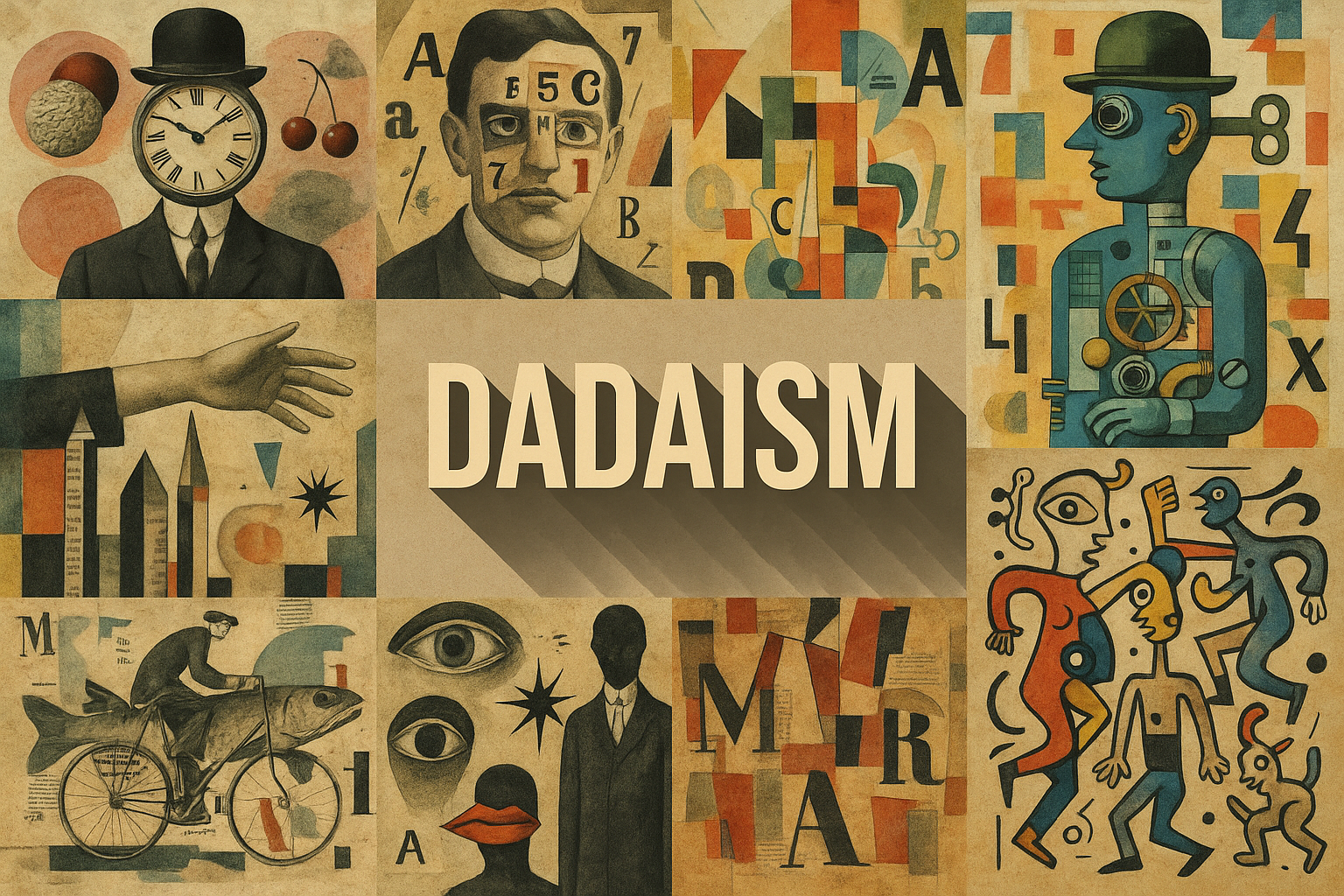
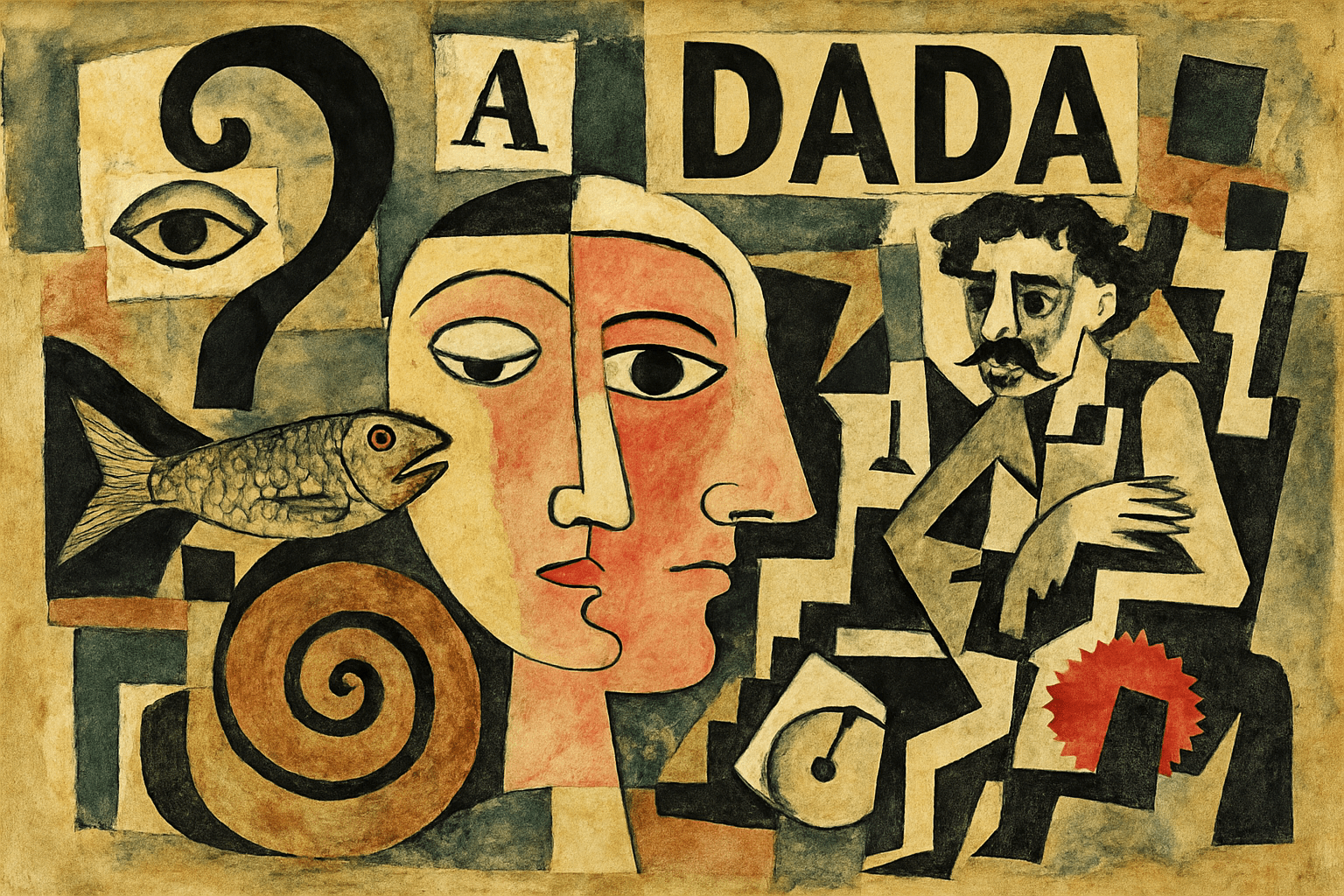
Creative toolbox · take this style further
Choose an input and a destination. Search sends your words to the chosen site; Copy & open puts them on your clipboard to paste there.
Create with AI
Turn your chosen input into an image prompt or a new creative direction.
ChatGPT
Copy your input and paste it into a ChatGPT conversation or image request.
Copy & open ChatGPT (new tab)Claude · Anthropic
Develop an image prompt or explore the style in a new Claude conversation.
Copy & open Claude · Anthropic (new tab)Midjourney
Paste your input into the Imagine bar on the Create page.
Copy & open Midjourney (new tab)Adobe Firefly
Copy your input, open Firefly, and paste it into the prompt field.
Copy & open Adobe Firefly (new tab)Leonardo.Ai
Copy your input, open Leonardo, and paste it into the generation field.
Copy & open Leonardo.Ai (new tab)Image search
Find visual references. Short, concrete keywords usually work best.
Lexica
Search AI images and prompts using your selected input.
Search with this input Lexica (new tab)Pexels
Search the photo and video library. Short keywords often work best.
Search with this input Pexels (new tab)Pixabay
Search photos, illustrations and other images.
Search with this input Pixabay (new tab)Unsplash
Search photographs using the style name or your own keywords.
Search with this input Unsplash (new tab)Wikimedia Commons
Search photographs, artworks and historical images. Check each file for its source and reuse terms.
Search with this input Wikimedia Commons (new tab)Art & research
Explore artists, collections and the ideas behind a style.
Wikipedia
Search for background reading. A style may not have its own article.
Search with this input Wikipedia (new tab)WikiArt
Copy your input into WikiArt’s search to explore artists and artworks.
Copy & open WikiArt (new tab)Europeana
Paste your keywords into the search to explore European museum, library and archive collections.
Copy & open Europeana (new tab)Inspiration
Discover portfolios and visual ideas from creative communities.
Instagram hashtags
Search a hashtag made from your input: spaces and punctuation are removed. Instagram may require sign-in.
Search with this input Instagram hashtags (new tab)ArtStation
Paste your input into artwork search for concept art, environments, characters and visual development.
Copy & open ArtStation (new tab)Behance
Paste your input into project search for illustration, design and visual storytelling.
Copy & open Behance (new tab)A closer look
Abrupt changes of scale, incompatible image sources, displaced objects and disruptive word-image relationships can challenge a familiar reading rather than simply decorate it with absurdity.
A method needs a question
Dada developed amid the upheaval of the First World War and challenged established assumptions about art and social order. MoMA emphasizes its variety of media and strategies. Dadaism and Dada do not identify two separate movements; the distinction between these AOI pages is practical method versus historical overview.
Begin an original exercise with a question about an image or object that seems ordinary. What authority does it claim? What kind of behavior does it encourage? A collage becomes more purposeful when its disruptions respond to such a question instead of collecting unrelated strange things.
Collage and photomontage alter relationships
Changing scale can make a small manufactured object dominate a public space. A mechanical fragment attached to a figure can suggest a different relationship between people and systems. Keep the cut edges or joins visible when they are part of the argument. A perfectly seamless composite may conceal the collision that the work needs.
Use a small number of source types at first. Compare a version with a clear focal contradiction to one filled with many competing fragments. Density can be effective, but it should not prevent the viewer from finding the relationship that matters.
Chance is a procedure, not a vague look
A chance operation follows a chosen rule: drawing fragments from a container, assigning positions through a random sequence or accepting an accidental overlap. Record the rule before seeing the result. Afterwards, decide whether to keep the result as evidence of the procedure or revise it into a different kind of composition.
An image that merely appears disorderly does not establish that chance was used. Similarly, an AI model's unpredictability is not automatically the same as a deliberately framed artistic procedure. Explain what was controlled and what was left open.
Reframing an object changes the question
The readymade asks how selection and presentation affect the status of an ordinary object. Duchamp's Fountain should not be called a painting. A contemporary exercise can investigate this problem with an original choice and a carefully considered display context rather than copying a famous object.
Do not confuse a generated illustration of an installation with the installation itself. State the medium and intention. The aim is a sharper question about meaning, authorship or convention, not a compulsory collection of historical motifs.
The prompt workshop
Original creative exercises. These prompts create new illustrations, not documentary evidence.
A clear contradiction
Original collage in which an oversized household key interrupts a tiny formal meeting room, visible paper-cut edges, restrained source palette, one readable absurd relationship, no borrowed slogans.
Chance with a rule
Visual concept for a collage made from twelve original geometric paper fragments assigned to a numbered grid by chance, preserve overlaps and empty cells, no decorative additions, clear paper material.
Reframe an ordinary object
Original conceptual exhibition study of a worn measuring tape displayed as a ceremonial object in a plain case, carefully controlled lighting and empty space, no copied historical artwork or fabricated museum label.