
Historical art and literary movement
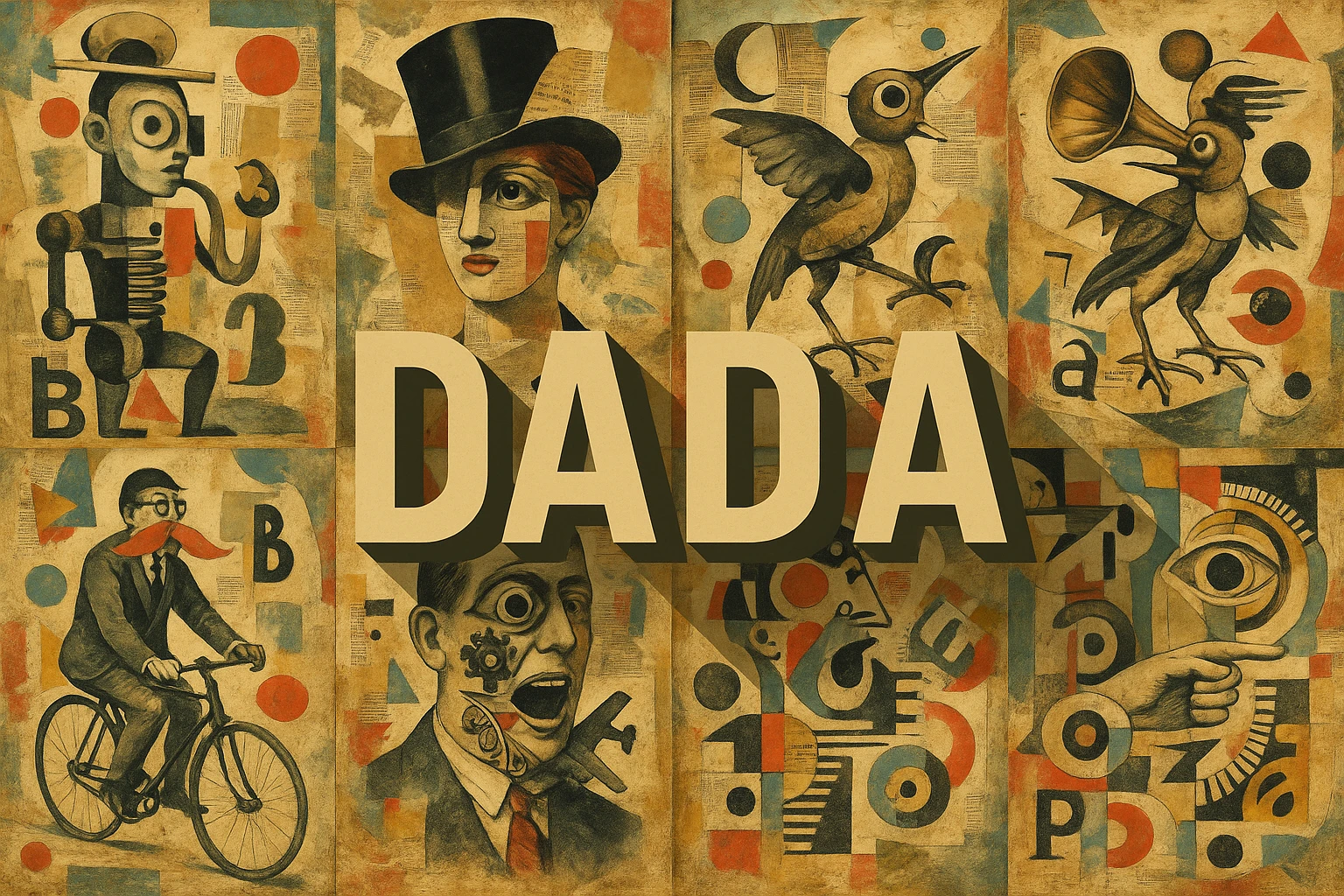
Dada brought artists and writers into a loose international field of experimentation during and after the First World War. It questioned artistic convention through objects, images, language, performance and deliberate disruption.
A visual introduction
Select an image for a closer look. Use the thumbnails, arrow keys or a swipe to compare examples. Zoom in to inspect details, or share the image that inspires you.
Creative toolbox · take this style further
Choose an input and a destination. Search sends your words to the chosen site; Copy & open puts them on your clipboard to paste there.
Create with AI
Turn your chosen input into an image prompt or a new creative direction.
ChatGPT
Copy your input and paste it into a ChatGPT conversation or image request.
Copy & open ChatGPT (new tab)Claude · Anthropic
Develop an image prompt or explore the style in a new Claude conversation.
Copy & open Claude · Anthropic (new tab)Midjourney
Paste your input into the Imagine bar on the Create page.
Copy & open Midjourney (new tab)Adobe Firefly
Copy your input, open Firefly, and paste it into the prompt field.
Copy & open Adobe Firefly (new tab)Leonardo.Ai
Copy your input, open Leonardo, and paste it into the generation field.
Copy & open Leonardo.Ai (new tab)Image search
Find visual references. Short, concrete keywords usually work best.
Lexica
Search AI images and prompts using your selected input.
Search with this input Lexica (new tab)Pexels
Search the photo and video library. Short keywords often work best.
Search with this input Pexels (new tab)Pixabay
Search photos, illustrations and other images.
Search with this input Pixabay (new tab)Unsplash
Search photographs using the style name or your own keywords.
Search with this input Unsplash (new tab)Wikimedia Commons
Search photographs, artworks and historical images. Check each file for its source and reuse terms.
Search with this input Wikimedia Commons (new tab)Art & research
Explore artists, collections and the ideas behind a style.
Wikipedia
Search for background reading. A style may not have its own article.
Search with this input Wikipedia (new tab)WikiArt
Copy your input into WikiArt’s search to explore artists and artworks.
Copy & open WikiArt (new tab)Europeana
Paste your keywords into the search to explore European museum, library and archive collections.
Copy & open Europeana (new tab)Inspiration
Discover portfolios and visual ideas from creative communities.
Instagram hashtags
Search a hashtag made from your input: spaces and punctuation are removed. Instagram may require sign-in.
Search with this input Instagram hashtags (new tab)ArtStation
Paste your input into artwork search for concept art, environments, characters and visual development.
Copy & open ArtStation (new tab)Behance
Paste your input into project search for illustration, design and visual storytelling.
Copy & open Behance (new tab)A closer look
The movement has no single visual recipe: collage and photomontage, ordinary manufactured objects, geometric construction and experiments with words can serve different critical purposes.
Historical setting matters
MoMA connects Dada's emergence to the violence of the First World War and to modern media and machine culture. Activities in Zurich and New York developed into a wider network that included Berlin, Cologne, Hannover and Paris. This was a varied field of people and practices rather than a uniform school with one approved appearance.
The label is also commonly written as Dadaism. AOI's companion Dadaism page concentrates on practical methods; this overview emphasizes the historical questions that make those methods more than an aesthetic of randomness.
Different media challenged different assumptions
Collage could bring incompatible fragments together. Photomontage could expose the construction of public images. Performance and wordplay could disrupt the expectation that meaning must arrive through orderly language. A selected everyday object could challenge the assumption that an artwork must be a unique, skillfully fashioned object.
These approaches do not all make the same argument. When looking at a work, identify what was selected, altered, combined or presented. Then ask how the viewer is invited to encounter it. An ordinary object on a pedestal and a densely cut printed image create different kinds of attention.
Irreverence does not eliminate specificity
Humor and absurdity can unsettle authority, but “nonsense” alone is an incomplete description. A work may engage with newspapers, advertisements, machinery or social conventions through quite precise choices. Look for a recognizable source of authority or expectation before interpreting its disruption.
Avoid turning every historical work into a simple anti-war illustration. The movement's circumstances are essential, but individual works require their own dates, locations and evidence. A collection record is a better starting point than an invented universal manifesto.
Read the legacy without erasing the differences
Later artists have continued to use appropriation, found objects and chance. That influence does not make every collage or strange assemblage a Dada work. The historical movement, its later reception and a contemporary exercise should be described separately.
For an original study, choose one convention to question and make the intervention legible. Explain the materials and method, including whether the result is a generated concept. AOI's illustrations are contemporary interpretations; they are not archival evidence of Dada performances or objects.
A small poetic detour
Original words from the AOI studio.
Poetry
Whimsy in chaos,
Randomness speaks louder than
Order’s quiet norm.
The prompt workshop
Original creative exercises. These prompts create new illustrations, not documentary evidence.
Media fragments in conflict
An original collage study juxtaposing invented newspaper columns, a mechanical dial and a hand-shaped paper cutout, deliberate scale conflict, visible joins and one strong focal relation, no copied text.
Language as material
Original abstract print concept using blank typographic blocks, interrupted lines and repeated punctuation-like shapes, rhythmic spacing and sharp hierarchy, no pseudo-historical manifesto.
An object and its setting
Contemporary conceptual still life of a commonplace household object displayed in an unexpectedly formal setting, precise lighting, spare composition and a readable change of status, no replica of a named artwork.