
Art and cultural context · researched guide
Art in Croatia is a broad field, not an interchangeable set of coastal landscapes and folk costumes. This introduction uses the National Museum of Modern Art in Zagreb and a documented self-portrait by Miroslav Kraljević to explore artistic choices, international connections and the limits of an AI mood board.
A visual introduction
Open any image to look closer, then browse the examples.
A closer look
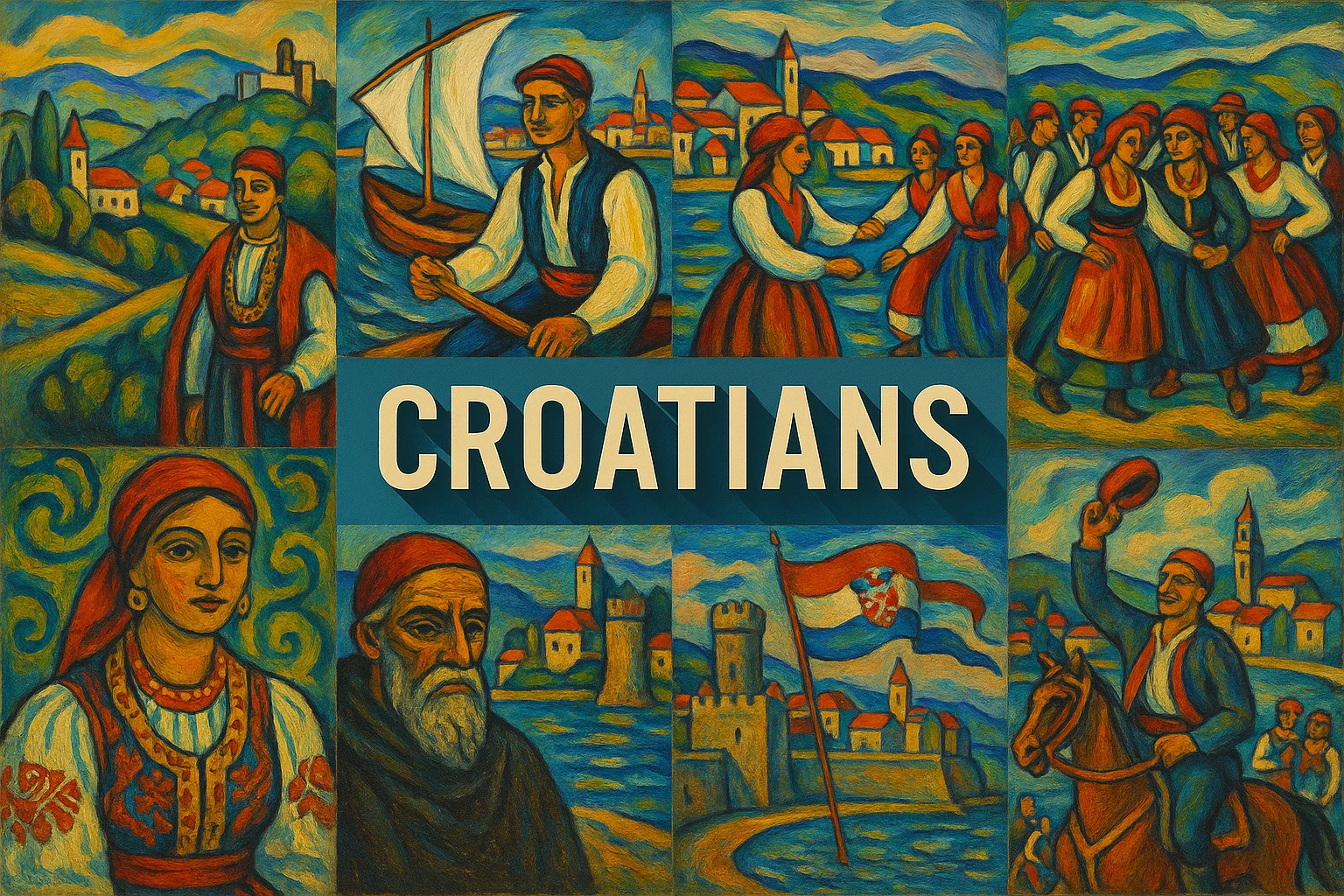
The archive collage repeats red headwear, blue water, hills and dance scenes around the word Croatians. Its warm outlines and rhythmic brushlike marks unify the panels. These invented scenes illustrate a decorative approach; they do not reproduce Croatian paintings or verify historical dress.
Replace the national preset with a specific collection
Zagreb’s National Museum of Modern Art describes a collection spanning Croatian fine art from the nineteenth century to the present, with attention to its relationships with international movements. This scope already exceeds the idea of one national style. The museum’s collection overview is a route into individual objects, not a promise that everything in the collection looks alike. [1]
When beginning research, choose a manageable comparison: two portraits, two treatments of an interior, or a painting and a graphic work. Record the date and medium before deciding what connects them. Shared nationality may explain part of their institutional context; it cannot replace an account of the actual forms on the surface.
A self-portrait with another presence
Miroslav Kraljević’s Self-portrait with a Dog (1910) is catalogued by the museum as an oil painting on canvas. Its account draws attention to the painter and dog facing the viewer, the intimate interior, dark tones and energetic brushwork. These are specific features to examine in the linked reproduction, not features of the AOI collage above. [2]
The museum also describes Kraljević’s training in Munich and subsequent move to Paris. His example makes artistic movement across places concrete. A useful question is how a painter makes a self-image through posture, companionship, references and handling of paint. A biography should help us ask that question, not become a list of cities pasted over an unread picture. [2]
Look for relationships inside the frame
Begin with the directions of the two gazes and the relative scale of the figures. Then look for transitions between carefully described passages and looser marks. Ask how the background affects the apparent closeness of the sitter. You do not need to assign an emotion immediately. Describing the evidence first leaves room for more than one reading.
Next, compare the museum reproduction with our synthetic collage. The collage depends on repeated bright colours and familiar scenic motifs; the documented self-portrait asks for sustained attention to a particular person’s staging of himself. Neither the dog nor the darker palette is a national signature. They belong to the decisions made in that work.
A practical study with a clear credit
Make a self-portrait sketch with one ordinary object beside you. Move the object through three positions before changing the colours. Does it become a companion, an obstacle, a joke or simply a shape? This is an exercise in arranging relationships. It does not require copying Kraljević’s painting or attaching his name to a generated picture.
If using AI, describe the lighting, distance and material you want. Keep the result labelled as an original synthetic study. For historical or regional costume, consult a documented object and its place and date; the collage cannot supply those details. Follow the museum’s collection links for further examples and check its current visitor information separately from this introductory art guide.
People & works to explore
References discussed in this article. Consult the sources below for context.
Artists and practitioners
Miroslav Kraljević — the painter discussed in the museum object record
Paintings and other works
Self-portrait with a Dog (1910), oil on canvas — linked museum example, not reproduced here
Sources and further exploration
[1] National Museum of Modern Art, Zagreb — collection overview
[2] NMMU — Miroslav Kraljević, Self-portrait with a Dog, 1910