
Historical movement
CoBrA was a short-lived postwar experimental movement whose name joins Copenhagen, Brussels and Amsterdam. Its importance lies in a restless approach to making, not a recipe for brightly coloured monsters.
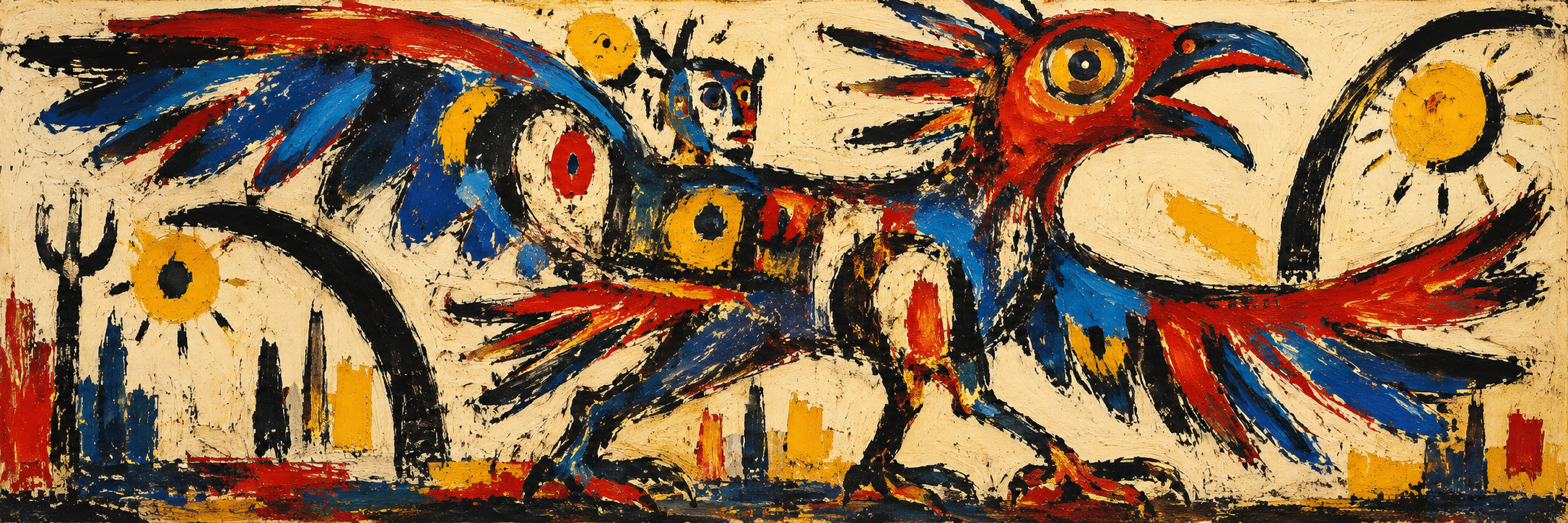
A visual introduction
Select an image for a closer look. Use the thumbnails, arrow keys or a swipe to compare examples. Zoom in to inspect details, or share the image that inspires you.


Creative toolbox · take this style further
Choose an input and a destination. Search sends your words to the chosen site; Copy & open puts them on your clipboard to paste there.
Create with AI
Turn your chosen input into an image prompt or a new creative direction.
ChatGPT
Copy your input and paste it into a ChatGPT conversation or image request.
Copy & open ChatGPT (new tab)Claude · Anthropic
Develop an image prompt or explore the style in a new Claude conversation.
Copy & open Claude · Anthropic (new tab)Midjourney
Paste your input into the Imagine bar on the Create page.
Copy & open Midjourney (new tab)Adobe Firefly
Copy your input, open Firefly, and paste it into the prompt field.
Copy & open Adobe Firefly (new tab)Leonardo.Ai
Copy your input, open Leonardo, and paste it into the generation field.
Copy & open Leonardo.Ai (new tab)Image search
Find visual references. Short, concrete keywords usually work best.
Lexica
Search AI images and prompts using your selected input.
Search with this input Lexica (new tab)Pexels
Search the photo and video library. Short keywords often work best.
Search with this input Pexels (new tab)Pixabay
Search photos, illustrations and other images.
Search with this input Pixabay (new tab)Unsplash
Search photographs using the style name or your own keywords.
Search with this input Unsplash (new tab)Wikimedia Commons
Search photographs, artworks and historical images. Check each file for its source and reuse terms.
Search with this input Wikimedia Commons (new tab)Art & research
Explore artists, collections and the ideas behind a style.
Wikipedia
Search for background reading. A style may not have its own article.
Search with this input Wikipedia (new tab)WikiArt
Copy your input into WikiArt’s search to explore artists and artworks.
Copy & open WikiArt (new tab)Europeana
Paste your keywords into the search to explore European museum, library and archive collections.
Copy & open Europeana (new tab)Inspiration
Discover portfolios and visual ideas from creative communities.
Instagram hashtags
Search a hashtag made from your input: spaces and punctuation are removed. Instagram may require sign-in.
Search with this input Instagram hashtags (new tab)ArtStation
Paste your input into artwork search for concept art, environments, characters and visual development.
Copy & open ArtStation (new tab)Behance
Paste your input into project search for illustration, design and visual storytelling.
Copy & open Behance (new tab)A closer look
Urgent brushwork, emphatic outlines, unexpected colour and unstable animal-human forms can make a picture feel as though it is still discovering its subject.
A movement with a specific history
CoBrA took shape in 1948 and its collective period ended in 1951. The Constant Foundation traces its network through artists including Asger Jorn, Constant, Karel Appel and Corneille, with Christian Dotremont central to its literary and organizational life. The name combines the founding network’s three cities. Treat those dates as the history of the group, not as limits on the later careers of its members.
The foundation’s account also emphasizes publications, collaboration and exhibitions in Amsterdam and Liège. Painting was part of a larger exchange between disciplines. A contemporary image that borrows vigorous colour may be CoBrA-inspired, but it is not thereby a work made by the historical movement.
Allow the creature to remain unsettled
A useful way into this visual language is to let a shape suggest several identities. An eye may belong to a bird, a person or an invented animal. A broad stroke can serve as both limb and border. Resist explaining every ambiguous feature: the tension between recognition and raw paint is often more interesting than a neatly illustrated fantasy creature.
Spontaneity still produces relationships that can be examined. Look at which marks interrupt others, where a dark contour gathers force and where a light patch opens the composition. An apparently unruly surface becomes readable through differences in scale, density and direction.
Colour should act, not merely decorate
Try a limited group of forceful colours against one quieter ground. A red body might push forward against blue while a small yellow shape redirects attention. Give the darkest strokes a structural job: they can connect separated forms or establish the weight of a face. Filling every gap with another equally strong colour removes that hierarchy.
Keep some marks visibly different from their neighbours. A scraped edge, a thick opaque patch and a thin wandering line can coexist. In a digital interpretation, avoid distributing the same texture uniformly across the whole image. Surface variety should follow the action of the composition.
Experiment without pretending to be innocent
Roughness is not a shortcut to authenticity. An adult artist’s deliberate use of simplified forms differs from a child’s drawing, and a generated image cannot document a spontaneous physical encounter with paint. Describe the actual process. The works here are newly generated interpretations of formal ideas, not rediscovered paintings or collaborative CoBrA documents.
For a studio exercise, begin with several unrelated marks and respond to the shapes they suggest. Change one form when it becomes too predictable. Afterwards, choose what to retain rather than polishing every irregularity away. The goal is an active negotiation between accident and decision.
Three studies, three kinds of energy
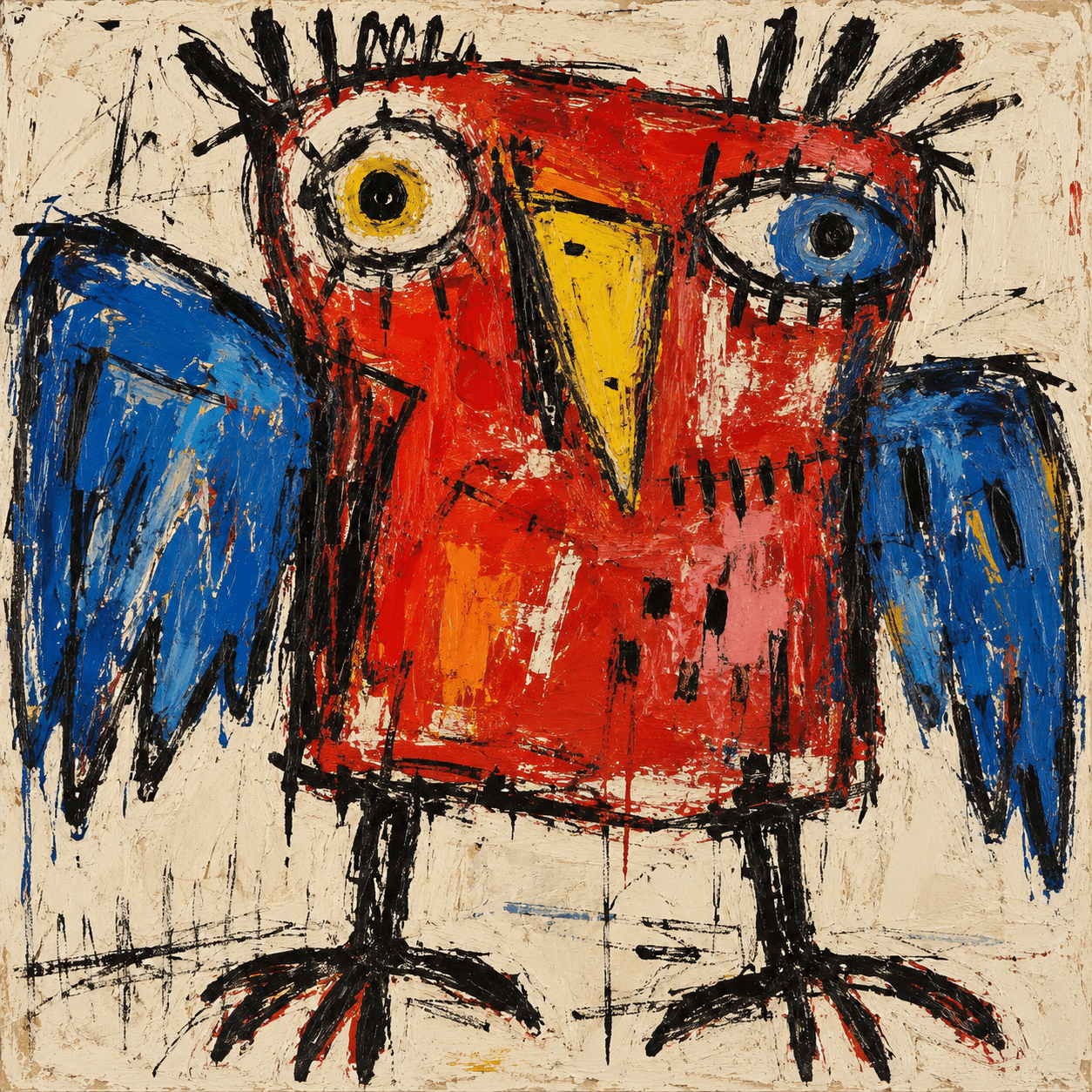
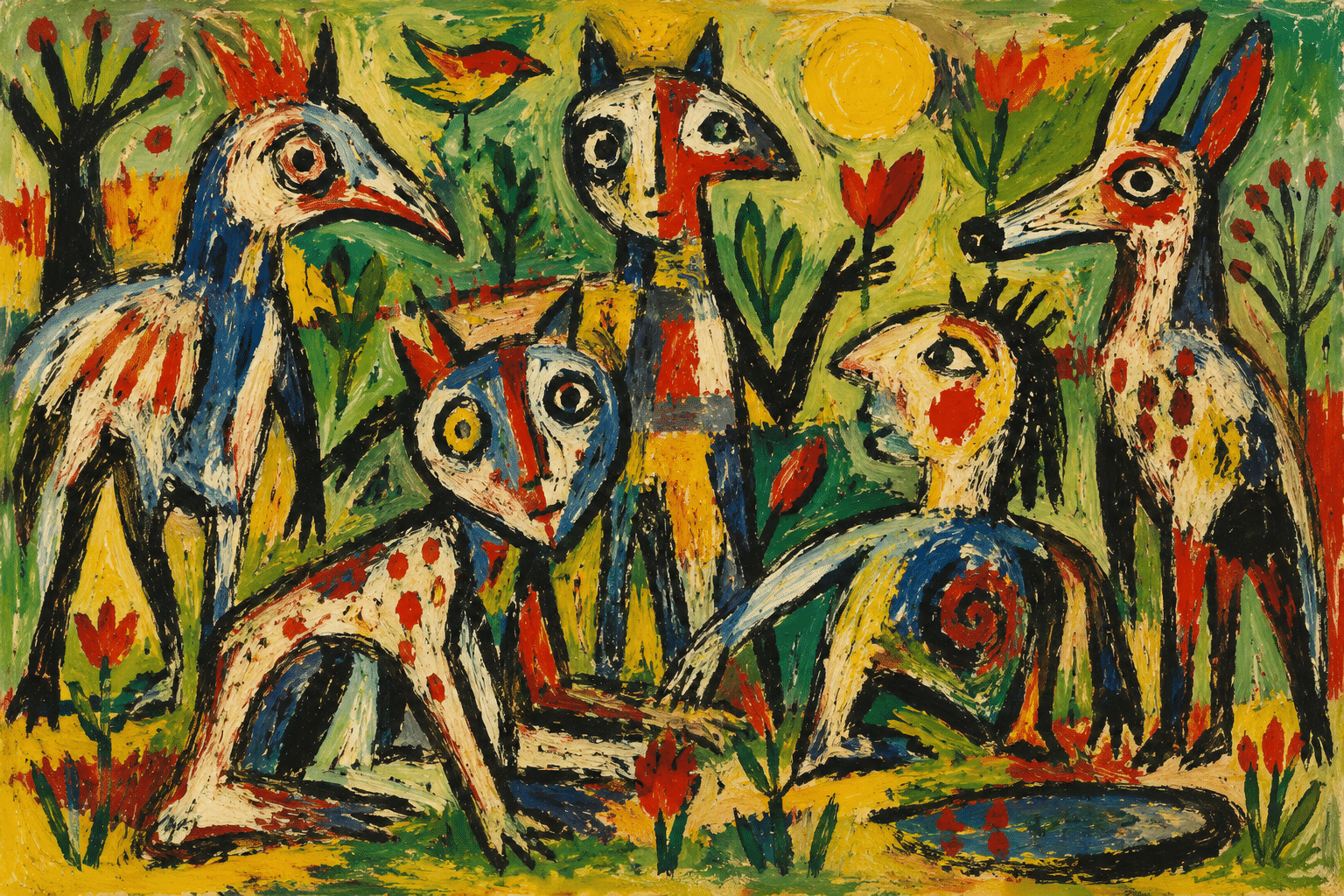
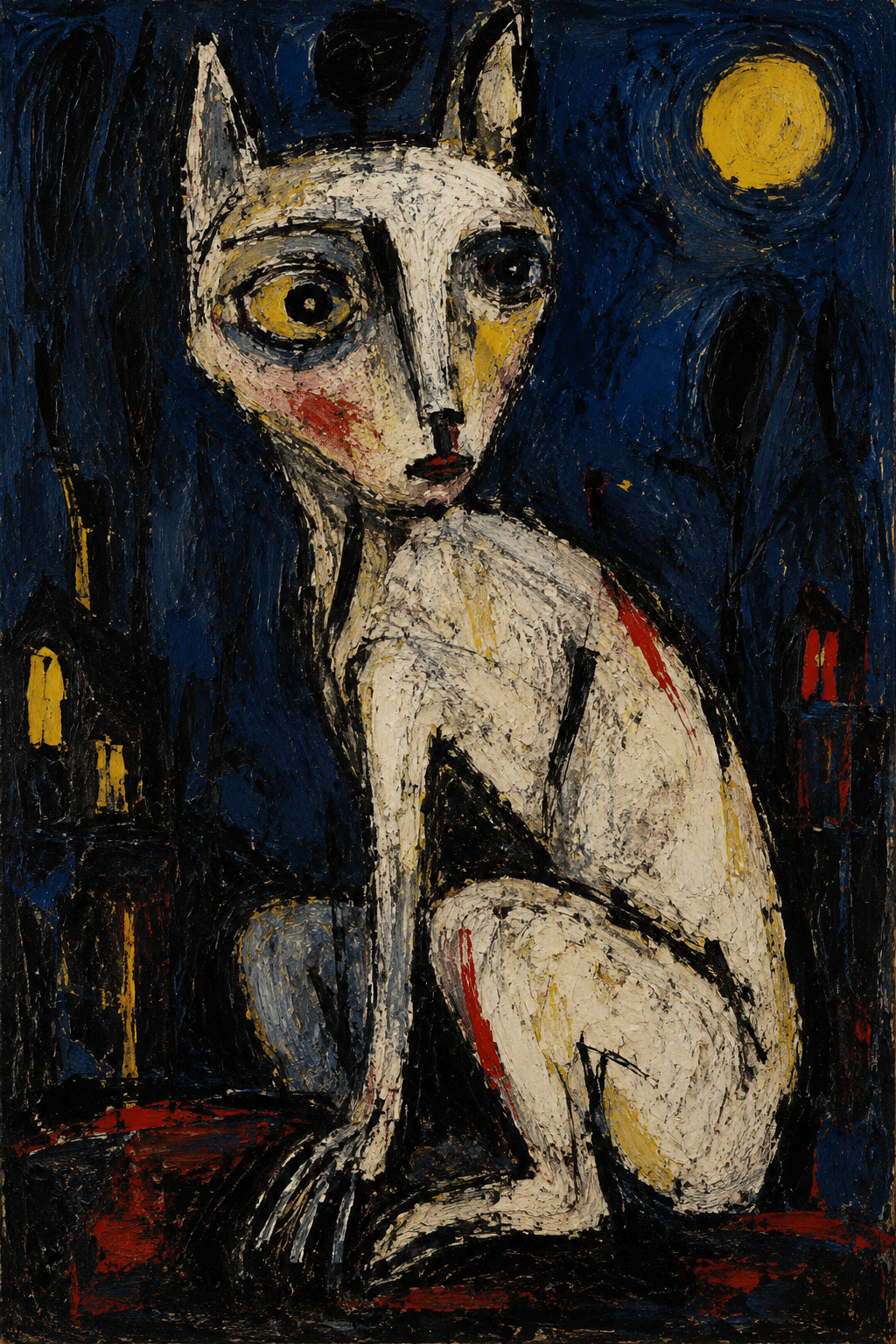
The bird-creature study concentrates force in a single frontal presence. The crowded imaginary garden tests how several beings can share a shallow space. The quieter nocturnal composition uses a dark ground and fewer bright marks. Together they show that expressive intensity does not require the same density or palette in every image.
Use these principles for an original painting, a book illustration or an expressive poster, while keeping the historical reference explicit. If the result reads as a tidy mascot with decorative splashes added afterwards, reconsider the interaction between figure and ground. Let the paint-like forms participate in inventing the subject.
A small poetic detour
Original words from the AOI studio.
Poetry
An Animal Arrives
A red mark turns and grows an eye;
a blue one will not stay the sky.
The brush has made a door ajar,
and something steps through where we are.
No polished cage, no settled name—
just paint that changes as we claim.
The prompt workshop
Original creative exercises. These prompts create new illustrations, not documentary evidence.
An invented bird
Create an original CoBrA-inspired bird-creature with an unstable silhouette, forceful red and blue forms, rough black strokes and a warm pale ground. Visible painterly variation; no signature or claim of historical authorship.
An unruly garden
Create a crowded imaginary garden of interlocking animal-human forms, shallow space, emphatic colour contrasts and varied scraped and brushed marks. Preserve several quiet gaps so the image remains readable.
A nocturnal experiment
Create a sparse CoBrA-inspired nocturnal composition with one strange pale creature, dark blue space and a few yellow and red interruptions. Let ambiguous marks suggest the subject without fully explaining it.
A smile from the studio
Jokes
The invented bird refused to pose. It said the background was still becoming a forest.
Sources and further exploration
Constant Foundation — the group’s network, publications and 1948–1951 history