
Artist study · portrait, grid and perception
Explore Chuck Close’s systematic portrait construction through documented grid, fingertip and airbrush works, with practical guidance and five labelled AOI image studies.
A visual introduction
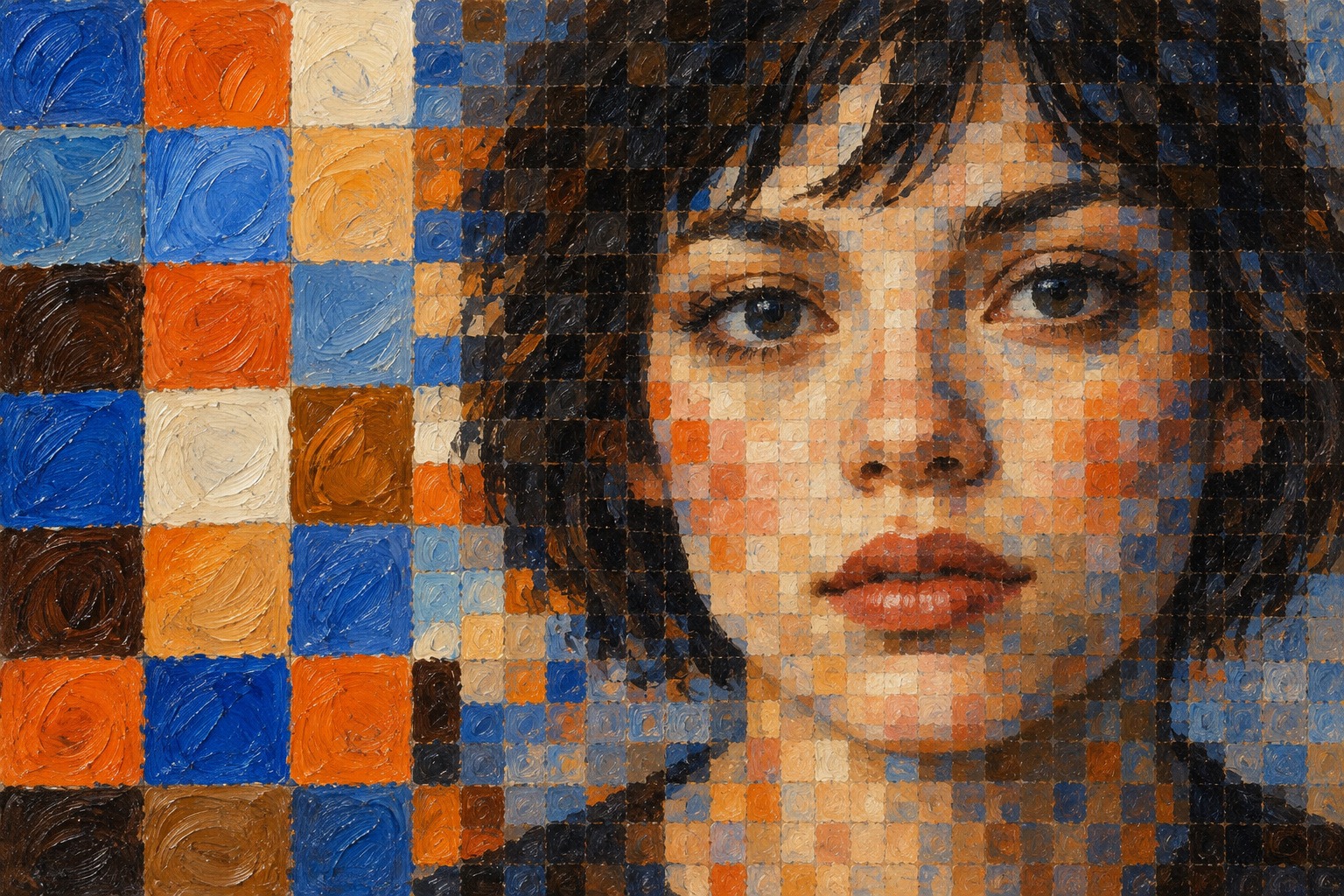
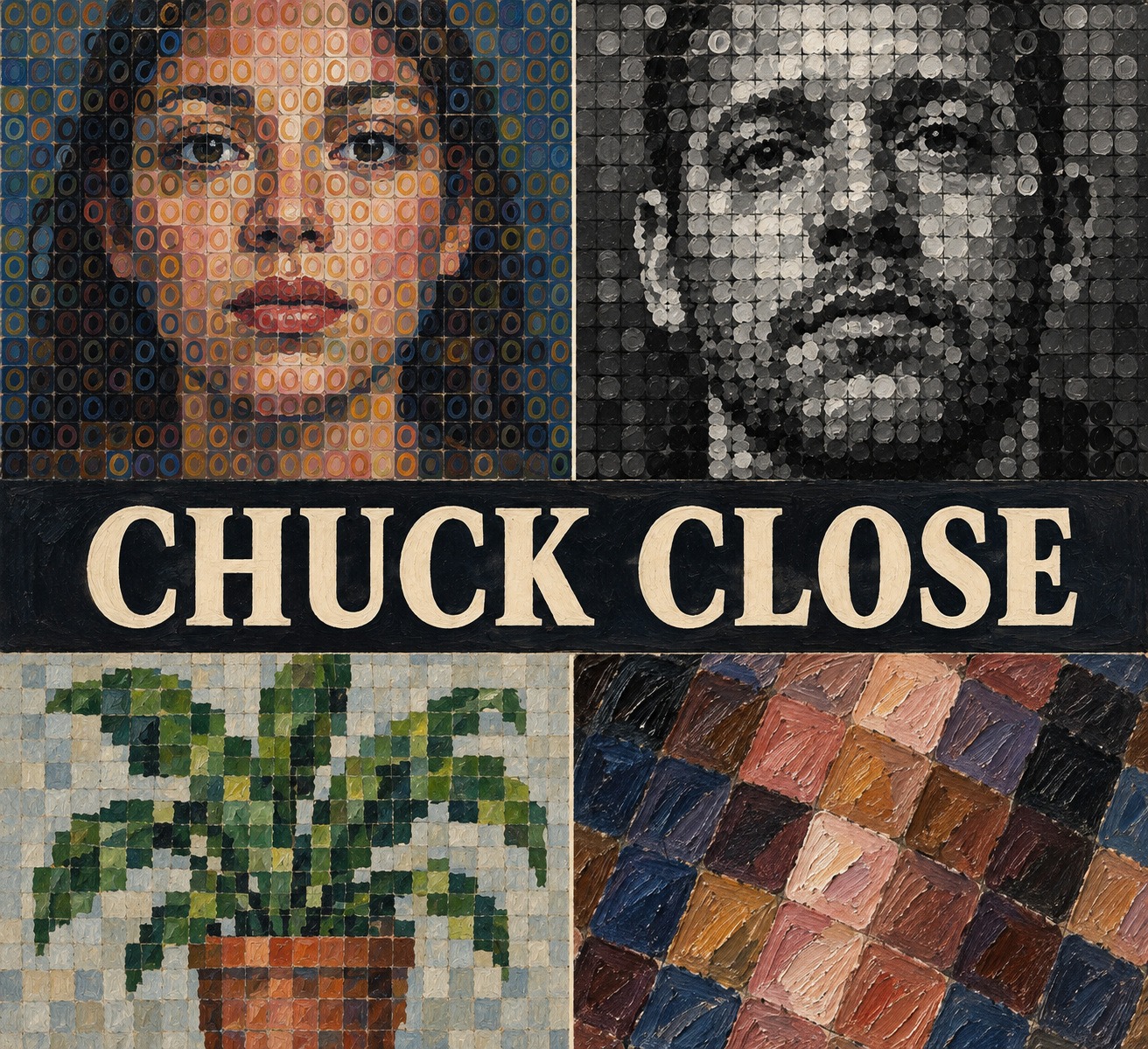
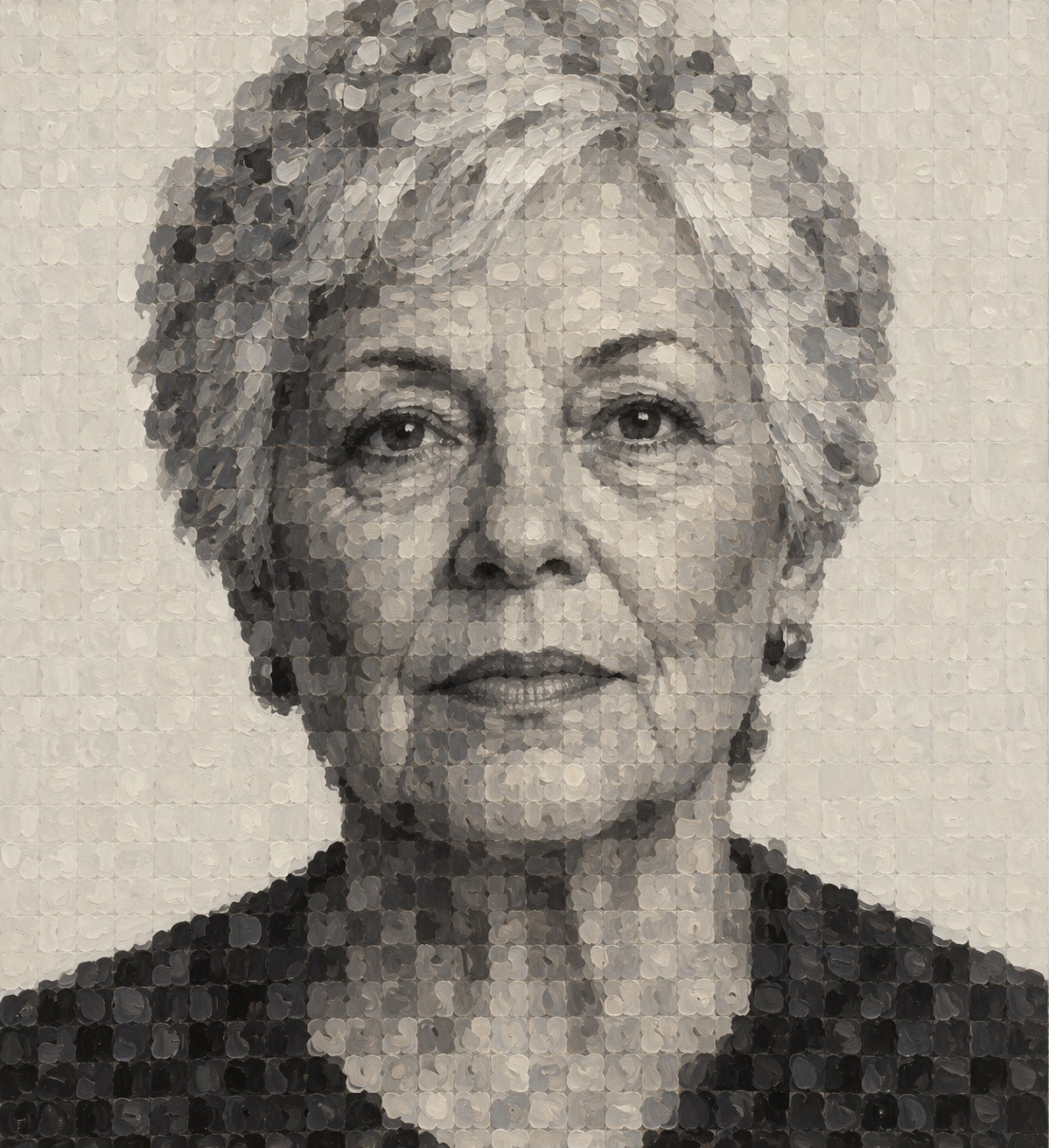
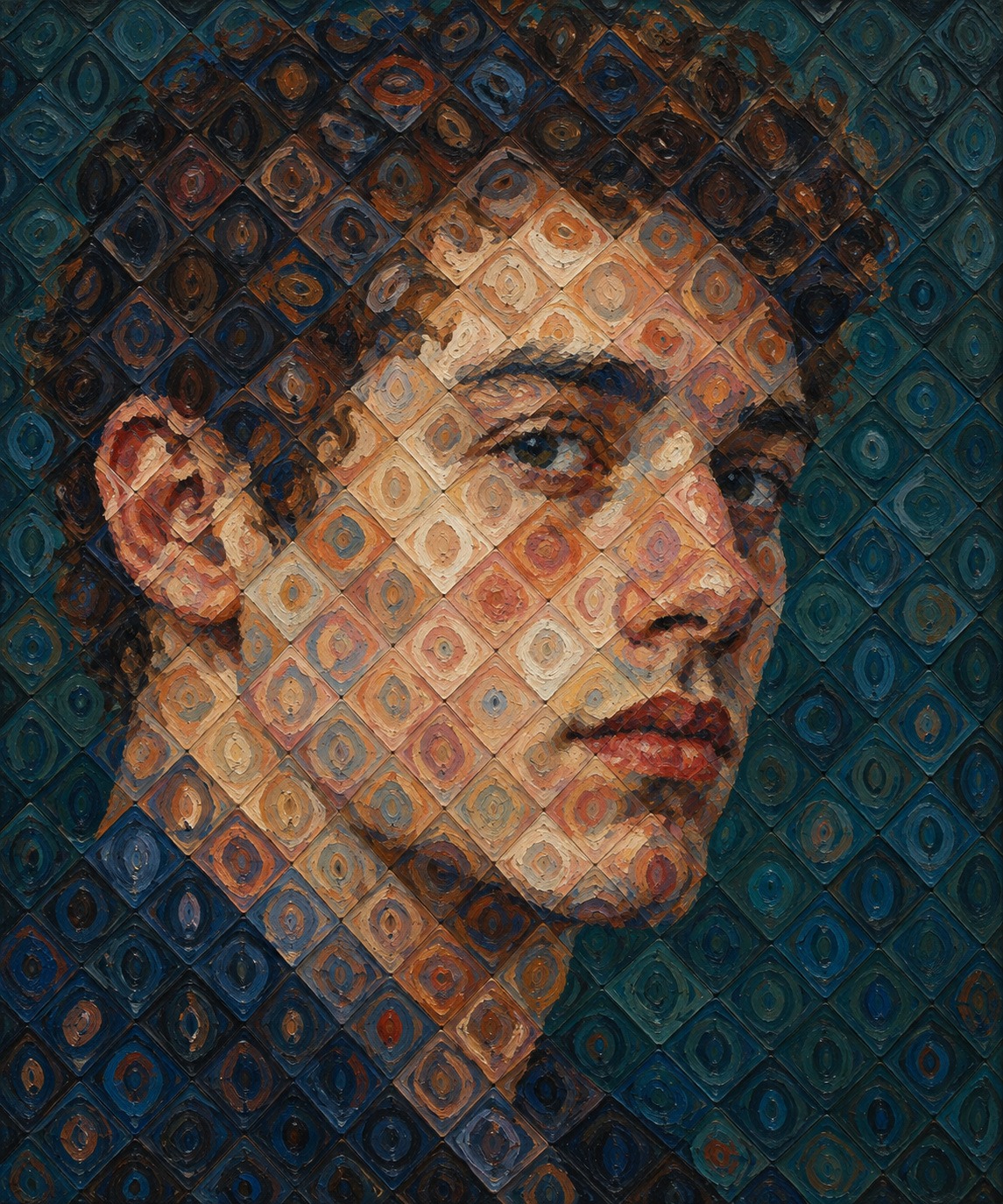
Five AOI interpretations explore colored units, monochrome dabs, diagonal grids and nonportrait adaptations. All are AI-generated teaching images, not works by Chuck Close. The unrelated older Impressionism collage is explicitly marked as an archive mismatch.
Select an image for a closer look. Use the thumbnails, arrow keys or a swipe to compare examples. Zoom in to inspect details, or share the image that inspires you.


Creative toolbox · take this style further
Choose an input and a destination. Search sends your words to the chosen site; Copy & open puts them on your clipboard to paste there.
Create with AI
Turn your chosen input into an image prompt or a new creative direction.
ChatGPT
Copy your input and paste it into a ChatGPT conversation or image request.
Copy & open ChatGPT (new tab)Claude · Anthropic
Develop an image prompt or explore the style in a new Claude conversation.
Copy & open Claude · Anthropic (new tab)Midjourney
Paste your input into the Imagine bar on the Create page.
Copy & open Midjourney (new tab)Adobe Firefly
Copy your input, open Firefly, and paste it into the prompt field.
Copy & open Adobe Firefly (new tab)Leonardo.Ai
Copy your input, open Leonardo, and paste it into the generation field.
Copy & open Leonardo.Ai (new tab)Image search
Find visual references. Short, concrete keywords usually work best.
Lexica
Search AI images and prompts using your selected input.
Search with this input Lexica (new tab)Pexels
Search the photo and video library. Short keywords often work best.
Search with this input Pexels (new tab)Pixabay
Search photos, illustrations and other images.
Search with this input Pixabay (new tab)Unsplash
Search photographs using the style name or your own keywords.
Search with this input Unsplash (new tab)Wikimedia Commons
Search photographs, artworks and historical images. Check each file for its source and reuse terms.
Search with this input Wikimedia Commons (new tab)Art & research
Explore artists, collections and the ideas behind a style.
Wikipedia
Search for background reading. A style may not have its own article.
Search with this input Wikipedia (new tab)WikiArt
Copy your input into WikiArt’s search to explore artists and artworks.
Copy & open WikiArt (new tab)Europeana
Paste your keywords into the search to explore European museum, library and archive collections.
Copy & open Europeana (new tab)Inspiration
Discover portfolios and visual ideas from creative communities.
Instagram hashtags
Search a hashtag made from your input: spaces and punctuation are removed. Instagram may require sign-in.
Search with this input Instagram hashtags (new tab)ArtStation
Paste your input into artwork search for concept art, environments, characters and visual development.
Copy & open ArtStation (new tab)Behance
Paste your input into project search for illustration, design and visual storytelling.
Copy & open Behance (new tab)A closer look
Individual cells, dabs and loops organize into a readable image through shared value structure; close and distant views reveal different information.
Chuck Close: a face made from decisions
Chuck Close (1940–2021) is the American artist whose portrait practice connects a photographic source with a systematic process of constructing an image. SFMOMA describes his use of a grid to transfer a source image to another surface and situates that practice across painting, drawing, photography, collage and printmaking. The grid is a working structure, not merely a pattern laid over a finished face. [1, 2]
The useful question is how a small mark contributes to a larger likeness. Up close, the eye follows individual cells, dabs or loops. At a greater distance, their values and colors join into a head. This change in reading is central to the exercises below. It differs from simply sharpening a photograph or adding a mosaic filter that leaves all important decisions to the software.
Three works, three material questions
The National Gallery of Art records Jasper (1997–1998) as oil on canvas. Its visual description identifies a diagonal grid with dots and nested circular or oval forms. Study how the tilted cells interrupt a face while still allowing it to be read. “Jasper” here is the artwork’s title; it has no connection to an AI writing platform. [2]
Fanny/Fingerpainting (1985), also documented by the National Gallery, builds a portrait through fingertip-applied pigment. The museum explains that pressure and pigment quantity change the tonal result. This is not the same process as filling every cell with a colored oval. The comparison matters because Close’s systematic practice accommodated substantially different kinds of touch. [3]
In MoMA’s audio record for Robert/104,072 (1973–1974), Close discusses spraying ink mixed with acrylic through an airbrush into grid spaces. That first-person account provides a further material contrast. Grid, fingertip and airbrush describe different aspects of making; none should be used as a universal recipe for every work. [4]
Visual grammar: the cell serves the whole
Begin with the largest value masses: the background, hair, lit face, shadow side and clothing. These groups must remain distinguishable after subdivision. A beautifully patterned cell that is too pale can puncture a cheek shadow; a dark cell in the wrong place can imply a feature that the source never contained. Local invention works best when it respects the larger structure.
Choose a grid orientation deliberately. An orthogonal grid provides a stable horizontal and vertical rhythm. A diagonal grid makes the units read as diamonds and can complicate the relation between facial axes and the picture surface. Neither option is inherently more advanced. Test the orientation against the particular subject rather than treating a diagonal grid as an instant sign of sophistication.
Keep some irregularity within a clear system. Hand-painted loops may vary in thickness, center and hue while retaining each cell’s approximate value. Mechanical repetition can flatten the image into wallpaper. Unrestricted variation can destroy the face. The productive interval lies between those outcomes: a viewer should be able to enjoy the units without losing the organized image.
Palette and viewing distance
Start a practice study in five broad values before adding a complex palette. Once the face reads, try neighboring warm and cool colors inside the same value group. Orange and blue can create lively local contrast, but a dark blue and a pale orange do not become equivalent simply because they are complementary. Squint, reduce the preview or view a grayscale version to check the larger organization.
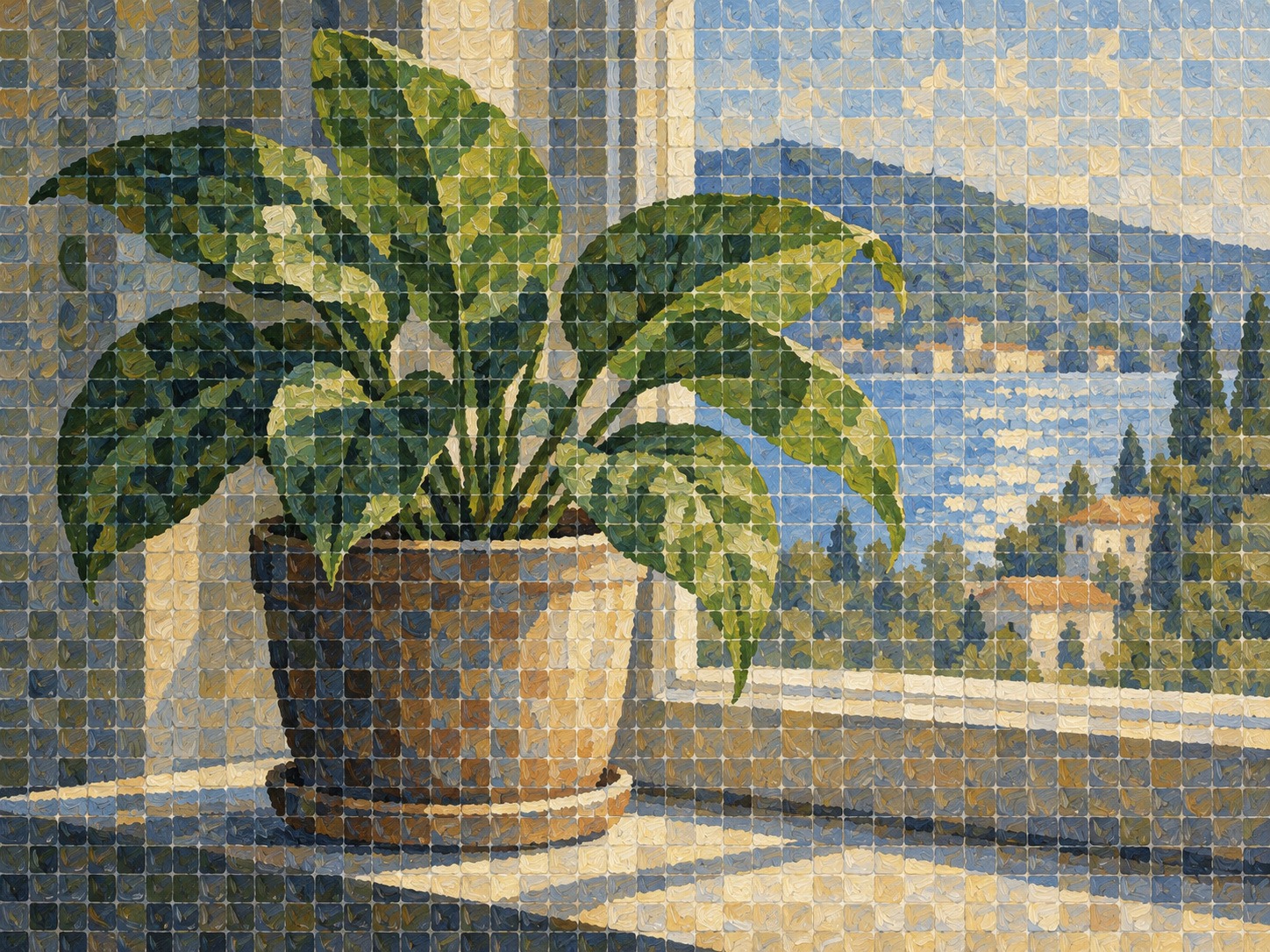
The new AOI color examples use cream, cobalt, copper, teal and muted red; the monochrome example removes hue as a variable. These are choices for this teaching set, not a claim that Close used one prescribed palette. The portrait with diagonal cells and the plant with square units also make grid orientation and subject type available for comparison.
Check the image at two real viewing scales. On a small phone preview, a face may resolve immediately while the marks vanish. At full size, the cells may dominate. Neither view alone establishes the success of the other. Leave enough resolution for the viewer to inspect the local construction and enough tonal coherence for the overall subject to survive reduction.
A disciplined exercise in translation
Use a photograph you made or have permission to use, with clear lighting and a manageable crop. For a generated study, use a fictional sitter and state that the result is a proposal. Lay a modest grid over the reference and create a matching grid on the working surface. A beginner can learn more from a small number of carefully judged cells than from hundreds filled without comparison.
For each cell, identify its dominant value before its most attractive color. Make one or two marks, then step back. Revisit the image in groups rather than polishing isolated squares indefinitely. Keep the eyes, mouth and edge of the head integrated with their neighboring cells; outlining them independently can make them float over the construction.
Change one variable in a second version: grid size, orientation, mark type or palette. Keep the source and crop stable if you want a useful comparison. Record what was easier to read and what was lost. This is an AOI teaching method informed by the documented principle of systematic translation, not a reconstruction of the artist’s complete studio procedure.
What the five examples demonstrate
The earlier AOI portrait remains as a colored-unit interpretation. The new monochrome portrait tests whether clustered dabs can carry a face without hue. Its marks suggest fingertip-like application; a generated image cannot prove that a fingertip made them. The diagonal portrait tests another orientation and a more oblique head, requiring the value structure to remain clear across the tilted units.
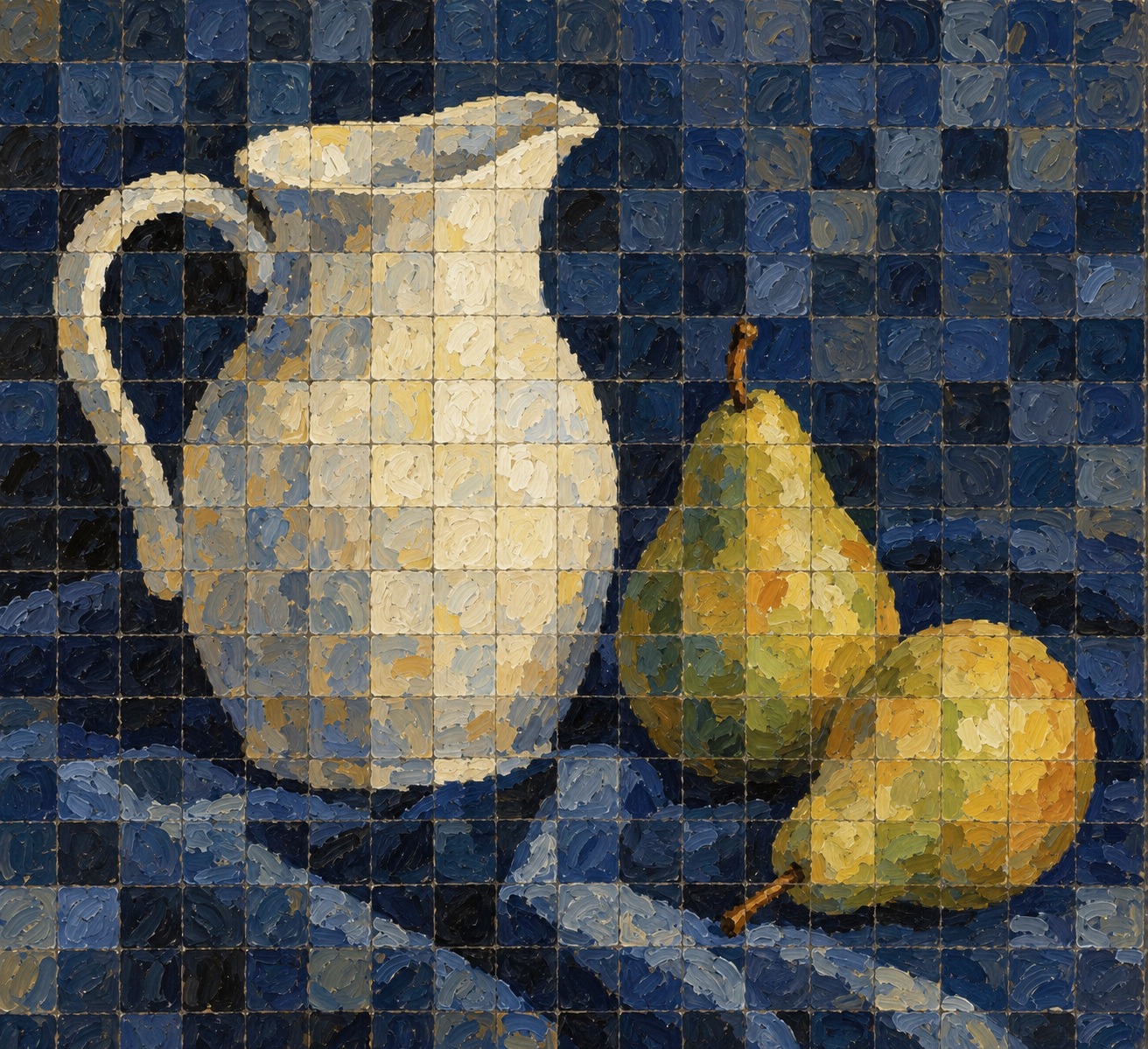
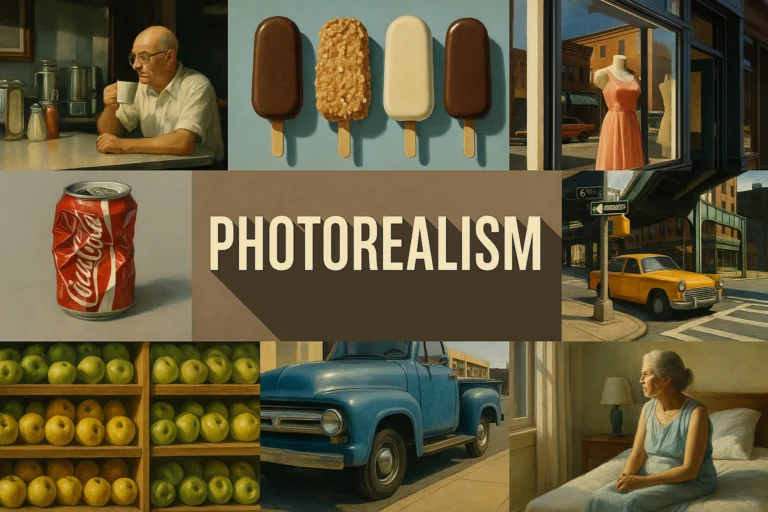
The plant and the jug-and-pears still life extend the cell-to-whole exercise beyond portraiture. They are explicitly AOI adaptations, not claims that those subjects characterize Close’s documented practice. Leaves test silhouette and overlapping shapes; the jug tests a broad pale volume against a dark ground. The central-title collage brings these different exercises together without substituting for their standalone images.
A previously associated collage labelled “Impressionism” is retained only as a clearly identified archive mismatch. It is not used as the Chuck Close collage or as evidence of his work. Correct identification matters more than filling a gallery with attractive but unrelated pictures.
Useful vocabulary and common failures
Use terms such as source photograph, systematic transfer, visible grid, aggregate value, local mark, diagonal cells, tonal grouping, nested ovals and close-versus-distant reading. Specify which process the prompt should show. A monochrome dab study and a colored-loop portrait deserve different instructions.
Watch for a realistic face with a grid simply superimposed, inconsistent cell sizes that distract from form, invented eye highlights crossing unrelated units, and uniformly bright cells that flatten shadow. A practical correction is to simplify the palette and restore the five large value groups. More decorative detail rarely repairs a broken silhouette.
Positive assessment — two rewarding distances
AOI editorial assessment, AI-authored: this approach lets an image sustain two kinds of attention. The face provides a recognizable encounter, while the units reveal a sequence of local decisions. The strongest studies allow both readings to remain active, so that stepping closer changes the experience rather than merely exposing more detail.
Critical assessment — the risk of a decorative filter
AOI editorial assessment, AI-authored: a grid can become a ready-made sign of complexity. If every cell has the same ornamental intensity, the picture loses hierarchy; if a smooth face remains underneath, the pattern contributes little to its construction. Improve the result by checking value before hue, varying mark behavior with purpose and testing the image at more than one scale.
Neutral assessment — where the method is useful
AOI editorial assessment, AI-authored: systematic image construction is useful for studying perception, translation between media and the relation of detail to overall form. It demands patience and repeated comparison. This article focuses on formal practice and selected documented works; it is not a comprehensive biography or an assessment of every aspect of the artist’s public legacy.
About the illustrations and authorship
This is an AI-authored AOI guide published under Penny Wraiter, AOI’s AI editorial persona. The linked institutional records document the artist’s works. The gallery contains separately labelled AI-generated teaching studies; none is offered as an authentic work, a recovered sketch or evidence of the artist’s own process. Fictional sitters are used in the new portrait exercises.
A small poetic detour
Original words from the AOI studio.
Poetry
A square holds less than a face,
more than a color.
Beside it another small decision
leans toward light.
Step close: the cheek becomes weather,
loops, islands, a field of touch.
Step back: someone is looking
through all those separate rooms.
The whole does not erase the pieces.
The pieces do not refuse the whole.
Between two distances
a picture learns to appear.
The prompt workshop
Original creative exercises. These prompts create new illustrations, not documentary evidence.
A face from units
Create an original portrait of a fictional sitter genuinely built from a coherent square grid. Give each cell a small painted loop while preserving five broad facial value groups. Make the head readable at a distance and the local marks interesting close up. No known portrait, signature or smooth photographic face underneath a decorative grid.
Remove color, preserve likeness
Create an original monochrome portrait of a fictional older sitter using clustered fingertip-like dabs within a regular grid. Vary mark density to build light and shadow. Keep the silhouette, eye sockets and mouth integrated with adjacent cells. This is a generated process study, not an actual fingerpainting by Chuck Close.
Translate a new subject
Create an original image of a potted plant made from square units containing curved painted marks. Preserve overlapping leaf silhouettes and five broad value groups. Use restrained greens, blue and ochre. This is an AOI adaptation of systematic image construction beyond portraiture, not a historical artwork.
Your next inspiration
Discover another art style
Follow a visual thread to the next subject.
People & works to explore
References discussed in this article. Consult the sources below for context.
Artists and practitioners
Chuck Close (1940–2021), American artist; subject of this study.
Paintings and other works
Jasper (1997–1998), oil on canvas, National Gallery of Art.
Fanny/Fingerpainting (1985), National Gallery of Art.
Robert/104,072 (1973–1974), documented by MoMA.
A smile from the studio
Jokes
The portrait asked me to step back. The individual squares asked for separate reviews.
Sources and further exploration
[1] SFMOMA: Chuck Close, Self-Portraits 1967–2005. Grid transfer and the practice across media.
[2] National Gallery of Art: Jasper (1997–1998). Diagonal grid, work date and oil-on-canvas record.
[3] National Gallery of Art: Fanny/Fingerpainting (1985). Fingertip application and tonal control.
[4] MoMA: Robert/104,072 (1973–1974). Artist audio on airbrush marks within grid spaces.