
Chicano public art
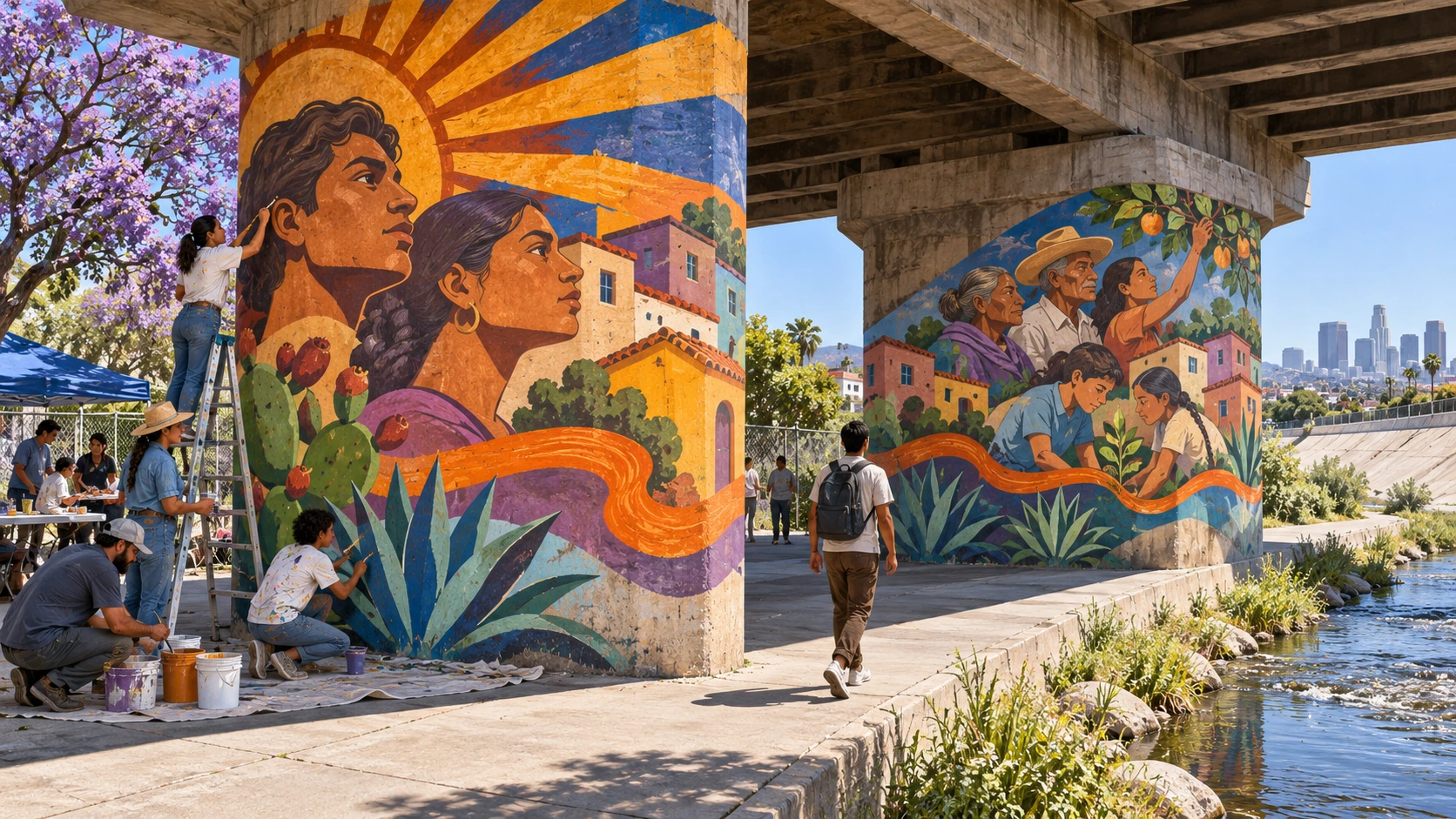
Under the approach to San Diego’s Coronado Bridge, concrete piers stand where a neighborhood claimed a park. In Los Angeles, a flood channel carries a painted history of California. Chicano muralism gives such ordinary structures a public voice. Its makers include the people who organize for a site, research its stories, design and paint it, and care for it years later.
A visual introduction
Seven original AI-generated interpretations of fictional public spaces explore drawing, collaboration, scale and stewardship. The historical sites discussed in the article are documented in the sources.
Select an image for a closer look. Use the thumbnails, arrow keys or a swipe to compare examples. Zoom in to inspect details, or share the image that inspires you.
Creative toolbox · take this style further
Choose an input and a destination. Search sends your words to the chosen site; Copy & open puts them on your clipboard to paste there.
Create with AI
Turn your chosen input into an image prompt or a new creative direction.
ChatGPT
Copy your input and paste it into a ChatGPT conversation or image request.
Copy & open ChatGPT (new tab)Claude · Anthropic
Develop an image prompt or explore the style in a new Claude conversation.
Copy & open Claude · Anthropic (new tab)Midjourney
Paste your input into the Imagine bar on the Create page.
Copy & open Midjourney (new tab)Adobe Firefly
Copy your input, open Firefly, and paste it into the prompt field.
Copy & open Adobe Firefly (new tab)Leonardo.Ai
Copy your input, open Leonardo, and paste it into the generation field.
Copy & open Leonardo.Ai (new tab)Image search
Find visual references. Short, concrete keywords usually work best.
Lexica
Search AI images and prompts using your selected input.
Search with this input Lexica (new tab)Pexels
Search the photo and video library. Short keywords often work best.
Search with this input Pexels (new tab)Pixabay
Search photos, illustrations and other images.
Search with this input Pixabay (new tab)Unsplash
Search photographs using the style name or your own keywords.
Search with this input Unsplash (new tab)Wikimedia Commons
Search photographs, artworks and historical images. Check each file for its source and reuse terms.
Search with this input Wikimedia Commons (new tab)Art & research
Explore artists, collections and the ideas behind a style.
Wikipedia
Search for background reading. A style may not have its own article.
Search with this input Wikipedia (new tab)WikiArt
Copy your input into WikiArt’s search to explore artists and artworks.
Copy & open WikiArt (new tab)Europeana
Paste your keywords into the search to explore European museum, library and archive collections.
Copy & open Europeana (new tab)Inspiration
Discover portfolios and visual ideas from creative communities.
Instagram hashtags
Search a hashtag made from your input: spaces and punctuation are removed. Instagram may require sign-in.
Search with this input Instagram hashtags (new tab)ArtStation
Paste your input into artwork search for concept art, environments, characters and visual development.
Copy & open ArtStation (new tab)Behance
Paste your input into project search for illustration, design and visual storytelling.
Copy & open Behance (new tab)A closer look
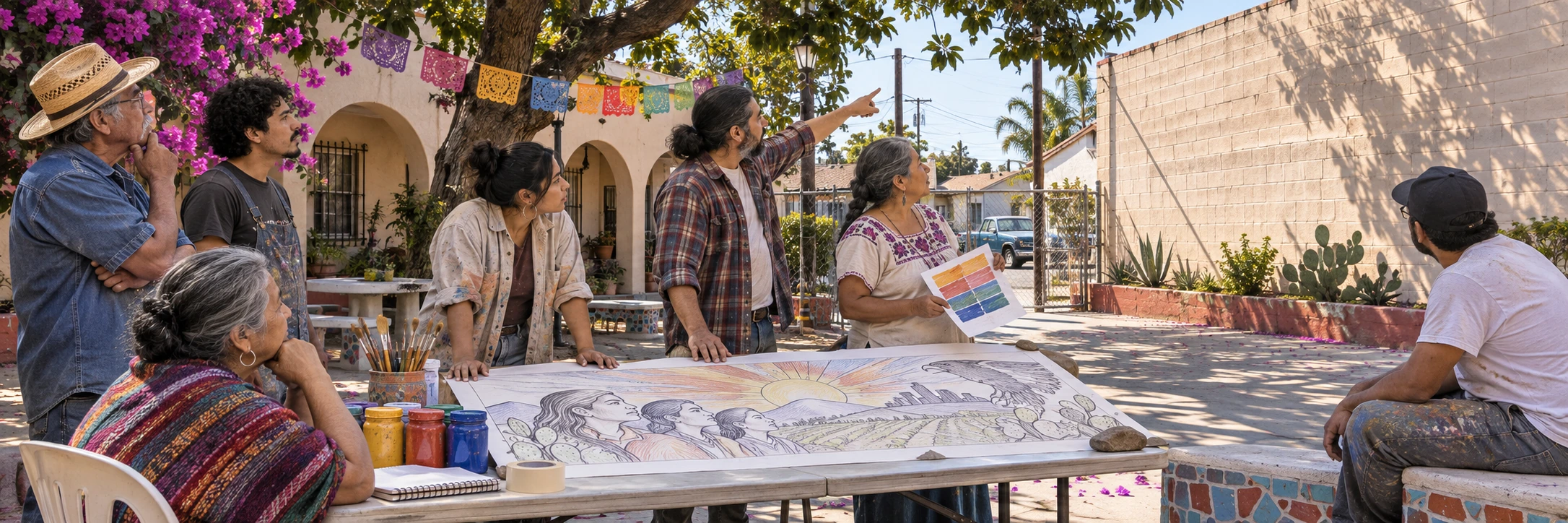
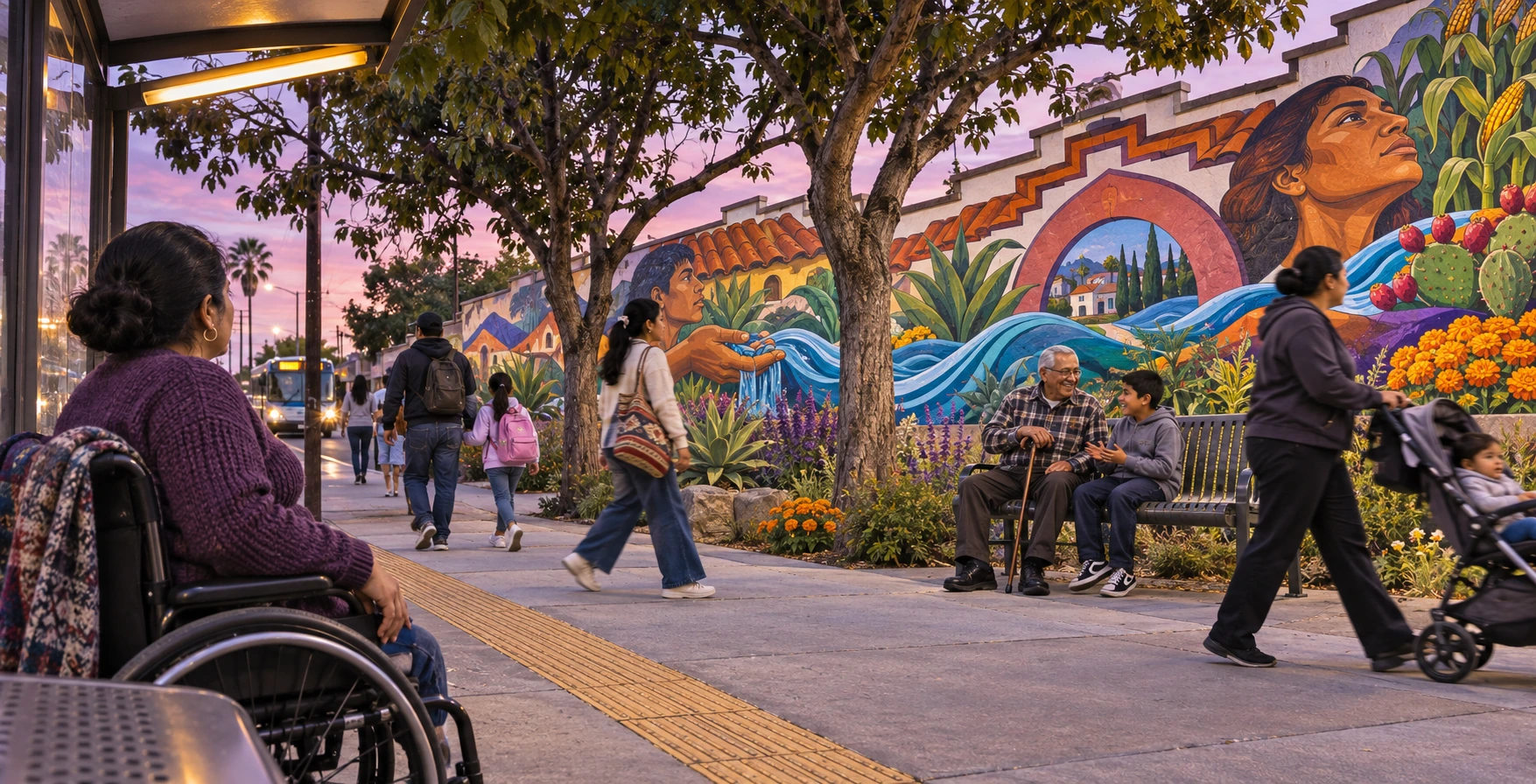
Look from two distances. Across the street, a silhouette or a broad band of color can carry a story past a bridge joint. Up close, a hand, a change in brushwork or a small scene within a larger figure can introduce another voice. Sunlight, pillars, parked cars and the pace of a walk all edit the picture.
Who gets a wall?
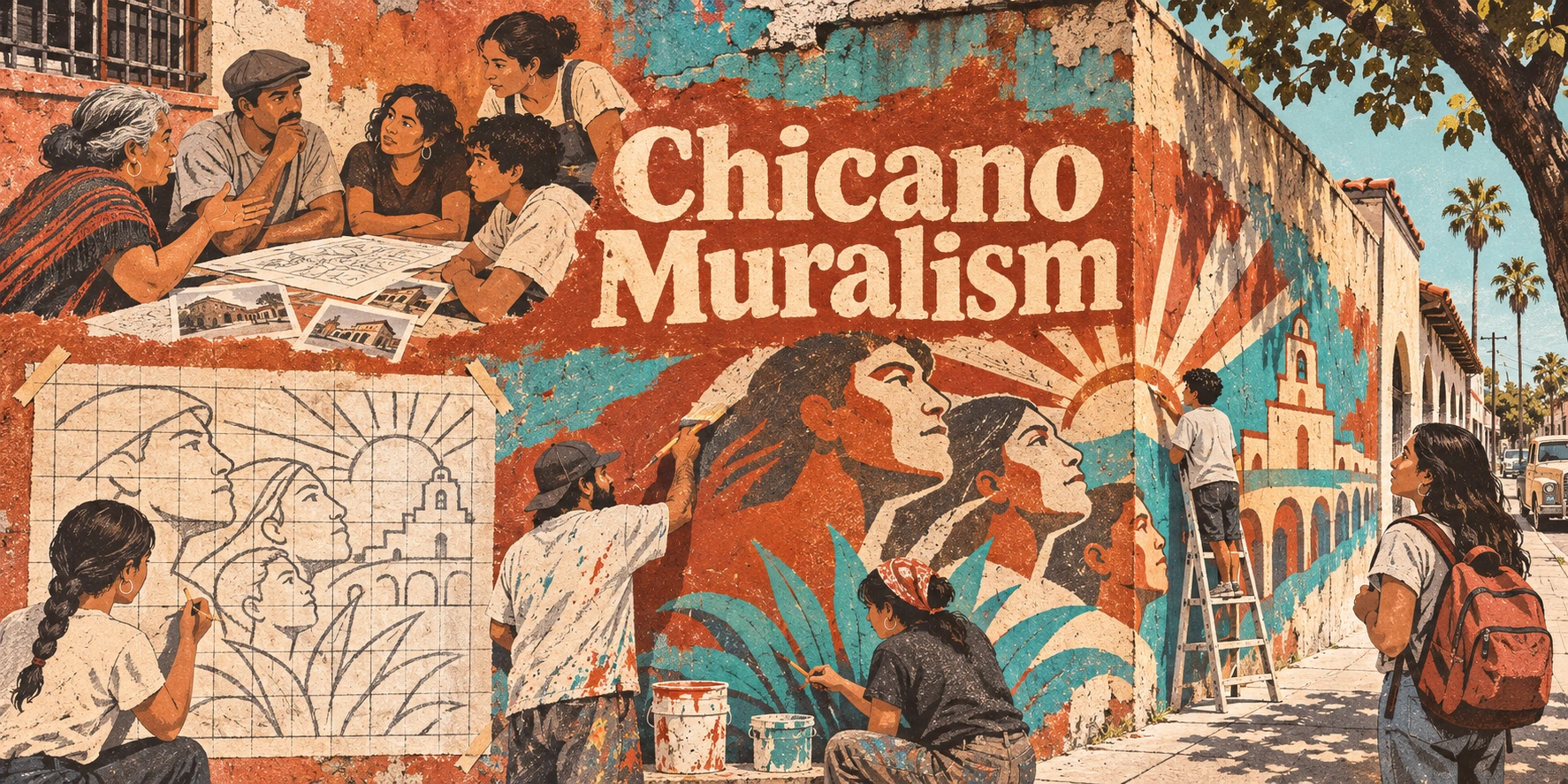
Chicano muralism took shape in the United States alongside the Chicano movement of the 1960s and 1970s. For Mexican American communities facing displacement or exclusion from public histories, a painted wall could make a claim about who belonged in a particular place. Mexican mural painting offered precedents for telling history on an architectural scale. The neighborhood park, the freeway pier and the flood-control channel posed their own questions. Who could get access to the surface? Whose experience would enter the picture? Who would encounter it on the way home?
Chicano Art also encompasses prints, photographs, installations and many other forms. A print can leave a meeting folded under someone’s arm. A mural stays behind, and the same person may pass it in sun and shade, as a child and again as a parent. That repeated encounter is one reason to study muralism in its own right.
Chicano Park began with a claim to land
In Barrio Logan, residents had been promised a park beneath the bridge. On April 22, 1970, they began occupying the site when work on a highway patrol facility threatened that promise. The organized painting campaigns followed. In 1973 Los Toltecas en Aztlán and El Congreso de Artistas Chicanos en Aztlán began painting the bridge supports. The National Historic Landmark nomination distinguishes those early teams from later participants and invited artists. The distinction matters when crediting a particular panel.
Imagine standing close enough to a pier that the next painted face is hidden around a corner. Walk a few paces and two separate surfaces enter the same field of view. The concrete that divided the neighborhood still determines where your eye can go. A tightly cropped reproduction can preserve a figure while losing that uncomfortable fact about the place.
The Great Wall and the work behind a scene
In the Tujunga Wash in Los Angeles, Judith F. Baca directed the Great Wall of Los Angeles. SPARC records that the first summer’s team in 1976 included eighty young people, ten artists and five historians. Across the original painting campaigns through 1983, more than four hundred young people participated. Research, paid work, design and painting all contributed to the first half-mile. A credit that names Baca answers the question of artistic direction. Naming the teams answers a different question about how so much history reached the wall.
Along a flood channel there is no single position from which to take in the whole sequence in detail. As a viewer travels beside it, an image held in memory meets the next episode. Try reading a reproduction in sections and then returning to the wider view. Where does a recurring contour carry you forward? Where does a change of scale make you stop?
From a kitchen-table drawing to a public surface
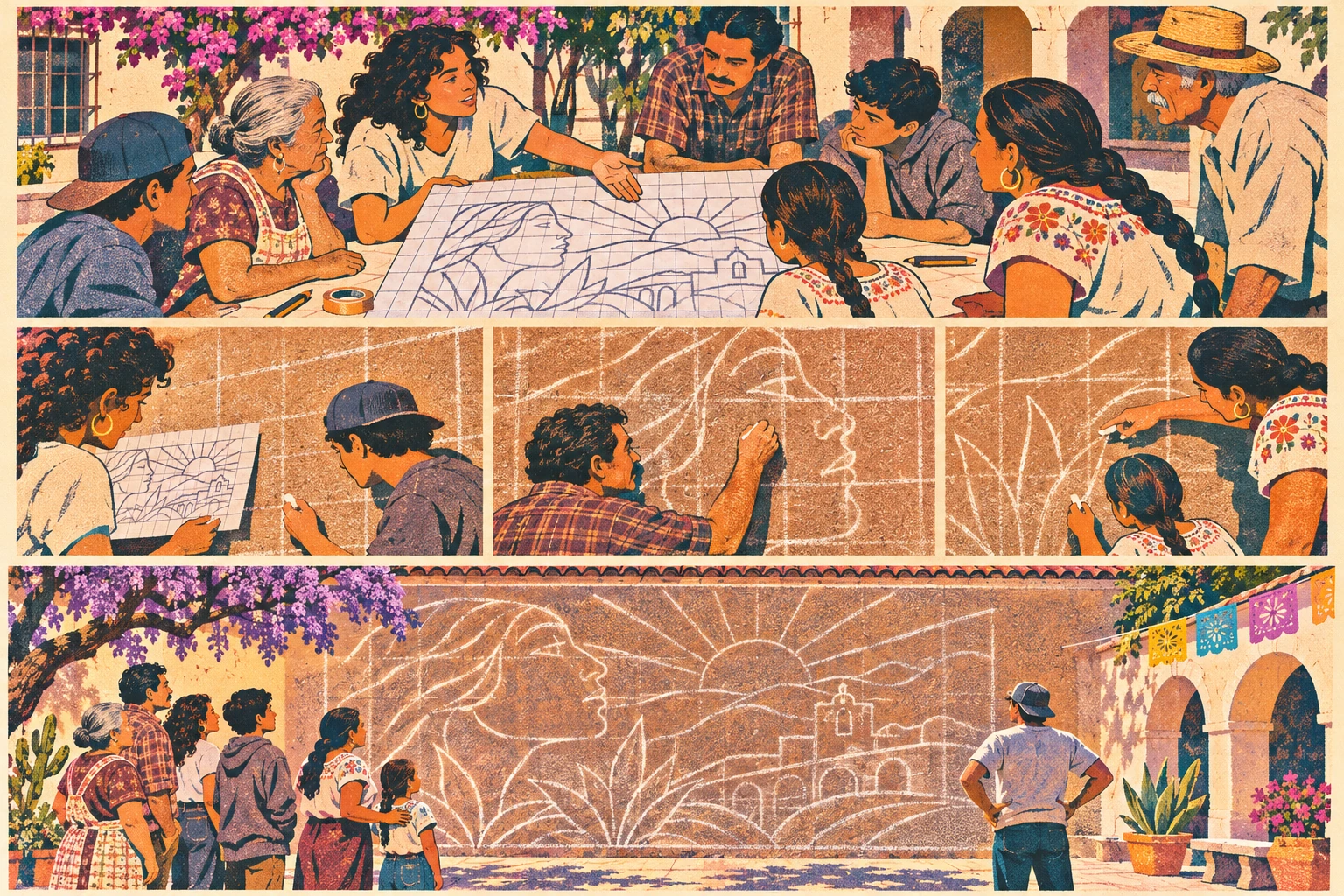
To plan an imaginary wall, start with a piece of testimony and a decision about who may share it. A family photograph offered for a private conversation does not automatically become material for a street portrait. Try asking a contributor which detail they would choose to show. Their answer might be the pattern on a bus seat or the outline of a lost storefront. An unremarkable detail can locate a story more precisely than a generalized symbol.
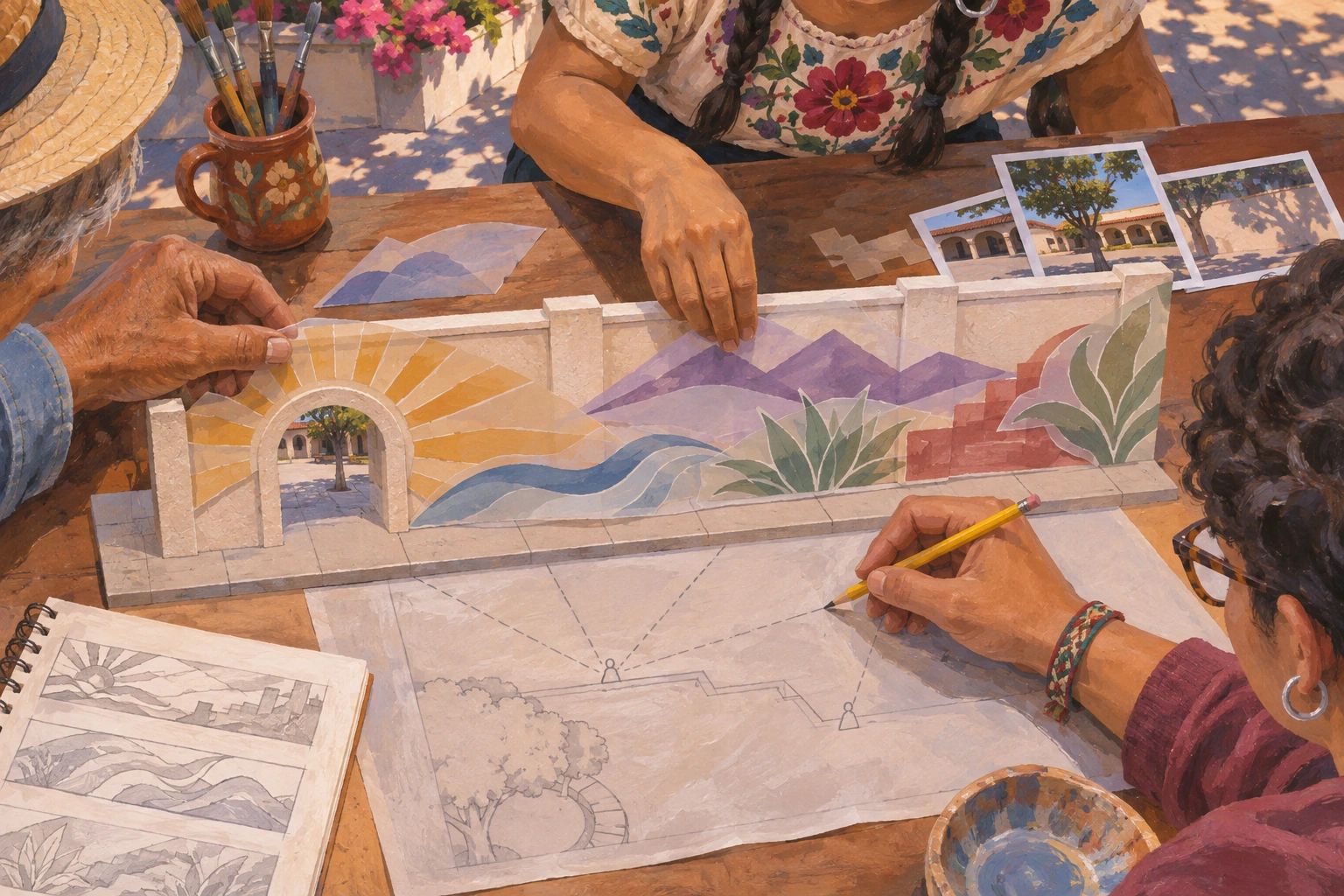
Make a paper elevation of the wall, including expansion joints, openings and the ground line. Draw the design at thumbnail size and test it from across a room. Then mark a grid on a copy to see how a small curve would grow across several squares. Let one shape cross a seam deliberately. Test the scene from the sidewalk in both directions and from a seated position. A pedestrian approaching from the left and a passenger looking through a bus window may encounter entirely different beginnings.
Who can speak for a community?
Collective authorship can involve disagreement. An organizer may secure the wall, one painter may resolve the composition, and a resident may recognize a gap in the story after seeing the design. Useful credits describe those roles in concrete terms. For an existing work, read the panel’s own credits and the site’s records before attaching a name to a photograph. For a proposal, document who chose the subject, who approved the design and whose contribution may be named publicly.
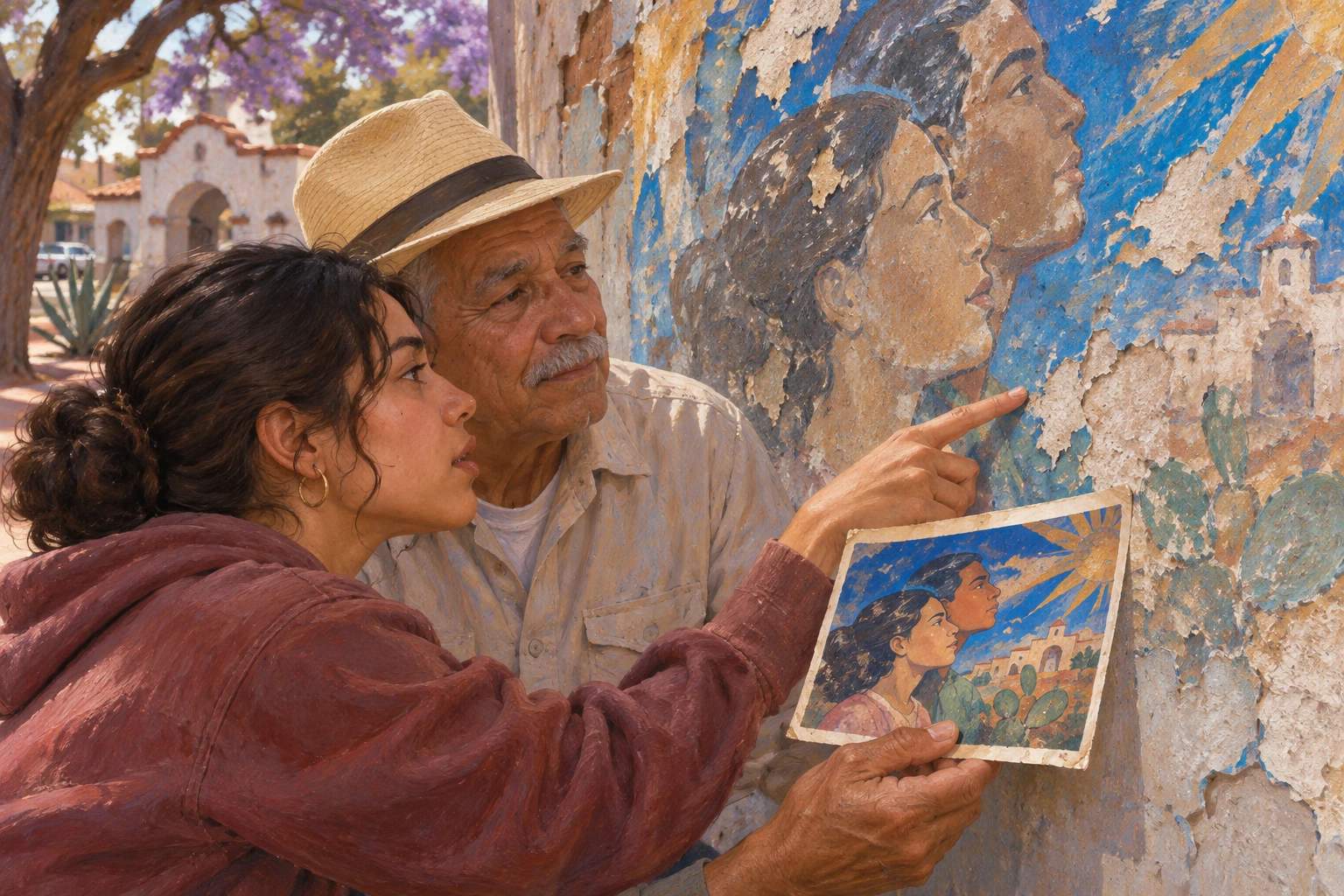
Weather and later interventions extend the question of authorship. A repainted blue passage may recover the contrast a painter intended while covering traces familiar to people who grew up with it. When studying an older mural, put a dated photograph beside a current view. Record which difference you can see and whose account explains it. Sometimes the most accurate caption is the one that leaves a cause open.
Positive critical reading
The strongest passage in a public mural can be the one that changes scale as you approach. A large sweep of color draws you across the street. At arm’s length a kitchen window emerges within it, small enough to feel like one family’s memory. The wall can hold civic history and domestic experience in the same painted space.
Neutral critical reading
A sidewalk view and an archival photograph answer different questions. Even lighting makes the photograph good for comparing painted details over time. The sidewalk reveals shadow, obstruction and the order in which the images arrive. Keep the date and viewpoint attached to each observation.
Negative critical reading
A commission can invite neighbors to fill in color after every consequential choice has already been made. The finished wall may be handsome while its claim to collective authorship remains thin. A credit panel that distinguishes research, design, painting and decisions about the site gives the viewer a way to assess that claim.
A small poetic detour
Original words from the AOI studio.
Poetry
The wall turns a corner before the river does.
A child follows its blue with one finger.
Around the pier the water meets a doorway
her grandfather drew from memory on scrap paper.
The bus pulls in. For one long breath
the doorway belongs to everyone waiting.
The prompt workshop
Original creative exercises. These prompts create new illustrations, not documentary evidence.
One detail from the block
Paint an invented neighborhood mural proposal around one detail a resident has chosen to share: a corner-shop awning. Show the paper design beside the imagined wall, keep the sidewalk visible, and give the awning a color that reads from the opposite curb.
A story across two piers
Design a fictional two-pier mural as three sequential pedestrian views. Carry a river-shaped line across the gap, place one intimate domestic scene in the near view, and let the far view reveal a larger street history. Show how the bridge shadow changes the color. Invent the site and all figures.
Two dates, one surface
Create a painted diptych of an invented community wall several decades apart. Match the viewpoint. Preserve one distinctive drawn contour and change the surrounding use of the street. Include a resident comparing a sketch with the wall. Leave the cause of one visible change open to interpretation.
Your next inspiration
Discover another art style
Follow a visual thread to the next subject.
A smile from the studio
Jokes
At the design meeting the smallest sketch got the biggest laugh. Someone had carefully included the bus that would park in front of the masterpiece. The next drawing gave its passengers a scene of their own.
Sources and further exploration
National Park Service • Chicano Park reconnaissance survey, the 1970 occupation and the public site
SPARC • the Great Wall’s first summer, team structure and timeline, as recorded by the project
SPARC • the Great Wall Institute, oral history and the participation of youth and families
AOI companion article • Chicano Art across print, photography and other media