
Art and cultural context · researched guide
Art in Bosnia and Herzegovina encompasses painting, sculpture, photography, religious objects and contemporary media. It is not a single folk aesthetic. The National Gallery in Sarajevo offers a grounded starting point: its collections reveal different periods, artistic networks and ways of preserving experience.
A visual introduction
Open any image to look closer, then browse the examples.
A closer look
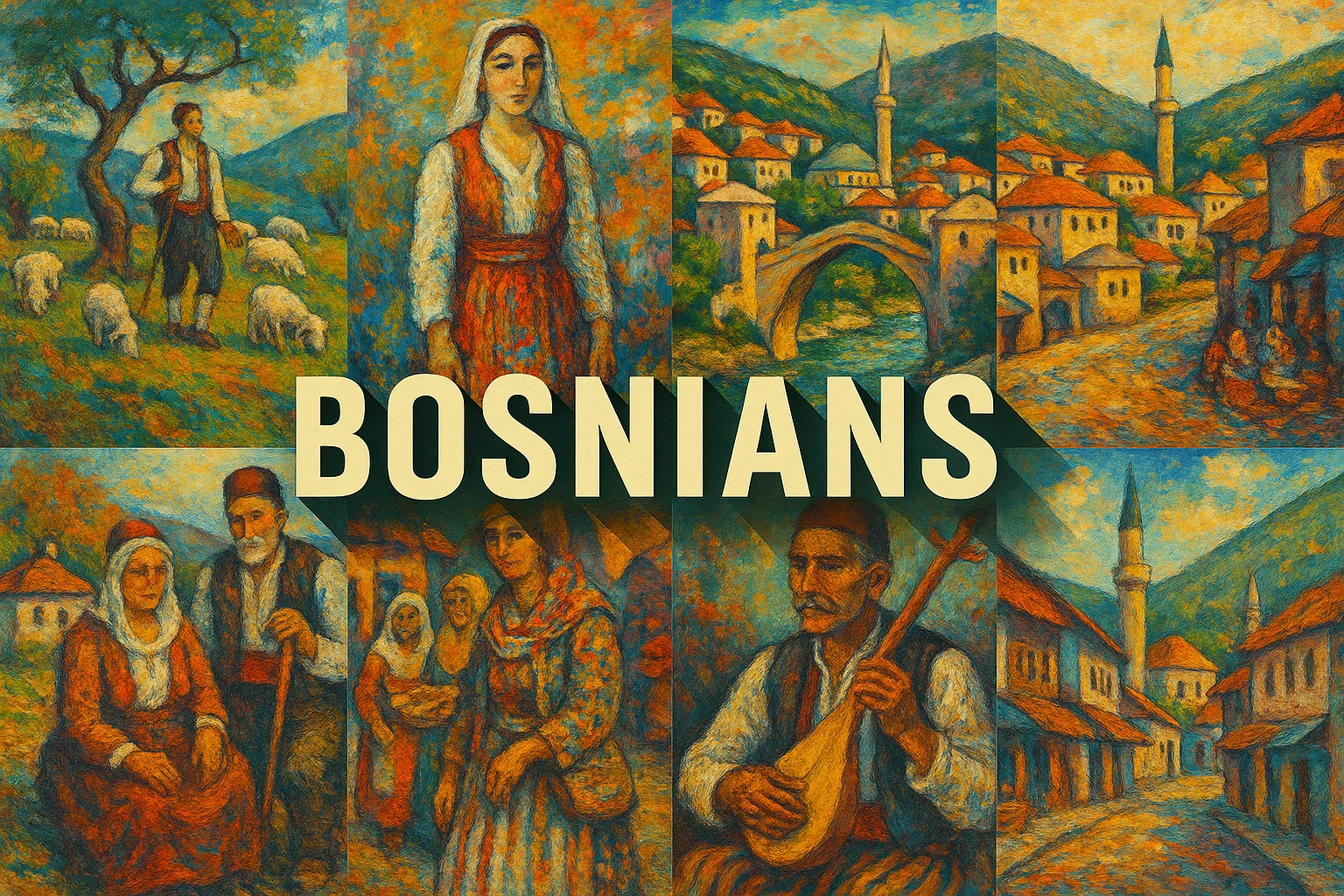
The AOI collage uses textured blue and ochre to connect invented portraits, mountain scenes, a bridge and minarets. The repeated rural imagery creates a nostalgic mood. It neither documents particular monuments nor represents the full range of art in Bosnia and Herzegovina.
A collection contains more than one history
The National Gallery of Bosnia and Herzegovina was established in 1946, with an initial collection transferred from the National Museum; it opened to the public in 1959. Its institutional history is a better foundation for this guide than an invented date when a supposed Bosnian style began. A collection grows through decisions about what to acquire, preserve, research and display. [1]
The gallery distinguishes art of Bosnia and Herzegovina, Yugoslav art, international material, icons, photographs and new media. Its collection of Ferdinand Hodler is a particularly clear reminder that a museum’s location does not determine the nationality of every artist it collects. These categories overlap in the stories they can tell, but they should not be collapsed into one visual recipe. [2]
Follow the change of medium
The gallery traces its photography collection back to the 1950s. It also describes photographs responding to the 1992–1995 war and a new-media collection involving video, sound, installation and digital imagery. Named artists in that account include Danica Dakić and Maja Bajević. This is evidence of varied artistic activity, not a claim that every work by either artist has the same subject. [2]
A photograph, a sound installation and a painted landscape ask different things of a viewer. Consider the duration of the encounter, the position of the body and the relation between a document and its presentation. Where a work concerns conflict, read its caption and account of production before assuming it records a particular event. An affecting image can still be misidentified.
Preservation and solidarity
The gallery describes its international collection of donated works as developing after the 1992–1995 war through gifts from artists and organisations abroad. That history introduces another way to read a collection: as the result of relationships and acts of support. The meaning of a donation is not necessarily visible in the donated object’s colours or shapes. [3]
This also explains why provenance belongs beside visual description. A useful research note records who made the work, when, in what medium, and how it entered the collection. If an attribution or date is uncertain, preserve the uncertainty. Do not improve the apparent neatness of a story by supplying a detail that the museum has not established.
What our illustration can and cannot show
The generated collage makes its panels agree through brushlike texture and a narrow palette. Notice how often the mountains frame a solitary figure or a compact settlement. That is a compositional pattern within this image. It is not evidence that contemporary life, urban experience or experimental art is absent from the country.
Use the collage as a starting exercise in visual description, then open the gallery’s collection guide and deliberately choose a different medium. Compare what each encounter allows you to know. The best introduction leaves you with a more precise question, rather than the reassuring fiction that an entire culture has been explained by one picturesque bridge.
People & works to explore
References discussed in this article. Consult the sources below for context.
Artists and practitioners
Danica Dakić — represented in the gallery’s new-media account
Maja Bajević — represented in the gallery’s new-media account