
Historical visual tradition · Buddhist narrative sculpture in Central Java
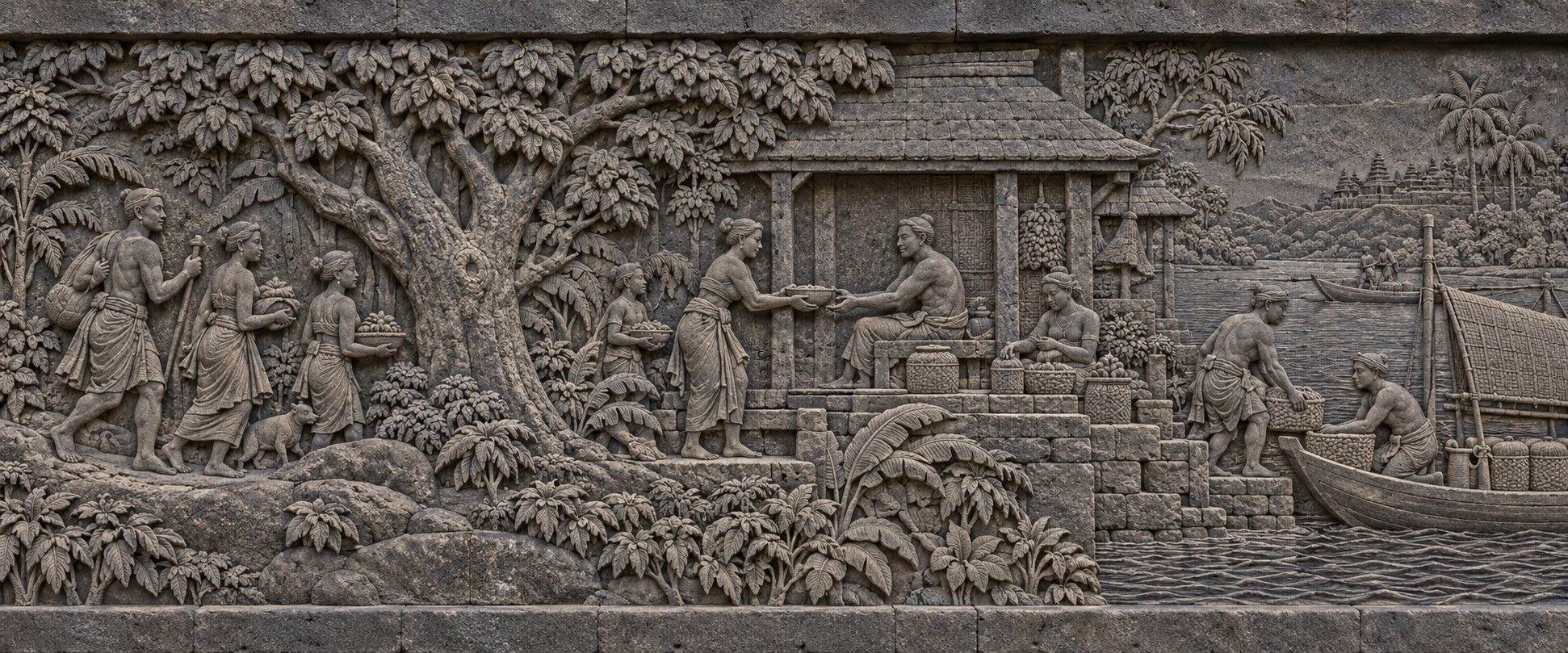
Borobudur’s narrative reliefs turn stone surfaces into sustained visual storytelling. Figures, trees, buildings and repeated gestures organize episodes that unfold along the galleries of the Central Javanese Buddhist monument.
A visual introduction
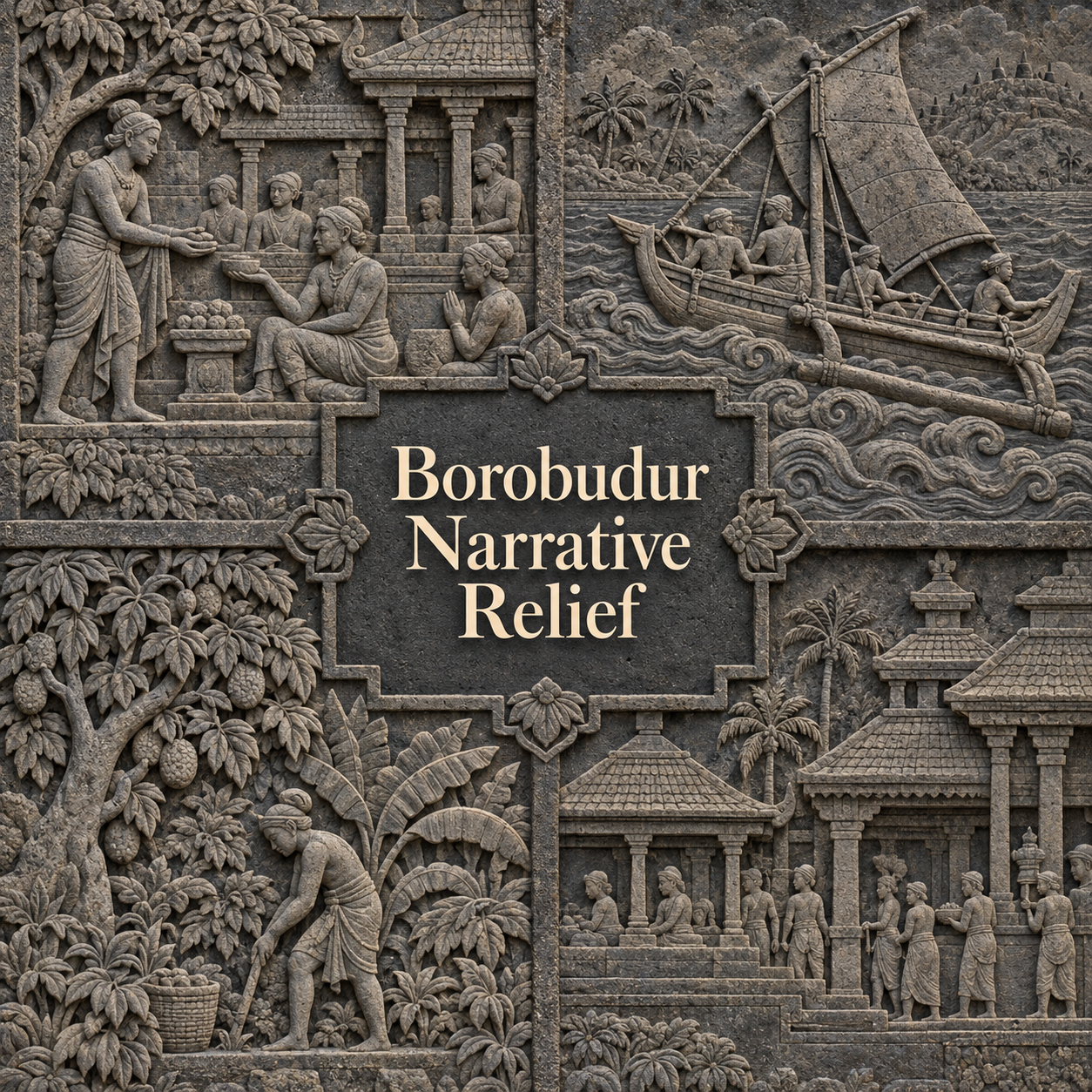
Five original AI-generated AOI studies: a dedicated banner, a centrally titled collage and three standalone examples. These are contemporary interpretations of the visual principles discussed here.
Select an image for a closer look. Use the thumbnails, arrow keys or a swipe to compare examples. Zoom in to inspect details, or share the image that inspires you.
Creative toolbox · take this style further
Choose an input and a destination. Search sends your words to the chosen site; Copy & open puts them on your clipboard to paste there.
Create with AI
Turn your chosen input into an image prompt or a new creative direction.
ChatGPT
Copy your input and paste it into a ChatGPT conversation or image request.
Copy & open ChatGPT (new tab)Claude · Anthropic
Develop an image prompt or explore the style in a new Claude conversation.
Copy & open Claude · Anthropic (new tab)Midjourney
Paste your input into the Imagine bar on the Create page.
Copy & open Midjourney (new tab)Adobe Firefly
Copy your input, open Firefly, and paste it into the prompt field.
Copy & open Adobe Firefly (new tab)Leonardo.Ai
Copy your input, open Leonardo, and paste it into the generation field.
Copy & open Leonardo.Ai (new tab)Image search
Find visual references. Short, concrete keywords usually work best.
Lexica
Search AI images and prompts using your selected input.
Search with this input Lexica (new tab)Pexels
Search the photo and video library. Short keywords often work best.
Search with this input Pexels (new tab)Pixabay
Search photos, illustrations and other images.
Search with this input Pixabay (new tab)Unsplash
Search photographs using the style name or your own keywords.
Search with this input Unsplash (new tab)Wikimedia Commons
Search photographs, artworks and historical images. Check each file for its source and reuse terms.
Search with this input Wikimedia Commons (new tab)Art & research
Explore artists, collections and the ideas behind a style.
Wikipedia
Search for background reading. A style may not have its own article.
Search with this input Wikipedia (new tab)WikiArt
Copy your input into WikiArt’s search to explore artists and artworks.
Copy & open WikiArt (new tab)Europeana
Paste your keywords into the search to explore European museum, library and archive collections.
Copy & open Europeana (new tab)Inspiration
Discover portfolios and visual ideas from creative communities.
Instagram hashtags
Search a hashtag made from your input: spaces and punctuation are removed. Instagram may require sign-in.
Search with this input Instagram hashtags (new tab)ArtStation
Paste your input into artwork search for concept art, environments, characters and visual development.
Copy & open ArtStation (new tab)Behance
Paste your input into project search for illustration, design and visual storytelling.
Copy & open Behance (new tab)A closer look
Shallow carved figures share a continuous stone ground. Overlap, gesture, architectural frames and clustered foliage organize scenes, while angled light reveals contours and small differences in relief depth.
A story encountered through movement
Borobudur is a Buddhist monument in Central Java, Indonesia, built in the eighth and ninth centuries during the Syailendra period. UNESCO identifies its walls and balustrades as major settings for low-relief sculpture. These carvings belong to the architecture and its religious program; they are not simply detachable ornaments with an antique texture.
A narrative relief asks the viewer to connect events. At Borobudur, looking takes place along galleries and within an ascending spatial journey. A single scene can reward close attention, but its position among other scenes matters. The image has neighbors, and the viewer has a body moving through space.
Different narrative cycles, different purposes
The relief program includes Lalitavistara scenes concerning the Buddha's life, Jataka and Avadana narratives, and the Gandavyuha cycle associated with Sudhana's search for spiritual instruction. These are distinct bodies of narrative, not interchangeable names for a generic temple story. The conservation material linked below provides a more detailed account of their placement and content.
For a first encounter, separate three questions: what appears in the panel, what narrative an identified panel belongs to, and what interpretation the viewer is proposing. A recognizable tree or boat can be described directly. Naming a particular episode requires a reliable panel identification. This article's generated studies use invented scenes to explore the visual method, rather than claiming to reconstruct an undocumented episode.
Relief builds depth without opening a deep room
In low relief, figures remain attached to the background plane. Their volume is compressed, but their relationships can be rich. A shoulder crossing another figure, a hand projecting slightly farther, or a roof casting a narrow shadow can establish an order of near and far without the illusion of a deep painted landscape.
To study that effect, begin with a few broad depth levels: background, principal bodies and selected details. Let important contours stay readable before adding ornament. The face, hand and object involved in an action need enough separation to be understood. Recessing every small mark equally can turn a scene into a noisy texture with no leading gesture.
The volcanic stone gives the image a physical unity. Light does much of the drawing: low raking illumination reveals the edges, while frontal light can flatten them. In a digital study, keep one consistent light direction and resist the temptation to give every figure its own dramatic spotlight.
Architecture and vegetation can organize the reading
A pavilion can establish a place, a tree can gather a group, and a stretch of open ground can pause the action. These elements can divide or connect episodes without behaving like modern comic-book borders. Look at where attention changes direction: a seated figure may face an approaching visitor, while a branch carries the eye toward another group.
For a new composition, choose one dominant interaction. Two people sharing a bowl need a clear exchange of hands and gazes; adding ten unrelated figures will not make the story more substantial. Put secondary activity where it supports that exchange. Repeated clothing, posture or a distinctive object can help the viewer recognize a recurring participant across a sequence.
Scale need not operate like a camera photograph, but variation should have a purpose. A central figure may need greater visual emphasis; a building may function as a setting sign rather than a measured architectural survey. Avoid treating every proportion difference as a mistake or every decorative detail as a hidden symbol.
Stone, weather and the danger of picturesque damage
Weathered edges and mineral variation can make a surface convincing, yet heavy cracks are not the essence of the tradition. Begin with coherent carving, then add restrained wear. A readable hand or face matters more than an elaborate simulation of erosion.
UNESCO's conservation material documents the importance of monitoring water and the monument's structural condition. For image-making, the useful distinction is between depicting a material and romanticizing its deterioration. A contemporary relief study can retain the density and tactile character of stone without pretending that more damage means more history.
Keep the palette largely within the stone's tonal range if the aim is to study carved form. Warm highlights and cooler recesses can clarify the surface subtly. Gold accents, glowing eyes and theatrical smoke would introduce a different fantasy vocabulary and should be deliberate additions rather than default shorthand for sacred art.
Three ways to practice the visual grammar
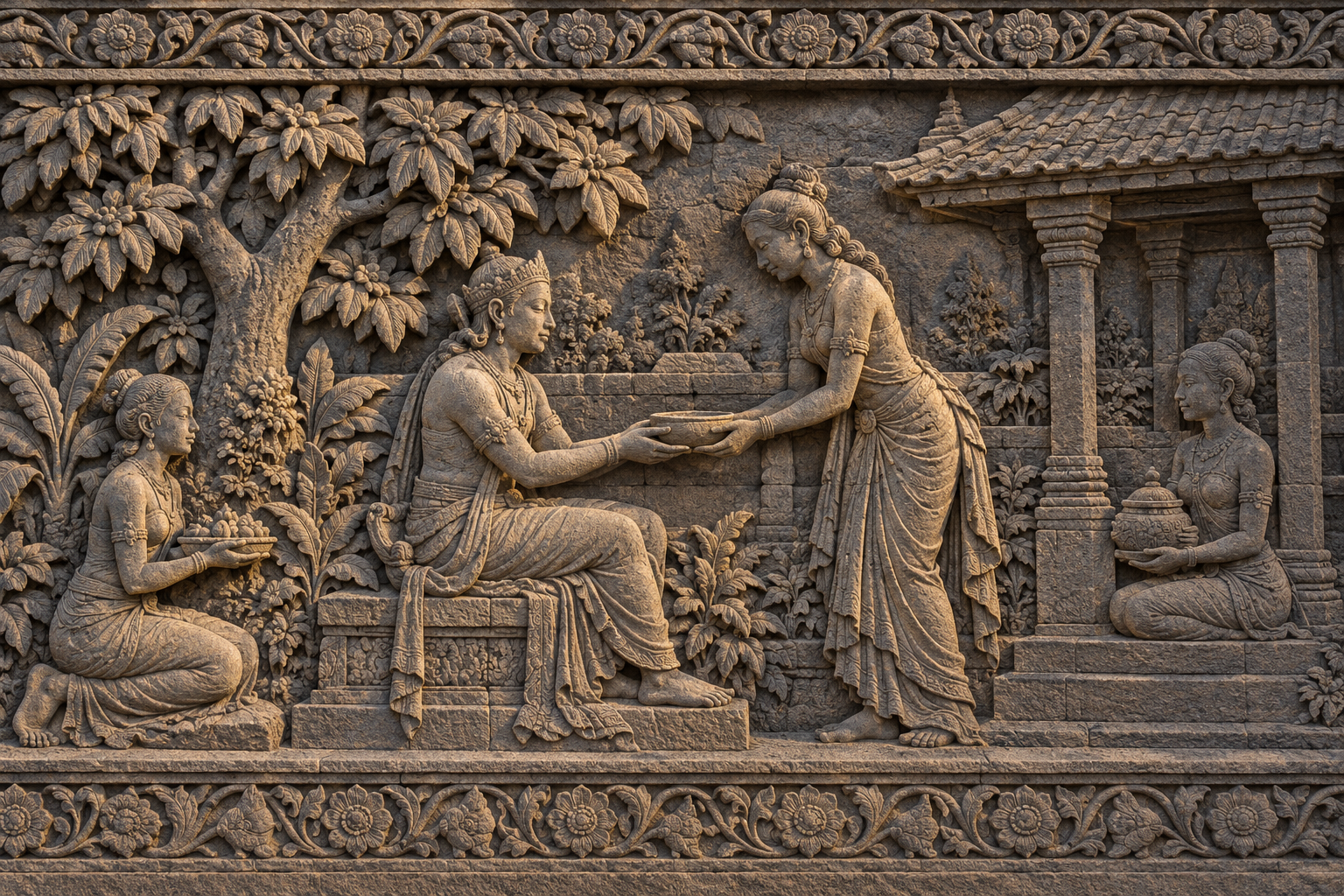
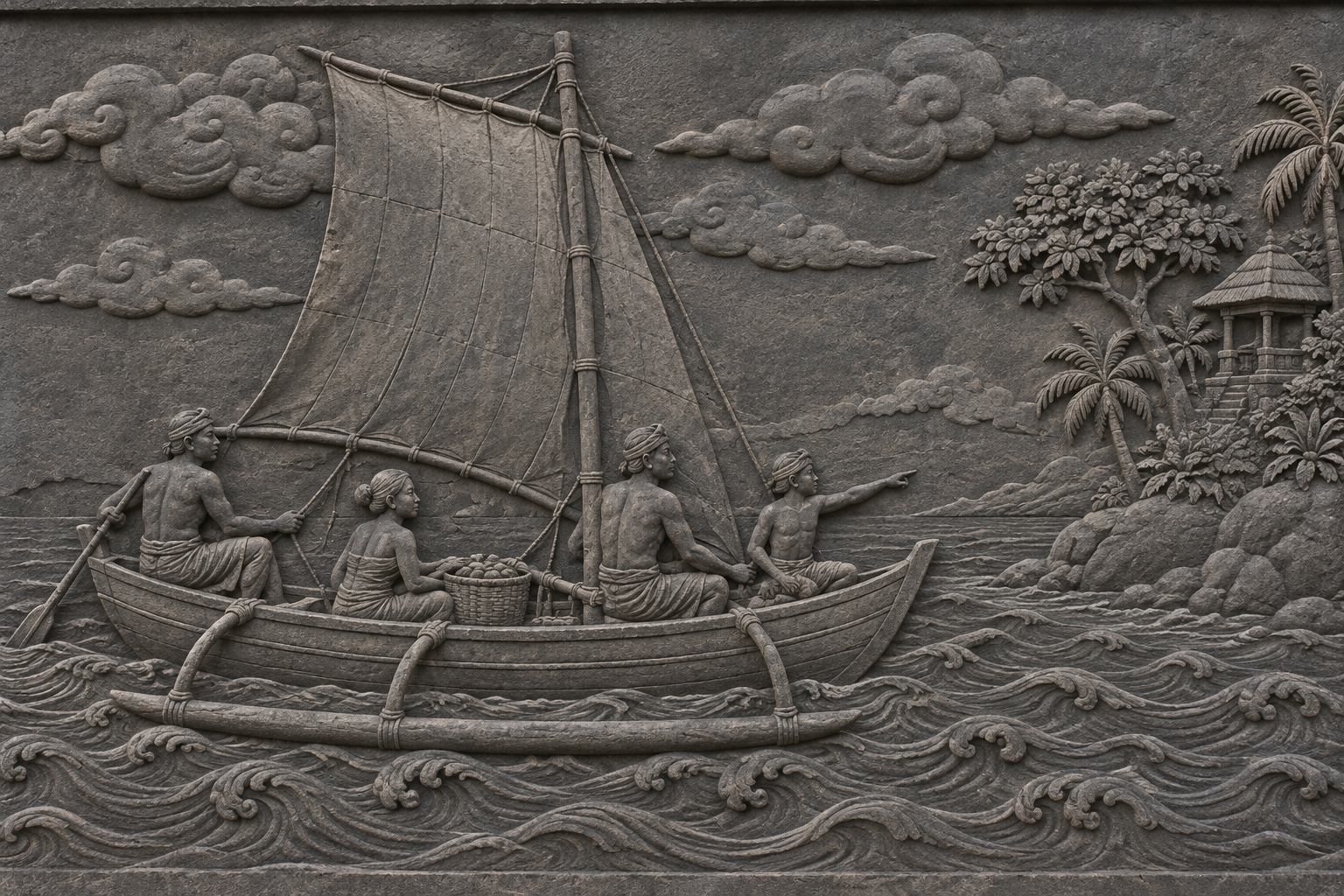
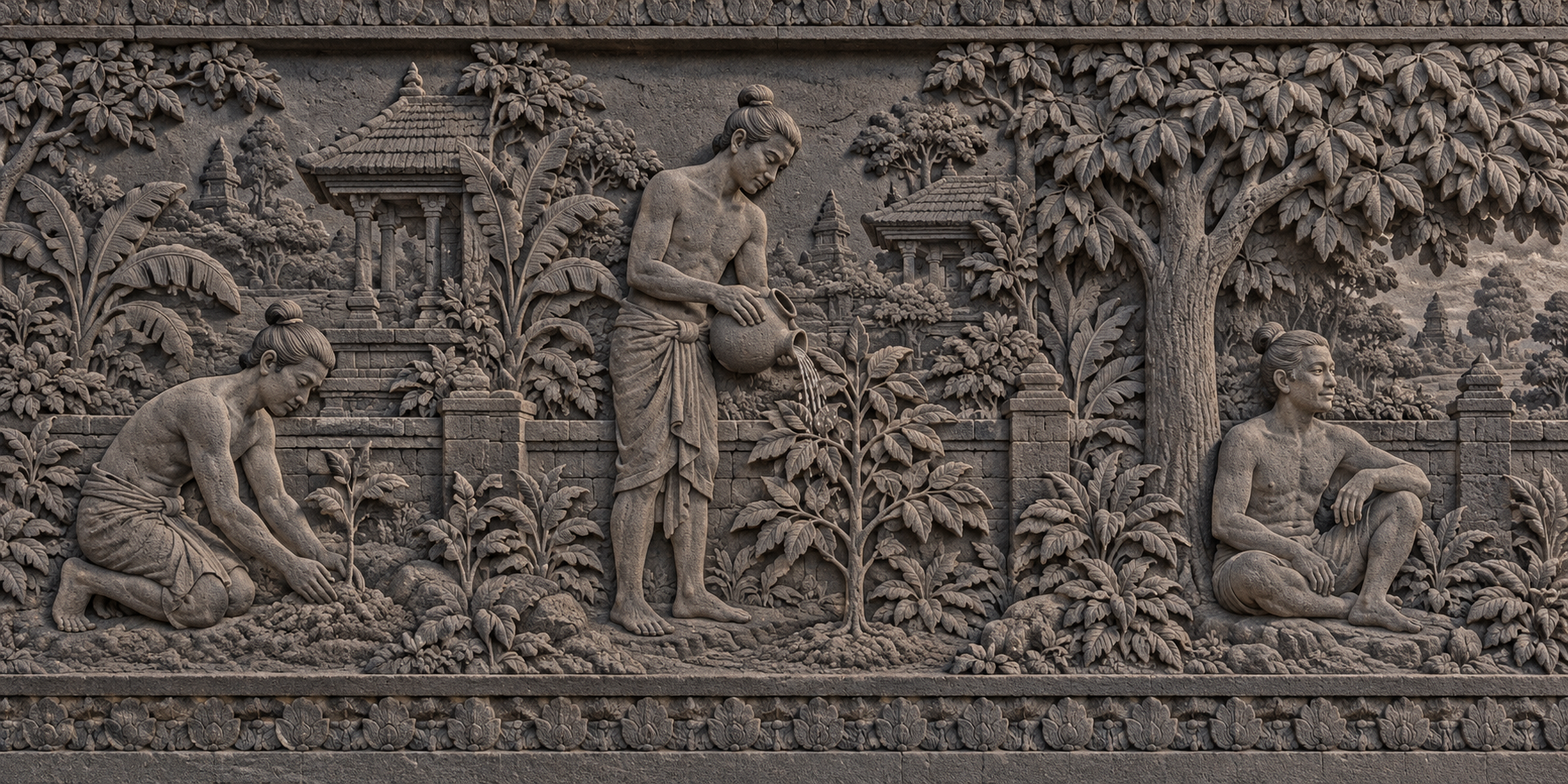
The AOI examples use a courtyard exchange, a boat journey and a sequence of planting and growth. The first concentrates on gesture, the second on the relationship between vessel, figures and surrounding bands, and the third on repetition across episodes. A wide introductory frieze and a titled collage complete the five-image set.
These exercises can inform storyboards, carved-panel concepts, architectural illustration and digital sculpture. Start by writing one sentence about the action. Sketch the main silhouettes, assign shallow depth levels, and inspect the result under a single side light. If the event cannot be read before ornament is added, simplify the arrangement.
The historical subject remains specific to Borobudur and its Buddhist setting. A contemporary maker can learn from its pacing, relief depth and organization of figures while being precise about the new work's own subject. The shared lesson is that a surface can carry a story through carefully related forms.
A small poetic detour
Original words from the AOI studio.
Poetry
A hand in stone
The hand extends a bowl beyond its shade;
another hand approaches through the grain.
A narrow ridge remembers how it made
a little light survive the passing rain.
The tree gives shelter to a second scene.
A roof begins where one encounter ends.
I walk the quiet intervals between
the figures, strangers slowly becoming friends.
No single glance can finish what is here.
The path asks time; the stone makes time appear.
The prompt workshop
Original creative exercises. These prompts create new illustrations, not documentary evidence.
Make one exchange readable
Create an original low-relief stone study of two figures sharing a bowl beneath a broad tree, inspired by the narrative organization of Borobudur. Use shallow connected forms, a clear exchange of hands, a quiet background and one consistent raking light. Invent the scene rather than reproducing or naming a historical panel.
The action should read before small surface details are added.
Let a journey travel across the stone
Design an original wide volcanic-stone relief of a small boat journey, with coherent figures, restrained wave bands and a shoreline that guides the eye. Keep forms attached to the stone ground and use overlapping silhouettes instead of deep photographic perspective.
Study movement and compressed depth; retain a clear focal group.
Repeat a figure across three episodes
Create an original narrative relief showing one gardener planting, tending and resting beside a young tree across three connected episodes. Use recurring clothing, architectural and botanical dividers, shallow carved depth and calm side light. No inscriptions or invented claims of historical authenticity.
Repetition connects the episodes; each change must be visually legible.
Your next inspiration
Discover another art style
Follow a visual thread to the next subject.
A smile from the studio
Jokes
A storyboard artist tried to summarize a long relief sequence in three slides. “Arrival, conversation, departure,” he said. The guide nodded and began explaining the first panel. Twenty minutes later, the artist added a slide. Then another. By the end of the gallery his presentation had become a very long horizontal strip. “Much clearer,” said the guide. “Now all you need is a wall and someone willing to walk.”
Sources and further exploration
UNESCO — Borobudur Temple Compounds: date, location, architectural and Buddhist context
Borobudur conservation material hosted by UNESCO — narrative cycles and their placement (PDF)
UNESCO World Heritage case study — monitoring water, relief panels and structural movement (PDF)