
Design · ornament, luxury, industry and measured rhythm
Art Deco brings a modern decorative imagination to furniture, interiors, graphics, fashion and objects. Geometry is important, but so are material contrasts, stylised natural forms and the promise of contemporary life. It is a varied design culture, not a rule requiring every surface to be black, gold and covered in sunbursts.
Creative toolbox · take this style further
Choose an input, adjust it, then open a tool. Search links pass your text to the destination. Copy & open copies it for you to paste into the generator; you start generation there.
ChatGPT
Copy your input and paste it into a ChatGPT conversation or image request.
Copy & open ChatGPT (new tab)Claude · Anthropic
Develop an image prompt or explore the style in a new Claude conversation.
Copy & open Claude · Anthropic (new tab)Midjourney
Paste your input into the Imagine bar on the Create page.
Copy & open Midjourney (new tab)Adobe Firefly
Copy your input, open Firefly, and paste it into the prompt field.
Copy & open Adobe Firefly (new tab)Leonardo.Ai
Copy your input, open Leonardo, and paste it into the generation field.
Copy & open Leonardo.Ai (new tab)Lexica
Search AI images and prompts using your selected input.
Search with this input Lexica (new tab)Pexels
Search the photo and video library. Short keywords often work best.
Search with this input Pexels (new tab)Pixabay
Search photos, illustrations and other images.
Search with this input Pixabay (new tab)Unsplash
Search photographs using the style name or your own keywords.
Search with this input Unsplash (new tab)Wikipedia
Search for background reading. A style may not have its own article.
Search with this input Wikipedia (new tab)WikiArt
Copy your input into WikiArt’s search to explore artists and artworks.
Copy & open WikiArt (new tab)Instagram hashtags
Search a hashtag made from your input: spaces and punctuation are removed. Instagram may require sign-in.
Search with this input Instagram hashtags (new tab)A closer look
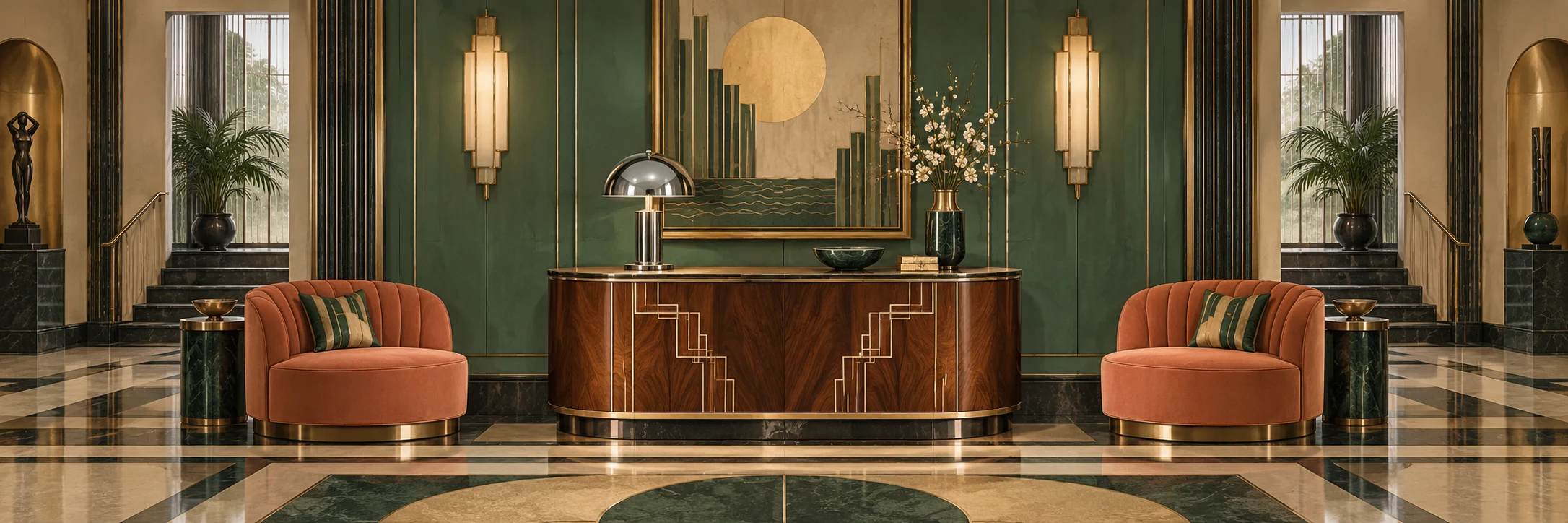
Our AI-generated banner imagines a lobby with a veneered console, chrome lamp, coloured upholstery and geometric wall divisions. The objects are original concepts rather than replicas of named designers’ work. Their purpose is to show how line, proportion and material can cooperate.
A useful historical starting point
The 1925 Paris Exposition Internationale des Arts Décoratifs et Industriels Modernes was a pivotal event for the design now called Art Deco. The V&A notes that the label itself came later, and identifies figures including Émile-Jacques Ruhlmann and René Lalique among the exhibition’s designers. [1]
The same account shows that Art Nouveau supplied some of Art Deco’s sources. The transition is therefore more complicated than curves suddenly being replaced by straight lines. Floral forms could be simplified, geometry could become ornamental, and traditional craftsmanship could contribute to an emphatically modern object. [1]
This guide treats Art Deco chiefly as a design context. A painting’s influence on designers does not automatically make its painter an Art Deco practitioner. Cubist or Surrealist masterpieces should not be inserted into a list of representative Deco objects simply because they belong to the twentieth century.
Read the object from silhouette to surface
First look at the outline: stepped, curved, tapered, symmetrical or deliberately offset. Then examine how smaller divisions reinforce it. A cabinet may use veneer patterns to clarify its main volumes; a lamp may set a polished stem against a broad shade. Decoration can help organise the object rather than merely cover it.
Material contrast supplies another rhythm. Warm wood beside cool metal, opaque colour beside translucent glass, or a soft textile beside a crisp frame can make simple forms feel precise and rich. The quality of the relationship matters more than the number of expensive-looking finishes.
In the banner, the console and lamp form a central pair. The surrounding colour fields should support their proportions instead of competing with them. At phone size, the silhouette must still work after small decorative details have become almost invisible.
More than a luxury-party mood board
An Art Deco study can use colour without becoming a carnival of unrelated motifs. Choose a dominant material, a supporting colour family and one or two accents. If you include a fan, zigzag or radiating form, give it a compositional job. Repeating every familiar motif usually weakens the design.
Historical designers drew on many cultures and periods, sometimes through unequal systems of collecting and appropriation. When discussing an actual object, identify those sources rather than treating a borrowed motif as anonymous exotic decoration. A contemporary exercise can also invent its own pattern vocabulary.
Do not collapse Art Deco, Art Nouveau, Bauhaus design and later streamlined imagery into one vintage category. Compare the specific object’s date, purpose, materials and construction. Shared geometry is a beginning for comparison, not proof that the designs mean the same thing.
Design a small ensemble that belongs together
Try a console, lamp and textile panel for an imagined entrance hall. Begin with black-and-white silhouettes. Establish a repeated proportion or curve, then introduce the materials. If the ensemble only becomes coherent after you add gold everywhere, return to the shapes.
For generated imagery, specify a small number of objects and inspect their construction. Drawers should open plausibly, lamp parts should connect and veneer should follow an intelligible surface. An attractive rendering can conceal impossible furniture behind reflections and decorative seams.
Finish by removing one embellishment. Does the main rhythm become stronger? The best contemporary study does more than announce a decade. It shows that an object can feel composed, useful and pleasurable before anyone reads its style label.
A small poetic detour
Original words from the AOI studio.
Poetry
The curve meets the polished line;
wood keeps its warmth beside the chrome.
The prompt workshop
Original creative exercises. These prompts create new illustrations, not documentary evidence.
Compose three objects
Original Art Deco-inspired console, lamp and textile panel for an invented entrance hall, measured geometry, walnut veneer, chrome and jade green, restrained ornament, no text.
Original AOI exercise; a generated image is not historical or documentary evidence.
Let materials organise the room
An imagined Deco lobby vignette with a curved veneered console, stepped marquetry, chrome lamp and coral upholstery, balanced proportions and pale gold details, no famous designer replicas or logos.
Original AOI exercise; a generated image is not historical or documentary evidence.
Reduce the decoration
Create two versions of one Deco-inspired furniture ensemble, first with a restrained geometric motif and then with the motif removed. Keep silhouette and material contrast constant and compare coherence.
Original AOI exercise; a generated image is not historical or documentary evidence.
People & works to explore
References discussed in this article. Consult the sources below for context.
Artists and practitioners
Émile-Jacques Ruhlmann
René Lalique
Paintings and other works
Ruhlmann, dressing table, 1919–23 — V&A
Lalique, Ceylan vase, 1924 — V&A
Sources and further exploration
Creative studies to try
Explore these collected prompts as creative interpretations. They are starting points for image-making, not reproductions of historical artworks or evidence about a tradition.
Visual cues: symmetry, polished surfaces, theatrical elegance; Geometry with glamour
Study 1 — Art Deco
Ultra-wide panoramic banner, a human hand and a sleek robotic hand reaching toward each other, fingertips almost touching, a bright luminous spark of intelligence between them, a subtle world map behind them with global data network lines, symbolizing human-AI collaboration and digital transformation, rendered in Art Deco style, with strong composition, refined geometry, crisp silhouettes, premium graphic design, high quality, high detail, balanced composition, no text, no logo, no watermark, exact aspect ratio 1584:396
Prompt source: 1001 Art Styles. Select the text to copy, then adapt the subject and composition.
Study 2 — Art Deco
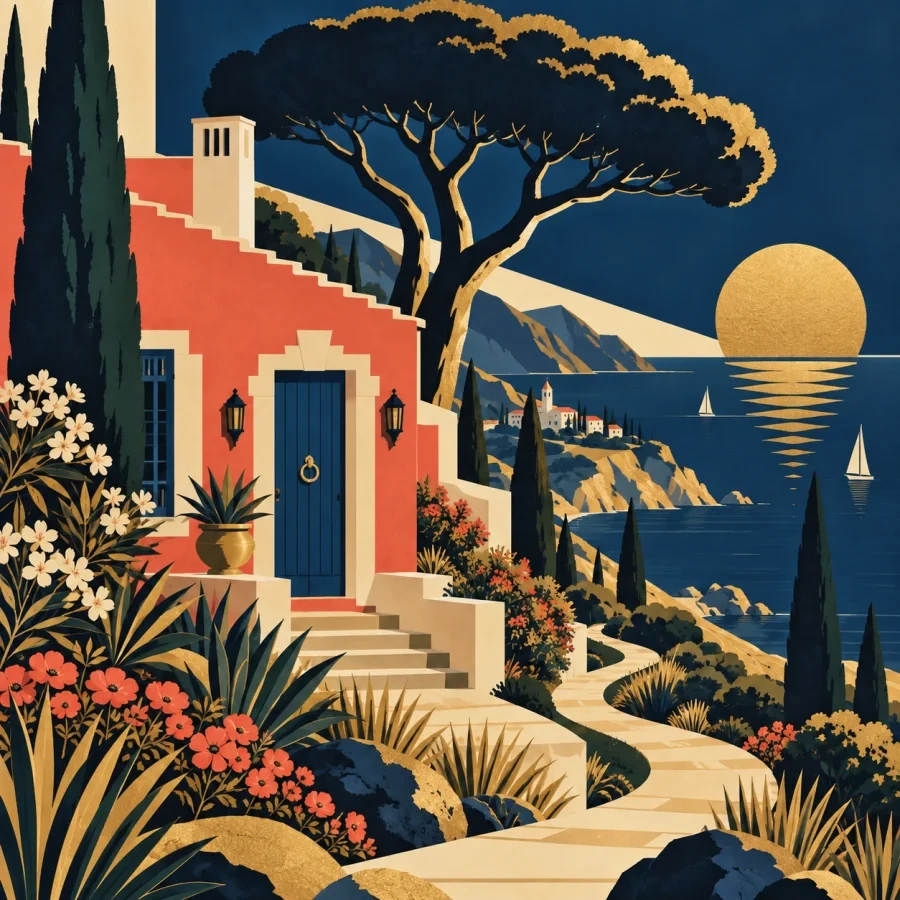
Apply the following visual style to my subject or project, preserving its core content and purpose. Use an Art Deco poster aesthetic with streamlined geometric forms, stepped shapes, symmetrical rhythms, and dramatic clean silhouettes. Work with deep navy, cream, and warm metallic gold. Use restrained ornament and crisp flat shading for an elegant architectural composition. Adapt the composition and palette to suit my subject. Do not add text unless my project calls for it.
Prompt source: Emergent Mind Style Atlas. Select the text to copy, then adapt the subject and composition.