
Drawing practice and visual storytelling
Anime Manga Drawing is a practical guide to character, line, tone and sequential images. It brings related drawing choices into view while keeping manga pages, animation and standalone illustrations distinct.
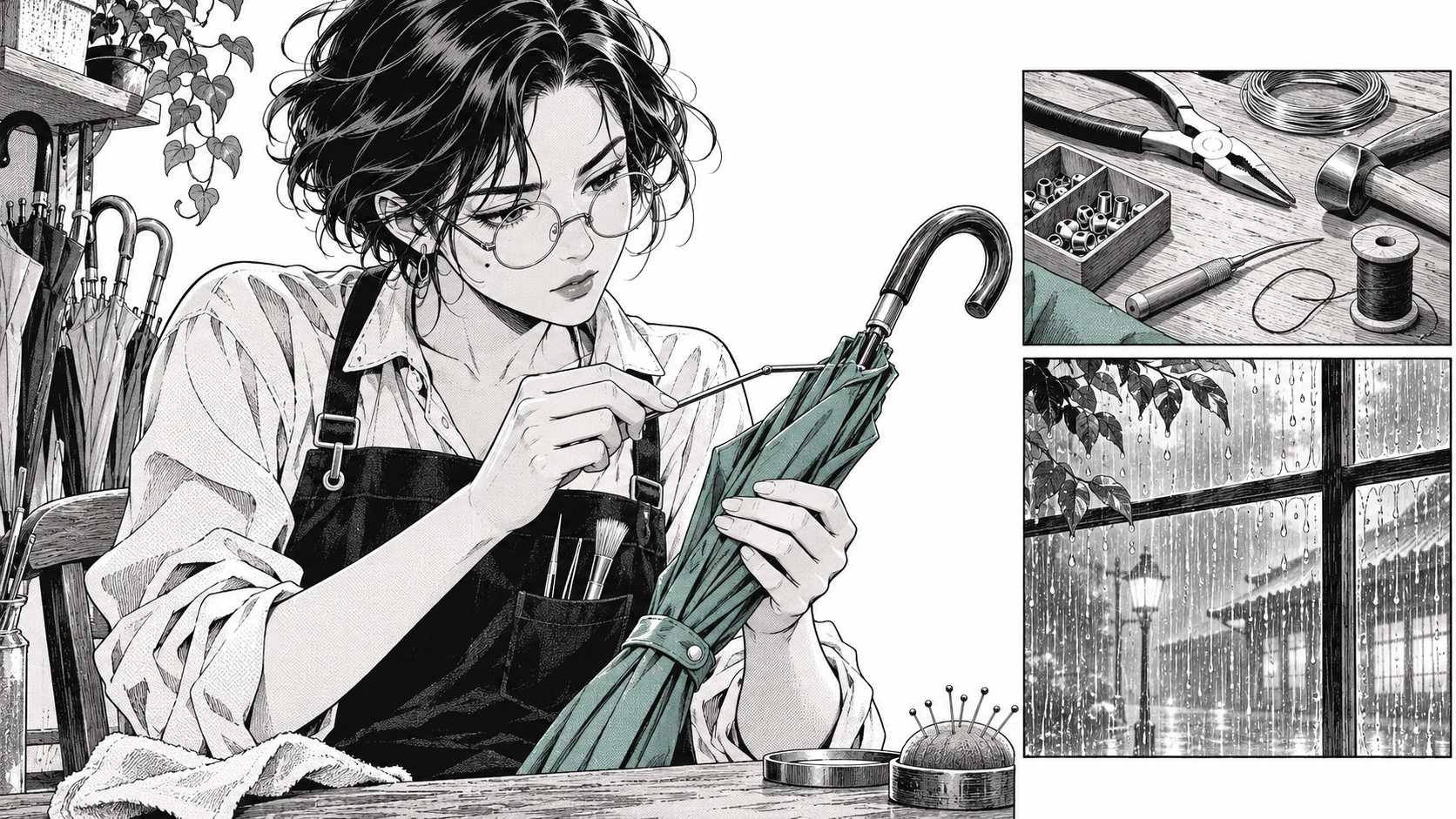
A visual introduction
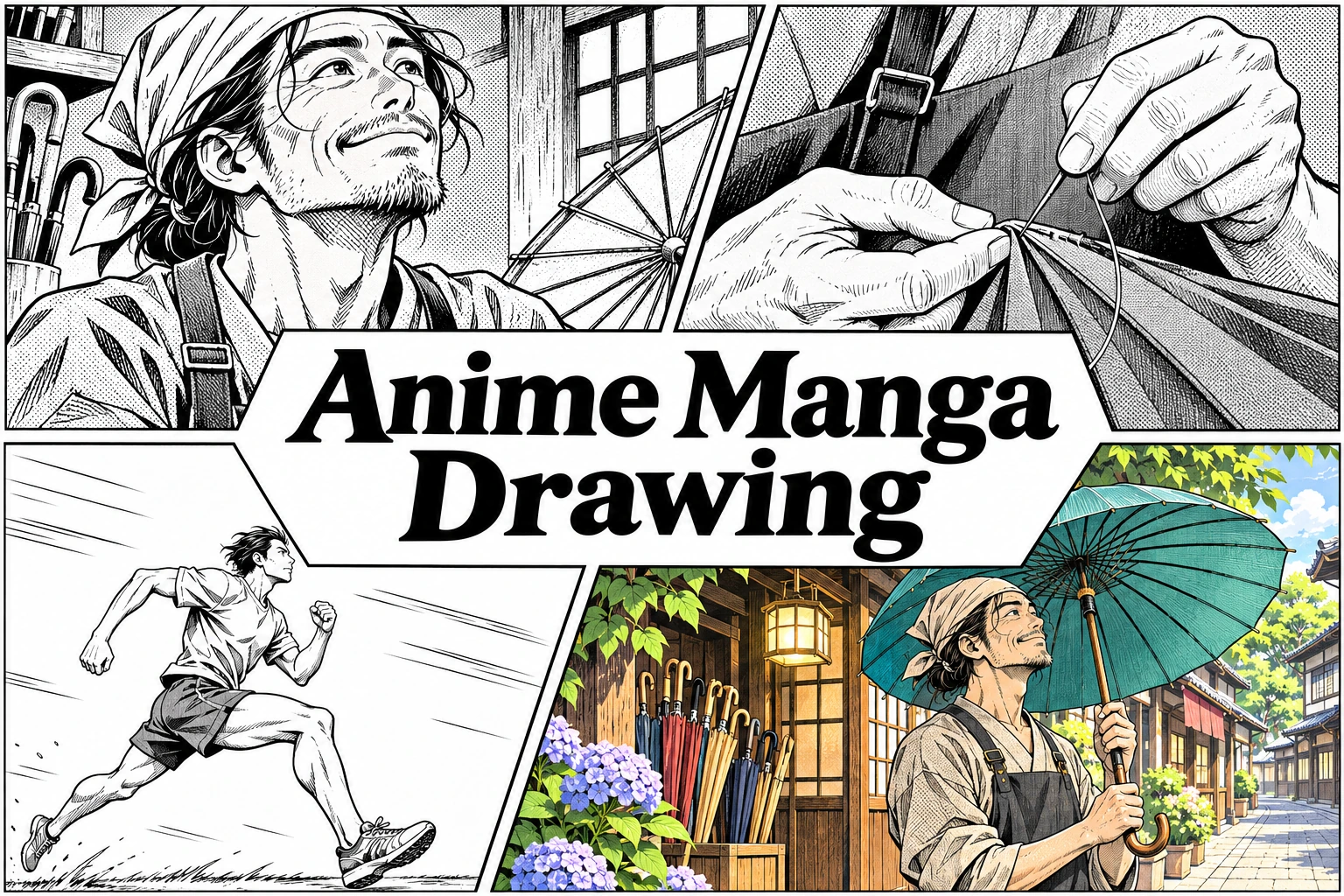
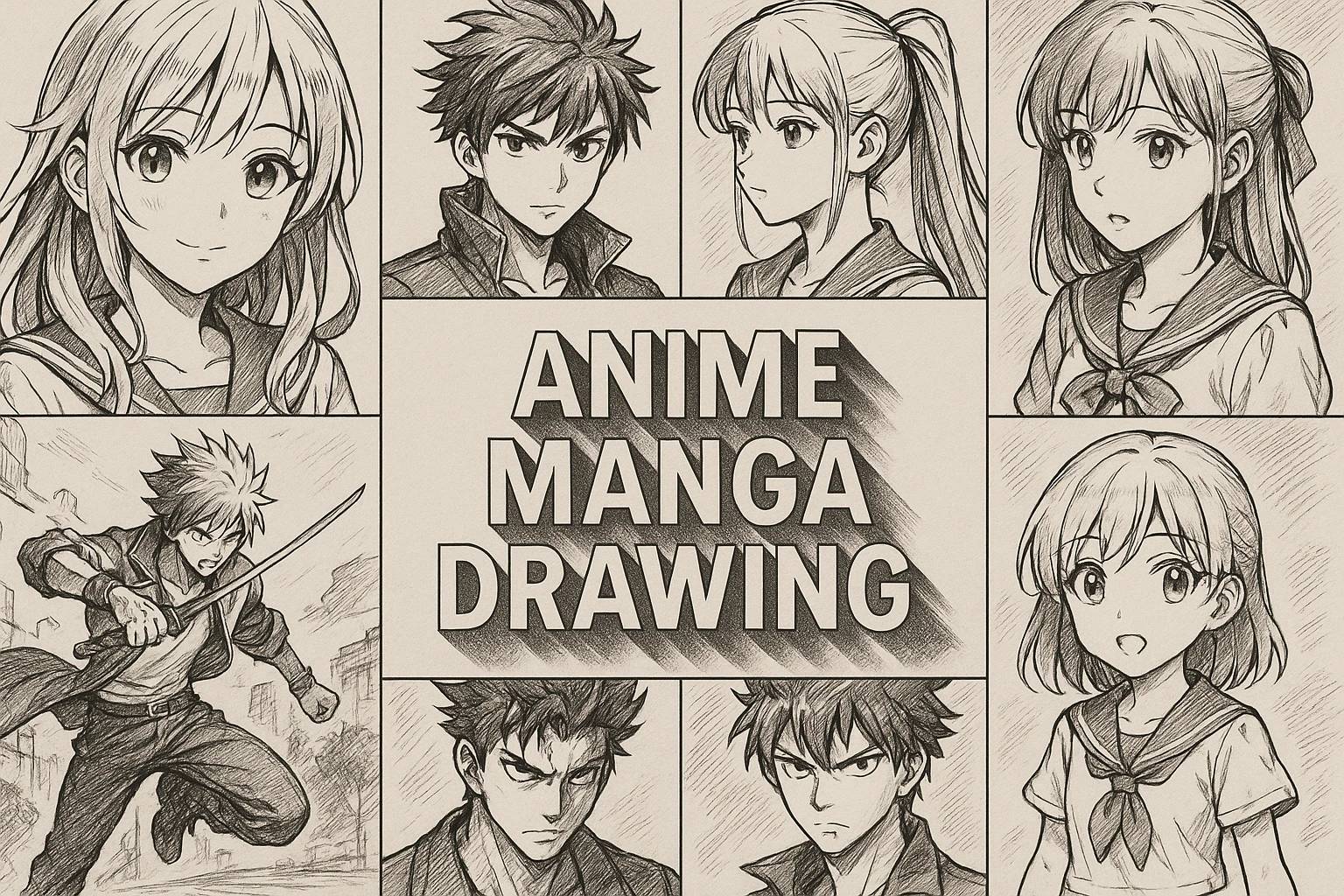
Five new AI-generated studies explore contour, expression, panel sequence and color. The repairers, messenger and settings are original inventions, not characters or pages from published manga. The earlier AOI collage is retained separately as archive artwork.
Select an image for a closer look. Use the thumbnails, arrow keys or a swipe to compare examples. Zoom in to inspect details, or share the image that inspires you.
Creative toolbox · take this style further
Choose an input and a destination. Search sends your words to the chosen site; Copy & open puts them on your clipboard to paste there.
Create with AI
Turn your chosen input into an image prompt or a new creative direction.
ChatGPT
Copy your input and paste it into a ChatGPT conversation or image request.
Copy & open ChatGPT (new tab)Claude · Anthropic
Develop an image prompt or explore the style in a new Claude conversation.
Copy & open Claude · Anthropic (new tab)Midjourney
Paste your input into the Imagine bar on the Create page.
Copy & open Midjourney (new tab)Adobe Firefly
Copy your input, open Firefly, and paste it into the prompt field.
Copy & open Adobe Firefly (new tab)Leonardo.Ai
Copy your input, open Leonardo, and paste it into the generation field.
Copy & open Leonardo.Ai (new tab)Image search
Find visual references. Short, concrete keywords usually work best.
Lexica
Search AI images and prompts using your selected input.
Search with this input Lexica (new tab)Pexels
Search the photo and video library. Short keywords often work best.
Search with this input Pexels (new tab)Pixabay
Search photos, illustrations and other images.
Search with this input Pixabay (new tab)Unsplash
Search photographs using the style name or your own keywords.
Search with this input Unsplash (new tab)Wikimedia Commons
Search photographs, artworks and historical images. Check each file for its source and reuse terms.
Search with this input Wikimedia Commons (new tab)Art & research
Explore artists, collections and the ideas behind a style.
Wikipedia
Search for background reading. A style may not have its own article.
Search with this input Wikipedia (new tab)WikiArt
Copy your input into WikiArt’s search to explore artists and artworks.
Copy & open WikiArt (new tab)Europeana
Paste your keywords into the search to explore European museum, library and archive collections.
Copy & open Europeana (new tab)Inspiration
Discover portfolios and visual ideas from creative communities.
Instagram hashtags
Search a hashtag made from your input: spaces and punctuation are removed. Instagram may require sign-in.
Search with this input Instagram hashtags (new tab)ArtStation
Paste your input into artwork search for concept art, environments, characters and visual development.
Copy & open ArtStation (new tab)Behance
Paste your input into project search for illustration, design and visual storytelling.
Copy & open Behance (new tab)A closer look
Readable silhouettes, selective line weight, organized black and white masses, expressive gestures and deliberate framing help an image communicate before surface detail is added.
A drawing guide, not a single historical style
Anime and manga do not name one face shape, palette or audience. Here, Anime Manga Drawing is a practical label for studying related drawing and storytelling choices. Manga organizes a reader’s encounter with images on a page; animation adds controlled duration, movement, editing and sound. A standalone illustration can draw on either field without becoming a comic sequence or an animated scene.
Curator Nicole Coolidge Rousmaniere’s account of the British Museum’s manga exhibition emphasizes expressive line, panel composition, symbols and character development. It also points to the role of editors in shaping and producing manga. That broader view is more useful than a formula built from large eyes and brightly colored hair. Start by asking what the drawing needs to communicate, and to whom.
Construct a character that can act
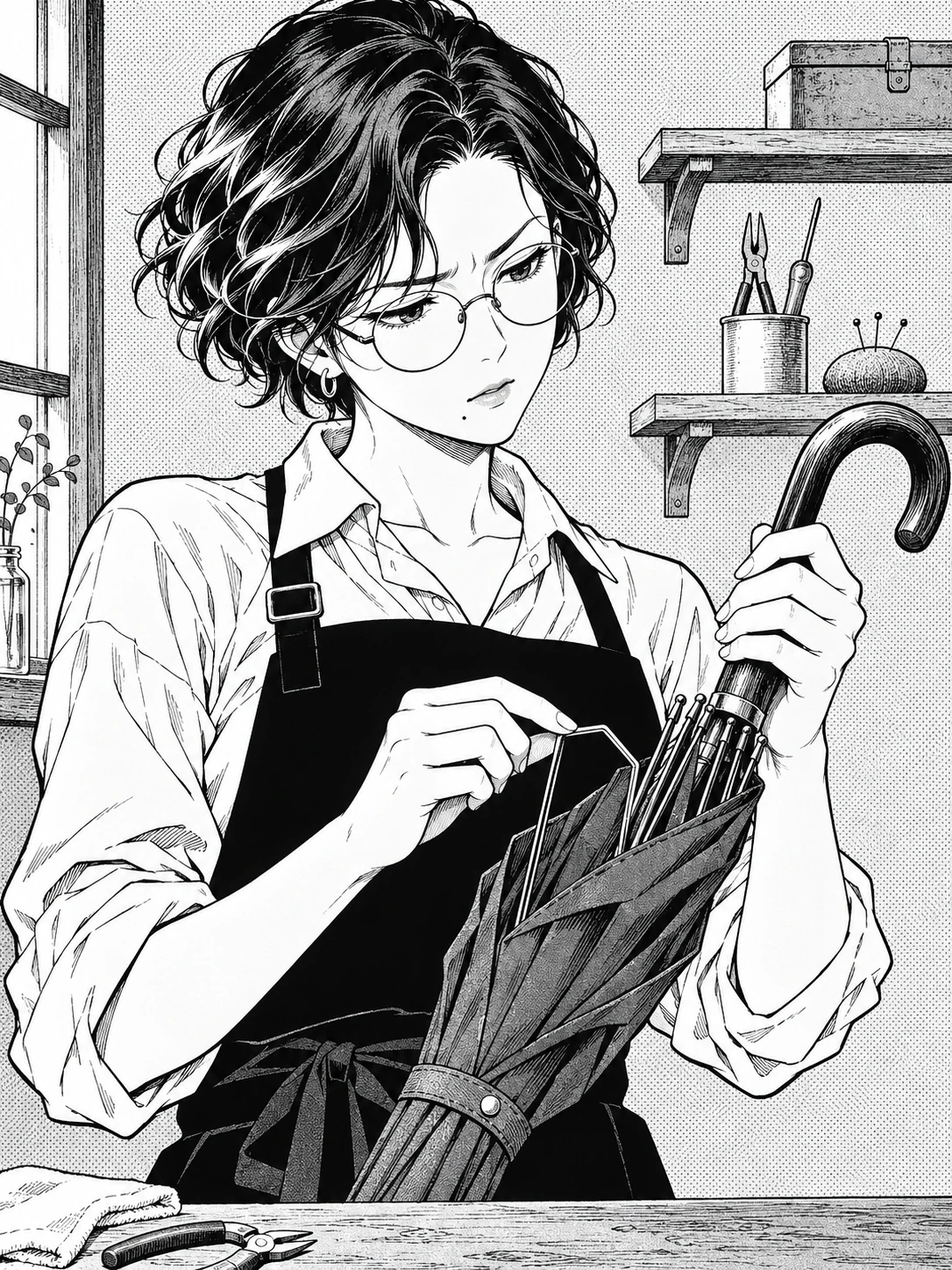
Begin with a simple proportion system and a readable silhouette. Decide how the head, rib cage and pelvis relate before adding clothing or facial detail. A character should remain recognizable when turned, reduced in size or partly hidden. In the repairer study, the glasses and hair help identify her, but her concentrated gaze and hand placement explain the action.
Expression is a relationship between features and posture. A slight brow change can be enough when the eyes, shoulders and hands point toward the same problem. Test the gesture without dialogue first. Then decide whether words add information rather than repeating what is already visible. A dramatic face cannot rescue a hand that appears disconnected from its tool.
Give lines and tones different jobs
Use the outer contour to separate major forms, lighter interior marks to describe folds or features, and solid black shapes to establish weight. This is an exercise in hierarchy, not a requirement that every manga drawing use the same pen treatment. In our monochrome portrait, the dark apron gives the pale hands and face room to stand out; the workshop remains secondary.
Screentone can organize gray values without turning every surface into a shaded gradient. The CLIP STUDIO PAINT manual distinguishes pattern type, dot frequency, density and angle. These settings control different aspects of a tone: frequency concerns lines per inch, while density affects the amount of tone. Test at the intended display or print size, since a beautiful close-up texture may become distracting when reduced.
Our generated dots are an illustration of tonal appearance, not a calibrated print-ready screentone file. For production work, use controllable tone layers and inspect the actual export. Keep important edges and expressions readable without relying on very fine pattern detail.
Make the page readable before making it elaborate
The SOAS reading guide describes the conventional Japanese manga path from upper right toward lower left and explains the role of framed units, or koma. It also discusses emotion symbols and speech balloons. Reading order belongs in the first small layout sketch: panel placement, gaze and balloon order should cooperate rather than send the reader in competing directions.
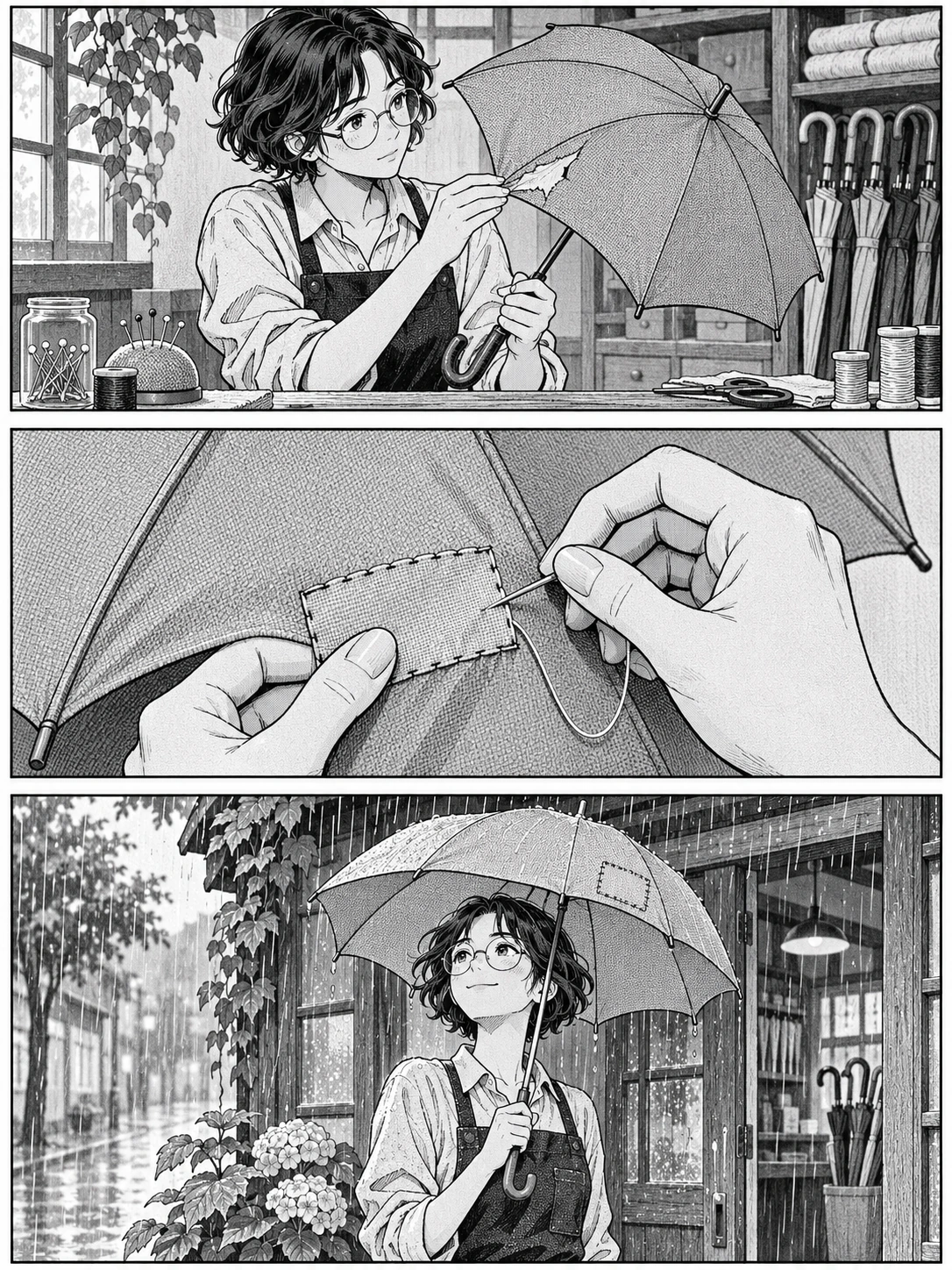
The new wordless page uses three full-width panels stacked vertically, so its intended route is simply top to bottom. First the repairer examines damage; next a close view isolates the stitching; finally the patched umbrella returns to use in the rain. The gutter lets the reader infer work and elapsed time that are not shown. This modest sequence demonstrates a complete change without requiring a dramatic event.
Keep continuity visible. The repairer’s glasses, clothing and umbrella identify the connection between views, and the patch links the close-up to the final scene. The page is a generated study, not a substitute for checking every prop and pose in a finished comic. Compare adjacent panels at thumbnail size as well as enlarged.
Color and action without visual clutter
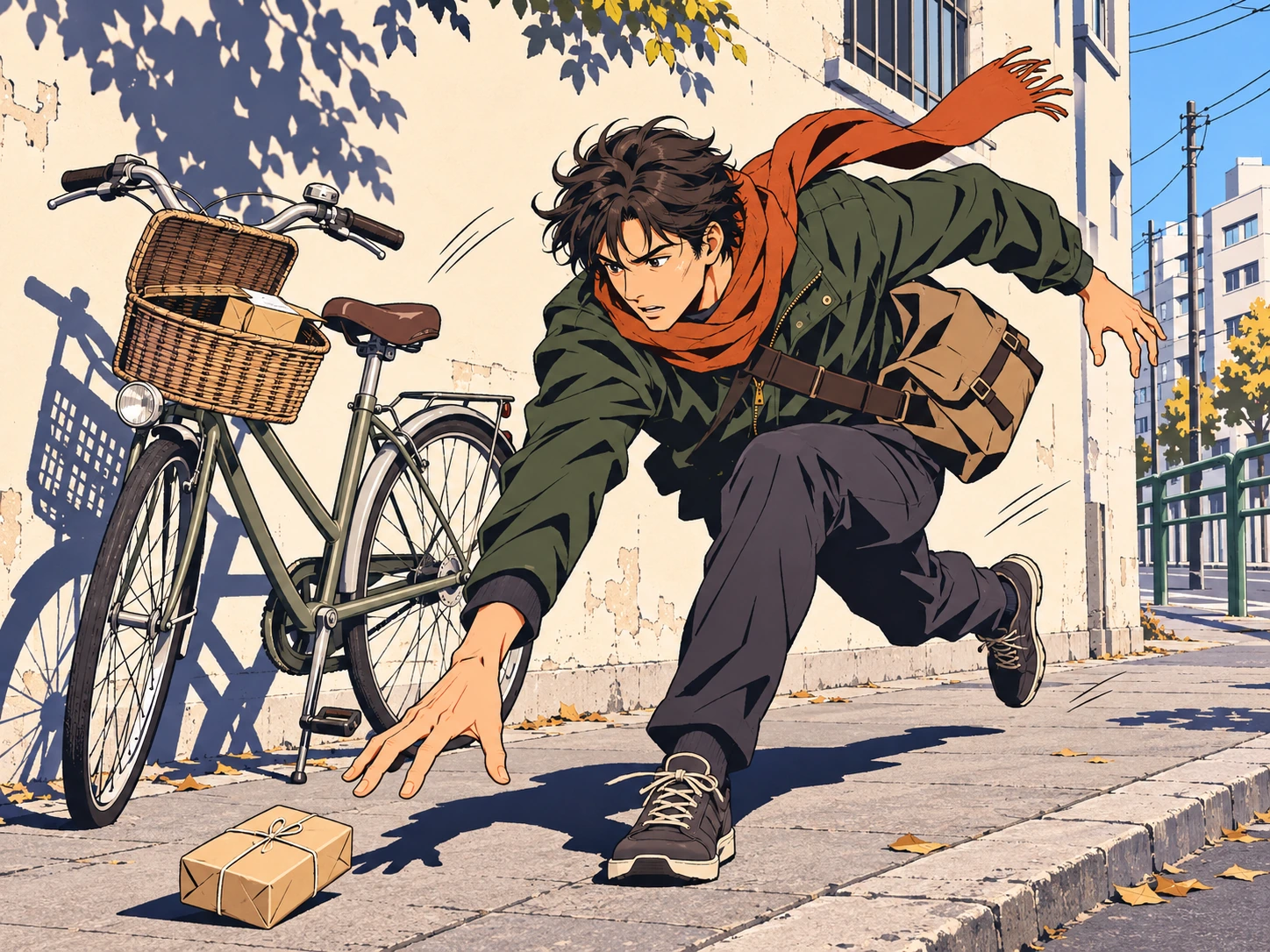
The messenger illustration changes both palette and pace. A reaching arm, bent knee and trailing scarf direct attention toward the fallen parcel. Dark green clothing and a warm orange accent sit against a quieter cream wall. The background bicycle establishes context, while a small number of directional marks reinforce an already readable pose.
Try converting such a composition to black and white. If the hand, parcel and face disappear into equal values, reorganize the masses before adding more effects. Color can support the drawing, but it should not be asked to repair unclear anatomy or a confused focal point.
Use the studies as exercises
For character sheets, comic pitches or original illustrations, choose a narrow question: can one gesture show concentration, can three panels explain a repair, or can a single pose make an action legible? Keep the exercise small enough to compare alternatives. When adding dialogue, reserve its space early and check its reading order against the images.
The linked Anime overview covers the wider animated medium; this companion concentrates on drawing and the page. The new art is invented and the sources document actual practices. Neither an attractive image nor a familiar visual convention establishes a historical origin, a creator’s influence or membership in one universal style.
A small poetic detour
Original words from the AOI studio.
Poetry
The line grows quiet where the fingers meet;
a black sleeve leaves the paper face alight.
One panel holds the weather in the street,
the next a needle drawing damage tight.
Between the frames, the reader lends the time;
no clock is drawn, yet something has been done.
The final page releases us to rain—
a little shelter carried into sun.
The prompt workshop
Original creative exercises. These prompts create new illustrations, not documentary evidence.
Draw concentration
Create an original adult umbrella repairer examining one bent rib. Make gaze and coherent hands explain the task. Use a strong black apron, lighter facial lines and a quiet screentone background. Test the silhouette before adding tools. No dialogue, copied character or implied published source.
Tell a complete change in three panels
Plan three full-width panels read top to bottom: inspect a torn umbrella, stitch a patch in close-up, then use the repaired umbrella in rain. Keep character, clothing and umbrella consistent; show the patch in the final image. Use even gutters, varied camera distance and no words. Review continuity rather than accepting any three attractive scenes.
Let the pose lead
Draw an original adult messenger reaching for a dropped parcel beside a parked bicycle. Establish one planted foot, a coherent reaching hand and a clear diagonal through the body. Use dark green clothing, one orange accent and a quiet cream background. Add directional lines only after the action reads without them.
A smile from the studio
Jokes
The umbrella asked for a dramatic backstory. The artist gave it three panels and a small repair bill.