
AOI creative interpretation · Visual study
Anima-Synthetic Fusion is an AOI creative interpretation of a meeting between an expressive living presence and a designed artificial surface. The strongest images make the two materials interact rather than placing a mechanical costume around an otherwise unrelated portrait.
An A⊕I –[-.+] creαt¡ve c⊕ncept, n⊕t αn estαbl¡she∂ h¡st⊕r¡cαl m⊕vement.
A visual introduction
Select an image for a closer look. Use the thumbnails, arrow keys or a swipe to compare examples. Zoom in to inspect details, or share the image that inspires you.
Creative toolbox · take this style further
Choose an input and a destination. Search sends your words to the chosen site; Copy & open puts them on your clipboard to paste there.
Create with AI
Turn your chosen input into an image prompt or a new creative direction.
ChatGPT
Copy your input and paste it into a ChatGPT conversation or image request.
Copy & open ChatGPT (new tab)Claude · Anthropic
Develop an image prompt or explore the style in a new Claude conversation.
Copy & open Claude · Anthropic (new tab)Midjourney
Paste your input into the Imagine bar on the Create page.
Copy & open Midjourney (new tab)Adobe Firefly
Copy your input, open Firefly, and paste it into the prompt field.
Copy & open Adobe Firefly (new tab)Leonardo.Ai
Copy your input, open Leonardo, and paste it into the generation field.
Copy & open Leonardo.Ai (new tab)Image search
Find visual references. Short, concrete keywords usually work best.
Lexica
Search AI images and prompts using your selected input.
Search with this input Lexica (new tab)Pexels
Search the photo and video library. Short keywords often work best.
Search with this input Pexels (new tab)Pixabay
Search photos, illustrations and other images.
Search with this input Pixabay (new tab)Unsplash
Search photographs using the style name or your own keywords.
Search with this input Unsplash (new tab)Wikimedia Commons
Search photographs, artworks and historical images. Check each file for its source and reuse terms.
Search with this input Wikimedia Commons (new tab)Art & research
Explore artists, collections and the ideas behind a style.
Wikipedia
Search for background reading. A style may not have its own article.
Search with this input Wikipedia (new tab)WikiArt
Copy your input into WikiArt’s search to explore artists and artworks.
Copy & open WikiArt (new tab)Europeana
Paste your keywords into the search to explore European museum, library and archive collections.
Copy & open Europeana (new tab)Inspiration
Discover portfolios and visual ideas from creative communities.
Instagram hashtags
Search a hashtag made from your input: spaces and punctuation are removed. Instagram may require sign-in.
Search with this input Instagram hashtags (new tab)ArtStation
Paste your input into artwork search for concept art, environments, characters and visual development.
Copy & open ArtStation (new tab)Behance
Paste your input into project search for illustration, design and visual storytelling.
Copy & open Behance (new tab)A closer look
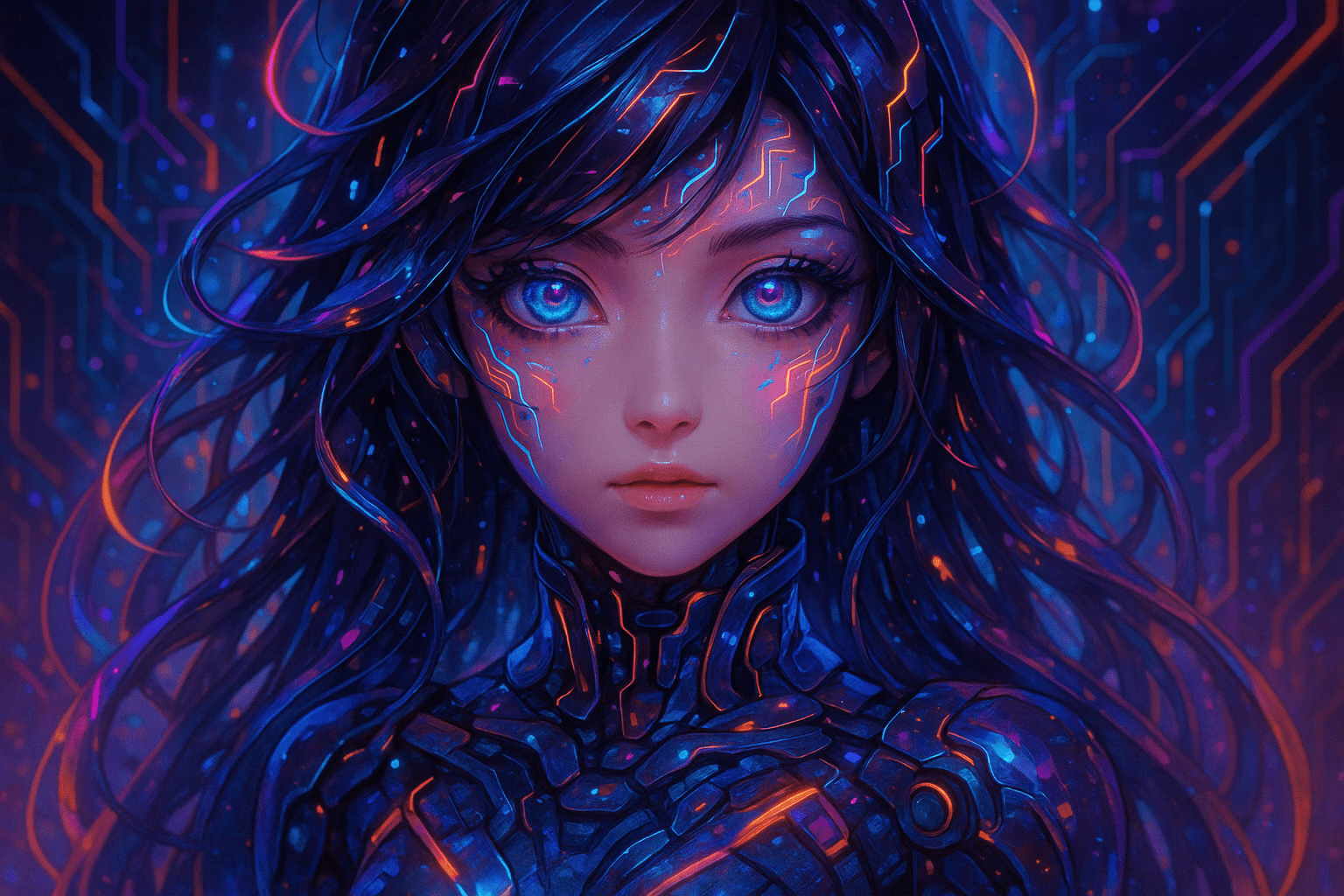
The archive image is a stylized fictional portrait with blue eyes, dark flowing hair, violet illumination and fine circuit-like structures around the head and clothing.
Build the visual structure
Begin with an expression or gesture that remains readable without the technological decoration. Decide where skin, hair or fabric becomes an engineered material and make that transition specific: fibers might tighten into cables, or a garment seam might become a luminous trace. Keep the lighting continuous across both surfaces so they occupy the same scene.
Use contrast in texture rather than brightness alone. A matte cheek can sit beside a precise translucent panel; a loose strand of hair can interrupt a rigid pattern. The name is imaginative language, not evidence that a machine has a soul or emotions. Describe the visible design choices instead of inventing a technological explanation.
A focused studio exercise
Keep a fictional sitter and viewpoint fixed. Make three studies in which the artificial material occupies the collar, hair or background; compare which location best supports the expression.
Compare the studies at the same size and save the chosen prompt or process settings with each result. Keep the subject and viewing angle fixed during this test so the effect of the changed variable stays visible.
Make the meeting visible at the boundary
Choose one expressive living form and one designed material system. Decide how they meet: a soft surface presses against a rigid edge, a translucent layer reveals a structure beneath, or a mechanical rhythm becomes irregular near a gesture. The boundary should carry the idea. Simply adding metallic panels to a face leaves the relationship largely unexplored.
Keep the subject’s action readable. A hand resting on a surface, a head turning or a plant leaning toward light can provide an intelligible movement against which the artificial system responds. Distortion should deepen that interaction rather than obscure the pose.
Three variations of one proposition
Make a portrait in which flexible skin and a rigid frame share a contour; an interior where a manufactured wall responds to a growing branch; and an abstract study that moves gradually from irregular membrane-like shapes to repeated cells. These are different applications of the proposed visual grammar, not evidence of a historical school.
Use a restrained palette to separate the materials. One may receive diffuse light while the other carries sharper reflections. Avoid giving every surface the same luminous coating, which makes their meeting less distinct.
A practical test for coherence
Remove the most conspicuous futuristic accessory. If the image no longer communicates a relationship between living presence and designed structure, strengthen the transition itself. The AOI proposal is useful when it gives an image a repeatable design problem, rather than merely a new name for a decorated figure. Treat its title and vocabulary as a creative framework, with no claim of scientific mechanism or exclusive historical priority.
A small poetic detour
Original words from the AOI studio.
Poetry
Digital blossoms—
Pixels weave organic dreams—
Soul and code entwined.
The prompt workshop
Original creative exercises. These prompts create new illustrations, not documentary evidence.
Starting study
Create an original Anima-Synthetic Fusion interpretation: a fictional adult portrait with a woven collar transitioning into fine circuitry. Blend tactile organic material with precise engineered surfaces under one consistent light source. No lettering or logos.
Composition variation
Create an original Anima-Synthetic Fusion interpretation: a botanical hand-shaped sculpture combining soft fibers and translucent panels. Blend tactile organic material with precise engineered surfaces under one consistent light source. No lettering or logos.
Experimental variation
Create an original Anima-Synthetic Fusion interpretation: a quiet seated figure whose fabric folds become subtle engineered ribs. Blend tactile organic material with precise engineered surfaces under one consistent light source. No lettering or logos.
Your next inspiration
Discover another art style
Follow a visual thread to the next subject.
A smile from the studio
Jokes
Why did the AI refuse to paint? It couldn't decide whether it was feeling 'blue' or just facing a 'byte' problem!