
Algorithmic art · AOI geometric study
Algorithmic Cubism is used here as a practical brief for rule-based geometric composition. Divide, rotate and reconnect a subject while keeping enough structural clues for the viewer to reconstruct it. The interest lies in the relationship between the rule and the recognizable object.
A visual introduction
Select an image for a closer look. Use the thumbnails, arrow keys or a swipe to compare examples. Zoom in to inspect details, or share the image that inspires you.
Creative toolbox · take this style further
Choose an input and a destination. Search sends your words to the chosen site; Copy & open puts them on your clipboard to paste there.
Create with AI
Turn your chosen input into an image prompt or a new creative direction.
ChatGPT
Copy your input and paste it into a ChatGPT conversation or image request.
Copy & open ChatGPT (new tab)Claude · Anthropic
Develop an image prompt or explore the style in a new Claude conversation.
Copy & open Claude · Anthropic (new tab)Midjourney
Paste your input into the Imagine bar on the Create page.
Copy & open Midjourney (new tab)Adobe Firefly
Copy your input, open Firefly, and paste it into the prompt field.
Copy & open Adobe Firefly (new tab)Leonardo.Ai
Copy your input, open Leonardo, and paste it into the generation field.
Copy & open Leonardo.Ai (new tab)Image search
Find visual references. Short, concrete keywords usually work best.
Lexica
Search AI images and prompts using your selected input.
Search with this input Lexica (new tab)Pexels
Search the photo and video library. Short keywords often work best.
Search with this input Pexels (new tab)Pixabay
Search photos, illustrations and other images.
Search with this input Pixabay (new tab)Unsplash
Search photographs using the style name or your own keywords.
Search with this input Unsplash (new tab)Wikimedia Commons
Search photographs, artworks and historical images. Check each file for its source and reuse terms.
Search with this input Wikimedia Commons (new tab)Art & research
Explore artists, collections and the ideas behind a style.
Wikipedia
Search for background reading. A style may not have its own article.
Search with this input Wikipedia (new tab)WikiArt
Copy your input into WikiArt’s search to explore artists and artworks.
Copy & open WikiArt (new tab)Europeana
Paste your keywords into the search to explore European museum, library and archive collections.
Copy & open Europeana (new tab)Inspiration
Discover portfolios and visual ideas from creative communities.
Instagram hashtags
Search a hashtag made from your input: spaces and punctuation are removed. Instagram may require sign-in.
Search with this input Instagram hashtags (new tab)ArtStation
Paste your input into artwork search for concept art, environments, characters and visual development.
Copy & open ArtStation (new tab)Behance
Paste your input into project search for illustration, design and visual storytelling.
Copy & open Behance (new tab)A closer look
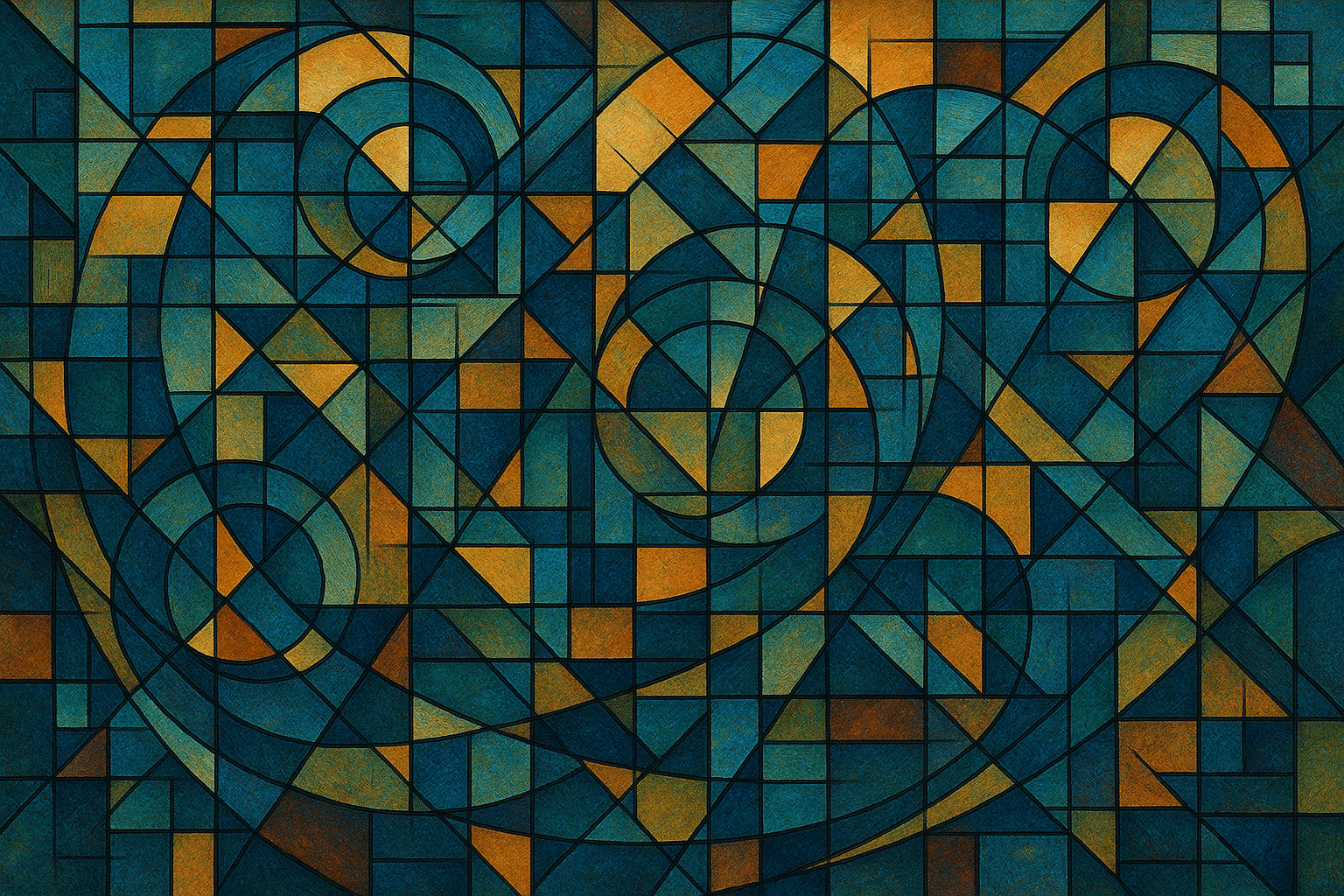
The retained illustration arranges teal and ochre triangles, rectangles and curved segments inside a dark grid. Its repeated modules demonstrate geometric organization more clearly than multiple viewpoints of a recognizable object.
Documented context and this exercise
Robert A. Gonsalves documents Dial-A-Style, an interactive installation shown in 2013 that applies algorithms to visitors’ portraits, including a Cubism option. This is a concrete example of algorithmic stylization; it does not establish a historical movement called Algorithmic Cubism. The exercises below are AOI’s own geometric interpretation.
Build the visual structure
Choose an object with a distinct contour: a jug, guitar or folded chair. Identify three features that must survive fragmentation, then partition the surrounding space into a limited set of planes. Rotate selected planes or change their scale according to a stated rule. Avoid scattering every feature independently; the object needs a visual route back to coherence.
An algorithm can guide a composition without making its artistic decisions inevitable. Compare a regular grid with a version in which only one region breaks the rule. Keep the palette small enough to see the structural change. A generated picture that resembles geometric painting does not, by itself, document the use of a particular algorithm.
A focused studio exercise
Draw the same jug with six, twelve and twenty-four planes. Preserve its handle in every version and compare the point at which extra subdivisions stop adding useful information.
Compare the studies at the same size and save the chosen prompt or process settings with each result. Keep the subject and viewing angle fixed during this test so the effect of the changed variable stays visible.
A small poetic detour
Original words from the AOI studio.
Poetry
Pixels whisper truth, / Geometry's silent dance, / Art in code's embrace.
The prompt workshop
Original creative exercises. These prompts create new illustrations, not documentary evidence.
Starting study
Create an original Algorithmic Cubism interpretation: a ceramic jug and pear divided into a limited set of rotated planes. Use a limited palette and repeated angular divisions while preserving the subject’s identifying contours. No lettering or logos.
Composition variation
Create an original Algorithmic Cubism interpretation: a guitar reconstructed from overlapping front and side views. Use a limited palette and repeated angular divisions while preserving the subject’s identifying contours. No lettering or logos.
Experimental variation
Create an original Algorithmic Cubism interpretation: an ochre and teal modular abstract grid with one deliberate interruption. Use a limited palette and repeated angular divisions while preserving the subject’s identifying contours. No lettering or logos.
Your next inspiration
Discover another art style
Follow a visual thread to the next subject.


A smile from the studio
Jokes
Why did the computer fall in love with Cubism? It couldn’t resist the angles!
Sources and further exploration
Robert A. Gonsalves — Dial-A-Style, artist project documentation