
Art and cultural context · researched guide
Art in Angola includes individual practices, institutions and histories that cannot be reduced to bright colours or geometric patterns. This guide begins with a specific contemporary example: Edson Chagas and the movement of everyday objects through a city, a photograph and an exhibition. The archive collage is discussed as an AI interpretation, not as evidence of a national style.
A visual introduction
Open any image to look closer, then browse the examples.
A closer look
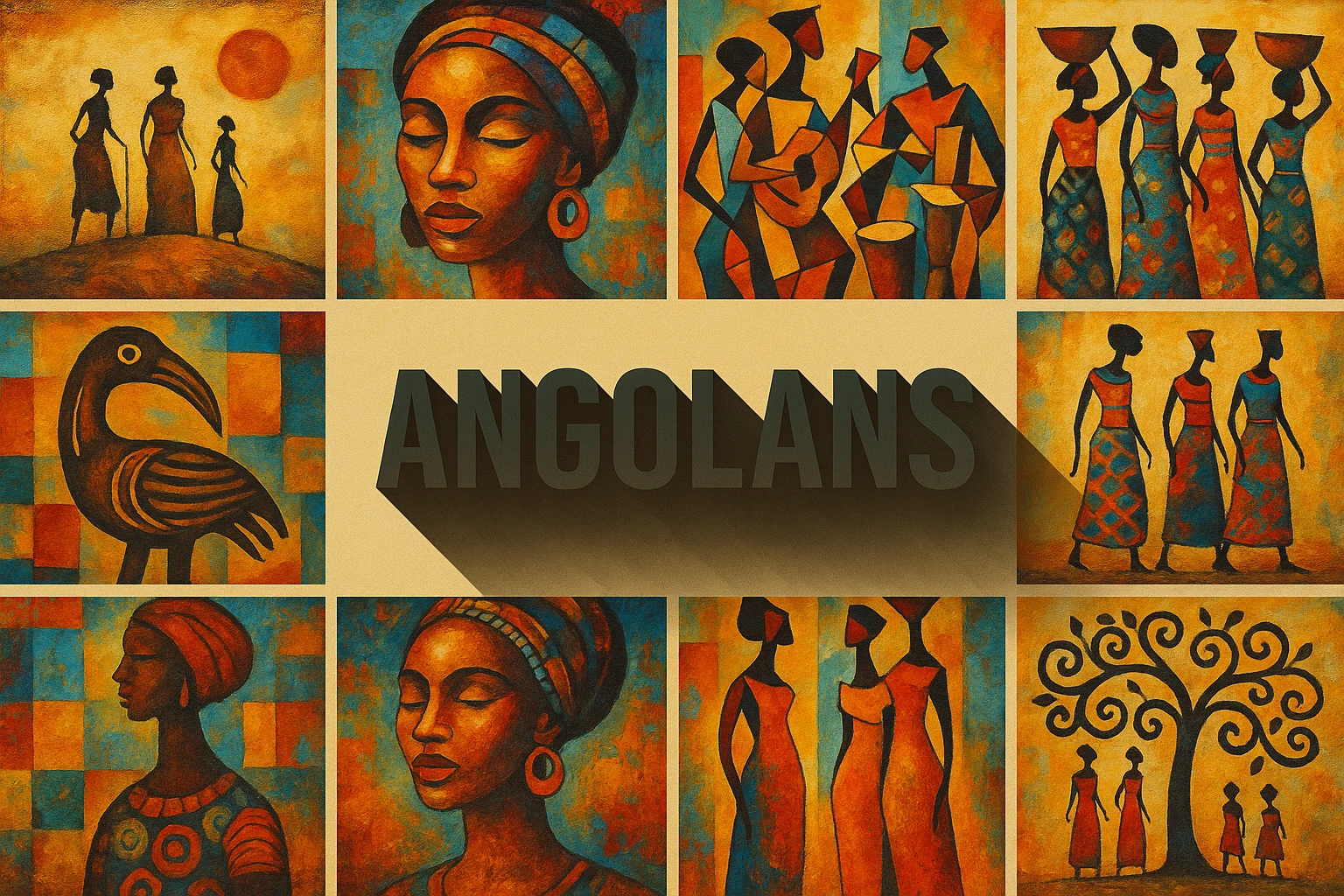
The archive collage repeats ochre and teal across portraits, musicians, silhouettes and decorative motifs. Its strong outlines unite unrelated scenes. That consistency belongs to the generated composition; it does not establish that Angolan artists share one palette, subject or technique.
Begin with an artist and a question
What makes an ordinary object worth looking at? In Found Not Taken, Edson Chagas photographed discarded objects after relocating them within urban settings. The artist’s gallery describes work made in Luanda, London and Newport. Position and background are active decisions: the photograph is constructed, even when its materials come from everyday life. This is a useful starting point for looking at contemporary art connected with Angola because it leads to a method rather than a national stereotype. [1]
Try describing the relationship between one object and the surface behind it. Is the object isolated by colour, repeated by a nearby shape, or made awkward by the amount of empty space? These are questions a viewer can test against an individual photograph. A phrase such as vibrant African culture cannot do that work; it substitutes an atmosphere for observation.
The photograph becomes an installation
MoMA documents Found Not Taken, Luanda (2013) as five stacks of offset lithographs on pallets in its 2015–2016 Ocean of Images exhibition. The record matters because it identifies a particular presentation and material form. A photograph reproduced on a screen and a stack of printed images occupying a gallery are different encounters with the work. [2]
Zeitz MOCAA records Chagas’s birth in Luanda in 1977 and the inclusion of the series in Angola’s pavilion at the 2013 Venice Biennale, which received the Golden Lion for best national pavilion. The award belongs to that documented exhibition history; it is not a certificate that one artist represents every artistic practice in Angola. The museum also situates his work around urban life, consumption and identity. [3]
Read our collage critically
Our synthetic illustration offers almost the reverse of the photographic example: it makes disparate subjects look uniformly decorative. The orange sun, repeated profile shapes and patterned garments quickly establish a mood, but they tell us nothing reliable about a named maker, a location or an object’s history. The bird motif is not assigned a cultural meaning here because the image supplies no provenance for one.
The collage remains useful as a lesson in how an image can appear culturally specific while withholding the information needed to support that impression. Its people are not portraits of the artists discussed. Its panels are not reproductions of Angolan artworks. The caption makes that distinction explicit, and the linked collection records provide the route to documented work.
A more useful creative exercise
Photograph an everyday object you own in three different settings. Keep its size in the frame consistent and change only the background. Compare how much of the apparent meaning comes from the object and how much from placement. If you use an image model instead, label the results as synthetic studies and record the compositional instructions.
This exercise does not make the result Angolan art or a work by Chagas. It teaches a transferable question about context. For further study, choose another documented artist or collection and let the differences complicate this introduction. A country is a place to begin research, not a colour preset.
People & works to explore
References discussed in this article. Consult the sources below for context.
Artists and practitioners
Edson Chagas — photographer discussed through museum and gallery records
Paintings and other works
Found Not Taken, Luanda (2013) — installation documented by MoMA; not reproduced in the AOI collage
Sources and further exploration
[1] STEVENSON — Edson Chagas, Found Not Taken