
Early Chinese material arts: jade, bronze and earthenware
Explore early Chinese art through three documented objects: a Liangzhu jade cong, a Shang bronze vessel and an Eastern Han granary model. Compare geometry, material, decoration and context while distinguishing historical evidence from contemporary illustration.
A visual introduction
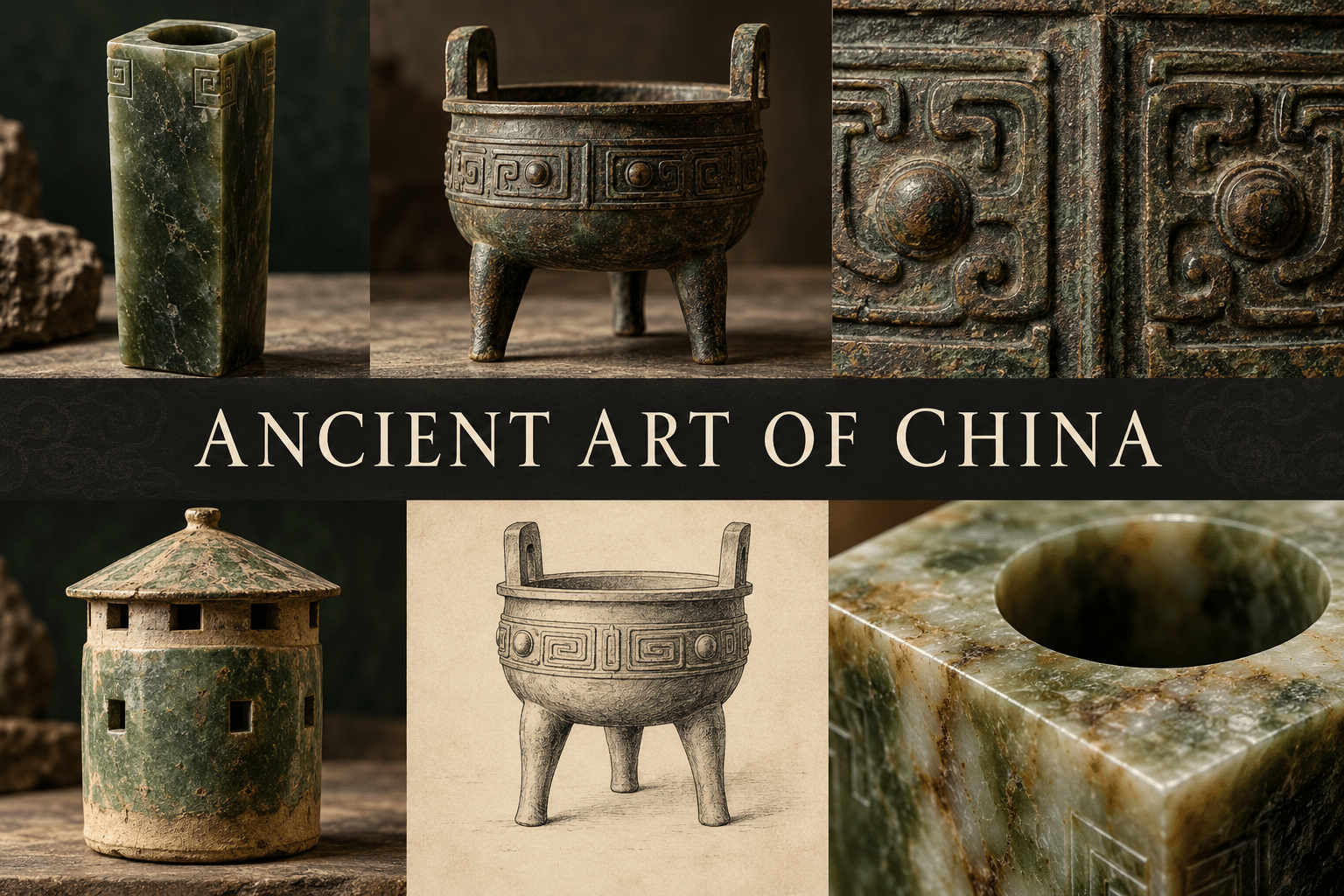
A documented Shang bronze photograph, an original AOI material-study collage, and two preserved archive interpretations. Captions distinguish their sources and purposes.
Select an image for a closer look. Use the thumbnails, arrow keys or a swipe to compare examples. Zoom in to inspect details, or share the image that inspires you.


Creative toolbox · take this style further
Choose an input and a destination. Search sends your words to the chosen site; Copy & open puts them on your clipboard to paste there.
Create with AI
Turn your chosen input into an image prompt or a new creative direction.
ChatGPT
Copy your input and paste it into a ChatGPT conversation or image request.
Copy & open ChatGPT (new tab)Claude · Anthropic
Develop an image prompt or explore the style in a new Claude conversation.
Copy & open Claude · Anthropic (new tab)Midjourney
Paste your input into the Imagine bar on the Create page.
Copy & open Midjourney (new tab)Adobe Firefly
Copy your input, open Firefly, and paste it into the prompt field.
Copy & open Adobe Firefly (new tab)Leonardo.Ai
Copy your input, open Leonardo, and paste it into the generation field.
Copy & open Leonardo.Ai (new tab)Image search
Find visual references. Short, concrete keywords usually work best.
Lexica
Search AI images and prompts using your selected input.
Search with this input Lexica (new tab)Pexels
Search the photo and video library. Short keywords often work best.
Search with this input Pexels (new tab)Pixabay
Search photos, illustrations and other images.
Search with this input Pixabay (new tab)Unsplash
Search photographs using the style name or your own keywords.
Search with this input Unsplash (new tab)Wikimedia Commons
Search photographs, artworks and historical images. Check each file for its source and reuse terms.
Search with this input Wikimedia Commons (new tab)Art & research
Explore artists, collections and the ideas behind a style.
Wikipedia
Search for background reading. A style may not have its own article.
Search with this input Wikipedia (new tab)WikiArt
Copy your input into WikiArt’s search to explore artists and artworks.
Copy & open WikiArt (new tab)Europeana
Paste your keywords into the search to explore European museum, library and archive collections.
Copy & open Europeana (new tab)Inspiration
Discover portfolios and visual ideas from creative communities.
Instagram hashtags
Search a hashtag made from your input: spaces and punctuation are removed. Instagram may require sign-in.
Search with this input Instagram hashtags (new tab)ArtStation
Paste your input into artwork search for concept art, environments, characters and visual development.
Copy & open ArtStation (new tab)Behance
Paste your input into project search for illustration, design and visual storytelling.
Copy & open Behance (new tab)A closer look
Look for relationships between opening and body, support and weight, small repeated motifs and large surface divisions. Jade, cast bronze and glazed earthenware demand different treatment of shape, texture and light.
Ancient China is a field of study, not one style
Ancient Chinese art includes objects made in different regions, periods and materials for very different purposes. A jade object, a bronze food vessel and an earthenware building model do not share a single technique or visual language. This introduction uses three documented examples, from the Neolithic period through the Eastern Han, to make those differences visible. It is a starting point for looking, not a complete history of Chinese art.
Begin with the object’s material, date and context. Do not place later court painting, landscape painting and all Chinese ceramics into an undifferentiated ancient category. Nor should a list of famous painters stand in for evidence about an archaeological object whose maker is unnamed. A museum identifier is often a more useful starting point than a supposed master’s name.
Jade: a circle within a square
The Met’s Ritual object (cong), accession 2004.52, is a nephrite jade object dated to about 2400 BCE and assigned to the Liangzhu culture. A circular tube passes through a gently tapering square exterior. Small mask-like designs occupy the corners. The museum describes the object’s function and meaning as uncertain, while suggesting a connection with wealth and social status. That uncertainty belongs in an explanation of the work. [1]
The design offers a precise looking exercise: compare the round opening, the flat faces and the corners. Notice how a motif can depend on an edge instead of sitting in the middle of a flat picture. In a drawing, show the top and two sides so the contrast between inner and outer geometry becomes clear. Do not turn a modern interpretation of that geometry into a proven ancient belief.
Bronze: form, support and patterned surface
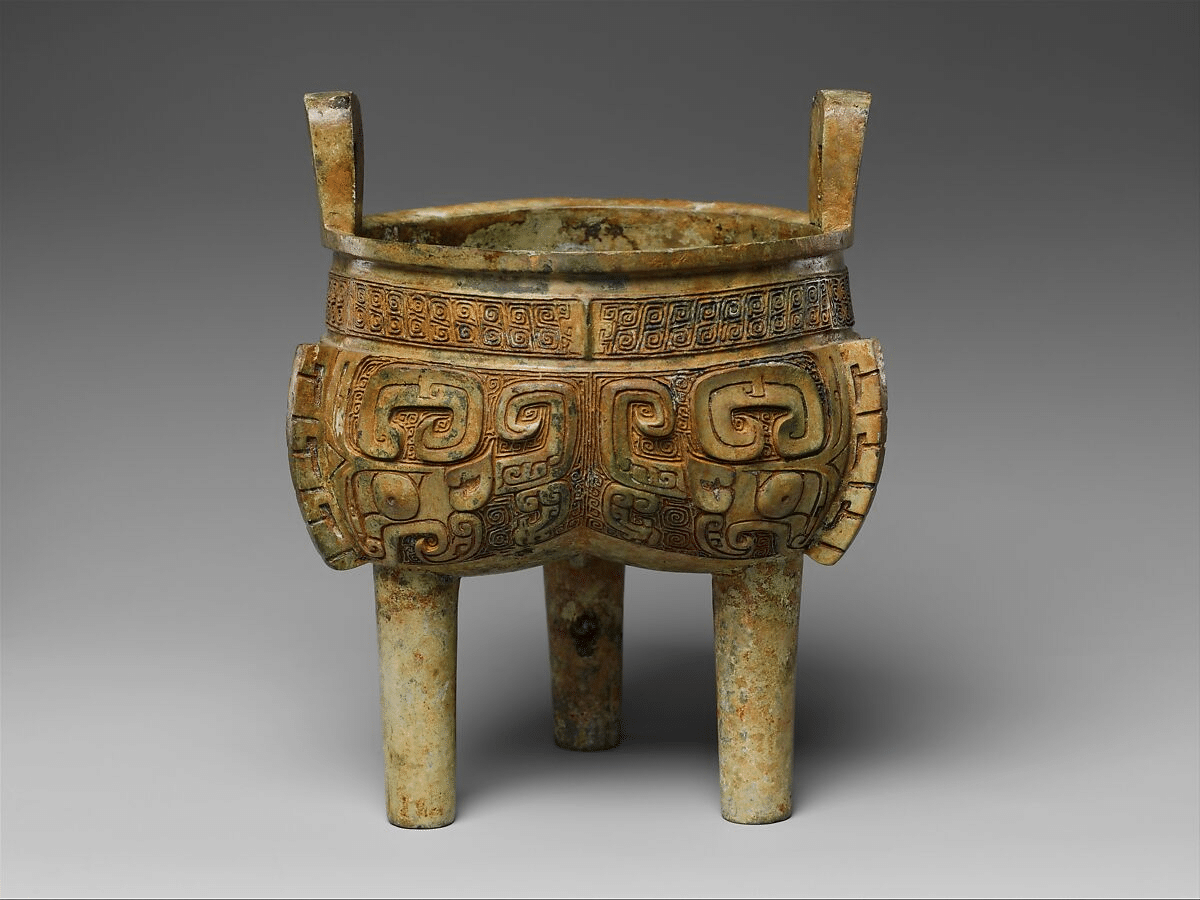
The photographed object in this article is the Met’s Lobed Tripod Cauldron (Liding), accession 49.136.5. The museum dates it to the twelfth–eleventh century BCE, within the Shang dynasty, and identifies the material as bronze. It explains that the shape derives from pottery prototypes; its accompanying interpretation discusses food offerings and ancestor rituals. This is a specific vessel, not a template for every early Chinese bronze. [2]
Look first at the three supports and the relationship between the lobed body and upright handles. Then examine the narrow band below the rim, the larger motifs across the body and the projecting divisions between them. Small repeated marks and larger paired forms operate at different scales. The photograph’s mottled surface is the object’s present appearance; copying its colors does not reconstruct the appearance of newly cast metal.
Earthenware: buildings at a different scale
The Met’s Granary Tower, accession 13.100.11, is an Eastern Han model dated to the first–early third century CE. Its material is earthenware with green lead glaze. The museum explains that models of houses and farm structures were placed in Eastern Han burials to provide for the afterlife. The model therefore needs to be understood as a made object with a funerary setting, not simply a small modern architectural model. [3]
When studying such a model, compare its overall mass, roof silhouette, openings and base. A modest change in the spacing of windows can alter the sense of scale. In an original design exercise, keep those structural relationships legible before adding surface texture. A shiny green finish alone cannot establish a Han date, and a decorative tower invented today should be labelled as such.
Separate evidence from contemporary interpretation
The featured bronze photograph is supplied by The Metropolitan Museum of Art and marked public domain in its collection record. The new titled AOI collage is AI-generated: its jade-like forms, bronze-like vessels, contour study and small green building model are contemporary interpretations. They illustrate material contrasts and compositional questions; they are not reproductions of the three cited objects or evidence of their original use.
Two earlier AOI images remain as additional archive examples. One presents an imagined woman among flowers beside a crane; the other combines figures, landscapes, a rider and dragon-like motifs. Their warm paper-like surface, fine contours and broad historical atmosphere do not establish an ancient date. They are useful for comparison with the new object-focused approach, but should not be used to identify a dynasty, person, garment or artifact.
A practical vocabulary for looking and making
Use specific relationships in your notes: a round bore within a square body, an edge carrying a motif, three supports balancing a vessel, a narrow repeated band above a broad decorated field, or small openings punctuating a solid volume. These observations can guide drawing and design without claiming that all early Chinese art has one palette, mood or symbolism.
For a study from a historical object, keep its museum identifier and date range beside your working notes. For a new image, choose one medium and one structural problem, then make the contemporary status clear. Avoid adding invented Chinese characters as decoration or describing an imagined object as excavated. The three prompts below explore geometry, supporting structure and scale. This article is AI-assisted editorial writing in AOI’s Penny Wraiter persona.
Compare what the material permits
Draw the main silhouette of the jade object, bronze vessel and earthenware model at comparable page sizes, while recording their actual dimensions beside them. Notice how each uses openings, supports and surface divisions. The comparison should reveal construction and purpose rather than suggest that the objects originally shared one scale or setting.
Then ask what information a photograph cannot provide: weight, interior form, texture under changing light or the relationship to other objects in its original context. These questions make the limitations of a digital reference useful rather than invisible.
Avoid a single decorative vocabulary
Do not transfer a motif from one period and material onto another merely because both are labelled Chinese. For an original study, choose one documented structural idea, such as a round opening within a square mass, and transform it into a clearly contemporary object. Credit the reference and describe the transformation without claiming ancient authenticity.
A small poetic detour
Original words from the AOI studio.
Poetry
The circle opens through the square;
a corner changes how we stare.
Three feet support a patterned bowl,
small lines converse with its whole.
Before a name, before a tale,
look close at substance, edge and scale.
The prompt workshop
Original creative exercises. These prompts create new illustrations, not documentary evidence.
A round opening in a square form
Create a contemporary sculptural study of a tall gently tapered square prism with a circular vertical bore. Dark mottled jade-like material, polished planes and restrained shallow corner grooves. Three-quarter view showing the opening and two sides, soft side light, neutral background. An original geometry exercise prompted by looking at Liangzhu cong forms; no inscription, ancient-provenance claim or asserted ritual meaning.
One vessel, three supports
Design an original contemporary bronze-like vessel with a lobed rounded body, three coherent columnar supports and two upright loop handles. A narrow repeated geometric band below the rim contrasts with larger symmetrical curved forms on the body. Show all three supports clearly in a restrained studio composition. Brown metal with limited green surface variation. No writing or historical maker attribution; an original formal exercise, not a replica or excavated object.
A building made small
Create an original contemporary earthenware model of a simple cylindrical granary with a low conical roof, small regularly spaced openings and a stable base. Restrained green glaze with visible clay at the foot. Place it beside a plain drawing of its silhouette to compare volume and outline. Soft daylight, quiet background, no elaborate pagoda roofs, inscriptions or invented excavation labels. A new scale study informed by looking at Han ceramic building models.
A smile from the studio
Jokes
The little granary requested a larger room. Its curator suggested a smaller sense of scale.