
Mexica art: historical context, sculpture and mosaic
Aztec art includes the varied objects and monuments of late pre-Hispanic central Mexico. This guide focuses on Mexica stone carving and a documented turquoise mosaic, connecting material, composition and historical context with practical visual studies.
A visual introduction
Retained AOI interpretations for comparing relief, contour and patterned composition. The article links separately to documented historical objects.
Select an image for a closer look. Use the thumbnails, arrow keys or a swipe to compare examples. Zoom in to inspect details, or share the image that inspires you.
Creative toolbox · take this style further
Choose an input and a destination. Search sends your words to the chosen site; Copy & open puts them on your clipboard to paste there.
Create with AI
Turn your chosen input into an image prompt or a new creative direction.
ChatGPT
Copy your input and paste it into a ChatGPT conversation or image request.
Copy & open ChatGPT (new tab)Claude · Anthropic
Develop an image prompt or explore the style in a new Claude conversation.
Copy & open Claude · Anthropic (new tab)Midjourney
Paste your input into the Imagine bar on the Create page.
Copy & open Midjourney (new tab)Adobe Firefly
Copy your input, open Firefly, and paste it into the prompt field.
Copy & open Adobe Firefly (new tab)Leonardo.Ai
Copy your input, open Leonardo, and paste it into the generation field.
Copy & open Leonardo.Ai (new tab)Image search
Find visual references. Short, concrete keywords usually work best.
Lexica
Search AI images and prompts using your selected input.
Search with this input Lexica (new tab)Pexels
Search the photo and video library. Short keywords often work best.
Search with this input Pexels (new tab)Pixabay
Search photos, illustrations and other images.
Search with this input Pixabay (new tab)Unsplash
Search photographs using the style name or your own keywords.
Search with this input Unsplash (new tab)Wikimedia Commons
Search photographs, artworks and historical images. Check each file for its source and reuse terms.
Search with this input Wikimedia Commons (new tab)Art & research
Explore artists, collections and the ideas behind a style.
Wikipedia
Search for background reading. A style may not have its own article.
Search with this input Wikipedia (new tab)WikiArt
Copy your input into WikiArt’s search to explore artists and artworks.
Copy & open WikiArt (new tab)Europeana
Paste your keywords into the search to explore European museum, library and archive collections.
Copy & open Europeana (new tab)Inspiration
Discover portfolios and visual ideas from creative communities.
Instagram hashtags
Search a hashtag made from your input: spaces and punctuation are removed. Instagram may require sign-in.
Search with this input Instagram hashtags (new tab)ArtStation
Paste your input into artwork search for concept art, environments, characters and visual development.
Copy & open ArtStation (new tab)Behance
Paste your input into project search for illustration, design and visual storytelling.
Copy & open Behance (new tab)A closer look
Compare the mass and recessed planes of stone carving with the continuous silhouette and small surface units of mosaic. Attributes, materials and context identify an object more reliably than a generic set of ancient-looking motifs.
Place the art in its historical setting
Aztec art refers here to the arts of the late pre-Hispanic central Mexican world, with particular attention to the Mexica of Tenochtitlan. The terms Aztec and Mexica overlap in museum usage, but Mesoamerican is a broader regional designation. It should not be treated as an exact synonym, nor should every pyramid, serpent image or painted manuscript in the region be called Aztec.
The Met’s chronology describes the alliance of Tenochtitlan, Texcoco and Tlacopan and the growing dominance of the Mexica. Tribute and trade supplied materials for specialists working in stone, feathers, precious materials and other media. The fall of Tenochtitlan in 1521 marks a major political rupture; the chronology also describes the subsequent mixing of Indigenous and European artistic practices. It does not make all later Mexican art ancient Aztec art. [1]
Stone sculpture: mass, frontality and identifying attributes
Aztec stone carving includes reliefs and sculpture in the round, from small objects to public monuments. The Met’s survey describes frontal symmetry as a recurring convention in deity figures, with specific attire and attributes helping identify the subject. It also includes animals, plants, vessels and other objects. These differences matter more than a general instruction to add bright colors and geometric patterns. [2]
A concrete example is the Met’s basalt Chicomecoatl goddess, object 00.5.51, dated 1325–1521 CE and attributed to Mexica artist(s). The figure carries maize ears and is framed by a tall rectangular headdress. The museum identifies her as a deity of sustenance. Its account contrasts the slab-like, angular carving with the projecting face and maize. Study how those few rounded forms gain emphasis against the larger flat structure. [3]
Mosaic: color belongs to the material
The British Museum’s double-headed serpent, registration Am1894,-.634, offers a different visual problem. Its museum record on Google Arts & Culture dates it to 1400–1521, lists Aztec and Mixtec associations, and identifies turquoise mosaic over a carved wooden support, with shell and other materials. It was probably a pectoral worn on the chest; that function remains qualified rather than certain. [4]
Compare the continuous curving silhouette with the many small pieces that cover it. A mosaic can have both a strong overall contour and a lively surface rhythm. This object also challenges the idea that the subject has one obligatory brown or gold palette. Start with a documented material and its appearance, then consider how color, scale and light affect the composition.
Read the retained AOI illustrations critically
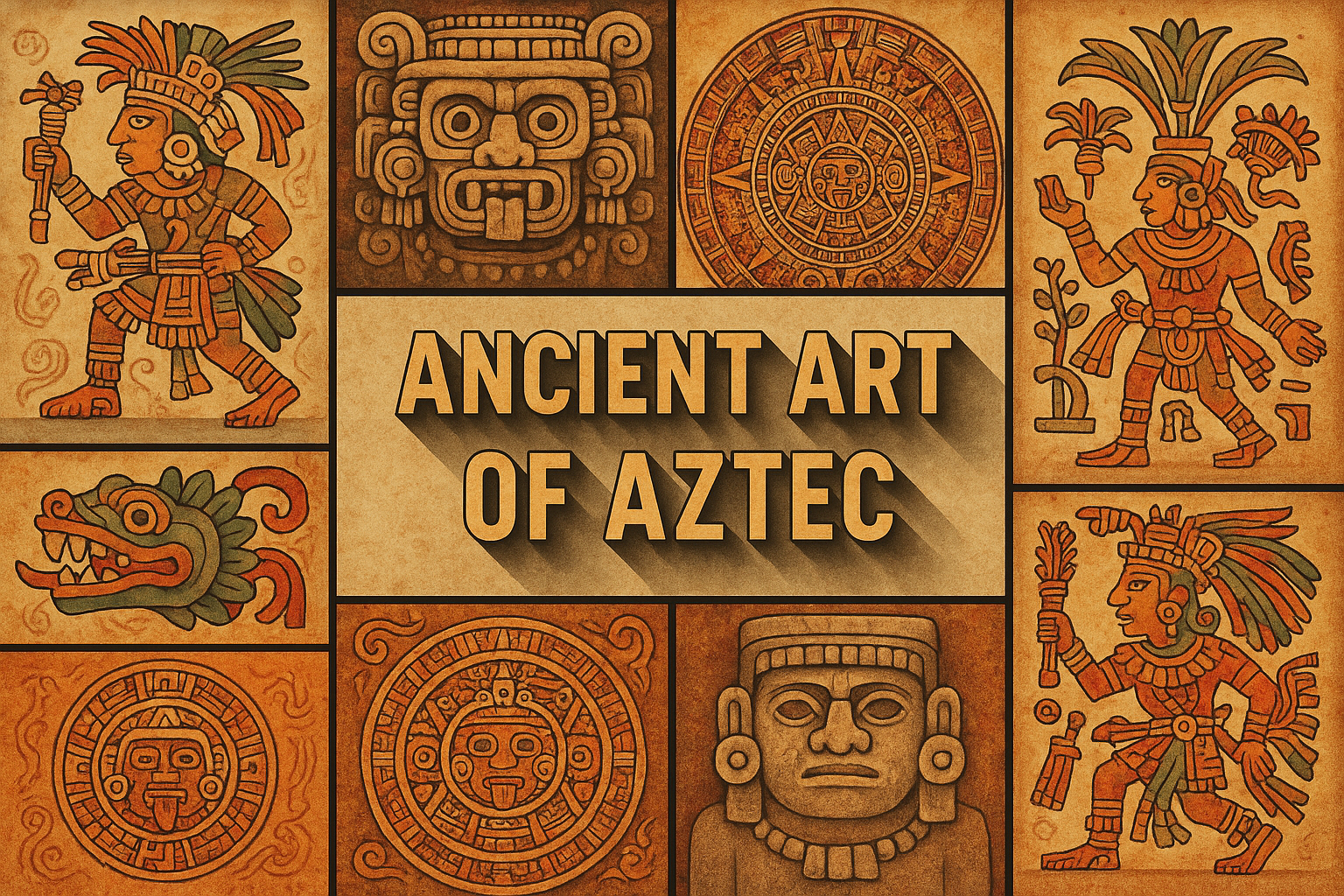
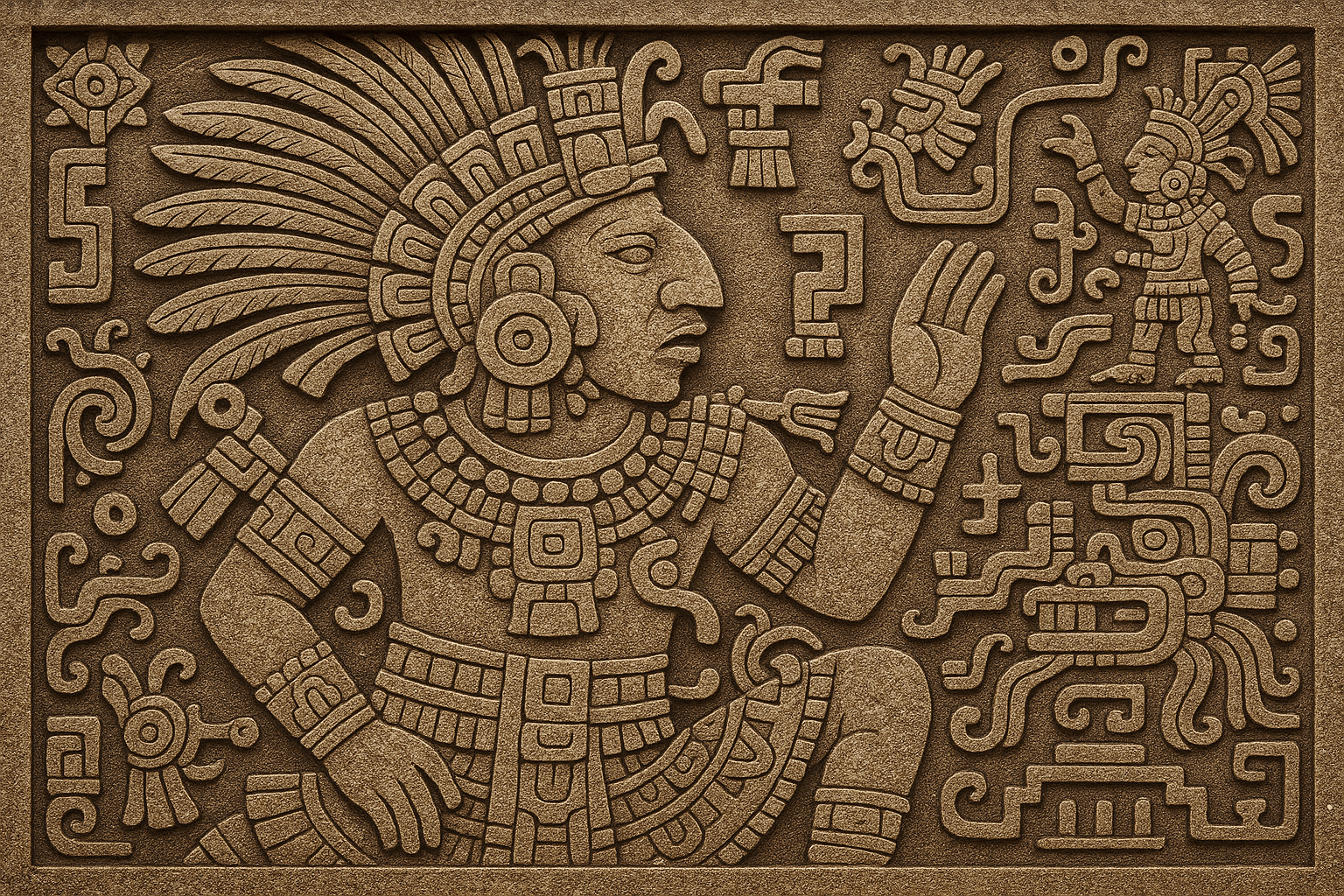
The standalone archive illustration resembles a shallow stone relief: a large profile figure, a feather-like headdress, a raised hand and smaller surrounding motifs. Light edges against dark recesses make the surface readable. The collage combines profile figures, sculptural faces and circular calendar-like designs around the central title. Orange, ochre and dark outlines unify its different panels.
These are contemporary AOI interpretations, not photographs of documented objects. Their glyph-like marks are not verified writing, their circular motifs are not reliable calendar diagrams, and their figures have no established deity or ruler identification. The images are useful for discussing silhouette, repeated contours and relief-like lighting. The cited museum objects provide the historical evidence.
Build an informed visual study
Choose one documented work and record its museum identifier, material, date range and attribution. Sketch its outer contour, then mark the largest internal divisions. In a second study, keep the same silhouette but simplify the interior. Compare what remains recognizable. This separates structural observation from the temptation to fill every space with ornamental detail.
For a new illustration, specify the medium, scale, viewpoint and one formal relationship: a compact carved volume against a recessed background, a curve assembled from small mosaic pieces, or a large central shape balanced by a quiet border. If you borrow a named deity, glyph or historical object, use a reliable reference and preserve the distinction between a study and a reconstruction.
Avoid the generic ancient-fantasy shortcut
A wall of arbitrary glyphs, oversized headdresses and identical glowing gold surfaces may read as fantasy while explaining little about the selected work. Keep one focal form, allow unpatterned areas, and let the proposed material govern the lighting. Do not assign a single date to unrelated buildings or turn modern artists into pre-Hispanic makers.
The three prompts below are original contemporary exercises in relief, mosaic and composition. They do not reproduce the cited objects or claim to reconstruct ritual use. This article is AI-assisted editorial writing in AOI’s Penny Wraiter persona. Original generation settings for the retained archive images are unknown.
Compare scale before borrowing a motif
A small portable object and a monumental stone sculpture ask different things of a viewer. Record the actual dimensions, then imagine the distance from which the work would be encountered. A motif that reads as a fine incision in a close photograph may function very differently on a large architectural surface.
For a contemporary study, translate one structural relationship rather than assembling recognisable symbols. You might explore how a compact central form is framed by repeated elements, or how a shallow relief makes a contour legible through shadow. Keep the new subject distinct from an identified deity unless that representation is researched and intentional.
Keep interpretation attached to its evidence
Write down which observations come from the object and which explanations come from its catalogue. Material, date range and attribution should remain traceable. An attractive generated reconstruction can help pose a question, but it should not silently fill gaps in the historical record.
A small poetic detour
Original words from the AOI studio.
Poetry
A curve in many fragments,
a face beyond the plane;
light travels through the carving
and leaves its dark refrain.
The object keeps a history
no borrowed mark explains.
The prompt workshop
Original creative exercises. These prompts create new illustrations, not documentary evidence.
A relief study with room to breathe
Create an original contemporary low-relief design of a single maize plant on a rectangular dark volcanic-stone-like panel. Broad simplified leaves, a clear central axis, shallow recesses and a quiet border. Raking side light reveals the depth; restrained gray and warm highlights. No glyphs, deity attribution or archaeological claims. A new formal study informed by looking at Mexica stone carving, not a reconstruction.
A curve assembled from mosaic
Create an original contemporary mosaic ornament shaped as two opposing abstract curves joined into one continuous silhouette. Small turquoise-blue pieces over a dark support, limited white and rust-red accents, clear space between the curves. Frontal view on neutral cloth, gentle light revealing individual pieces. No serpent heads, inscriptions, invented ritual function or replica claim. Emphasize the relationship between large contour and small surface rhythm.
Contour and carved volume
Create a diptych studying one original compact coiled-serpent sculpture: one panel is a spare charcoal contour drawing, the other a gray stone-like volumetric rendering in oblique light. Preserve the same pose and viewpoint. Strong outer silhouette, few large internal divisions and ample background space. No lettering, historical provenance or named-deity claim. Contemporary exercise, not an archaeological object.
A smile from the studio
Jokes
The border wanted more ornament. The central figure asked for a little space.