
Painting · interwar America, regional life and social observation
American Scene Painting is an umbrella term for representational pictures of American life, especially between the world wars. Farms, factories, city streets and leisure all belong within its reach. The category contains different attitudes: affection for a locality, celebration of work, social criticism and uneasy questions about who belongs in the national picture.
Creative toolbox · take this style further
Choose an input, adjust it, then open a tool. Search links pass your text to the destination. Copy & open copies it for you to paste into the generator; you start generation there.
ChatGPT
Copy your input and paste it into a ChatGPT conversation or image request.
Copy & open ChatGPT (new tab)Claude · Anthropic
Develop an image prompt or explore the style in a new Claude conversation.
Copy & open Claude · Anthropic (new tab)Midjourney
Paste your input into the Imagine bar on the Create page.
Copy & open Midjourney (new tab)Adobe Firefly
Copy your input, open Firefly, and paste it into the prompt field.
Copy & open Adobe Firefly (new tab)Leonardo.Ai
Copy your input, open Leonardo, and paste it into the generation field.
Copy & open Leonardo.Ai (new tab)Lexica
Search AI images and prompts using your selected input.
Search with this input Lexica (new tab)Pexels
Search the photo and video library. Short keywords often work best.
Search with this input Pexels (new tab)Pixabay
Search photos, illustrations and other images.
Search with this input Pixabay (new tab)Unsplash
Search photographs using the style name or your own keywords.
Search with this input Unsplash (new tab)Wikipedia
Search for background reading. A style may not have its own article.
Search with this input Wikipedia (new tab)WikiArt
Copy your input into WikiArt’s search to explore artists and artworks.
Copy & open WikiArt (new tab)Instagram hashtags
Search a hashtag made from your input: spaces and punctuation are removed. Instagram may require sign-in.
Search with this input Instagram hashtags (new tab)A closer look
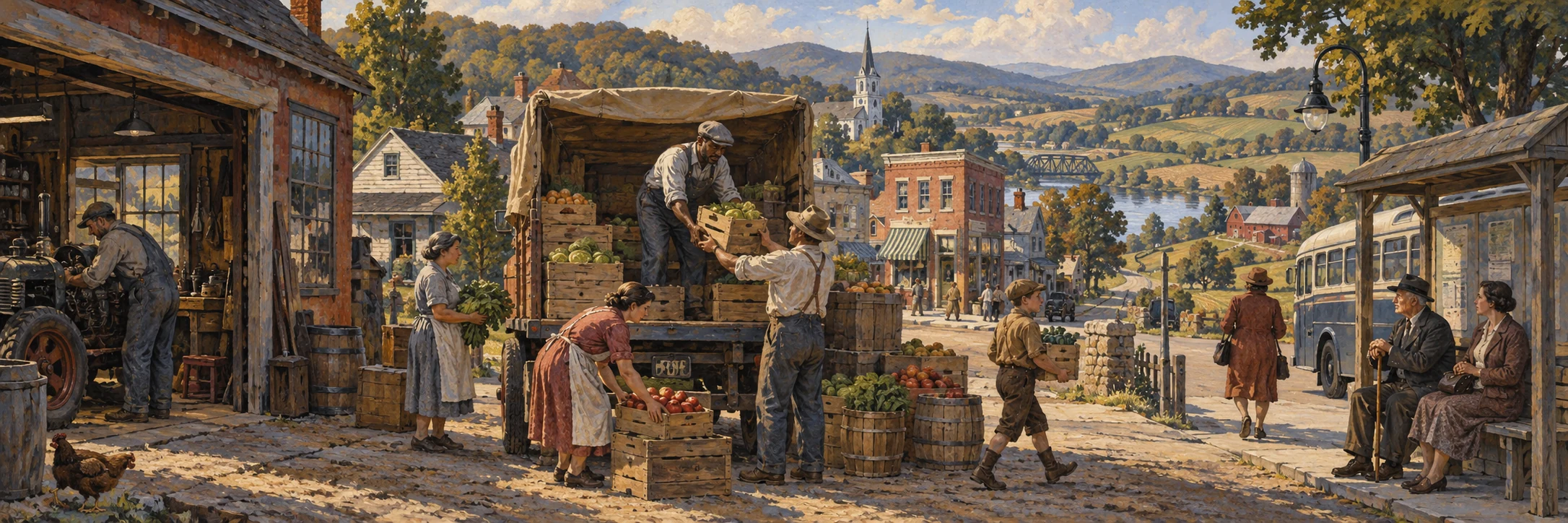
Our AI-generated banner imagines a town where a produce market, workshop and street meet. The connected activities provide a visual argument about interdependence. It is an invented composition rather than a reconstruction of a named town or a reproduction of a period painting.
An umbrella, not one school with one opinion
The term becomes more useful when it opens differences instead of flattening them. Regionalism is associated particularly with artists such as Thomas Hart Benton, Grant Wood and John Steuart Curry. American Scene Painting can also accommodate urban subjects and more overtly critical accounts of social conditions.
Benton’s America Today, made in 1930–31, is a ten-panel mural originally commissioned for the New School in New York. The Met describes its range across regional labour and urban leisure. This is already more complicated than a definition restricted to peaceful farms or small-town nostalgia. [1]
A subject does not reveal its politics automatically. A factory might stand for collective achievement, exhausting labour or both. Look at scale, facial expression, rhythm and the relation between workers and machinery before deciding what attitude the picture takes.
How a local scene becomes a larger claim
Repeated shapes can connect activities across a composition. A bent arm may echo a beam; a road may carry the eye from a field into a town. Such devices turn separate incidents into a story about a society. They can also make a complicated situation appear more unified than it really is.
Ask who performs the work, who watches and who is absent. These are questions for looking, not an invitation to invent missing biographical evidence. A picture’s selection of bodies and activities is part of its meaning, even when its surface seems to offer an uncomplicated slice of life.
The banner proposes a fictional relationship between food distribution, repair and public space. Its visual coherence should be judged as a composition. It cannot prove that a real community enjoyed equality, prosperity or agreement. A convincing panorama remains a constructed point of view.
Do not mistake a period for a filter
Earth colours, rounded hills and sturdy figures can be useful descriptive choices, but none is a membership certificate. A modern image with vintage clothing is not thereby an American Scene painting in the historical sense. Call it a contemporary study informed by the period when that is what it is.
Nor should every interwar American picture be labelled a government commission. Establish the commission and ownership history of the actual work. America Today, for example, had a specific institutional destination at the New School; its subject alone does not make it a federal arts project. [1]
The distinction from broader American Realism is one of historical focus, not a competition in accuracy. An American Scene picture may use conspicuous exaggeration and rhythmic design. Representation can be highly stylised while remaining engaged with recognisable social life.
Try a scene with more than one centre
Choose a fictional place with three connected activities: a market delivery, a repair stall and people waiting for transport. Draw a route through them. Give each group a clear action, then decide whether the composition suggests cooperation, friction or an unresolved mixture. Avoid making every person perform for the viewer.
For AI-assisted work, request legible relationships rather than simply asking for a nostalgic America. Check clothing and machinery if you specify a date. Examine whether people can actually carry, push or operate the things assigned to them. Remove invented signs that imply a real business or historical event.
A worthwhile finished study should let the viewer discover something after the first glance. Perhaps the main road divides the workers from the leisure crowd; perhaps the quietest figure carries the narrative. Let the scene ask a question rather than decorate a ready-made answer.
A small poetic detour
Original words from the AOI studio.
Poetry
The road joins field and street;
not every traveller arrives in the same picture.
The prompt workshop
Original creative exercises. These prompts create new illustrations, not documentary evidence.
Connect three activities
An original interwar American Scene-inspired painting of an invented town market, repair stall and transport stop, readable groups engaged in different activities, a road connecting them, no copied artwork or lettering.
Original AOI exercise; a generated image is not historical or documentary evidence.
Give the scene a point of view
Invented 1930s town panorama, produce delivery in foreground, repair workshop in middle distance, leisure figures across the street; rhythmic shapes connect work and rest, earthy colour with cool shadows, no claim of documentary accuracy.
Original AOI exercise; a generated image is not historical or documentary evidence.
Test the argument
Make two compositions of one fictional market street: the first emphasises shared activity, the second emphasises the distance between workers and spectators. Keep the setting and period constant; change framing and spatial relationships.
Original AOI exercise; a generated image is not historical or documentary evidence.
People & works to explore
References discussed in this article. Consult the sources below for context.
Artists and practitioners
Thomas Hart Benton — America Today
Grant Wood and John Steuart Curry — Regionalist context
Paintings and other works
Thomas Hart Benton, America Today, 1930–31