
Art history · transatlantic exchange and everyday subjects
American Impressionism developed through exchange with French painting and through artists’ encounters with places, people and changing daily life. Visible marks and responsive colour are part of the story, but the movement is not simply a soft-focus effect. Its paintings organize attention: to light on a park path, a figure at tea, a city street or a new bridge crossing a familiar river.
A visual introduction
Open any image to look closer, then browse the examples.
Creative toolbox · take this style further
Choose an input, adjust it, then open a tool. Search links pass your text to the destination. Copy & open copies it for you to paste into the generator; you start generation there.
ChatGPT
Copy your input and paste it into a ChatGPT conversation or image request.
Copy & open ChatGPT (new tab)Claude · Anthropic
Develop an image prompt or explore the style in a new Claude conversation.
Copy & open Claude · Anthropic (new tab)Midjourney
Paste your input into the Imagine bar on the Create page.
Copy & open Midjourney (new tab)Adobe Firefly
Copy your input, open Firefly, and paste it into the prompt field.
Copy & open Adobe Firefly (new tab)Leonardo.Ai
Copy your input, open Leonardo, and paste it into the generation field.
Copy & open Leonardo.Ai (new tab)Lexica
Search AI images and prompts using your selected input.
Search with this input Lexica (new tab)Pexels
Search the photo and video library. Short keywords often work best.
Search with this input Pexels (new tab)Pixabay
Search photos, illustrations and other images.
Search with this input Pixabay (new tab)Unsplash
Search photographs using the style name or your own keywords.
Search with this input Unsplash (new tab)Wikipedia
Search for background reading. A style may not have its own article.
Search with this input Wikipedia (new tab)WikiArt
Copy your input into WikiArt’s search to explore artists and artworks.
Copy & open WikiArt (new tab)Instagram hashtags
Search a hashtag made from your input: spaces and punctuation are removed. Instagram may require sign-in.
Search with this input Instagram hashtags (new tab)A closer look
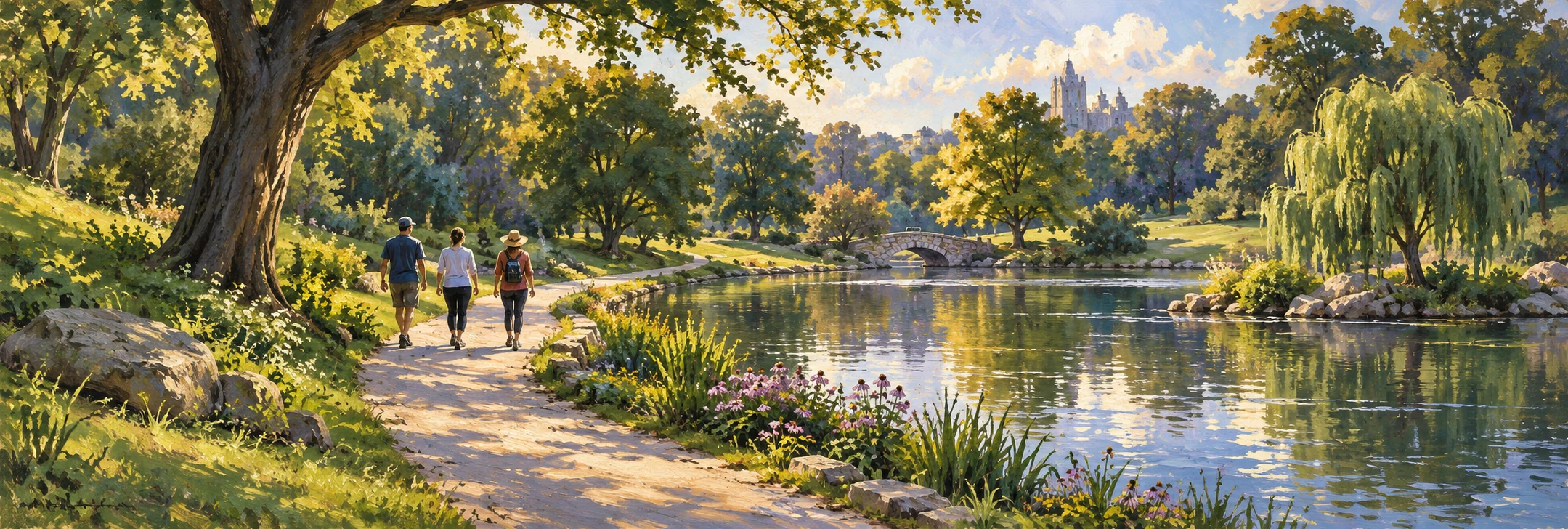
The original banner imagines a sunlit public park with a pond, a curving path and small walking figures. Broken touches of warm light meet cooler shadows; larger masses of trees and water hold the scene together. It is an AI-generated study of visual relationships, not a painting by a historical American Impressionist or a record of a particular park.
A transatlantic history with several routes
The Metropolitan Museum’s overview describes American artists studying and working in Europe, with Mary Cassatt and John Singer Sargent among those responding early to French Impressionism. Wider American interest developed during the 1880s; William Merritt Chase’s New York park paintings of 1886 form an important domestic example. [1]
The same account emphasizes urban subjects, rural retreats and domestic interiors. This variety matters: American Impressionism cannot be reduced to a single location, a uniform palette or a collection of country gardens. Some artists lived abroad, while others moved repeatedly between artistic communities. [1]
Use the national label to investigate those connections, not to isolate a self-contained tradition. A painter’s citizenship, residence, training and exhibition history are different facts. The particular work will often make their interaction more interesting than a broad category can.
Visible marks can support a precise structure
Look first at the large divisions of light and shade. Then notice how separate touches of colour describe a surface without blending every transition. A path may gather warm patches beneath trees while nearby shadow shifts toward blue or violet.
Loose handling does not mean that composition has disappeared. A dark mass can anchor the frame, a diagonal can guide the eye and repeated colours can connect distant areas. The lively surface works because the larger arrangement gives it direction.
Our banner uses the curve of a path to join foreground and distance. Small figures establish scale, while the pond interrupts the denser foliage with a different rhythm of marks. The effect is neither a uniform blur nor a field of equally sharp details.
Two works that expand the familiar picture
Mary Cassatt’s Lady at the Tea Table (1883–1885) brings the subject indoors. The Met identifies Mary Dickinson Riddle and the family connection behind the portrait, and points to its sketch-like handling and compressed space. The social ritual and the particular sitter matter alongside the technique. [2]
Julian Alden Weir’s The Red Bridge (1895) offers another useful example. The Met describes a new iron truss bridge over Connecticut’s Shetucket River, covered in red priming paint. Its account connects the work with outdoor painting, modern infrastructure and Weir’s developing response to Impressionism and Japanese prints. [3]
Put these examples beside an outdoor leisure scene. They ask different things of colour and composition, and they resist the idea that Impressionism always means an idyllic garden. A modern subject may be intimate, industrial or both ordinary and visually surprising.
Ask what the light makes visible
A beautifully lit scene is still a selected view. Notice who appears, what activity is represented and which edges of the setting are excluded. An image of leisure can be pleasurable without becoming a complete account of the society around it.
This is a viewing question rather than an instruction to distrust every attractive painting. The useful habit is to move between formal attention and subject matter: how is the scene made, and what kind of life does that construction invite us to see?
For your own study, choose an ordinary public place instead of searching for an already picturesque subject. A bus shelter, a modest garden or a familiar footpath can offer complicated light and an interesting distribution of people and space.
Practice observation before adding effects
Make two small studies of the same view under different light. Keep the viewpoint stable and record which shapes merge, which edges sharpen and where the strongest colour contrast moves. The comparison is more instructive than applying the same lively brush texture everywhere.
With AI, specify a coherent light direction, broad value groups and selective broken colour. Inspect figures, reflections and cast shadows. A model can imitate a surface effect without maintaining the observed relationships that give it purpose.
Keep generated interpretations clearly labelled, and use museum records for historical attributions. The goal is not to make an image appear old. It is to make looking feel newly attentive.
A small poetic detour
Original words from the AOI studio.
Poetry
A patch of sun crosses the path.
The walker moves on.
The colour stays a moment longer.
The prompt workshop
Original creative exercises. These prompts create new illustrations, not documentary evidence.
Start with observed light
Create an original painterly study of an invented public park: a curving path, pond and small walking adults, one coherent afternoon light direction, warm highlights and cooler shadows. Use selective broken colour, not uniform blur.
Original AOI exercise; a generated image is not historical or documentary evidence.
Build the composition
Develop the scene with broad tree masses, a calm water interval and a diagonal route into depth. Keep figures coherent and details selective. No imitation of a specific historical painting.
Original AOI exercise; a generated image is not historical or documentary evidence.
Compare two moments
Render the same viewpoint under a second lighting condition. Change the pattern of illumination and shadow rather than simply shifting every colour. Label both images as AI-generated studies.
Original AOI exercise; a generated image is not historical or documentary evidence.
People & works to explore
References discussed in this article. Consult the sources below for context.
Artists and practitioners
Mary Cassatt
William Merritt Chase
John Singer Sargent
Julian Alden Weir
Paintings and other works
Lady at the Tea Table (1883–1885)
The Red Bridge (1895)