
Art history · American responses to French landscape painting
American Barbizon describes an important current in nineteenth-century American landscape painting shaped by contact with French Barbizon art. It directs attention toward intimate views, tonal relationships and the experience of a place rather than spectacle alone. Treat the label as a useful account of influence and affinity, not a single club whose members all painted alike.
A visual introduction
Open any image to look closer, then browse the examples.
Creative toolbox · take this style further
Choose an input, adjust it, then open a tool. Search links pass your text to the destination. Copy & open copies it for you to paste into the generator; you start generation there.
ChatGPT
Copy your input and paste it into a ChatGPT conversation or image request.
Copy & open ChatGPT (new tab)Claude · Anthropic
Develop an image prompt or explore the style in a new Claude conversation.
Copy & open Claude · Anthropic (new tab)Midjourney
Paste your input into the Imagine bar on the Create page.
Copy & open Midjourney (new tab)Adobe Firefly
Copy your input, open Firefly, and paste it into the prompt field.
Copy & open Adobe Firefly (new tab)Leonardo.Ai
Copy your input, open Leonardo, and paste it into the generation field.
Copy & open Leonardo.Ai (new tab)Lexica
Search AI images and prompts using your selected input.
Search with this input Lexica (new tab)Pexels
Search the photo and video library. Short keywords often work best.
Search with this input Pexels (new tab)Pixabay
Search photos, illustrations and other images.
Search with this input Pixabay (new tab)Unsplash
Search photographs using the style name or your own keywords.
Search with this input Unsplash (new tab)Wikipedia
Search for background reading. A style may not have its own article.
Search with this input Wikipedia (new tab)WikiArt
Copy your input into WikiArt’s search to explore artists and artworks.
Copy & open WikiArt (new tab)Instagram hashtags
Search a hashtag made from your input: spaces and punctuation are removed. Instagram may require sign-in.
Search with this input Instagram hashtags (new tab)A closer look
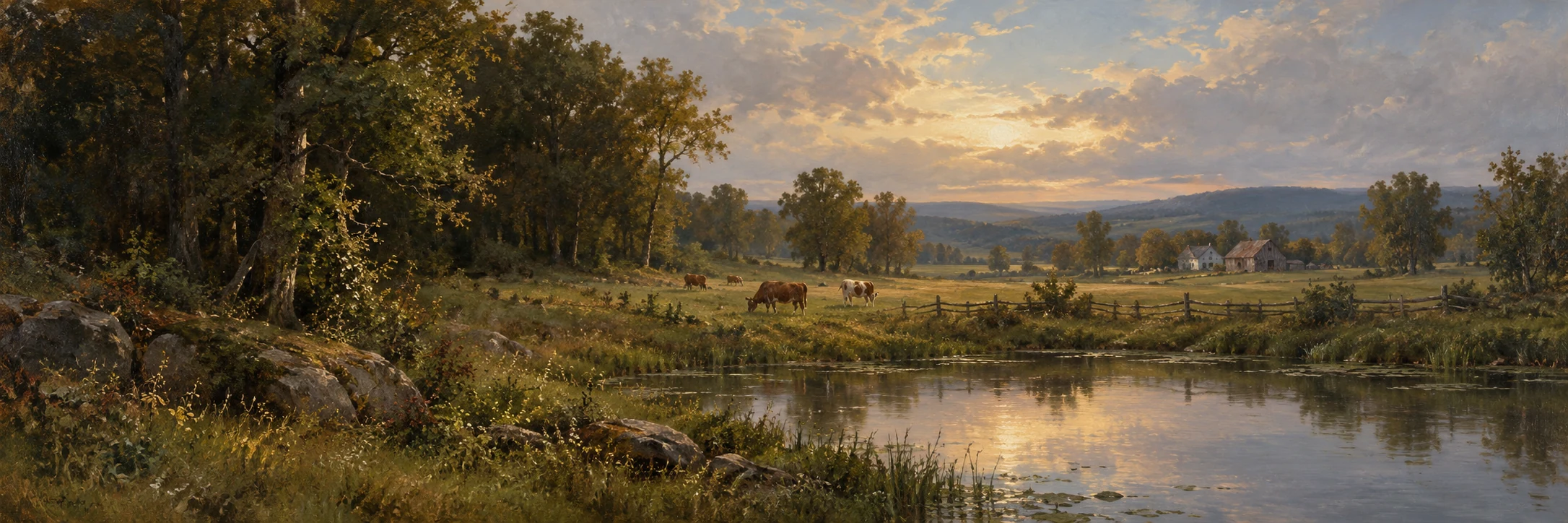
The original banner imagines a quiet meadow beside water, with a broad wooded mass, a few grazing cattle and a pale opening in the sky. Soft transitions connect the distances, while a small suggestion of farm activity keeps the landscape inhabited. It is a contemporary AI interpretation, not an attributed nineteenth-century painting or a documented location.
Influence travels; it does not arrive unchanged
The Metropolitan Museum’s account of the Hudson River School describes the growing appeal of a softer, more intimate French Barbizon approach in the United States and identifies George Inness as an important adapter. That connection helps explain a shift in emphasis without requiring a clean break between generations of landscape painters. [1]
An artist’s work can change over decades. Do not assign every painting by a familiar name to the same school, and do not assume that every American rural scene is Barbizon-influenced. Look for evidence in the particular work, its date and the artist’s documented encounters.
The label also does not mean “darker than the French version.” A limited palette, softened edges or a quiet subject may be useful observations, but none is a nationality test. The interesting question is how an artist organizes a landscape into a sustained visual experience.
Read the broad masses before the leaves
Begin with the proportion of sky to land. Notice whether the trees form a continuous mass or separate landmarks, and whether the light opens a passage through the scene. Small details become more convincing when these larger relationships already hold together.
Atmosphere is not simply blur. Nearby marks may be more distinct while distant shapes merge, but the transitions should support a believable spatial order. A few firm accents can prevent a softly handled landscape from becoming an indistinct wash.
Our banner places pale water beside darker foliage and lets the meadow carry the eye toward a quieter distance. The cattle provide scale without becoming a catalogue of animals. Its calm depends on intervals and grouped values, not on adding a brown filter to every surface.
A specific study: Eliza Pratt Greatorex
The Met dates Greatorex’s On the Hudson River, Near Idlewild to 1864 and explicitly connects its loosely handled foliage and river setting to Barbizon influence. The museum suggests that this oil-on-paper study was probably made outdoors in preparation for a finished studio landscape. That qualification matters: it is a curatorial assessment, not an eyewitness record of its making. [2]
Use the work to compare a study with your expectations of a finished picture. Quick marks can record a useful relationship without describing every leaf. The medium and purpose of the object help explain that economy better than calling it unfinished or careless.
Greatorex also broadens the entry beyond the same handful of canonical names. A documented object provides a stronger route into the subject than an expansive list of artists loosely associated with landscape.
Pastoral does not mean untouched
George Inness’s The Lackawanna Valley, dated about 1856 by the National Gallery of Art, was commissioned by a railroad company. The museum identifies cleared tree stumps, rail infrastructure and a landscape transformed by industry. It complicates any easy assumption that landscape painting simply celebrates untouched nature. [3]
Look for traces of work even in a quiet scene: a fence, a cleared margin, a path or managed animals. These details can change what apparently empty space means. Ask who uses the land and what the composition chooses to emphasize or leave outside its frame.
That question does not require every landscape to become an illustration of a single political claim. It asks the viewer to see atmosphere and material history together. Beauty and change can occupy the same field.
A practical study in atmosphere
Choose an ordinary local view and make a three-value sketch before adding colour. Group the largest masses, identify one light passage and reserve a few sharper accents. Then test how little detail is needed to make the distance readable.
If generating an interpretation, describe those relationships rather than requesting a generic old masterpiece. Check tree structure, water edges, animal scale and the transition between distances. Label the result honestly. A persuasive landscape study should reward looking at a place, not manufacture a provenance for it.
A small poetic detour
Original words from the AOI studio.
Poetry
The field lowers its voice.
A fence disappears into the trees.
Work has passed this way.
The prompt workshop
Original creative exercises. These prompts create new illustrations, not documentary evidence.
Start with masses
Paint an invented intimate rural landscape with three broad value groups: dark woodland, a middle-value meadow and pale water beneath a quiet sky. Earth colours, varied soft edges, a few firm accents. No copied painting.
Original AOI exercise; a generated image is not historical or documentary evidence.
Add an inhabited landscape
Develop the view with small grazing cattle, a modest fence and signs of a worked field. Preserve grouped values and atmospheric depth. Avoid picturesque clutter and exaggerated mountains.
Original AOI exercise; a generated image is not historical or documentary evidence.
Test the atmosphere
Create a second study with fewer leaf details and stronger relationships between light and dark masses. Compare distance and mood. Label the result as a contemporary AI interpretation.
Original AOI exercise; a generated image is not historical or documentary evidence.
People & works to explore
References discussed in this article. Consult the sources below for context.
Artists and practitioners
George Inness — American landscape and Barbizon influence
Eliza Pratt Greatorex — a documented Barbizon-influenced landscape study
Paintings and other works
On the Hudson River, Near Idlewild (1864)
The Lackawanna Valley (c. 1856)