
Art history · academic standards and the institutions behind them
Academicism describes the values and conventions associated with art academies: trained drawing, the study of earlier art, carefully organised composition and judgments about which subjects deserve ambitious treatment. Its history is larger than a smooth paint surface. To understand it, look at the schools, exhibitions and systems of recognition that helped decide what counted as accomplished art.
A visual introduction
Select an image for a closer look. Use the thumbnails, arrow keys or a swipe to compare examples. Zoom in to inspect details, or share the image that inspires you.
Creative toolbox · take this style further
Choose an input and a destination. Search sends your words to the chosen site; Copy & open puts them on your clipboard to paste there.
Create with AI
Turn your chosen input into an image prompt or a new creative direction.
ChatGPT
Copy your input and paste it into a ChatGPT conversation or image request.
Copy & open ChatGPT (new tab)Claude · Anthropic
Develop an image prompt or explore the style in a new Claude conversation.
Copy & open Claude · Anthropic (new tab)Midjourney
Paste your input into the Imagine bar on the Create page.
Copy & open Midjourney (new tab)Adobe Firefly
Copy your input, open Firefly, and paste it into the prompt field.
Copy & open Adobe Firefly (new tab)Leonardo.Ai
Copy your input, open Leonardo, and paste it into the generation field.
Copy & open Leonardo.Ai (new tab)Image search
Find visual references. Short, concrete keywords usually work best.
Lexica
Search AI images and prompts using your selected input.
Search with this input Lexica (new tab)Pexels
Search the photo and video library. Short keywords often work best.
Search with this input Pexels (new tab)Pixabay
Search photos, illustrations and other images.
Search with this input Pixabay (new tab)Unsplash
Search photographs using the style name or your own keywords.
Search with this input Unsplash (new tab)Wikimedia Commons
Search photographs, artworks and historical images. Check each file for its source and reuse terms.
Search with this input Wikimedia Commons (new tab)Art & research
Explore artists, collections and the ideas behind a style.
Wikipedia
Search for background reading. A style may not have its own article.
Search with this input Wikipedia (new tab)WikiArt
Copy your input into WikiArt’s search to explore artists and artworks.
Copy & open WikiArt (new tab)Europeana
Paste your keywords into the search to explore European museum, library and archive collections.
Copy & open Europeana (new tab)Inspiration
Discover portfolios and visual ideas from creative communities.
Instagram hashtags
Search a hashtag made from your input: spaces and punctuation are removed. Instagram may require sign-in.
Search with this input Instagram hashtags (new tab)ArtStation
Paste your input into artwork search for concept art, environments, characters and visual development.
Copy & open ArtStation (new tab)Behance
Paste your input into project search for illustration, design and visual storytelling.
Copy & open Behance (new tab)A closer look
Trained drawing, coherent anatomy, controlled modelling and deliberate composition can give academic work its persuasive finish. The new gallery separates tonal study, portraiture, narrative, drapery and architectural space. Its images are modern AI-generated interpretations; the earlier atelier banner remains as an archive illustration.
An institutional history, not a reaction invented in the 1890s
The Met dates the French Royal Academy to 1648 and the British Royal Academy to 1768. Its account links academic authority to training, exhibitions and professional advancement. Academicism therefore cannot sensibly be described as a late-nineteenth-century invention reacting to Impressionism: its institutions and ideals had much longer histories. [1]
Dates need their institutional names attached. The royal academy founded in seventeenth-century France should not be casually renamed as a later institution. Likewise, “the Academy” can mean different organisations in different places. A useful account names the body and the period before making claims about its rules.
Academicism is also a critical label. Writers may use it to praise discipline or criticise convention. Neither use gives us permission to replace a definition with insults. “Pedantry” and “pomposity” describe judgments somebody makes; they are not alternative names for a historical artistic practice.
The hierarchy of subjects and the public exhibition
The Musée d’Orsay’s account of the Salon discusses the hierarchy of genres formulated by Félibien in 1667, in which history painting held the highest position. [4] History painting included elevated narrative subjects rather than only events from a recent national past. Such rankings helped structure expectations about ambition and achievement.
A hierarchy explains an institutional value system; it does not prove that a still life is inherently less demanding or a large historical scene inherently better. When looking today, separate the prestige attached to a subject from the quality of the particular image. A grand theme still needs intelligible staging, and a quiet object can sustain close attention.
What the finished picture asks of its maker
Begin with relationships: the weight of a standing body, the turn of a head, the position of a hand and the direction of light. In a carefully constructed figurative painting, these must cooperate. Surface polish cannot repair a shoulder that belongs to a different pose or a cast shadow that contradicts its object.
An idealised figure is not simply a photograph rendered with a brush. Proportions, gestures and setting can be adjusted to serve a narrative or an inherited ideal. That distinction helps explain why naturalistic detail and deliberate invention can coexist in the same picture. Ask what has been observed and what has been organised.
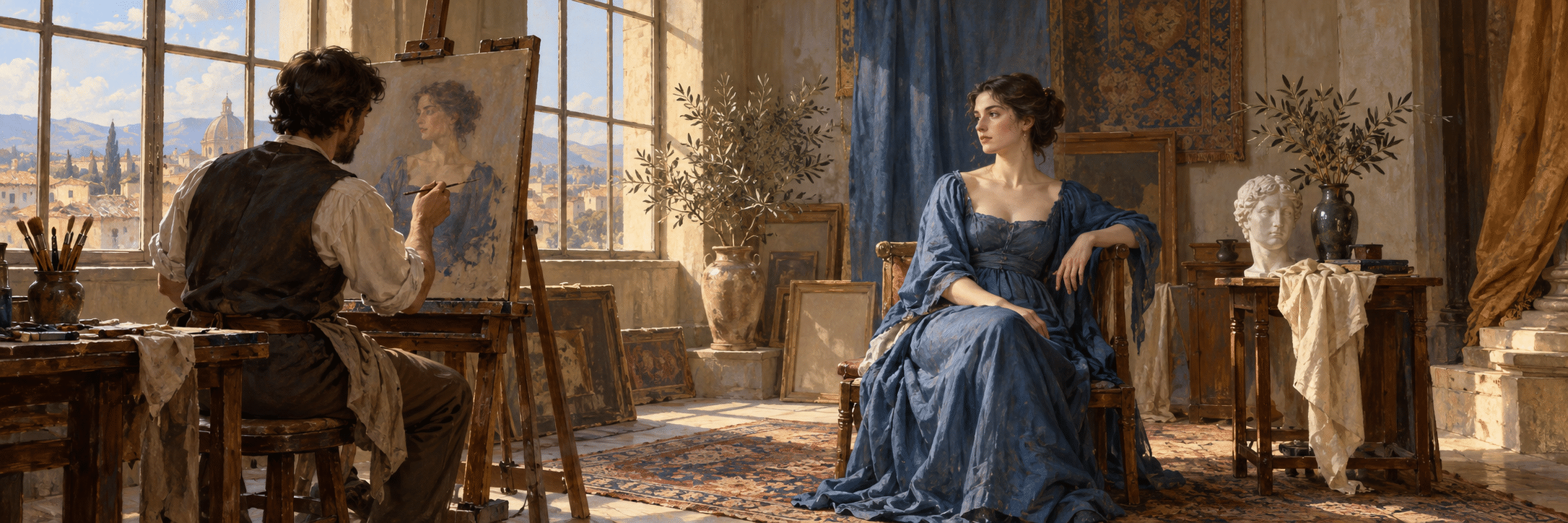
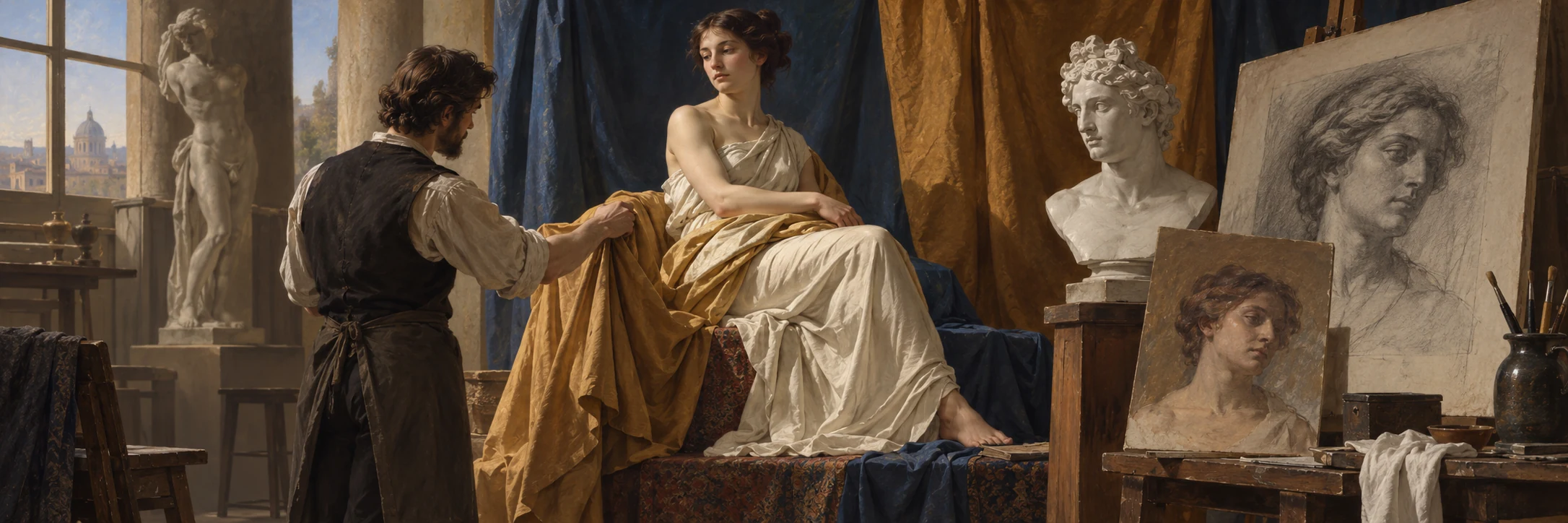
In the retained earlier atelier banner, the pale drapery separates the seated model from the dark blue background, while the artist’s arm links the two figures. The head studies on the right slow the eye and suggest repeated examination. These are observations about our synthetic illustration, not evidence that all academic studios looked alike.
Read one documented work carefully
Alexandre Cabanel’s The Birth of Venus at The Met is dated 1875. The museum identifies it as a smaller replica commissioned by John Wolfe of Cabanel’s celebrated 1863 painting. Keeping those dates distinct matters: a later version is not the original Salon exhibit merely because the title and composition recur. [2]
Use the collection image to examine the continuous modelling of the body, the arrangement of figures and the relationship between the mythological subject and the viewer. A historical title supplies context; it does not end the analysis. Consider how finish directs attention and how the subject grants permission for a particular kind of display.
This is more informative than assigning every famous nineteenth-century painter to one camp. Shared training, academy membership, Salon participation and a recognisably academic manner are related facts, but they are not interchangeable tests. Artist lists should explain the connection they claim.
Skill and access belong in the same account
The Met’s study of women artists notes that women were excluded from the state-sponsored École des Beaux-Arts until 1897 and often sought training elsewhere. Access to instruction was therefore part of the story of artistic opportunity, not merely background to individual talent. [3]
An institution can cultivate demanding skills while limiting who receives recognition. Both observations can be true. Avoid the tidy plot in which academic painters possess technique but no imagination, while every opponent possesses imagination but no training. Those characters are convenient for a lecture and inadequate for history.
A useful study for the present
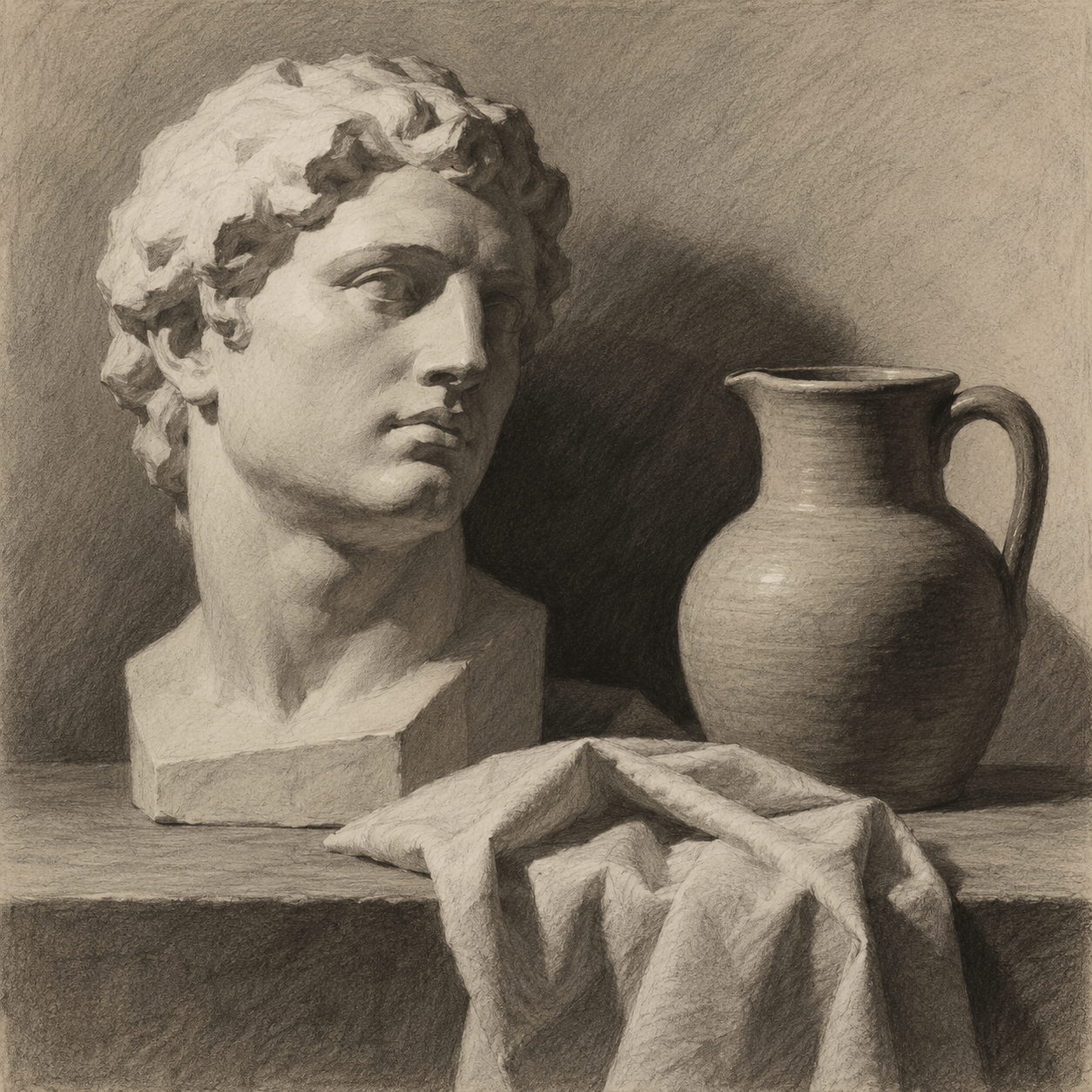
Arrange a cloth, a simple vessel and a plaster-like form under one lamp. Make a five-value drawing before introducing colour. Identify the darkest connected shape, the principal light and the interval between objects. Then alter only one element and decide whether the composition becomes clearer.
With an image model, describe the arrangement, lighting and degree of finish rather than requesting “a masterpiece.” Inspect anatomy, perspective and reflected light. Keep the result labelled as a modern interpretation and retain your reference notes. The machine can propose a finish in seconds; deciding whether the picture holds together still requires looking.
Five studies: preparation, finish and pictorial space
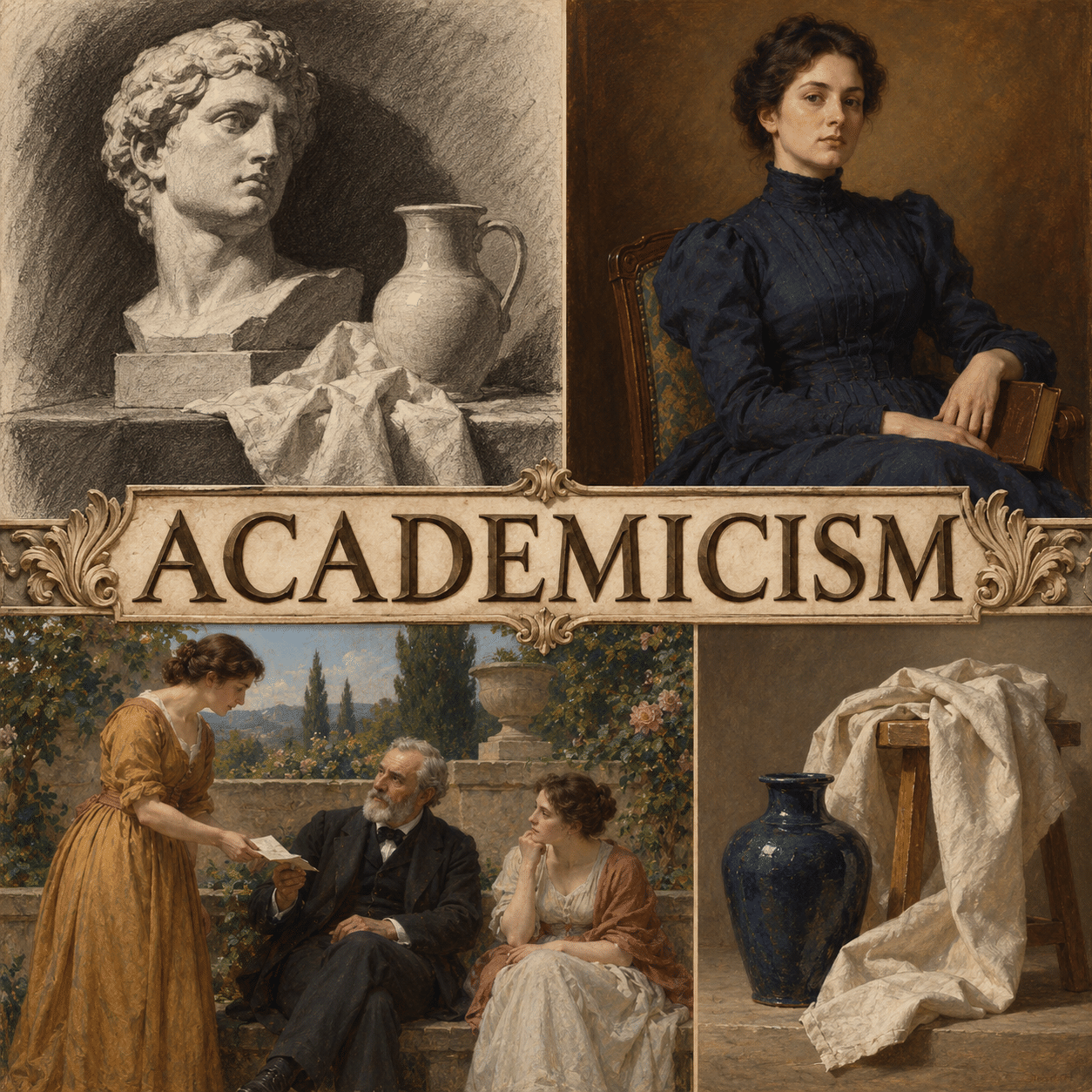
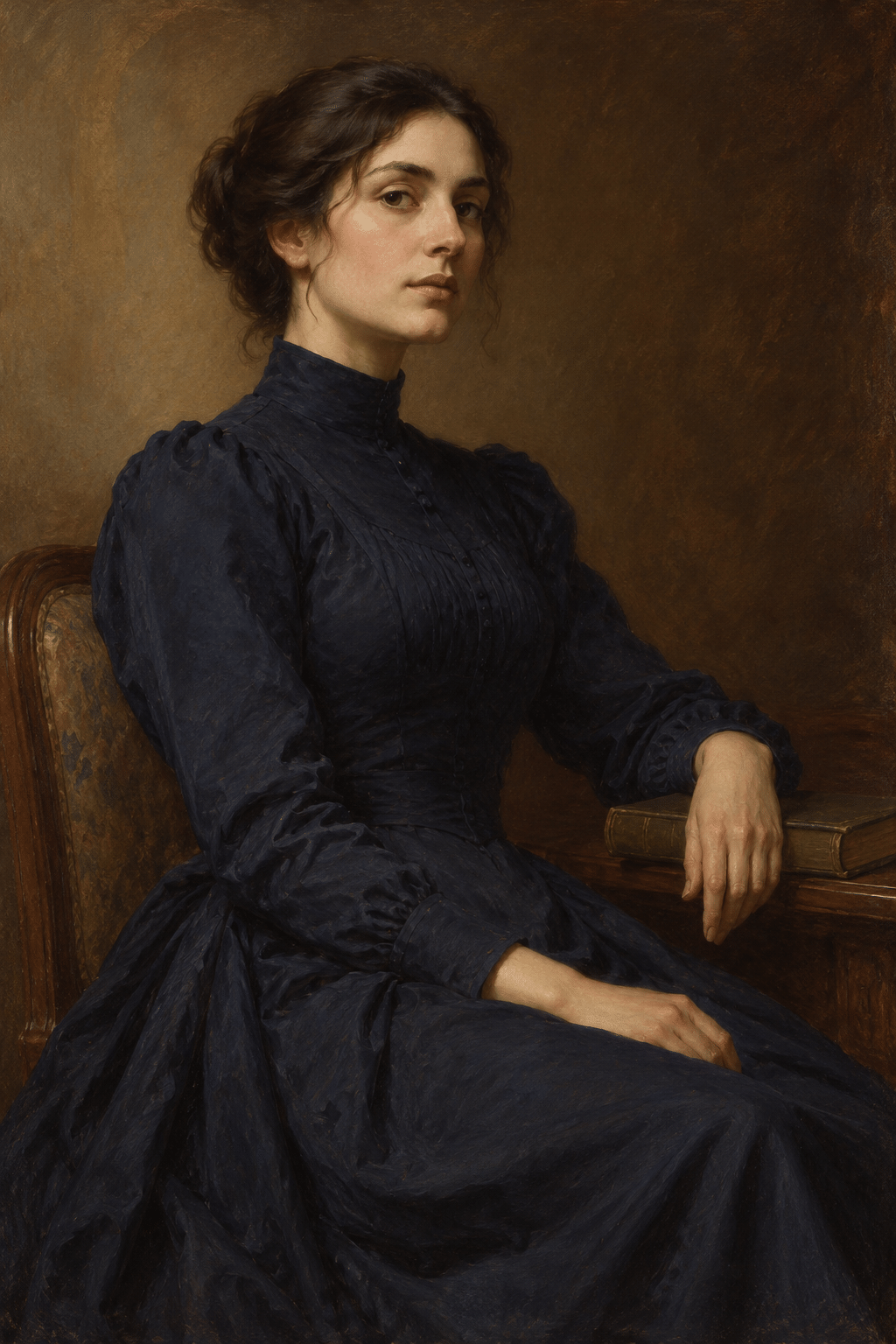
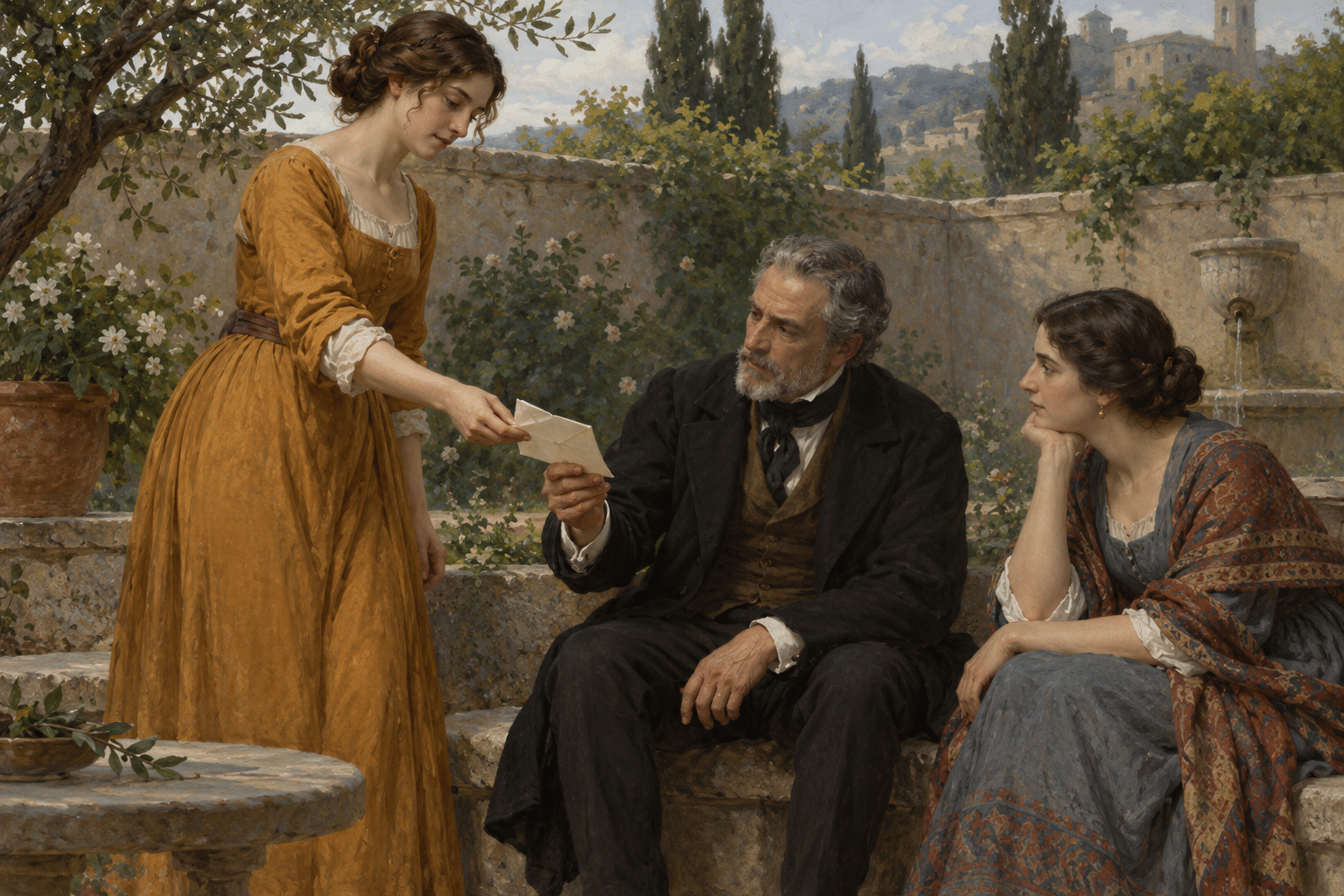
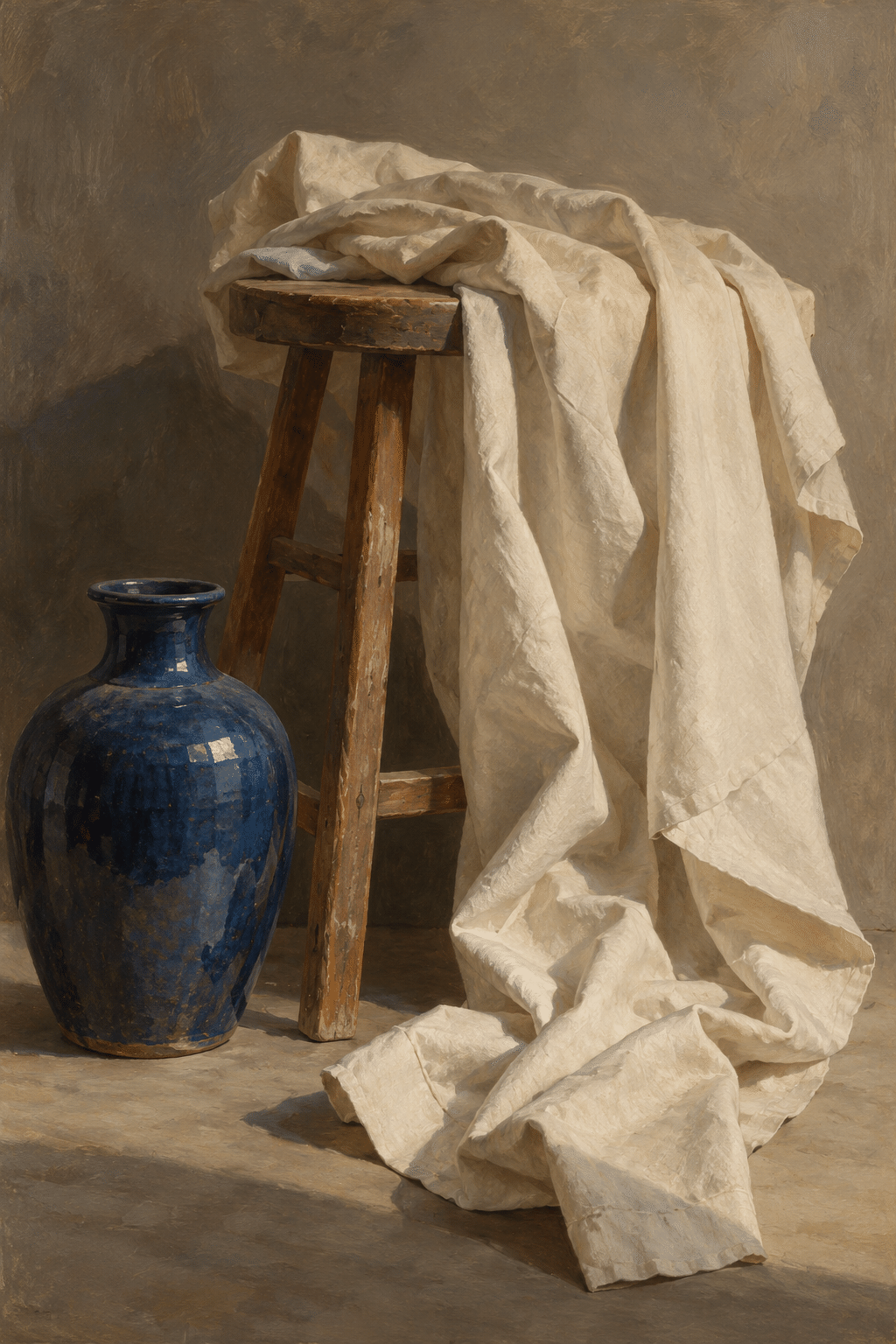
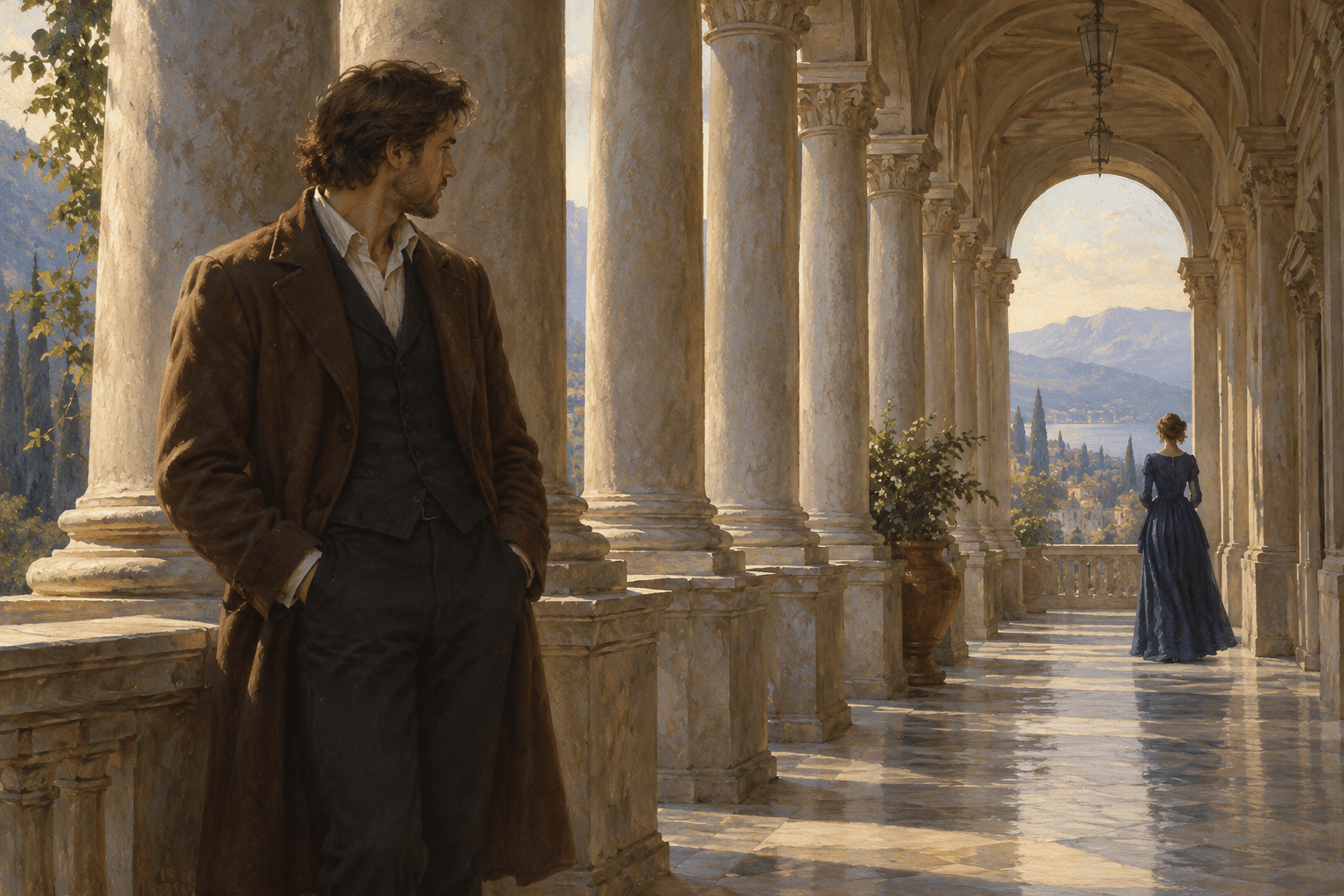
The charcoal still life makes value structure visible before colour. The portrait tests the relation between a face, clothing and a restrained background. Three adults examining a letter form an invented narrative whose meaning depends on gaze and gesture. A drapery study isolates folds and reflected light. A colonnade scene makes perspective and the scale of figures carry the composition.
The new banner imagines an artist painting a clothed adult sitter in a studio. None of these scenes documents a specific historical class, Salon entry or artist’s work. The point is to test the visual decisions discussed in the article, not to fabricate an academic pedigree. The central collage makes the range of exercises easy to compare.
Finish is a means, not a verdict
A smooth passage can keep attention on a gesture or the turning of a form. It can also conceal a weak decision beneath an attractive surface. Try viewing the image at thumbnail size or in greyscale: does the main action survive, and do its connected dark and light shapes still make sense?
The opposite shortcut is just as weak: visible brushwork does not automatically demonstrate freedom or sincerity. Judge the marks by what they do for the picture. An account of academicism becomes more useful when technical discipline, institutional power and individual invention remain distinct questions.
Positive editorial assessment — AI-authored
Academic preparation offers a demanding framework for connecting anatomy, light, space and narrative. Its strongest results make complex staging feel clear. Studying the construction behind a polished surface can improve an artist’s decisions even when the eventual work takes a very different direction.
Critical editorial assessment — AI-authored
Polish can become a substitute for urgency, and inherited ideals can narrow whose bodies, stories and skills receive recognition. A serious study should examine exclusions and conventions alongside craftsmanship. For generated imagery, convincing finish must never excuse inconsistent anatomy or fabricated historical attribution.
Neutral editorial assessment — AI-authored
Academicism refers to conventions and values associated with academies and systems of recognition. Their histories differ by place and period. This article combines a focused institutional account with practical visual exercises; the companion Academic Art page concentrates more closely on training and making.
A small poetic detour
Original words from the AOI studio.
Poetry
The charcoal line is rubbed away.
Its patient correction
remains in the painted hand.
A fold returns the borrowed light,
a shoulder settles into place;
the finished surface keeps from sight
the questions that have shaped the face.
The prompt workshop
Original creative exercises. These prompts create new illustrations, not documentary evidence.
Start with values
Create an original study of draped cloth, a ceramic vessel and a plaster bust under one side light. Five clear tonal values, coherent perspective, quiet background, no lettering.
Original AOI exercise; a generated image is not historical or documentary evidence.
Build a figurative composition
Create an invented atelier scene with two clothed adults, a stable triangular arrangement, carefully modelled hands, warm ochre and cool blue, restrained oil-painted finish. No historical attribution or copied painting.
Original AOI exercise; a generated image is not historical or documentary evidence.
Inspect the construction
Compare a drawing and painted version of the same invented still life. Keep the light source and object positions fixed. Identify inconsistent shadows, overlaps or perspective before adding detail.
Original AOI exercise; a generated image is not historical or documentary evidence.
People & works to explore
References discussed in this article. Consult the sources below for context.
Artists and practitioners
Alexandre Cabanel — documented example discussed in this guide
Paintings and other works
Alexandre Cabanel, The Birth of Venus (1875) — later replica; distinguish the 1863 original
A smile from the studio
Jokes
The portrait requested one more finishing touch. The preparatory drawing asked whether anyone had finished deciding where the elbow belonged.
Sources and further exploration
[1] The Metropolitan Museum of Art — The Salon and the Royal Academy in the Nineteenth Century
[2] The Metropolitan Museum of Art — Alexandre Cabanel, The Birth of Venus (1875)
[3] The Metropolitan Museum of Art — Women Artists in Nineteenth-Century France
[4] Musée d’Orsay — Salon, criticism and the hierarchy of genres