
Art practice · preparation, observation and pictorial construction
Academic art refers to work shaped by the teaching, conventions and ambitions of art academies. This guide concentrates on making: how observation, drawing, studies and compositional decisions can support a finished image. The companion Academicism entry examines institutions and authority. Here the central question is practical: what has to be understood before a convincing surface can be built?
Creative toolbox · take this style further
Choose an input and a destination. Search sends your words to the chosen site; Copy & open puts them on your clipboard to paste there.
Create with AI
Turn your chosen input into an image prompt or a new creative direction.
ChatGPT
Copy your input and paste it into a ChatGPT conversation or image request.
Copy & open ChatGPT (new tab)Claude · Anthropic
Develop an image prompt or explore the style in a new Claude conversation.
Copy & open Claude · Anthropic (new tab)Midjourney
Paste your input into the Imagine bar on the Create page.
Copy & open Midjourney (new tab)Adobe Firefly
Copy your input, open Firefly, and paste it into the prompt field.
Copy & open Adobe Firefly (new tab)Leonardo.Ai
Copy your input, open Leonardo, and paste it into the generation field.
Copy & open Leonardo.Ai (new tab)Image search
Find visual references. Short, concrete keywords usually work best.
Lexica
Search AI images and prompts using your selected input.
Search with this input Lexica (new tab)Pexels
Search the photo and video library. Short keywords often work best.
Search with this input Pexels (new tab)Pixabay
Search photos, illustrations and other images.
Search with this input Pixabay (new tab)Unsplash
Search photographs using the style name or your own keywords.
Search with this input Unsplash (new tab)Wikimedia Commons
Search photographs, artworks and historical images. Check each file for its source and reuse terms.
Search with this input Wikimedia Commons (new tab)Art & research
Explore artists, collections and the ideas behind a style.
Wikipedia
Search for background reading. A style may not have its own article.
Search with this input Wikipedia (new tab)WikiArt
Copy your input into WikiArt’s search to explore artists and artworks.
Copy & open WikiArt (new tab)Europeana
Paste your keywords into the search to explore European museum, library and archive collections.
Copy & open Europeana (new tab)Inspiration
Discover portfolios and visual ideas from creative communities.
Instagram hashtags
Search a hashtag made from your input: spaces and punctuation are removed. Instagram may require sign-in.
Search with this input Instagram hashtags (new tab)ArtStation
Paste your input into artwork search for concept art, environments, characters and visual development.
Copy & open ArtStation (new tab)Behance
Paste your input into project search for illustration, design and visual storytelling.
Copy & open Behance (new tab)A closer look
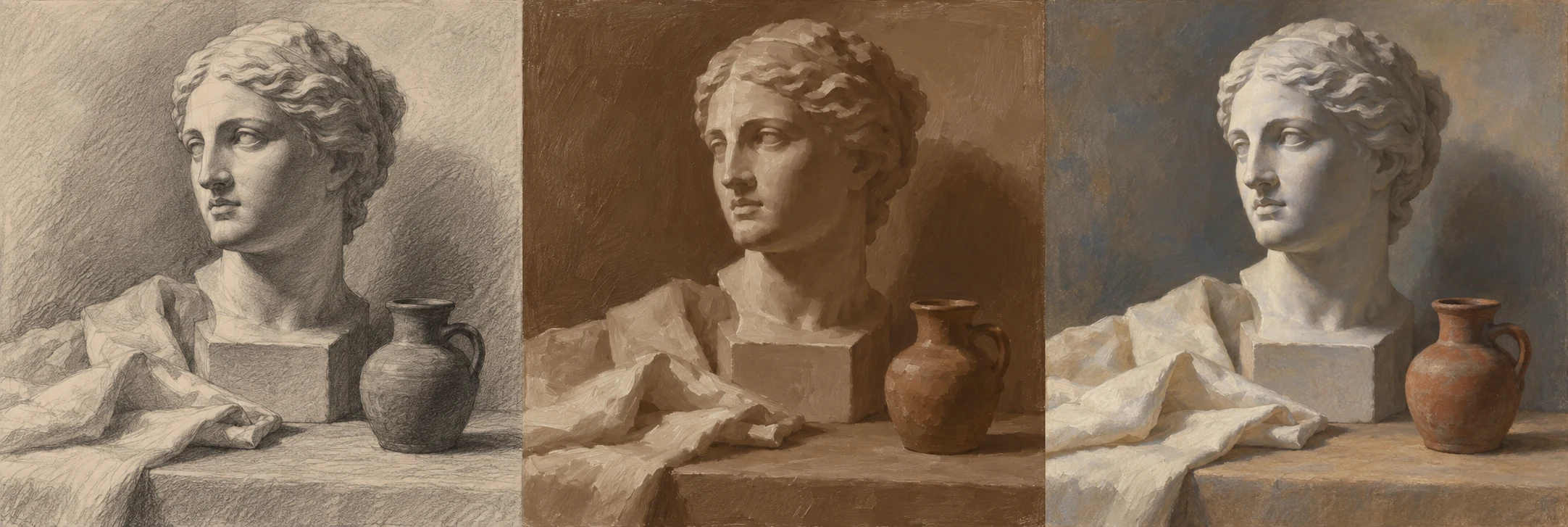
The new banner presents three invented treatments of a simple studio arrangement: a charcoal study, a tonal painted study and a more fully coloured version. Drapery, a pale sculptural head and a vessel provide forms to compare. This is a modern teaching illustration, not a reconstructed historical lesson or a record of an actual painting process.
Preparation is not the opposite of invention
A finished picture can hide the decisions that made it possible. A shoulder looks inevitable; a fold seems effortlessly placed. Yet an image may depend on changes of scale, studies of individual forms, rejected arrangements and repeated comparisons. Smoothness is a surface quality, not a complete account of the work.
The Met’s essay on the nineteenth-century sketch explains the role of the esquisse, a preparatory oil sketch used to establish composition and colour. It also describes the tension between the freshness admired in sketches and the expectations placed on finished paintings. Academic practice therefore cannot be reduced to slowly polishing every mark from the outset. [1]
A study has a purpose. One may investigate the turn of a head; another may test the distribution of light across a whole scene. It need not solve every problem at once. The discipline lies partly in knowing what question a particular study is meant to answer.
Draw relationships before details
Begin by comparing the largest shapes. Where does the subject sit within the rectangle? How wide is the gap beside it? Which edge establishes its direction? A carefully drawn eyelash cannot rescue a head that is too large for the composition.
For a still life, mark the principal heights and widths lightly, then check them against one another. Look at the negative shapes between objects as carefully as the objects themselves. These spaces often reveal a mistaken angle more quickly than staring harder at the contour.
Move from contour to value. Group the large lights and darks before introducing a full range of intermediate tones. This is a practical exercise offered by AOI, not a claim that every historical academy followed one identical sequence. Teaching varied by institution, period, teacher and medium.
A sketch can organise a larger ambition
The Met illustrates its discussion with Pierre Charles Jombert’s The Punishment of the Arrogant Niobe by Diana and Apollo, dated about 1772. It uses the work to explain how a small preparatory painting can establish a larger picture’s arrangement without completing all its detail. Study the museum image for the relation between broad masses and the intended narrative. [1]
The lesson for a present-day maker is not that every work requires a mythological subject. It is that a picture can be tested at a scale where the important relationships remain visible. If the main action cannot be read in a thumbnail, extra texture may only make the confusion more elaborate.
Try several small alternatives before committing to one. Shift a vessel, lower a horizon or turn a figure slightly. Compare the effect rather than assuming that the first arrangement has acquired authority simply because you have already spent time on it.
Finish is a decision about emphasis
In our banner, the three versions make different kinds of information available. The drawing emphasises edges and proportion; the tonal study organises light; the coloured version adds temperature and material contrast. Each can be judged on its own terms rather than treated as an inferior copy of the last.
A highly resolved area can attract attention, while a quieter passage can support it. Finishing everything equally may flatten that hierarchy. Ask where the viewer should pause and where the eye should move on. Precision is most useful when it serves a considered arrangement.
Do not assume that academy training, Salon exhibition and a polished manner are identical credentials. The Met’s account of the Salon and academies places teaching and exhibition within systems of professional recognition. Those systems provide context, but individual works still require close examination. [2]
A contemporary exercise, including AI
Set up one vessel, a folded cloth and a simple sculptural form under a single light. Make a small line study, a five-value study and a restrained colour study. Keep a note of what changed between stages and why.
For a generated interpretation, request the same arrangement in those three modes and inspect whether the objects actually remain consistent. Models may alter proportions or lighting while simulating continuity. The exercise succeeds when you can identify the change, explain its consequence and choose deliberately what to keep.
Use separate studies to answer separate questions
Give each preparatory drawing a limited job. A contour study can investigate proportion, a small tonal sketch can test the distribution of light, and a colour study can compare the main temperature relationships. Trying to solve all three at once may hide which decision is actually causing difficulty.
Write a short question beside each study: does the raised arm remain clear against the background, or does the brightest area draw attention away from the intended action? A useful study produces an answer or exposes a better question. It need not resemble a miniature finished painting.
Keep revision visible in the final decisions
Compare the finished image with the earliest sketch. Identify one relationship that improved and one expressive quality that became weaker. A more accurate surface can sometimes lose the initial rhythm of the pose. Recover that rhythm through placement and emphasis rather than deliberately introducing anatomical errors. Preparation is most valuable when it supports a specific pictorial purpose.
A small poetic detour
Original words from the AOI studio.
Poetry
Before the satin shines,
three dark shapes agree
where the light may enter.
The prompt workshop
Original creative exercises. These prompts create new illustrations, not documentary evidence.
Start with a drawing
Create an original charcoal study of a plaster-like sculptural head, a folded cloth and a ceramic vessel under one side light. Clear proportions and negative shapes, restrained detail, no lettering.
Original AOI exercise; a generated image is not historical or documentary evidence.
Build a tonal study
Show the same invented arrangement as a five-value painted study. Preserve the object positions, camera angle and light direction. Group the major shadow masses before adding small reflected lights.
Original AOI exercise; a generated image is not historical or documentary evidence.
Compare stages
Create a three-part study of one still life: line, tonal painting and restrained colour. Maintain the same proportions and overlaps. Inspect continuity rather than assuming the stages document a real process.
Original AOI exercise; a generated image is not historical or documentary evidence.
People & works to explore
References discussed in this article. Consult the sources below for context.
Artists and practitioners
Pierre Charles Jombert — preparatory painting discussed by The Met
Paintings and other works
Pierre Charles Jombert, The Punishment of the Arrogant Niobe by Diana and Apollo (about 1772)