
Literary modernism · visual interpretation clearly labelled
Sumatraism belongs first to the literary world of Miloš Crnjanski. His poem Sumatra and its accompanying explanation, dated 1920, connect distant places through memory, loss and unexpected affinities. This guide introduces that poetic idea and then proposes an original visual exercise. It does not identify an Indonesian painting school or a religion. [1]
A visual introduction
Open any image to look closer, then browse the examples.
Creative toolbox · take this style further
Choose an input, adjust it, then open a tool. Search links pass your text to the destination. Copy & open copies it for you to paste into the generator; you start generation there.
ChatGPT
Copy your input and paste it into a ChatGPT conversation or image request.
Copy & open ChatGPT (new tab)Claude · Anthropic
Develop an image prompt or explore the style in a new Claude conversation.
Copy & open Claude · Anthropic (new tab)Midjourney
Paste your input into the Imagine bar on the Create page.
Copy & open Midjourney (new tab)Adobe Firefly
Copy your input, open Firefly, and paste it into the prompt field.
Copy & open Adobe Firefly (new tab)Leonardo.Ai
Copy your input, open Leonardo, and paste it into the generation field.
Copy & open Leonardo.Ai (new tab)Lexica
Search AI images and prompts using your selected input.
Search with this input Lexica (new tab)Pexels
Search the photo and video library. Short keywords often work best.
Search with this input Pexels (new tab)Pixabay
Search photos, illustrations and other images.
Search with this input Pixabay (new tab)Unsplash
Search photographs using the style name or your own keywords.
Search with this input Unsplash (new tab)Wikipedia
Search for background reading. A style may not have its own article.
Search with this input Wikipedia (new tab)WikiArt
Copy your input into WikiArt’s search to explore artists and artworks.
Copy & open WikiArt (new tab)Instagram hashtags
Search a hashtag made from your input: spaces and punctuation are removed. Instagram may require sign-in.
Search with this input Instagram hashtags (new tab)A closer look
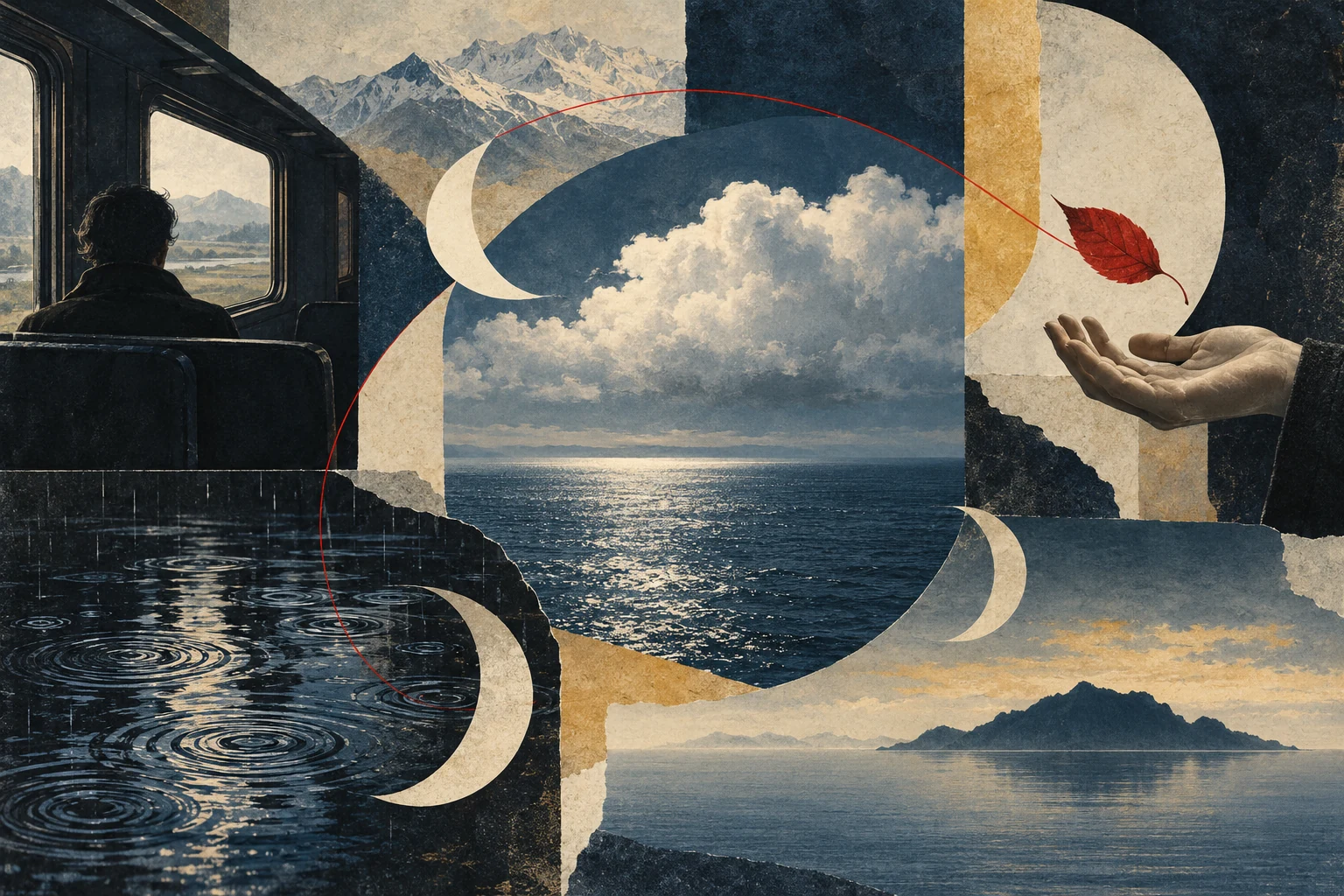
Our new illustration connects a traveller, mountain ridge, cloud, sea, leaf, open hand and rain ripples through repeated curves and a fine red line. The collage is a contemporary AI interpretation of connection across distance, not a period illustration, a map or an image made by Crnjanski.
Start with the literary source
The Travel Club publishes Sumatra and The Explanation of Sumatra in an English translation credited to Lazar Pašćanović. In the prose account, an encounter with a returning friend and a difficult train journey lead into associations between separation, landscapes and faraway places. Read the poem together with this prose rather than extracting the island’s name as a visual recipe. [1]
A title can act as a point of imaginative departure. It need not define the physical setting of every scene, the nationality of an artistic school or the materials of an image. That matters on a style website, where a compact label is easily mistaken for a complete description. Here, the label directs us toward a particular writer and a problem of relation.
Connection does not erase dislocation
In her 2025 study, Sanja Roić describes Crnjanski’s Sumatraism as a poetic-philosophical vision involving cosmopolitanism and the transformation of suffering. Her account places his writing within Mediterranean cultural encounters and questions of displacement and identity. This is a scholarly interpretation, not a claim that the concept has a single uncontested visual meaning. [2]
For a reader, the interesting tension is between the wish to feel connected and the experience of being separated. Treating the idea as a cheerful message that everything belongs together would remove that tension. A persuasive interpretation can retain the difficulty: a line may join two panels while their scale, light or viewpoint still refuses to settle into one seamless world.
How we translate an idea into a collage
The illustration above is our editorial response. The train window provides a bounded view, while the central sea opens into distance. The hand and leaf give the eye something small and close against those larger spaces. Repeated arcs let the separate panels answer one another without pretending they are adjacent places.
None of these formal choices is an authorised Sumatraist palette, compositional law or historic painting technique. They are choices made for this guide. A useful visual interpretation should be able to explain its relationship to a text without claiming that the text supplied a ready-made image. The distinction gives the illustrator freedom while keeping the literary source intact.
What this entry needed to correct
Earlier versions of this page confused Sumatraism with a supposed Indonesian visual movement and included an unsupported religious doctrine. Those accounts and the associated artist lists have been withdrawn. The name of the island is not evidence for those claims. The older decorative collage remains in the archive as part of the record, but it no longer leads this introduction.
Art made in or connected with Sumatra deserves its own researched accounts of particular communities, makers, media and histories. This literary guide cannot stand in for them. Likewise, the new collage is not ethnographic evidence. The most useful correction is to return the term to its documented context and make the limits of our subsequent creative interpretation visible.
An exercise in correspondence
Choose two places you know and a third you have encountered only through a reliable photograph or description. List one small observable detail from each: a surface, a colour relationship, an interrupted line. Create three separate frames and let one detail recur in altered form. Resist joining them with a literal map unless mapping is actually your subject.
Write a short caption explaining why the details belong together for you. Do not borrow Crnjanski’s lines and present them as your own; an original response can begin from a question without copying an answer. If using AI, label the generated study and preserve the source and prompt alongside it. The aim is a relation the viewer can discover, with enough distance left for the discovery to matter.
A small poetic detour
Original words from the AOI studio.
Poetry
A ticket folds.
Across the table, an empty cup
keeps room for someone else.
The prompt workshop
Original creative exercises. These prompts create new illustrations, not documentary evidence.
A visual response, not a historical style
Create an original three-panel collage about distance and remembered connection: a window, an empty table and a distant shoreline. Repeat one curved shadow across the separate frames, restrained blue and ivory, one warm accent, paper texture, no text, no map and no cultural costume. Contemporary literary response, not an authentic historical artwork.
Original AOI exercise; model output varies. Label generated results as synthetic.
A writing exercise
Write six original lines about two separated places connected by one ordinary object. Keep the link implied through a repeated detail. Do not quote or imitate a passage from an existing poem.
Original AOI exercise; model output varies. Label generated results as synthetic.
People & works to explore
References discussed in this article. Consult the sources below for context.
Artists and practitioners
Miloš Crnjanski — writer associated with Sumatraism
Lazar Pašćanović — translator of the linked English text
Paintings and other works
Sumatra (1920) — poem
The Explanation of Sumatra (1920) — accompanying prose