
Chicana art theory · memory, gender and the public life of domestic objects
Domesticana is Amalia Mesa-Bains’s critical approach to Chicana artistic practices and domestic space. It brings memory, women’s agency and the cultural work of the home into the discussion of art. A room full of personal objects is not automatically domesticana; the concept asks us to examine what those objects make visible and whose experience they carry. [1]
A visual introduction
Open any image to look closer, then browse the examples.
Creative toolbox · take this style further
Choose an input, adjust it, then open a tool. Search links pass your text to the destination. Copy & open copies it for you to paste into the generator; you start generation there.
ChatGPT
Copy your input and paste it into a ChatGPT conversation or image request.
Copy & open ChatGPT (new tab)Claude · Anthropic
Develop an image prompt or explore the style in a new Claude conversation.
Copy & open Claude · Anthropic (new tab)Midjourney
Paste your input into the Imagine bar on the Create page.
Copy & open Midjourney (new tab)Adobe Firefly
Copy your input, open Firefly, and paste it into the prompt field.
Copy & open Adobe Firefly (new tab)Leonardo.Ai
Copy your input, open Leonardo, and paste it into the generation field.
Copy & open Leonardo.Ai (new tab)Lexica
Search AI images and prompts using your selected input.
Search with this input Lexica (new tab)Pexels
Search the photo and video library. Short keywords often work best.
Search with this input Pexels (new tab)Pixabay
Search photos, illustrations and other images.
Search with this input Pixabay (new tab)Unsplash
Search photographs using the style name or your own keywords.
Search with this input Unsplash (new tab)Wikipedia
Search for background reading. A style may not have its own article.
Search with this input Wikipedia (new tab)WikiArt
Copy your input into WikiArt’s search to explore artists and artworks.
Copy & open WikiArt (new tab)Instagram hashtags
Search a hashtag made from your input: spaces and punctuation are removed. Instagram may require sign-in.
Search with this input Instagram hashtags (new tab)A closer look
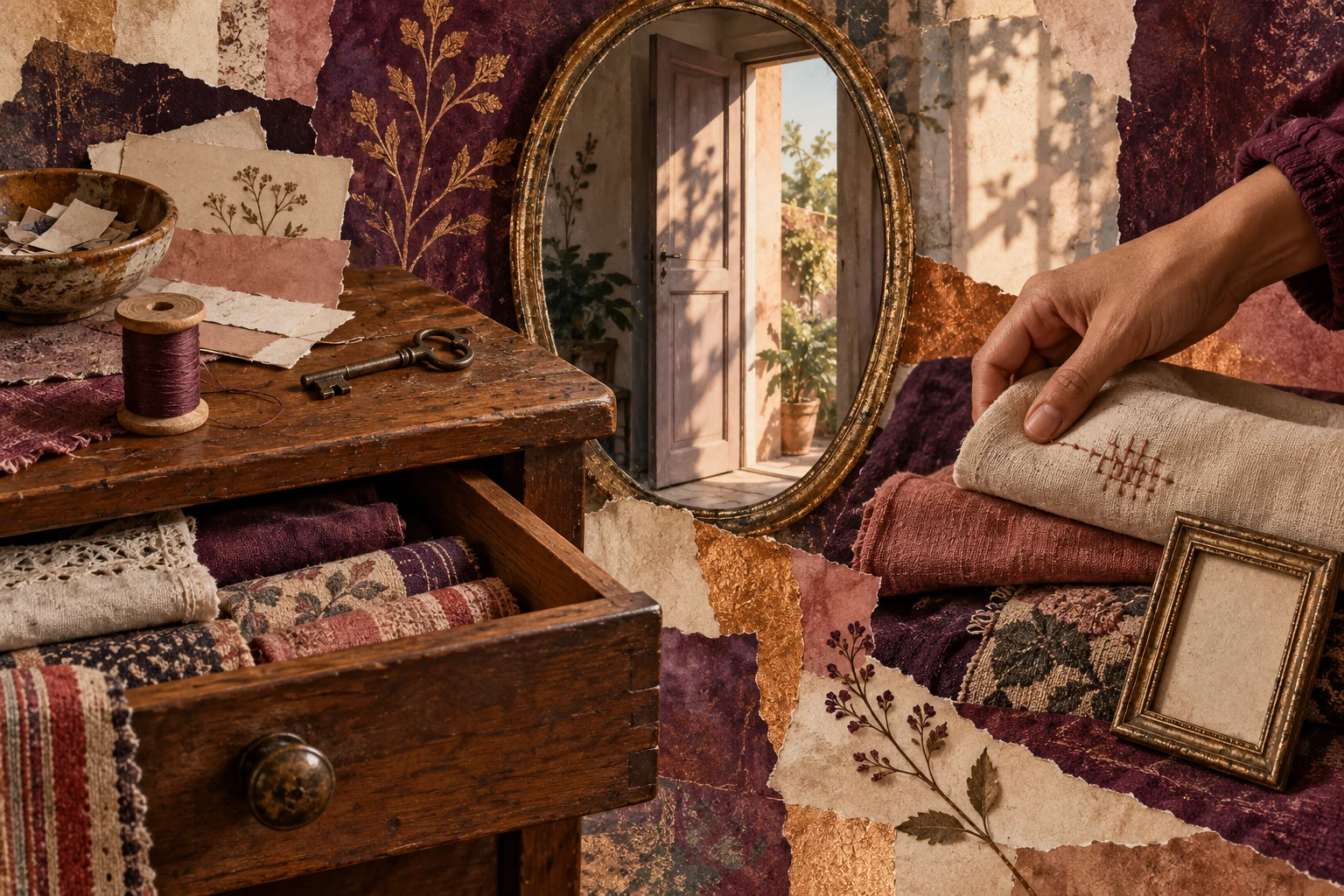
Our invented collage links an open drawer of folded fabrics, a mirror reflecting a doorway and a hand arranging a repaired cloth. The key, thread and empty frame suggest keeping, making and remembering. The image is a conceptual study, not a reconstruction of an altar or a work by Mesa-Bains.
Where the term comes from
The ICAA record describes Domesticana: The Sensibility of Chicana Rasquache as Mesa-Bains’s extension of the rasquachismo discussion. It traces an initial 1992 text through a 1995 online publication to the revised 1999 version in Aztlán. Those dates describe the text’s development, not the beginning of women’s domestic creativity. [1]
That distinction prevents a familiar historical shortcut: the date of an essay cannot stand in for the origin of all the practices it discusses. Theory can provide recognition and a language for debate without inventing the lives, skills or forms of knowledge that preceded it. Read the text as an intervention in how art is understood.
Domestic space is also a site of argument
The ICAA synopsis emphasises both resistance to dominant culture and a critique of restrictive gender expectations within Chicano culture. It connects domesticana with memory, home altars and the movement between private and public space. The framework therefore does more than celebrate a pleasing arrangement of familiar possessions. [1]
Ask who selected the objects, who maintained them and whose story is available to a viewer. A cabinet can display a history while concealing the work of keeping it. Bringing those decisions into an artwork can change the terms of attention. The important question is not whether an object looks domestic, but how domestic experience becomes a source of agency and interpretation.
Look closely at a documented installation
The Smithsonian American Art Museum presents Mesa-Bains’s An Ofrenda for Dolores del Rio as a mixed-media installation dated 1984, revised 1991. Its account identifies mirrors, photographs, fabric, found objects and other materials, and explains the work as a tribute to the Mexican actress. The museum notes that mirrors bring the viewer’s reflection into the installation. Consult that museum record for the work itself; our illustration is not a substitute. [2]
Begin with the relationships between display and spectator. What happens when looking at a memorial also means seeing yourself? How do photographs and surrounding objects establish a person’s presence without pretending to restore that person? These are interpretive questions to test against the documented installation, not answers supplied by the word “altar.”
What our illustration is doing
The drawer holds material that might otherwise remain out of sight. A hand makes an active choice about the cloth, while the mirror introduces a doorway and another space. The empty frame deliberately contains no invented ancestor. It leaves room to think about the difference between a visual suggestion of memory and a memory that belongs to someone.
Its layered surfaces are editorial choices, not a domesticana colour chart. Deep plum and warm paper create continuity across the separate views, and the stitched repair gives the eye one small act to attend to. The caption limits the claim: a contemporary synthetic study can open a discussion, but it cannot manufacture cultural provenance or lived experience.
An exercise in accountable remembering
Select one object of your own with a history you can describe. Write what you know, what someone told you and what you cannot establish. Make a drawing or arrangement that highlights one of those distinctions. If it involves another person’s photograph or private correspondence, decide with them what can be shared before making a public work.
An AI-assisted version can explore spacing, reflective surfaces or the relation between a closed drawer and an open doorway. Keep the people and histories real only where you have real evidence; label invented material as invented. More ornament will not supply the missing context. The strongest image may be the one that admits precisely what it remembers—and what it cannot know.
A small poetic detour
Original words from the AOI studio.
Poetry
A drawer opens.
The room has kept a history
no wall label knew.
The prompt workshop
Original creative exercises. These prompts create new illustrations, not documentary evidence.
Private space, public attention
Create an original conceptual collage of an open drawer with folded cloth, a mirror reflecting a doorway, and a hand choosing one mended textile. Emphasise arrangement and agency. No real people’s photographs, private text, religious reconstruction or attribution to an existing artist; label synthetic output.
Original AOI exercise; generated interpretations are not historical evidence.
Known, remembered, imagined
Write three clearly labelled notes about an object you own: what is documented, what is remembered and what is imagined. Suggest a visual arrangement that preserves those distinctions without revealing another person’s private information.
Original AOI exercise; generated interpretations are not historical evidence.
People & works to explore
References discussed in this article. Consult the sources below for context.
Artists and practitioners
Amalia Mesa-Bains — artist, curator and author of domesticana
Tomás Ybarra-Frausto — theorist whose rasquachismo framework provides a point of departure
Paintings and other works
Domesticana: The Sensibility of Chicana Rasquache — essay developed from 1992; revised version 1999
An Ofrenda for Dolores del Rio — installation, dated 1984, revised 1991 by the Smithsonian American Art Museum