
Chicano aesthetics · theory, interpretation and cultural position
Rasquachismo is a way of thinking about cultural value, inventiveness and the authority to define taste. It is not a uniform painting technique. The McNay Art Museum’s curator Mia Lopez describes it as an ethos or aesthetic rather than a cohesive movement. That distinction is the starting point for this guide. [1]
A visual introduction
Open any image to look closer, then browse the examples.
Creative toolbox · take this style further
Choose an input, adjust it, then open a tool. Search links pass your text to the destination. Copy & open copies it for you to paste into the generator; you start generation there.
ChatGPT
Copy your input and paste it into a ChatGPT conversation or image request.
Copy & open ChatGPT (new tab)Claude · Anthropic
Develop an image prompt or explore the style in a new Claude conversation.
Copy & open Claude · Anthropic (new tab)Midjourney
Paste your input into the Imagine bar on the Create page.
Copy & open Midjourney (new tab)Adobe Firefly
Copy your input, open Firefly, and paste it into the prompt field.
Copy & open Adobe Firefly (new tab)Leonardo.Ai
Copy your input, open Leonardo, and paste it into the generation field.
Copy & open Leonardo.Ai (new tab)Lexica
Search AI images and prompts using your selected input.
Search with this input Lexica (new tab)Pexels
Search the photo and video library. Short keywords often work best.
Search with this input Pexels (new tab)Pixabay
Search photos, illustrations and other images.
Search with this input Pixabay (new tab)Unsplash
Search photographs using the style name or your own keywords.
Search with this input Unsplash (new tab)Wikipedia
Search for background reading. A style may not have its own article.
Search with this input Wikipedia (new tab)WikiArt
Copy your input into WikiArt’s search to explore artists and artworks.
Copy & open WikiArt (new tab)Instagram hashtags
Search a hashtag made from your input: spaces and punctuation are removed. Instagram may require sign-in.
Search with this input Instagram hashtags (new tab)A closer look
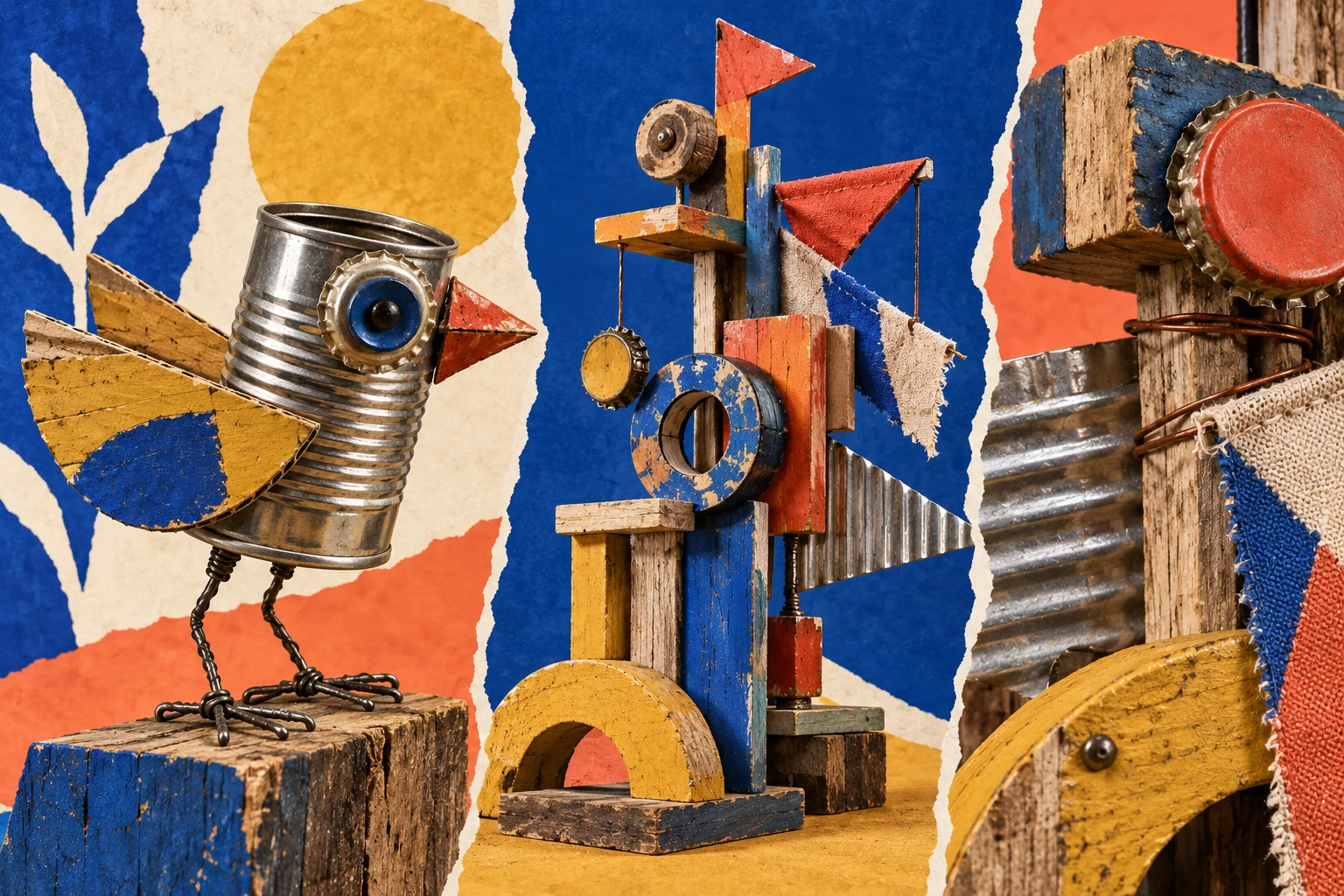
Our original collage transforms an ordinary tin into a bird-like construction, places wood, metal and cloth in a playful upright assemblage, and enlarges their joins. The torn-paper framing makes the act of combining visible. These are invented examples for visual discussion, not documented objects from a Chicano community.
A framework with a named intellectual history
Tomás Ybarra-Frausto’s Rasquachismo: A Chicano Sensibility appeared in 1989. The ICAA record places the essay within Chicano aesthetic discussion and describes a bicultural framework rather than a universal inventory of forms. The public record and synopsis are a useful research starting point; the full document scan is a separate access step. [2]
An aesthetic framework changes the questions we ask. Instead of beginning with whether an object conforms to an established standard of refinement, we can ask who set that standard and what it excludes. This does not require pretending every improvised object is an artwork. It asks us to take decisions seriously before deciding what category should contain them.
The danger of turning an attitude into a recipe
A visual preset promises recognition: add certain colours, surfaces and objects, and the result should look correct. A cultural sensibility is less obliging. Material resemblance alone cannot tell us what an object means to its maker or its users. Two similar-looking constructions may have different histories, purposes and relationships to place.
That is why a generated picture of reused tins should not be used as evidence that a model has understood rasquachismo. It may be an effective illustration of reuse. Understanding the cultural argument requires the accompanying account: whose inventiveness is being recognised, how value is assigned, and what gets lost when a practice becomes merely an attractive appearance.
A museum example of the discussion continuing
The McNay’s 2024 announcement for Rasquachismo: 35 Years of a Chicano Sensibility, scheduled for December 2024 to March 2025, located the subject across poetry, music and visual art. Among its examples was Einar and Jamex de la Torre’s Mi Chicano Corazón, described as blown glass and mixed media addressing dual American and Mexican identities. This is evidence of an ongoing curatorial discussion, not an exhibition being advertised as current. [1]
The useful lesson is that neither a material nor a medium owns the concept. Read the museum’s account of a specific work before making a connection. Record the artist, title and source; distinguish a curator’s interpretation from your own response. A well-supported example is more informative than a long list of artists linked only by a broad ethnic label.
Read the transformation, then ask about its setting
In the invented illustration, the tin remains recognisable even after it becomes a bird. Its circular opening, ridged surface and wire supports preserve the tension between container and creature. In the centre, cloth and cut wood establish an arrangement that looks intentional without concealing its parts. The right-hand detail makes connections into the subject of the image.
Those observations describe what is visible. They do not establish a community history. For a real object, follow them with questions about who made it, where it belongs, what it does and how its maker describes it. If that information is missing, keep the uncertainty in the caption. An attractive story is not a substitute for provenance.
A practical exercise in interpretation
Choose a personally owned object that has been altered or repurposed. Write three short accounts: its physical construction, its known history and your interpretation. Keep them separate. If a claim cannot be placed confidently in the history, phrase it as a question or a possibility. Then identify which source would help resolve it.
If you create a response with AI, specify the transformation you want to examine and label the result as invented. Preserve the source notes beside the prompt. The aim is not to earn a cultural label by including the correct props. It is to become a more attentive reader of how people make meaning with the materials and possibilities available to them.
A small poetic detour
Original words from the AOI studio.
Poetry
The tin remembers rain.
Someone gives it wings.
Its old shape comes along.
The prompt workshop
Original creative exercises. These prompts create new illustrations, not documentary evidence.
A transformation that remains visible
Invent a playful sculptural bird from a plain tin, wire and cardboard. Keep the container’s former use visible, articulate the joins, use one strong silhouette and two colour accents. Original conceptual illustration, no cultural attribution, words or logos.
Original AOI exercise; generated interpretations are not historical evidence.
Three accounts of one object
Describe an altered everyday object in three short paragraphs: observable construction; independently known history; your interpretation. Mark unknown details as unknown. Do not infer the maker’s identity or intention from appearance alone.
Original AOI exercise; generated interpretations are not historical evidence.
People & works to explore
References discussed in this article. Consult the sources below for context.
Artists and practitioners
Tomás Ybarra-Frausto — scholar and author
Mia Lopez — curator of the McNay exhibition
Einar and Jamex de la Torre — artists represented in the museum’s account
Paintings and other works
Rasquachismo: A Chicano Sensibility (1989) — essay
Einar and Jamex de la Torre, Mi Chicano Corazón — blown glass and mixed media; see McNay source