
ART STYLE READING LIST · 02 / 10
4 Photographic Processes That Make an Image More Than a Snapshot
Cameraless photography, cyanotype, hand-colouring and crystoleum: a compact guide to contact, colour and the photograph as an object.
Written with AI in Penny’s fictional editorial voice. Catalog illustrations are AI-generated interpretations; practical suggestions are proposed exercises, not documented model tests.
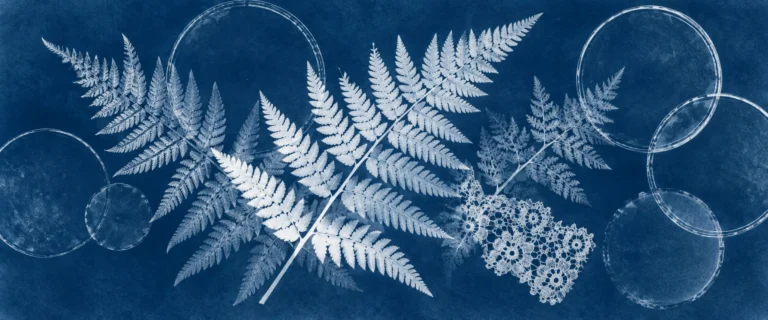
We tend to imagine photography as a person pointing a camera at something. That account leaves out a great deal of the interesting work: light touching a surface, colour applied after exposure, an image transferred into a small glass object. The shutter is not always the beginning, and it is rarely the whole story.
These four entries are deliberately related. They are not four mutually exclusive boxes: a cyanotype can be made as a cameraless photogram, for example. The point of the list is to separate the questions of how an image is formed, how it is altered and what physical object carries it.
Jump to a style in this list
1. Cameraless photography: begin with contact and light
Here the camera leaves the room. A photogram can register objects placed on or near a light-sensitive surface; other cameraless approaches organise light or chemical action differently. The V&A’s overview shows why the family is much wider than white leaves against a dark ground.
Look for edges that tell you something about contact: a crisp boundary beside a softer, hovering one. For an AI study, those differences are useful visual instructions. They do not establish that the generated image records a real object, exposure or chemical event.
2. Cyanotype: distinguish the process from the blue
Cyanotype is the process name, not the name for every blue photograph. The V&A dates Herschel’s invention to 1842 and describes Anna Atkins’s early botanical use of it. That context matters because the familiar silhouette is part of a material and publishing history, not just an attractive preset.
Try comparing the same arrangement as a flat blue illustration and as a contact-print-inspired study with varied translucency. The second should explain how objects block or transmit light. If it simply adds paper stains, it has changed the decoration rather than the visual logic.
3. Hand-coloured photograph: let colour make a second decision
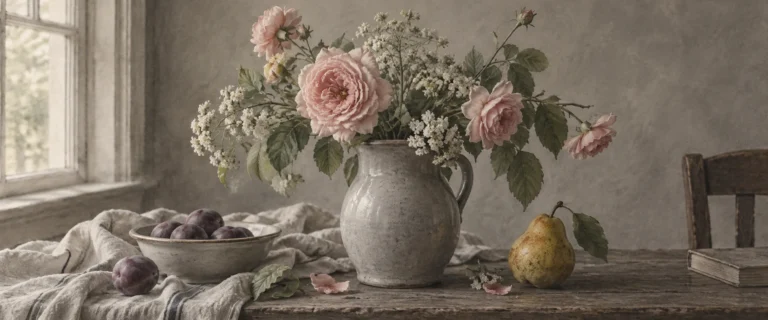
A photographic image supplies one structure; the colourist supplies another. Selective colour can pull a face, a ribbon or a flower forward while leaving the rest of the image restrained. It is interesting when that second intervention is visible, rather than when it perfectly imitates ordinary colour capture.
In a study, choose a single area to colour first and ask what changes in the picture’s emphasis. Do not describe a freshly generated scene as a restored family photograph. The catalog guide separates the historical practice from synthetic images that borrow its appearance.
4. Crystoleum: notice the glass between you and the image
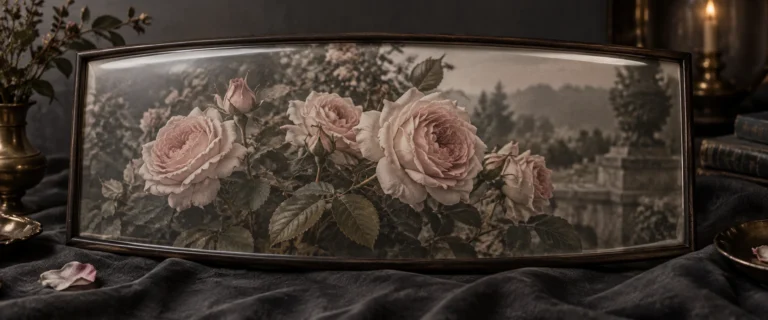
A crystoleum invites you to look at a picture and a thing at once. Te Papa describes a transfer process involving an image attached face-down to glass, removal of its support, translucency and possible additional painting. The result’s material presence is more specific than “old photo in a frame”.
For a visual study, include the edge of the object, restrained reflections and a believable relationship between the image and glass. An enormous lens flare will conceal the very layers you wanted to explore. This is one place where less shine can make an object more convincing.
Look for the process behind the appearance
Use the four entries as a sequence of questions: Did light meet a surface directly? What photographic process formed the image? Was colour added afterwards? What object are we looking at now? Those questions will get you farther than a bag of vintage adjectives.
My favourite is the awkward little glass object. It refuses to pretend the photograph is an immaterial window. You can almost feel the need to hold it carefully—and careful looking is a useful habit even when the image itself is digital.
Two useful next reads
- 6 Art Styles for Quiet Images That Still Have Something to Say
- 6 Art Techniques for Images That Remember Their Materials
Browse all Art Styles articles and explorers, compare entries in the Style Atlas, or open the full art style database.
Sources and visual notes
Prepared 11 October 2026. The selection and compositional advice are Penny’s editorial interpretation. The linked catalog guides provide longer context; older entries may carry source-review notices.
- V&A: Cameraless photography
- V&A: Cyanotype and other photographic processes
- Te Papa: Crystoleum process definition
Existing Art of AI images are reused with their catalog captions and links. They are visual interpretations, not archival documents, authentic cultural objects, verified construction drawings or exact pixel-format demonstrations. No shared image metadata was changed.