
Photographic printing process
Cyanotype is a light-sensitive photographic process known for its blue image. It can record objects by contact or print from a negative, making transparency, spacing and the support active parts of the composition.
A visual introduction
Select an image for a closer look. Use the thumbnails, arrow keys or a swipe to compare examples. Zoom in to inspect details, or share the image that inspires you.


Creative toolbox · take this style further
Choose an input and a destination. Search sends your words to the chosen site; Copy & open puts them on your clipboard to paste there.
Create with AI
Turn your chosen input into an image prompt or a new creative direction.
ChatGPT
Copy your input and paste it into a ChatGPT conversation or image request.
Copy & open ChatGPT (new tab)Claude · Anthropic
Develop an image prompt or explore the style in a new Claude conversation.
Copy & open Claude · Anthropic (new tab)Midjourney
Paste your input into the Imagine bar on the Create page.
Copy & open Midjourney (new tab)Adobe Firefly
Copy your input, open Firefly, and paste it into the prompt field.
Copy & open Adobe Firefly (new tab)Leonardo.Ai
Copy your input, open Leonardo, and paste it into the generation field.
Copy & open Leonardo.Ai (new tab)Image search
Find visual references. Short, concrete keywords usually work best.
Lexica
Search AI images and prompts using your selected input.
Search with this input Lexica (new tab)Pexels
Search the photo and video library. Short keywords often work best.
Search with this input Pexels (new tab)Pixabay
Search photos, illustrations and other images.
Search with this input Pixabay (new tab)Unsplash
Search photographs using the style name or your own keywords.
Search with this input Unsplash (new tab)Wikimedia Commons
Search photographs, artworks and historical images. Check each file for its source and reuse terms.
Search with this input Wikimedia Commons (new tab)Art & research
Explore artists, collections and the ideas behind a style.
Wikipedia
Search for background reading. A style may not have its own article.
Search with this input Wikipedia (new tab)WikiArt
Copy your input into WikiArt’s search to explore artists and artworks.
Copy & open WikiArt (new tab)Europeana
Paste your keywords into the search to explore European museum, library and archive collections.
Copy & open Europeana (new tab)Inspiration
Discover portfolios and visual ideas from creative communities.
Instagram hashtags
Search a hashtag made from your input: spaces and punctuation are removed. Instagram may require sign-in.
Search with this input Instagram hashtags (new tab)ArtStation
Paste your input into artwork search for concept art, environments, characters and visual development.
Copy & open ArtStation (new tab)Behance
Paste your input into project search for illustration, design and visual storytelling.
Copy & open Behance (new tab)A closer look
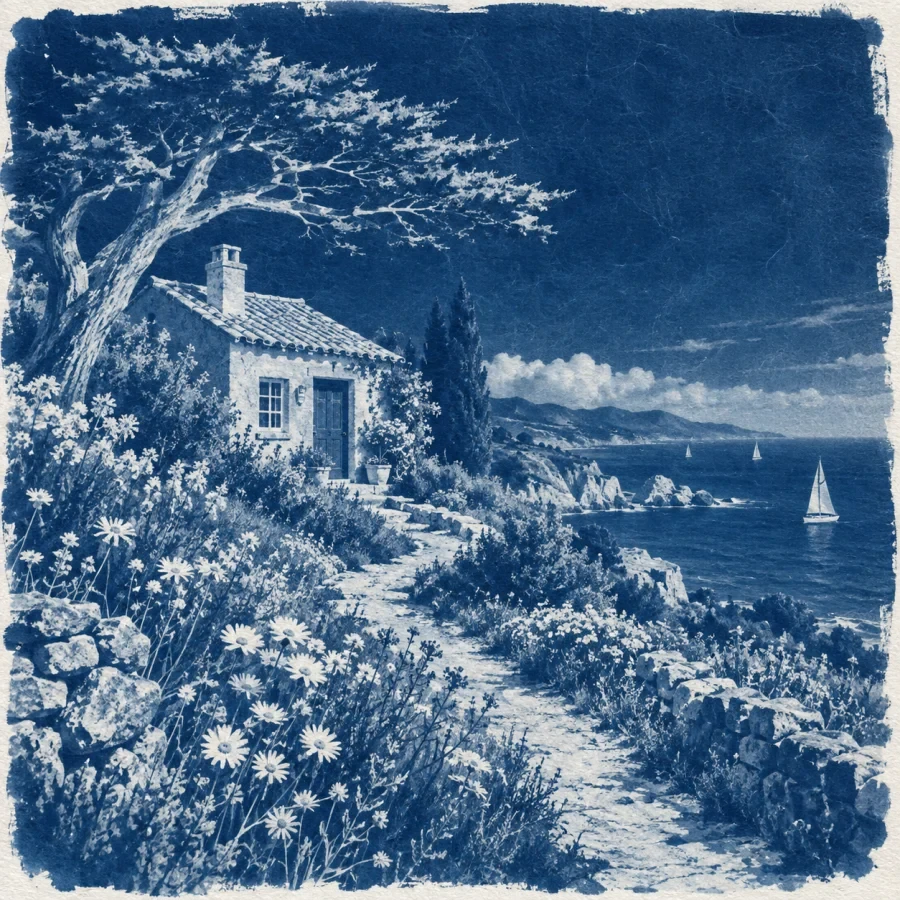
Blue fields, pale silhouettes, translucent overlaps and variable edge sharpness can express the relationship between an object and the light-sensitive surface.
A process with several uses
John Herschel introduced cyanotype in 1842. The V&A identifies Anna Atkins as an early practitioner who used it for botanical records and began publishing her algae images in 1843. The process also served the reproduction of drawings. These uses connect careful observation and visual organization without making every cyanotype a botanical illustration or technical blueprint.
A photogram is made through the interaction of objects and a light-sensitive surface without a camera. Cyanotype can also use a negative. Distinguishing these approaches helps explain whether the image records an object's contact, a photographic view or a deliberately assembled combination.
Compose the gaps as carefully as the objects
In an original contact-print study, a plant is more than an outline. Its branching rhythm, denser areas and translucent parts create different relationships with the blue ground. Give the negative spaces enough room to remain visible. Several individually attractive specimens can become an unreadable mass when crowded together.
Try a single branching shape first, then a second arrangement in which two forms overlap. Compare whether the overlap clarifies their differences or obscures both. A diagonal stem can lead the eye across the page, while a nearly symmetrical arrangement can emphasize classification and comparison.
Contact changes the edge
The Amon Carter Museum explains how close contact helps produce sharper outlines. An object lifted away from the support may yield a different edge character. This is useful visual information, not merely an imperfection to remove. Consider which parts should appear precise and which can remain more atmospheric.
The support matters too. Paper texture, margins and the shape of the coated area can contribute to the finished work. Use these features deliberately rather than applying identical distressed borders to every image. A clean edge and a quiet margin can be as expressive as a visible brush boundary.
Separate an interpretation from a specimen record
A generated cyanotype-like image can explore silhouettes and blue tonal relationships, but it does not document a real exposure or identify a plant reliably. Label it as an interpretation. For botanical or historical research, use the actual specimen or collection record.
For practical printing, follow the instructions for the specific materials being used. This visual guide focuses on composition and reading the result rather than prescribing a universal exposure time or chemical recipe.
The prompt workshop
Original creative exercises. These prompts create new illustrations, not documentary evidence.
One branching form
Original cyanotype-inspired digital study of a single invented fern-like branch, pale silhouette against rich blue, delicate internal translucency, generous paper margin, no botanical identification or antique provenance claim.
Transparency and overlap
Cyanotype-like interpretation of two overlapping leaves and a fine woven scrap, different transparency levels, clear negative spaces, varied but deliberate edge sharpness, matte paper surface.
A contemporary contact study
Abstract cyanotype-inspired arrangement of curved wire, folded translucent paper and a round aperture, asymmetrical balance, deep blue field, restrained visible coating edge, no labels.
Sources and further exploration
V&A — Herschel, Atkins and the uses of cyanotype
Amon Carter Museum — contact, arrangement and the printing process