
Comparative artist study
Yves Tanguy and Giorgio de Chirico offer distinct approaches to enigmatic space. This comparative study explores de Chirico’s Metaphysical architecture and Tanguy’s Surrealist landscapes through their shared interest in convincing yet unsettling pictorial worlds.
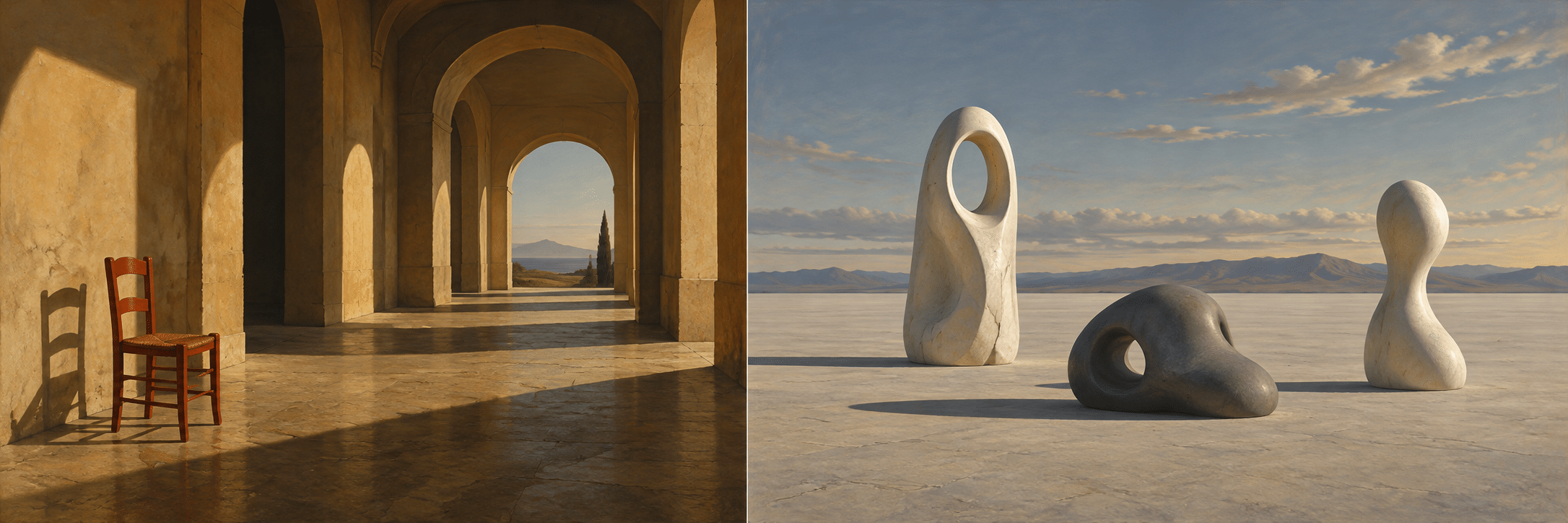
A visual introduction
Seven new AI-generated comparative studies explore enigmatic architecture, invented forms and spatial uncertainty. They are original interpretations, not works by Yves Tanguy or Giorgio de Chirico. The earlier illustration is retained.
Select an image for a closer look. Use the thumbnails, arrow keys or a swipe to compare examples. Zoom in to inspect details, or share the image that inspires you.

Creative toolbox · take this style further
Choose an input and a destination. Search sends your words to the chosen site; Copy & open puts them on your clipboard to paste there.
Create with AI
Turn your chosen input into an image prompt or a new creative direction.
ChatGPT
Copy your input and paste it into a ChatGPT conversation or image request.
Copy & open ChatGPT (new tab)Claude · Anthropic
Develop an image prompt or explore the style in a new Claude conversation.
Copy & open Claude · Anthropic (new tab)Midjourney
Paste your input into the Imagine bar on the Create page.
Copy & open Midjourney (new tab)Adobe Firefly
Copy your input, open Firefly, and paste it into the prompt field.
Copy & open Adobe Firefly (new tab)Leonardo.Ai
Copy your input, open Leonardo, and paste it into the generation field.
Copy & open Leonardo.Ai (new tab)Image search
Find visual references. Short, concrete keywords usually work best.
Lexica
Search AI images and prompts using your selected input.
Search with this input Lexica (new tab)Pexels
Search the photo and video library. Short keywords often work best.
Search with this input Pexels (new tab)Pixabay
Search photos, illustrations and other images.
Search with this input Pixabay (new tab)Unsplash
Search photographs using the style name or your own keywords.
Search with this input Unsplash (new tab)Wikimedia Commons
Search photographs, artworks and historical images. Check each file for its source and reuse terms.
Search with this input Wikimedia Commons (new tab)Art & research
Explore artists, collections and the ideas behind a style.
Wikipedia
Search for background reading. A style may not have its own article.
Search with this input Wikipedia (new tab)WikiArt
Copy your input into WikiArt’s search to explore artists and artworks.
Copy & open WikiArt (new tab)Europeana
Paste your keywords into the search to explore European museum, library and archive collections.
Copy & open Europeana (new tab)Inspiration
Discover portfolios and visual ideas from creative communities.
Instagram hashtags
Search a hashtag made from your input: spaces and punctuation are removed. Instagram may require sign-in.
Search with this input Instagram hashtags (new tab)ArtStation
Paste your input into artwork search for concept art, environments, characters and visual development.
Copy & open ArtStation (new tab)Behance
Paste your input into project search for illustration, design and visual storytelling.
Copy & open Behance (new tab)A closer look
De Chirico’s recognizable architecture and objects can become disquieting through staging and perspective; Tanguy’s unfamiliar forms can acquire convincing presence through modeling, shadows and distance.
Compare without collapsing their identities
MoMA describes Giorgio de Chirico’s early piazzas, distorted perspectives and unsettling arrangements as an important influence on the Surrealists. The Metropolitan Museum of Art identifies a connection to de Chirico in Tanguy’s Title Unknown of 1926, including its tower and strange juxtaposition of imagery. Influence is a starting point for comparison, not evidence that the artists founded an identical style.
The Met’s account of Tanguy’s The Satin Tuning Fork, painted in 1940, describes his sustained interest in invented landscapes and precisely rendered, rocklike forms. His mature vocabulary differs from de Chirico’s recognizable buildings and ordinary objects. Looking at that difference is more useful than treating both artists as interchangeable makers of dream scenes.
Familiar things in an unstable setting
In studying de Chirico, consider the relationship between architecture, empty space and an unexpected object. Perspective, cropping and cast shadows can make a recognizable setting feel unresolved. The effect depends on arrangement rather than a requirement to fill the scene with impossible creatures.
For an original exercise, keep the objects ordinary and alter one spatial relationship. Compare how the scene changes when a shadow extends beyond its expected role or an opening leads toward an uncertain destination.
Unfamiliar forms with physical presence
For a Tanguy-related study, begin with invented forms that have coherent volume. Give them a consistent ground and light situation. Their unfamiliarity becomes more compelling when the viewer can imagine their weight and distance.
Avoid assigning fixed meanings to every shape. A biomorphic form can invite associations without becoming a coded illustration of one concept. Vary size and spacing so the image has a rhythm rather than a uniform field of strange objects.
Two exercises, two outcomes
Use the same broad light direction for two original compositions: one architectural, one populated by invented forms. Keep the palettes restrained enough to compare their spatial logic. Explain which decisions create recognition and which create uncertainty.
This approach teaches more than combining both artists' names in a prompt. The retained AOI illustrations are interpretations, not authentic works by either artist, and should be evaluated for their own compositional clarity.
Recognition and uncertainty work differently
An arcade, chair or tower gives the viewer something to name immediately. The uncertainty can then arise from the way those things are placed: an opening that promises access but withholds a destination, an emphatic shadow, or a plaza whose scale feels difficult to settle. Architectural regularity makes a small displacement more noticeable. Filling the scene with unrelated anomalies would weaken that tension.
An unfamiliar biomorphic form works in the opposite direction. Its identity may be uncertain from the beginning, while its surface and contact with the ground feel convincing. Light and shadow give it a physical presence even when it cannot be classified. The image can therefore remain precise without becoming explanatory. A useful study preserves that tension rather than turning every shape into a recognizable creature.
Palette, edges and the pace of looking
For an architectural exercise, a restrained ochre wall can set off a cooler sky and one small red object. Strong edges establish the built space, while a few long shadows direct attention across it. For an open landscape, closely related blue-grey or sandy tones can make distance feel continuous. A small warm form then interrupts the field without dividing it into competing focal points.
These are practical choices for the new studies, not fixed rules governing either artist’s entire career. Evaluate edge sharpness according to distance and emphasis. A sharply modeled foreground object can coexist with an uncertain horizon; a distant arch can remain recognizable while its destination stays unclear. The visual rhythm depends as much on intervals between things as on the things themselves.
The new gallery as a comparative workshop
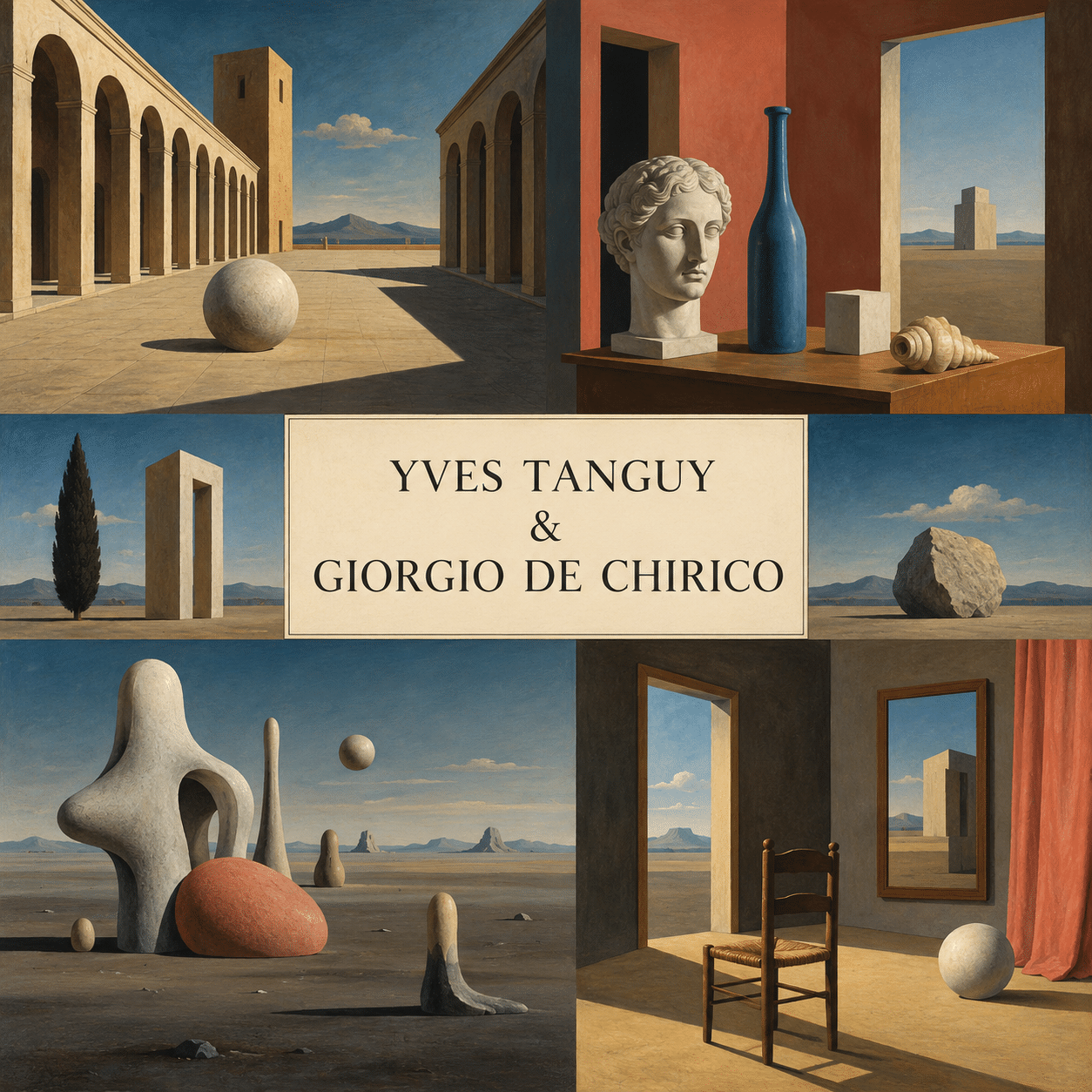
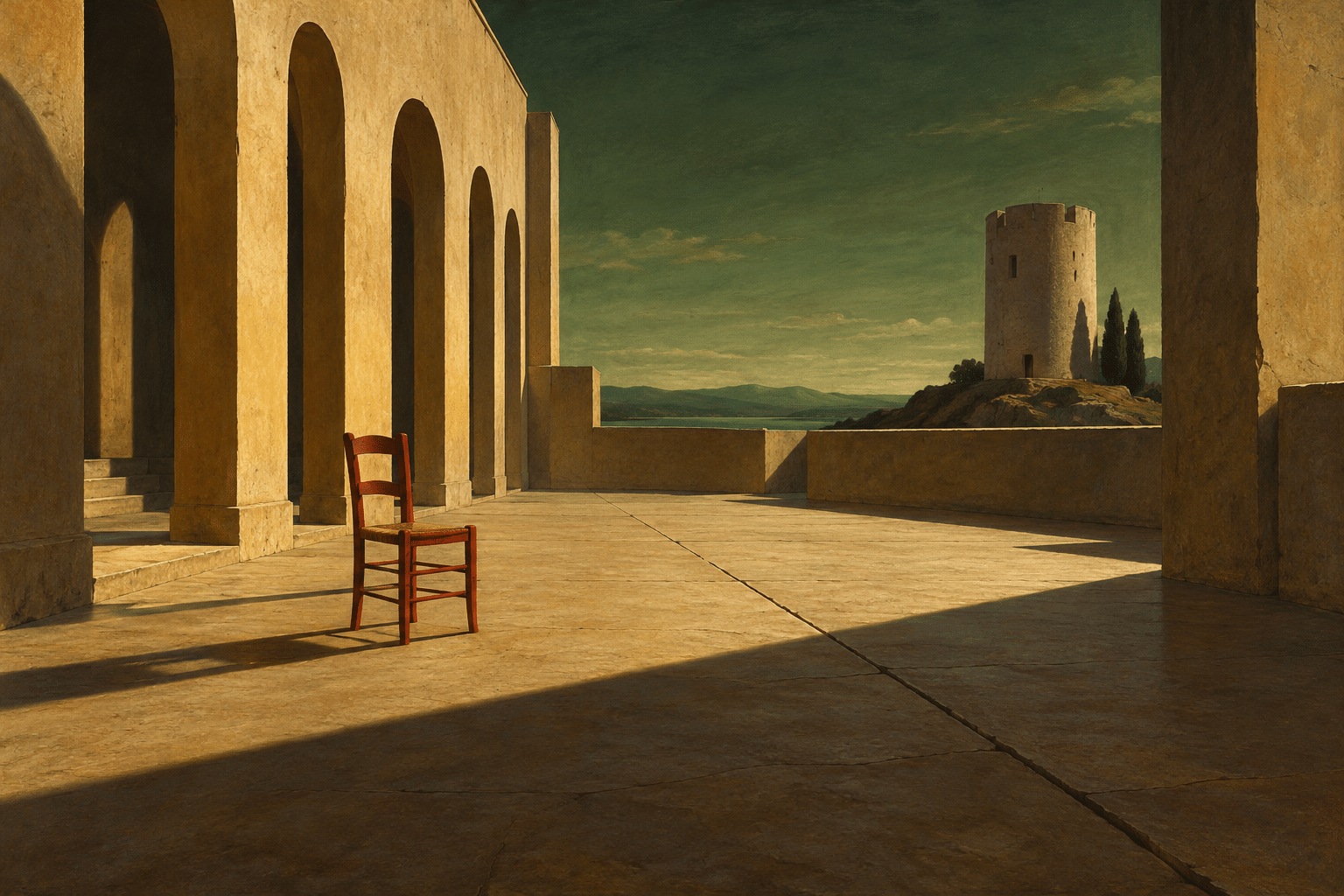
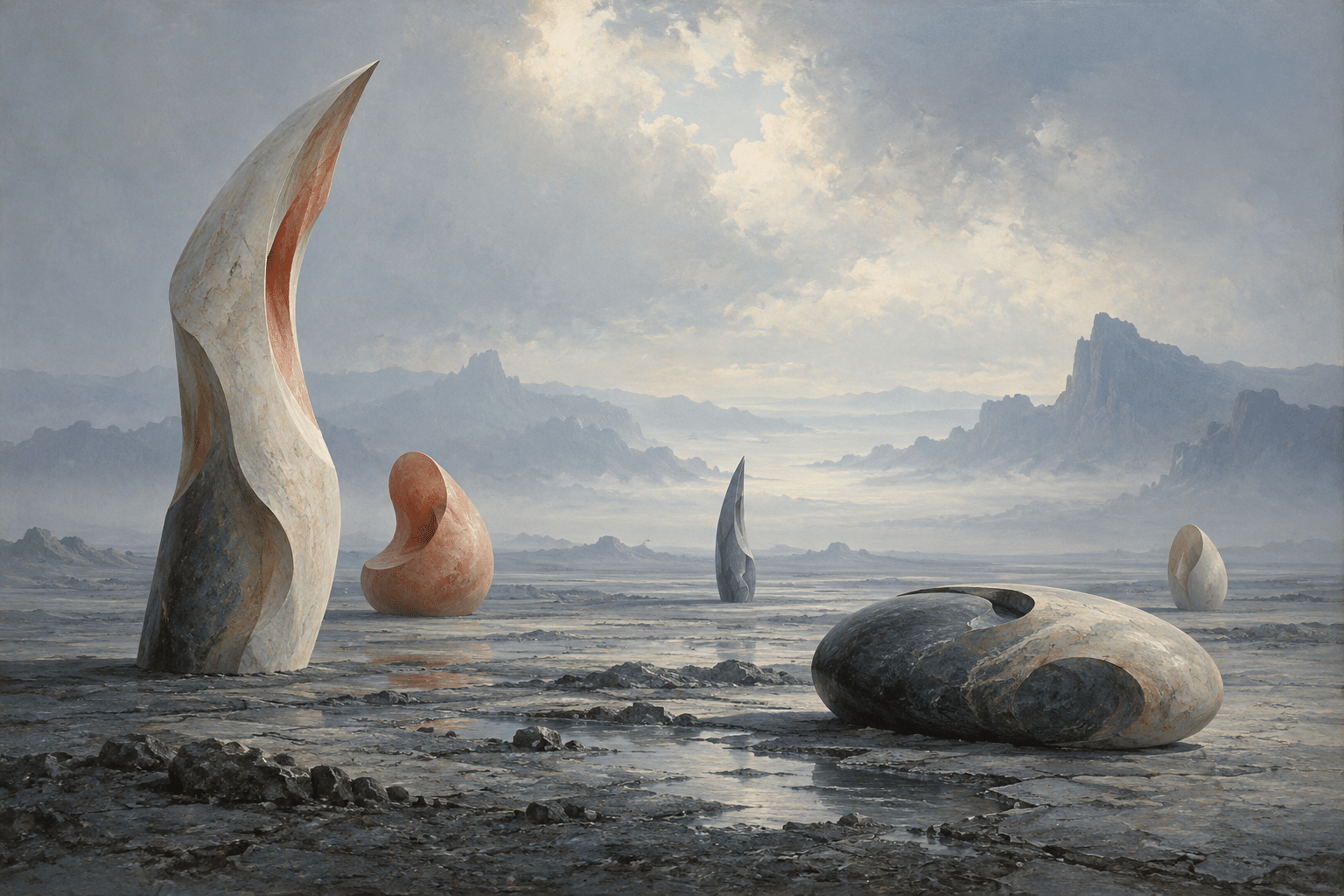
The banner places an empty architectural space beside an open landscape of invented solids. Its shared lighting makes the difference in spatial language easy to compare. The titled collage introduces several related motifs without claiming that the panels are reproductions. The courtyard example concentrates on an ordinary chair, architecture and cast shadows. The open-plain example replaces familiar objects with unfamiliar volumes.
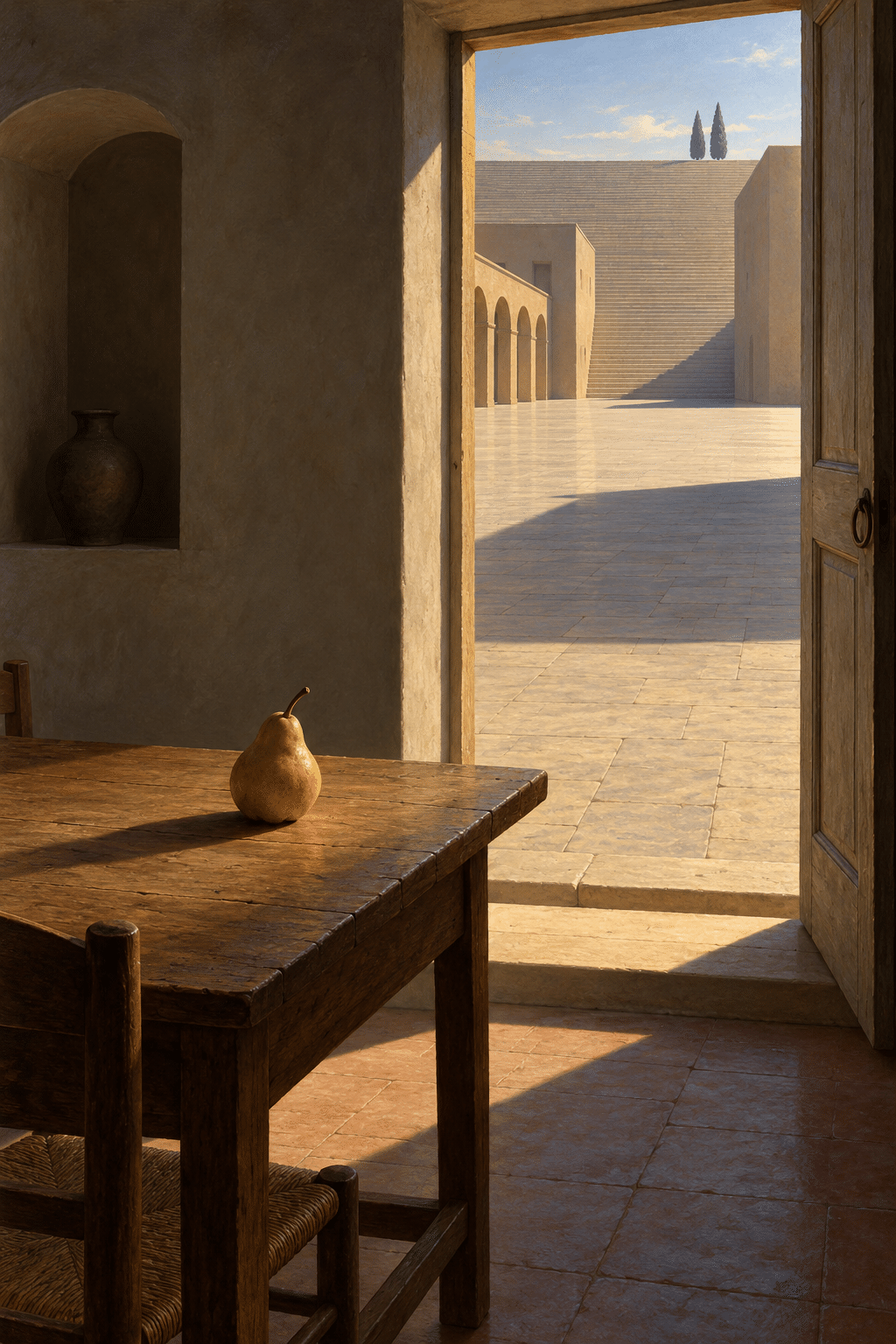
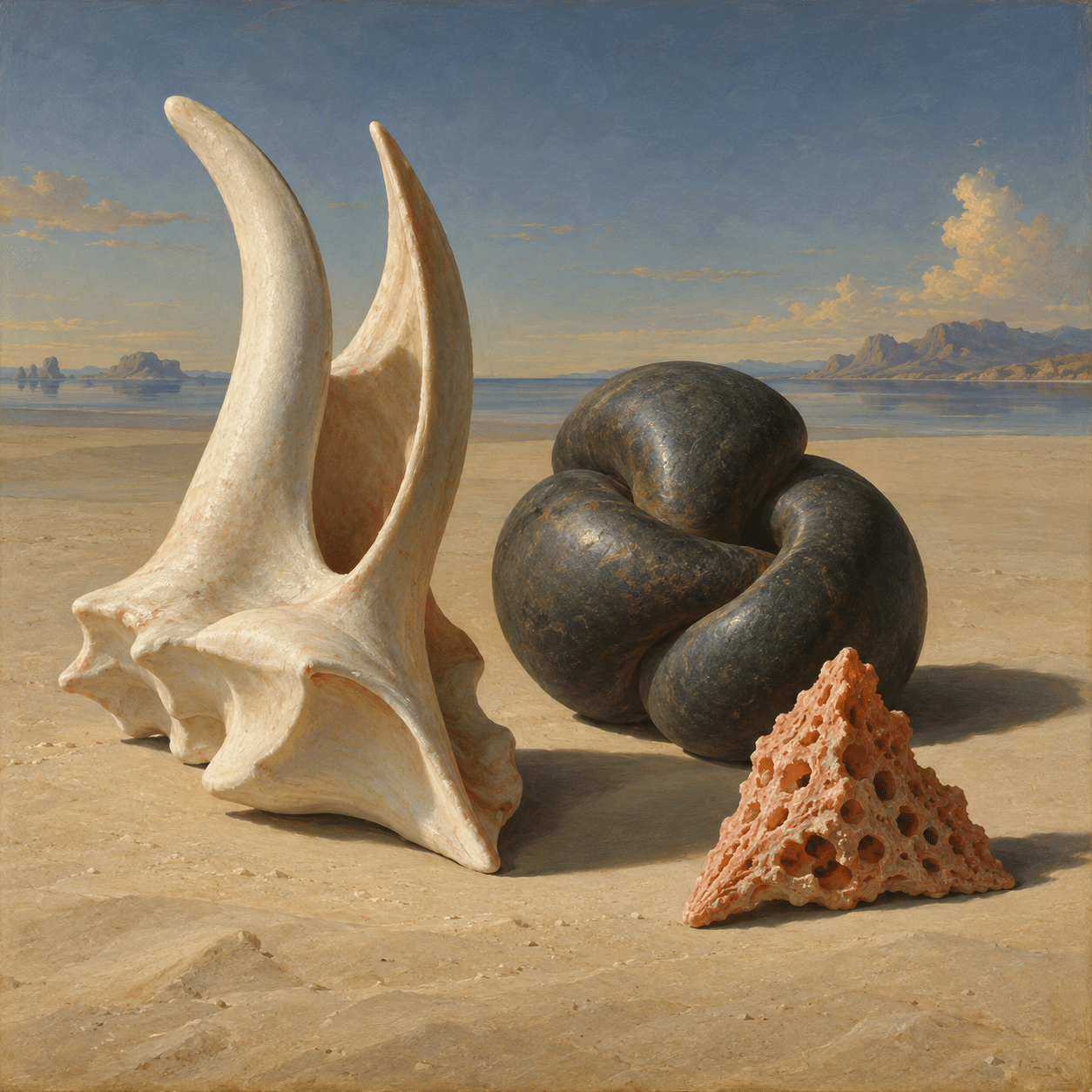
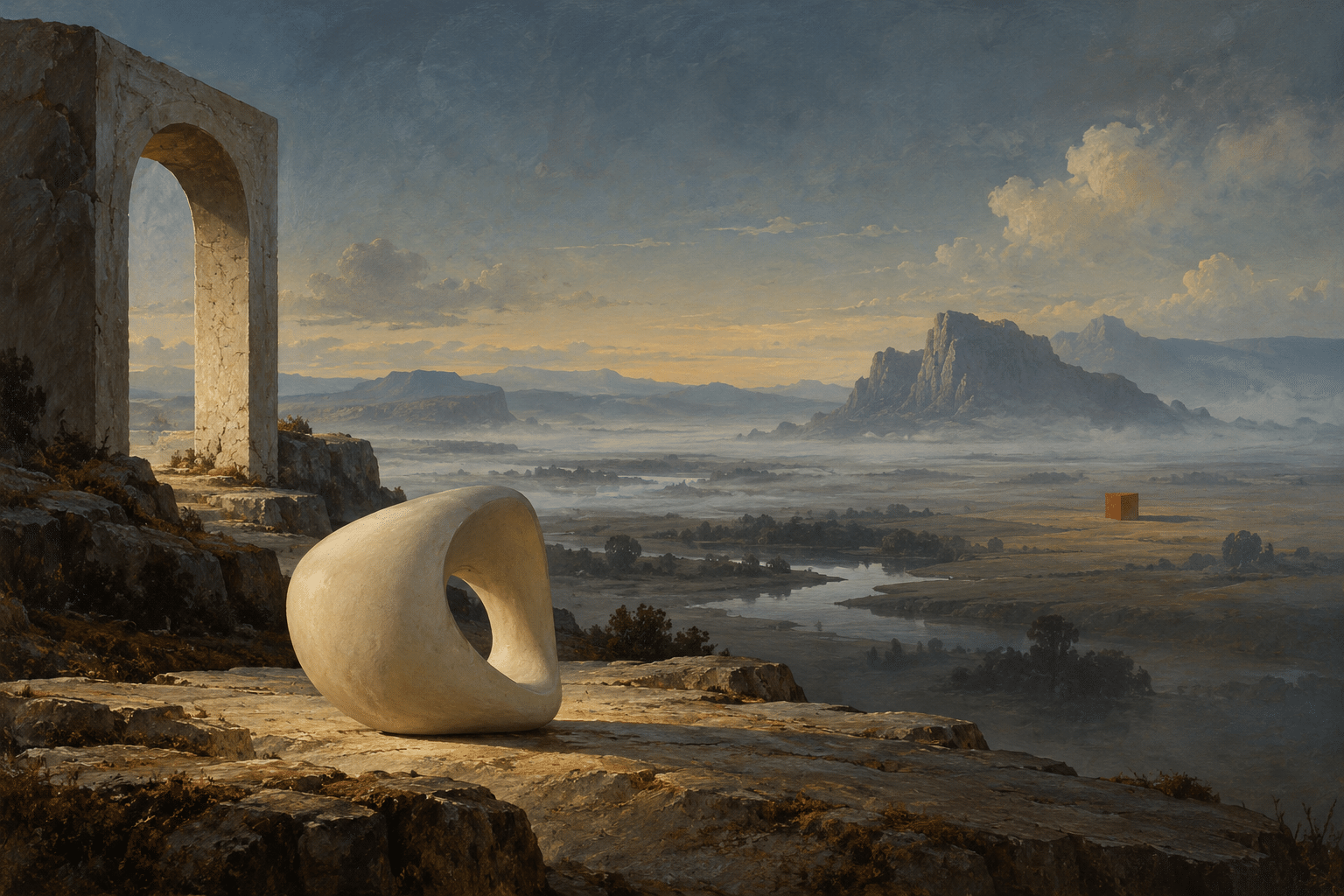
The interior study uses a table, pear and doorway to create an unsettled relationship between near and far. The close grouping of invented forms asks how much physical credibility can be supplied by modeling and contact shadows alone. The final scene brings an arch and an unfamiliar solid into one space as an original synthesis. It is an exercise in comparing decisions, not a newly discovered collaboration between the artists.
All seven new images are AI-generated interpretations created for this article. Neither artist made them. The earlier AOI illustration remains for comparison, with its interpretive status explicit. Consult the linked museum objects for authentic works and their documented dates, media and collection context.
A method for making an original study
Choose one kind of uncertainty before writing a prompt. For a built scene, describe a small set of ordinary elements and one uneasy spatial relationship. For an invented landscape, describe a few unfamiliar forms, a ground plane and consistent light. Add restrained palette and edge instructions only after that structure is clear. A list of famous names is less informative than a description of the visual problem.
Compare two versions with the same horizon and light direction. Change only the object language: recognizable furniture and architecture in one, biomorphic solids in the other. Then compare a second pair that changes the horizon instead. This separates the effects of subject and space, helping an original image develop beyond a collection of Surrealist clichés.
Positive editorial assessment — AI-authored
The comparison makes two ways of producing uncertainty visible. Familiar architecture can become strange through staging, while invented forms can feel tangible through precise modeling. The new paired banner and separate exercises help readers identify those decisions instead of treating dreamlike atmosphere as a single undifferentiated style.
Critical editorial assessment — AI-authored
Long shadows, empty plazas and smooth biomorphic objects can become formulas when separated from the artists’ particular works. The generated studies simplify complex practices and sometimes resemble polished sculptural renderings more than painted uncertainty. Their value lies in analysis and experimentation; they should not replace looking closely at authentic paintings or imply that these motifs exhaust either artist’s range.
Neutral editorial assessment — AI-authored
This is a comparative artist study, not the definition of a joint historical movement. It emphasizes selected spatial strategies that are useful for visual education and original composition. The cited museum records provide historical anchors, while the generated gallery supplies contemporary exercises whose authorship and limitations remain separate.
A small poetic detour
Original words from the AOI studio.
Poetry
Between the Arch and the Plain
A chair remembers someone’s weight;
an unknown stone remembers none.
The arch keeps open what it hides,
the plain lies quiet in the sun.
One shadow gives a thing its ground,
one doorway takes the distance apart.
We know the room, but not its end;
we know the form, but not its heart.
The prompt workshop
Original creative exercises. These prompts create new illustrations, not documentary evidence.
Recognizable but unresolved
Original metaphysical architectural scene with a quiet arcade, an ordinary chair and a deliberately unsettling spatial relationship, coherent light and no copied painting.
Unknown forms, credible ground
Original Surrealist landscape with a few invented biomorphic solids, convincing contact shadows and receding distance, restrained color and varied scale.
A comparative diptych
Original two-panel study: an enigmatic built space beside a landscape of unfamiliar forms, shared light direction but distinct spatial strategies, no artist signatures.
A smile from the studio
Jokes
The chair and the mysterious stone agreed on one thing: neither could explain the horizon.