
A documented series name and a spiral-composition exercise
Whirlism has a documented use in Louise Hankes’s work. The AOI archive’s spiral studies are separate interpretations, not evidence for a historical movement led by Pollock or Mondrian.
A visual introduction
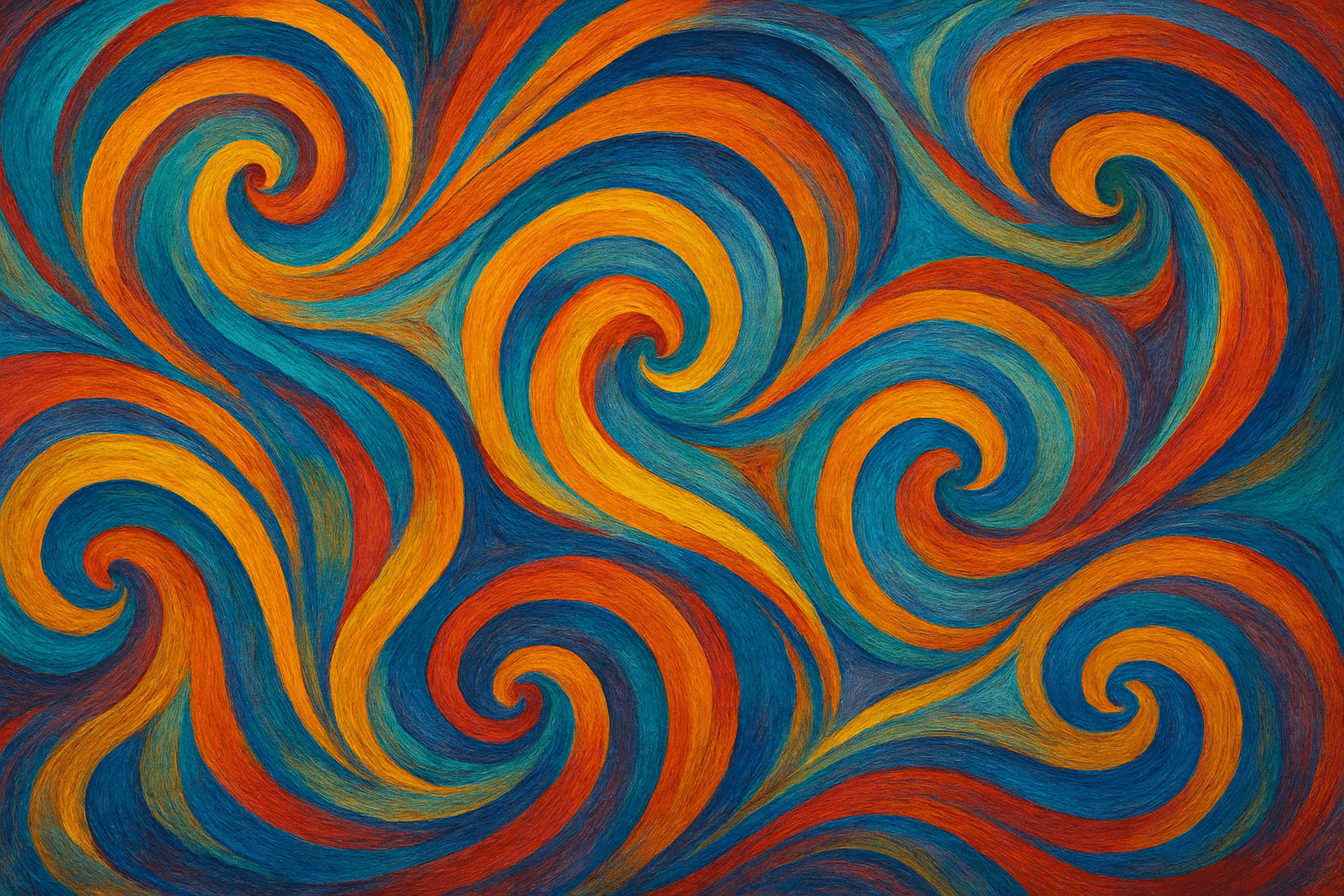
Compare the retained archive studies. The titled collage is modern editorial illustration; its panels are not reproductions of documented works.
Select an image for a closer look. Use the thumbnails, arrow keys or a swipe to compare examples. Zoom in to inspect details, or share the image that inspires you.

Creative toolbox · take this style further
Choose an input and a destination. Search sends your words to the chosen site; Copy & open puts them on your clipboard to paste there.
Create with AI
Turn your chosen input into an image prompt or a new creative direction.
ChatGPT
Copy your input and paste it into a ChatGPT conversation or image request.
Copy & open ChatGPT (new tab)Claude · Anthropic
Develop an image prompt or explore the style in a new Claude conversation.
Copy & open Claude · Anthropic (new tab)Midjourney
Paste your input into the Imagine bar on the Create page.
Copy & open Midjourney (new tab)Adobe Firefly
Copy your input, open Firefly, and paste it into the prompt field.
Copy & open Adobe Firefly (new tab)Leonardo.Ai
Copy your input, open Leonardo, and paste it into the generation field.
Copy & open Leonardo.Ai (new tab)Image search
Find visual references. Short, concrete keywords usually work best.
Lexica
Search AI images and prompts using your selected input.
Search with this input Lexica (new tab)Pexels
Search the photo and video library. Short keywords often work best.
Search with this input Pexels (new tab)Pixabay
Search photos, illustrations and other images.
Search with this input Pixabay (new tab)Unsplash
Search photographs using the style name or your own keywords.
Search with this input Unsplash (new tab)Wikimedia Commons
Search photographs, artworks and historical images. Check each file for its source and reuse terms.
Search with this input Wikimedia Commons (new tab)Art & research
Explore artists, collections and the ideas behind a style.
Wikipedia
Search for background reading. A style may not have its own article.
Search with this input Wikipedia (new tab)WikiArt
Copy your input into WikiArt’s search to explore artists and artworks.
Copy & open WikiArt (new tab)Europeana
Paste your keywords into the search to explore European museum, library and archive collections.
Copy & open Europeana (new tab)Inspiration
Discover portfolios and visual ideas from creative communities.
Instagram hashtags
Search a hashtag made from your input: spaces and punctuation are removed. Instagram may require sign-in.
Search with this input Instagram hashtags (new tab)ArtStation
Paste your input into artwork search for concept art, environments, characters and visual development.
Copy & open ArtStation (new tab)Behance
Paste your input into project search for illustration, design and visual storytelling.
Copy & open Behance (new tab)A closer look
Curved bands, varied spiral centers, directional flow and changes in scale can make an image turn without becoming uniform.
Keep the attribution precise
In her statement published by Yuan Ru Gallery, Louise Hankes refers to a Whirlism series and describes an interest in color, interacting shapes and a balance between structure and play. She also identifies Norwegian folk-art influences in her own practice. This is evidence for that artist’s use of the name, not for a broad movement with the famous founders listed in the older archive text.
The images on this page are AOI archive illustrations. Their spirals should not be attributed to Hankes or presented as reproductions of her series. Here they support a separate practical exercise in curved composition. A shared word does not establish a shared authorship or history.
Make the eye turn, then let it rest
Choose one main center of rotation and give it a different size or contrast from the others. Let a few curved bands guide the eye toward it. If every spiral is equally large, bright and tightly wound, the pattern becomes restless without gaining direction.
Try varying the distance between bands and leaving a quiet area near an edge. A warm curve against a cooler ground can feel more active than a field of equally saturated colors. In the archive studies, blue and orange provide that contrast. For an original image, test whether the movement still reads in grayscale; if it disappears, the composition may depend too heavily on hue. Spirals are a starting shape, not an automatic substitute for hierarchy.
The prompt workshop
Original creative exercises. These prompts create new illustrations, not documentary evidence.
One turning center
Create an original abstract painting with one large off-center spiral and two smaller curved echoes. Use blue, ochre and a small red accent, with varied band widths and a quiet corner. No text or artist imitation.
Slow and fast curves
Create an original abstract composition contrasting a broad slow curve with several tight short spirals. Use visible brush texture and a restrained warm-cool palette. Keep a clear focal point and avoid an evenly repeated pattern.
Almost a spiral
Create an original abstract image of interrupted curved bands that imply rotation without closing into complete spirals. Use deep blue, pale cream and burnt orange, with generous negative space. No lettering.
Sources and further exploration
Yuan Ru Gallery: Louise Hankes’s artist statement and Whirlism series