
Poetry in public space · Lettering and placement
Walk through wall poetry in Leiden and four imagined sites. See how masonry, letter size, a corner or a place to sit can change the way a poem is read.
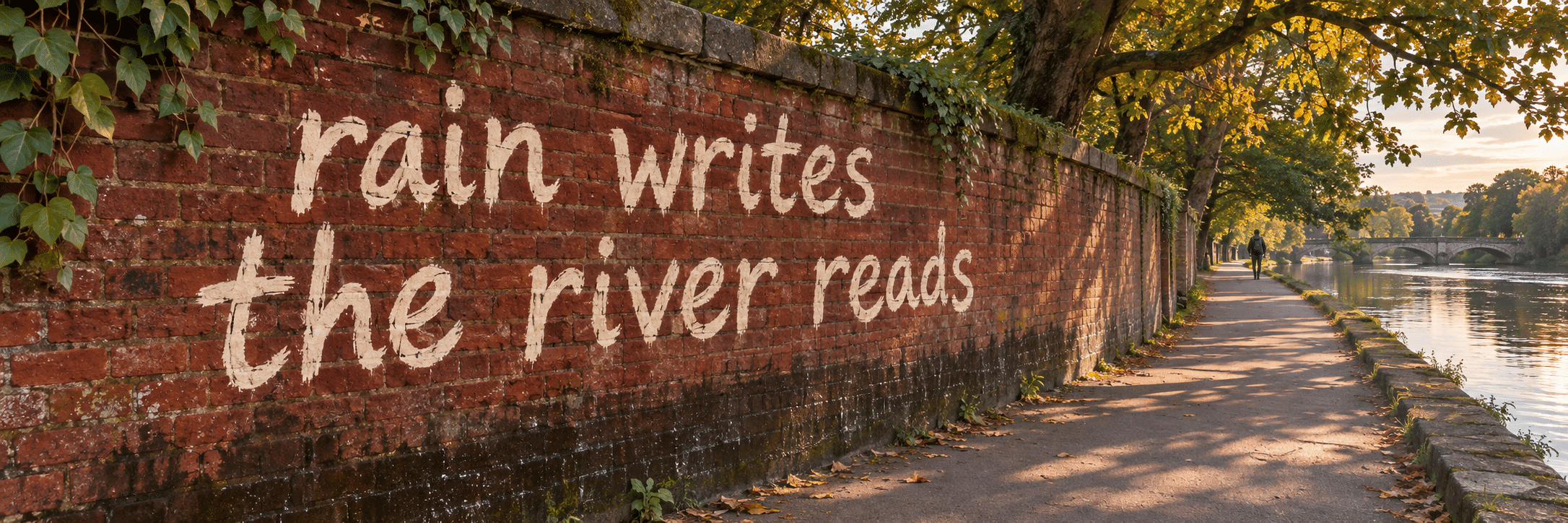
A visual introduction
Four original AOI proposals place short verse in different sites. The older collage is retained as a pictorial introduction. None of these images depicts an actual Leiden wall.
Select an image for a closer look. Use the thumbnails, arrow keys or a swipe to compare examples. Zoom in to inspect details, or share the image that inspires you.
A closer look
A line breaks at the edge of a wall; a word can appear before the rest as a person walks. Letters, their material, the reader’s distance and the surrounding architecture all enter the reading.
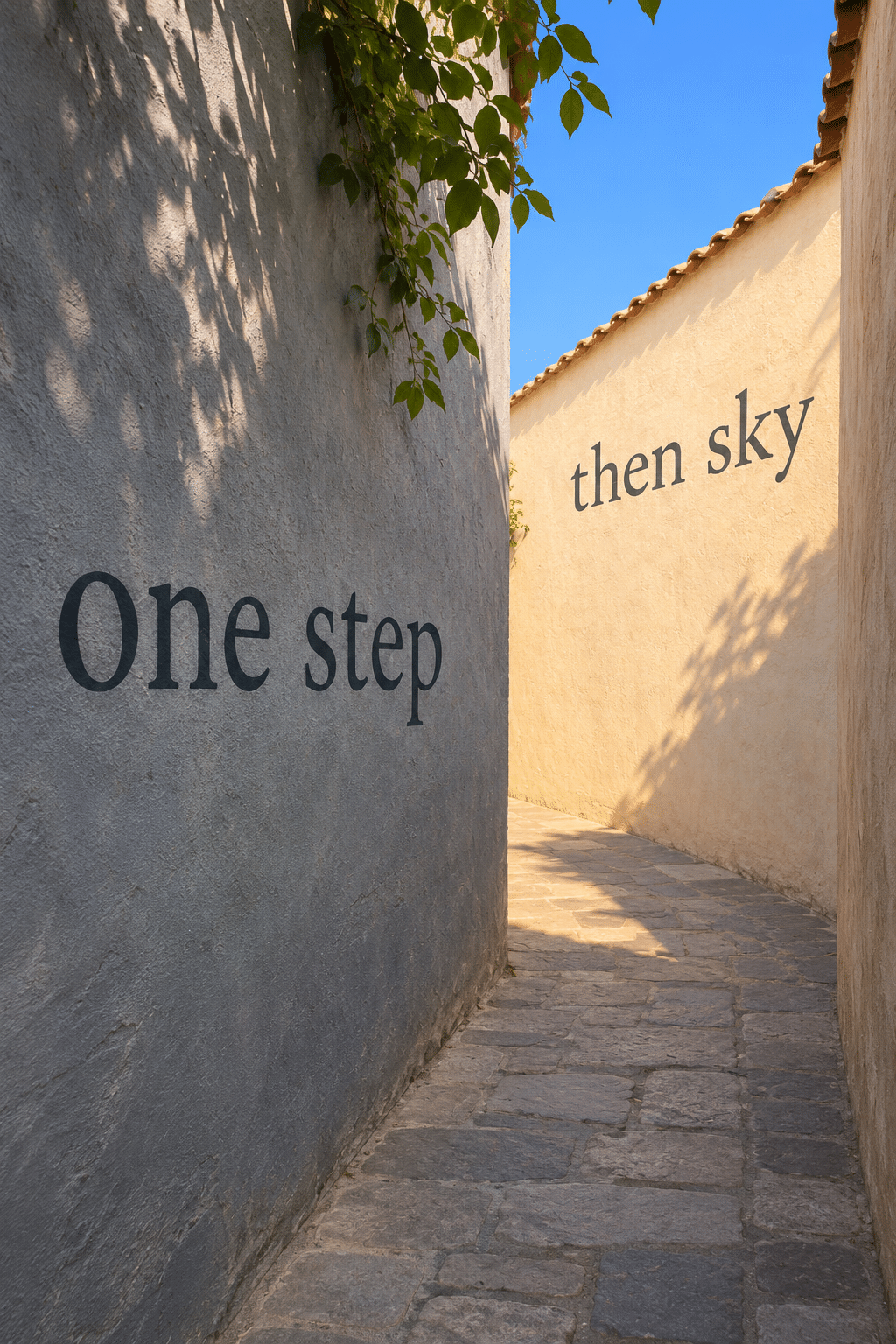
The second line comes around a corner
“One step” is on the wall nearest us. “Then sky” is farther away, in the sun. You might meet the words in a different order if you entered the alley from the other end. In a book, a line break is an arrangement on a sheet; here it is also the distance between two places. The illustration is an invented example. It gives you a question to take to an actual wall: from where can a stranger first read the whole poem?
Wall poetry means verse presented on a wall or façade. A poem can be painted, chalked, printed or assembled from raised letters. Mural painting and graffiti can also use writing, but covering a wall in expressive marks does not by itself make a poem. Attend to what the words say and what the location does to their timing.
Leiden: a city you can read
The Dutch Cultural Heritage Agency records that Leiden’s Gedichten en muren project began in 1992 with a work by Marina Tsvetaeva. Stichting TEGEN-BEELD maps the wall poems, and Leiden University and LeidenGlobal offer a walk through some of their locations. This is a documented local initiative, not a founding date for every poem ever written on a wall. Open the map alongside the walking route: one gives positions, the other makes a sequence from them.
A poem in a script unfamiliar to a passing reader can be visible before its words are understood. Use a transcription or translation to return to it a second time. Notice where the original changes line and how many letters can be seen from across the street. If you describe the work to someone else, distinguish the author of the text from the people who arranged or painted it.
Rain can be both subject and editor
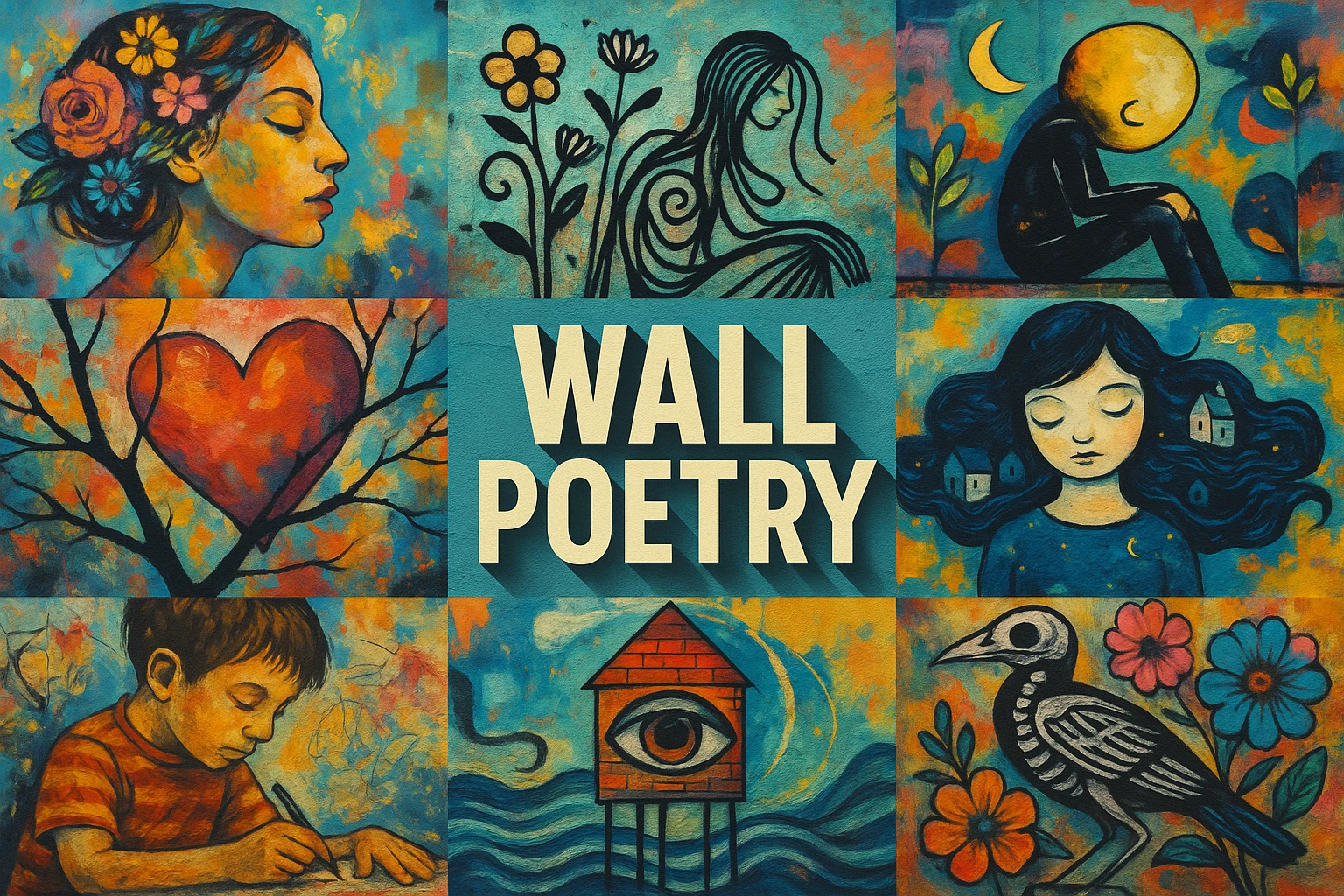
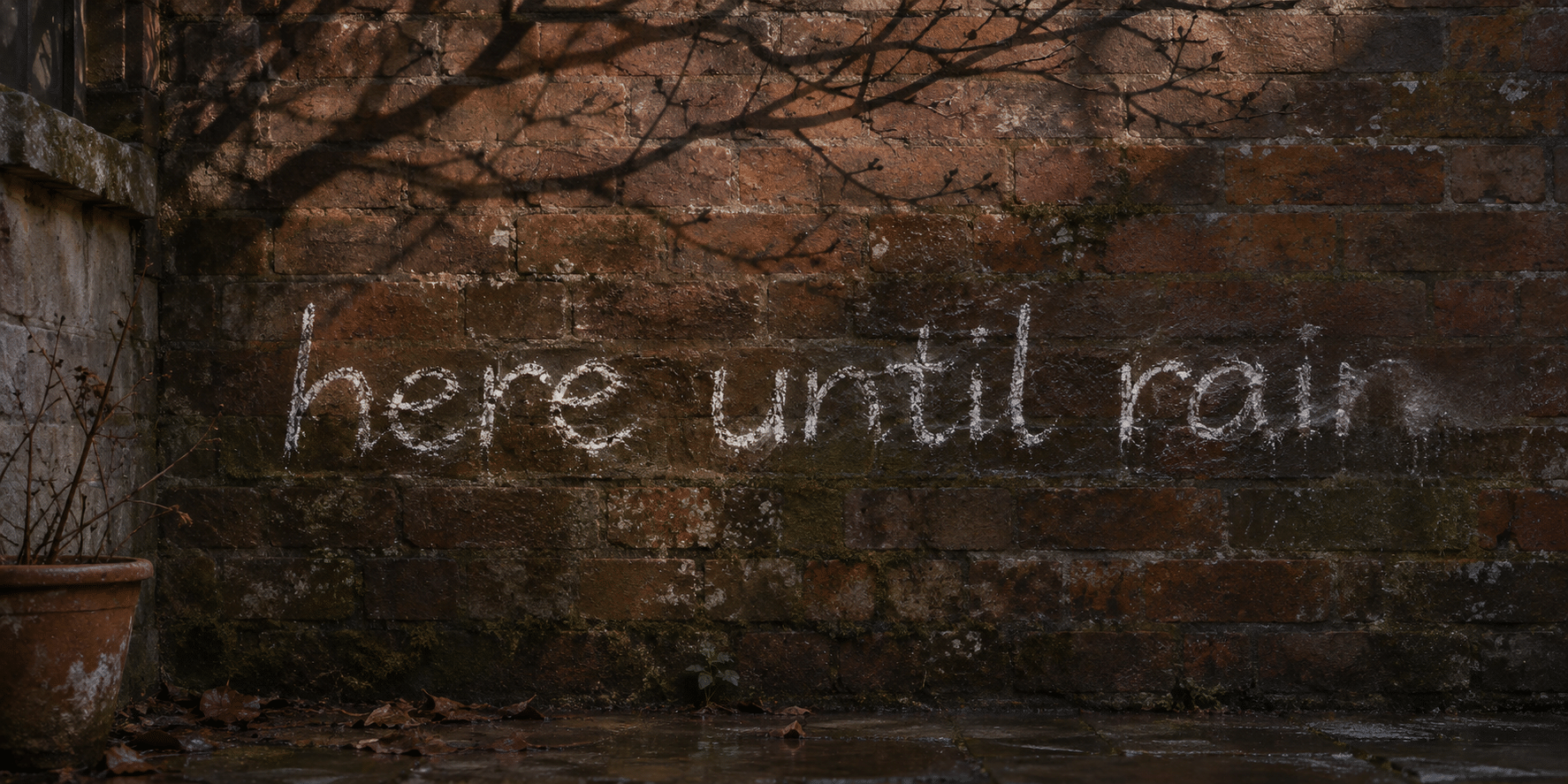
The banner says “rain writes / the river reads” beside an actual-looking stretch of water. The elongated wall gives the reader time to arrive at the second line. Our chalk study says “here until rain.” The powder already softens at its right edge, so the material makes a promise the sentence alone cannot keep. Both are visualisations, not photographs of existing public commissions.
Try transposing the two pieces. “Here until rain” in permanent raised metal would sound wry; in chalk, its literal disappearance is part of the work. A well-chosen material can change the meaning without changing a single letter. In a photograph record condition and date rather than assuming the version you saw is permanent.
Make room for the reader
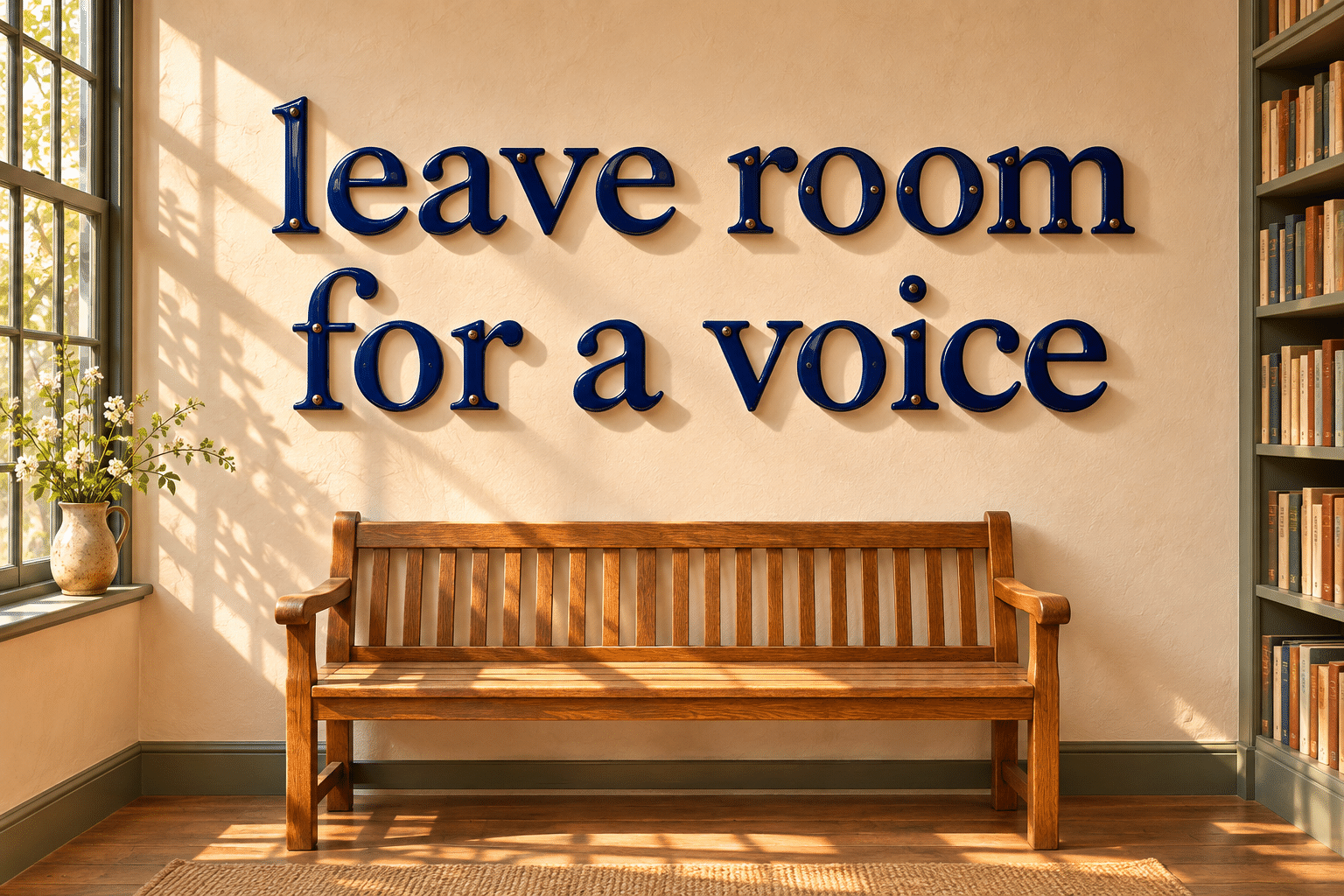
The indoor example sets blue letters over an empty bench: “leave room / for a voice.” The bench changes the pace. Someone can stop, look at the shadows behind the letters and read the phrase again. A reader at a busy crossing might see only the first two words. Test lettering at both distances with a paper model or a digital mock-up before proposing a real site.
Make a text-only transcript as well. Give the poem in its intended order, with its line breaks, then describe where the lines sit and what connects them. A screen reader should not have to guess a poem from a file name. A small printed or digital transcript is also useful when the wall is partly blocked or someone is reading from the opposite pavement.
Plan a four-line walk
Write four short lines about a place you know. Put them on loose cards and walk the route in both directions. At each stop, hold up one card and note whether a branch, a window or a change of light gives a word an unexpected neighbour. Back at a table, try a second order. Keep whichever version invites somebody else to notice a detail they might otherwise pass. The exercise needs no alteration to the wall.
The older collage in the gallery gathers portraits and symbols around the title. The four new proposals test the language itself: reading while walking, turning, waiting for weather or sitting still. Decide which proposal depends most on its particular site. Moving that one indoors is a good test of what the wall contributes.
A small poetic detour
Original words from the AOI studio.
Poetry
One brick keeps the first word.
Two more take the weight of rain.
At the corner my line goes missing;
across the lane you find it,
still damp,
and read it back to me.
The prompt workshop
Original creative exercises. These prompts create new illustrations, not documentary evidence.
Start from the place
Imagine a long brick wall beside a river. Paint the exact two lines “rain writes” and “the river reads” in readable off-white letters. Include the walkway and the water so the second line has a visible addressee.
Use a corner as a line break
Place “one step” on a near wall and “then sky” on the far side of an alley turn. Show the narrow opening to the sky and the two reading distances. No additional letters or signage.
Try the same words twice
Make two studies of “here until rain” on one courtyard wall: one in dry chalk before a shower and another with the right edge beginning to soften. Keep the text readable and preserve the same vantage point.
A smile from the studio
Jokes
Walking game: one reader gets the first wall and another the second. Meet at the corner and see whether your halves form a question, an answer or a completely different weather forecast.