
Poetic and visual practice
Visual poetry makes the visible arrangement of language part of its meaning. Size, spacing, direction, repetition and material can change how a poem is encountered, rather than simply decorate words already complete on their own.
A visual introduction
Select an image for a closer look. Use the thumbnails, arrow keys or a swipe to compare examples. Zoom in to inspect details, or share the image that inspires you.

Creative toolbox · take this style further
Choose an input and a destination. Search sends your words to the chosen site; Copy & open puts them on your clipboard to paste there.
Create with AI
Turn your chosen input into an image prompt or a new creative direction.
ChatGPT
Copy your input and paste it into a ChatGPT conversation or image request.
Copy & open ChatGPT (new tab)Claude · Anthropic
Develop an image prompt or explore the style in a new Claude conversation.
Copy & open Claude · Anthropic (new tab)Midjourney
Paste your input into the Imagine bar on the Create page.
Copy & open Midjourney (new tab)Adobe Firefly
Copy your input, open Firefly, and paste it into the prompt field.
Copy & open Adobe Firefly (new tab)Leonardo.Ai
Copy your input, open Leonardo, and paste it into the generation field.
Copy & open Leonardo.Ai (new tab)Image search
Find visual references. Short, concrete keywords usually work best.
Lexica
Search AI images and prompts using your selected input.
Search with this input Lexica (new tab)Pexels
Search the photo and video library. Short keywords often work best.
Search with this input Pexels (new tab)Pixabay
Search photos, illustrations and other images.
Search with this input Pixabay (new tab)Unsplash
Search photographs using the style name or your own keywords.
Search with this input Unsplash (new tab)Wikimedia Commons
Search photographs, artworks and historical images. Check each file for its source and reuse terms.
Search with this input Wikimedia Commons (new tab)Art & research
Explore artists, collections and the ideas behind a style.
Wikipedia
Search for background reading. A style may not have its own article.
Search with this input Wikipedia (new tab)WikiArt
Copy your input into WikiArt’s search to explore artists and artworks.
Copy & open WikiArt (new tab)Europeana
Paste your keywords into the search to explore European museum, library and archive collections.
Copy & open Europeana (new tab)Inspiration
Discover portfolios and visual ideas from creative communities.
Instagram hashtags
Search a hashtag made from your input: spaces and punctuation are removed. Instagram may require sign-in.
Search with this input Instagram hashtags (new tab)ArtStation
Paste your input into artwork search for concept art, environments, characters and visual development.
Copy & open ArtStation (new tab)Behance
Paste your input into project search for illustration, design and visual storytelling.
Copy & open Behance (new tab)A closer look
Ask what the eye has to do: cross a gap, follow a path, assemble a word, turn an object or move between competing reading orders.
Language has a position
Visual poetry is a broad field; concrete poetry is an important, overlapping historical practice. Neither term means simply a lyrical picture or a portrait beside a book. When placement changes the reading, the visual form is doing poetic work. A gap can delay a word; repetition can become pressure; a change of scale can turn a familiar word into a physical presence.
Getty’s account places the international concrete-poetry movement in the mid-twentieth century and discusses works by Augusto de Campos, Ian Hamilton Finlay, Mary Ellen Solt and others. Its examples include printed, folded, sculptural and projected forms. The field is not restricted to words arranged inside a recognizable silhouette. [1]
Look closely at one operation
Getty describes Augusto de Campos’s Luxo (1965), in which repetitions of the Portuguese word for luxury form the larger word for garbage. Meaning emerges from the relation between the two scales of reading. This documented work is a useful reference, not the source of the new AOI artwork on this page. [1]
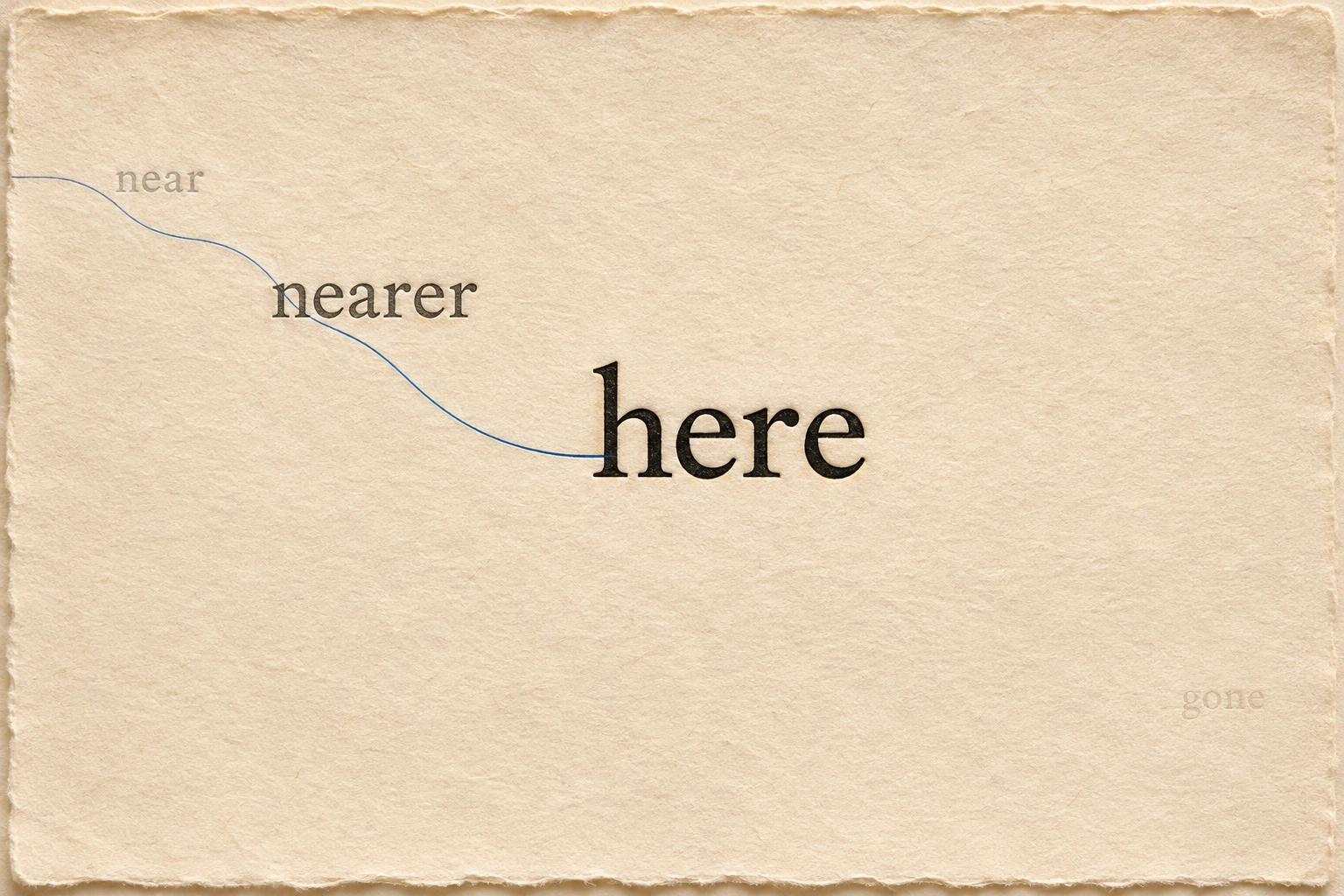
The new featured study uses four words: near, nearer, here, gone. The first three approach a large dark centre; the last is faint and distant. A thin blue line reaches the central word and stops. Distance, size and fading contribute to the reading. The text is supplied here so the visual image is not the only way to access its language.
Compose with a constraint
Choose one short verbal relationship before choosing a decorative typeface. Try changing only spacing, then only scale, then reading direction. If the arrangement could be replaced by any other without affecting the poem, it may still be an illustration or layout exercise rather than a fully developed visual poem.
For an AI-assisted draft, keep the text short enough to check letter by letter. Correct spelling is only the first test: verify that the spatial relationship still carries the intended effect. Provide a plain-text transcription and describe the arrangement. For work intended to be read precisely, controlled typesetting may be more appropriate than generated lettering.
From page to encounter
A folded sheet can reveal language over time; an object can make a reader turn it; an animated work can change its own sequence. The Chicago library exhibition discusses the reader’s activity as part of how concrete poetry happens. [2] Begin with a specific reading action, then select the medium that makes that action meaningful. Do not add motion or texture merely to make a quiet poem look more elaborate.
A small poetic detour
Original words from the AOI studio.
Poetry
near
nearer
here
gone
The prompt workshop
Original creative exercises. These prompts create new illustrations, not documentary evidence.
Approach and absence
Create an original visual poem using exactly four words, each once: near, nearer, here, gone. Let the first three grow toward a dark central here; place gone faintly at a distance. Ivory ground, ample space, no decorative scene. Check every letter.
A pause
Typeset the original words wait and now on a wide plain page, with an unusually large interval between them and only one small dot in the gap. Compare how the pause changes when the gap is doubled; no extra wording.
Turning the page
Design an original folded-paper poetry study using only open and close on opposite visible planes. Let the fold determine which word can be read. Clear letterforms, soft neutral light, no copied poem or author signature.