
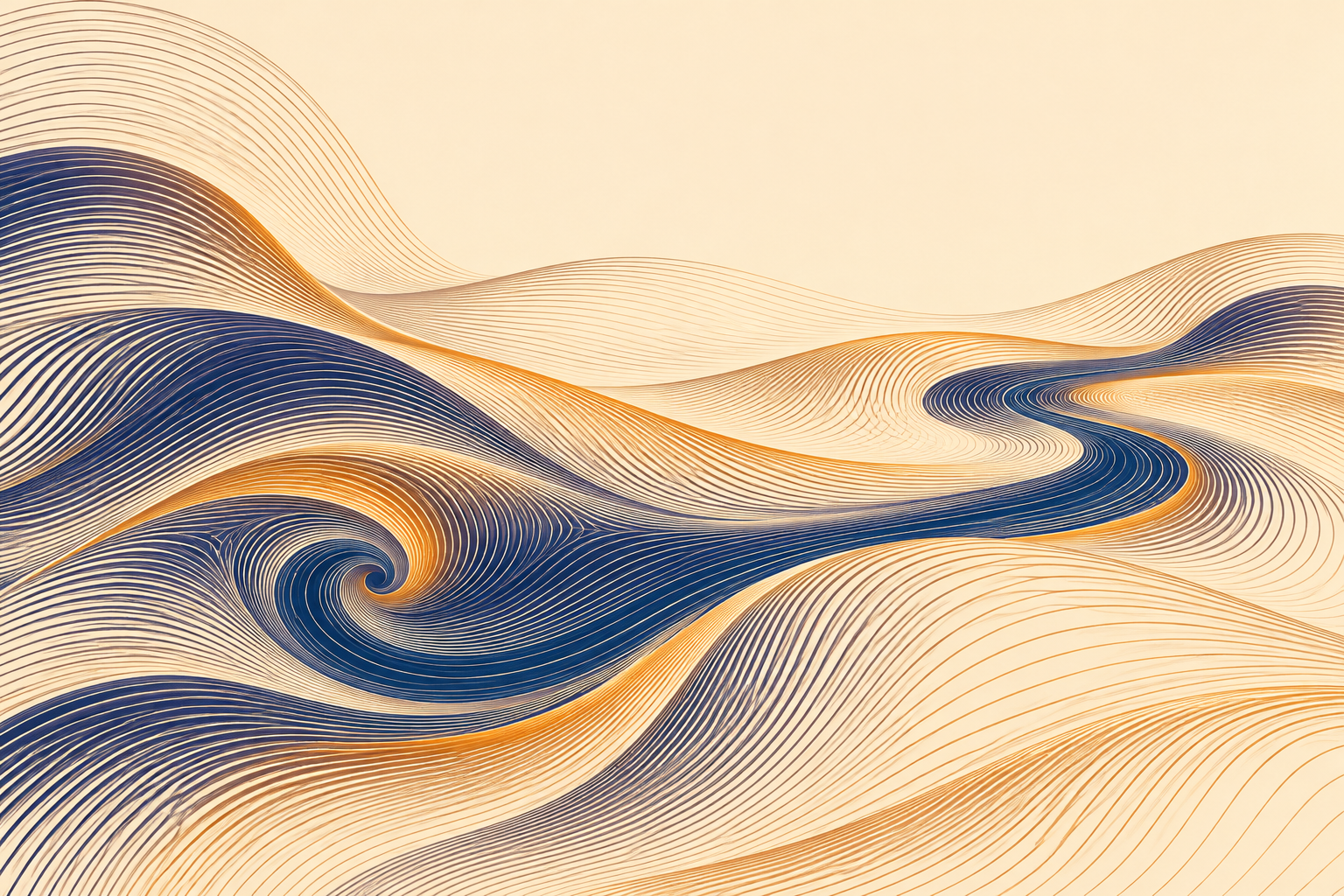
AOI artistic interpretation of vector-field visualization
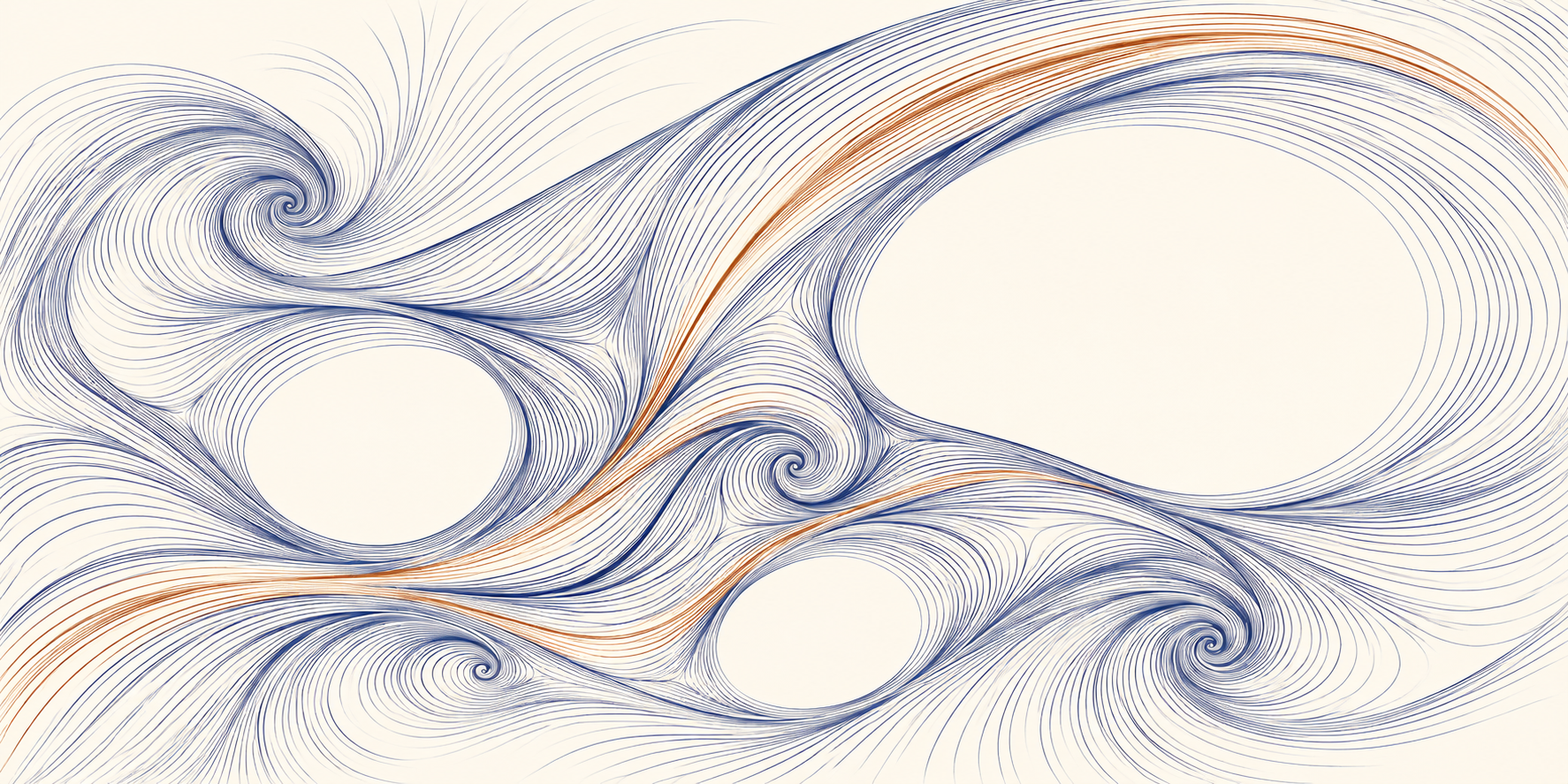
An artistic interpretation in which coherent families of flowing lines make direction, curvature and empty space the main compositional materials.
A visual introduction
Select an image for a closer look. Use the thumbnails, arrow keys or a swipe to compare examples. Zoom in to inspect details, or share the image that inspires you.
Creative toolbox · take this style further
Choose an input and a destination. Search sends your words to the chosen site; Copy & open puts them on your clipboard to paste there.
Create with AI
Turn your chosen input into an image prompt or a new creative direction.
ChatGPT
Copy your input and paste it into a ChatGPT conversation or image request.
Copy & open ChatGPT (new tab)Claude · Anthropic
Develop an image prompt or explore the style in a new Claude conversation.
Copy & open Claude · Anthropic (new tab)Midjourney
Paste your input into the Imagine bar on the Create page.
Copy & open Midjourney (new tab)Adobe Firefly
Copy your input, open Firefly, and paste it into the prompt field.
Copy & open Adobe Firefly (new tab)Leonardo.Ai
Copy your input, open Leonardo, and paste it into the generation field.
Copy & open Leonardo.Ai (new tab)Image search
Find visual references. Short, concrete keywords usually work best.
Lexica
Search AI images and prompts using your selected input.
Search with this input Lexica (new tab)Pexels
Search the photo and video library. Short keywords often work best.
Search with this input Pexels (new tab)Pixabay
Search photos, illustrations and other images.
Search with this input Pixabay (new tab)Unsplash
Search photographs using the style name or your own keywords.
Search with this input Unsplash (new tab)Wikimedia Commons
Search photographs, artworks and historical images. Check each file for its source and reuse terms.
Search with this input Wikimedia Commons (new tab)Art & research
Explore artists, collections and the ideas behind a style.
Wikipedia
Search for background reading. A style may not have its own article.
Search with this input Wikipedia (new tab)WikiArt
Copy your input into WikiArt’s search to explore artists and artworks.
Copy & open WikiArt (new tab)Europeana
Paste your keywords into the search to explore European museum, library and archive collections.
Copy & open Europeana (new tab)Inspiration
Discover portfolios and visual ideas from creative communities.
Instagram hashtags
Search a hashtag made from your input: spaces and punctuation are removed. Instagram may require sign-in.
Search with this input Instagram hashtags (new tab)ArtStation
Paste your input into artwork search for concept art, environments, characters and visual development.
Copy & open ArtStation (new tab)Behance
Paste your input into project search for illustration, design and visual storytelling.
Copy & open Behance (new tab)A closer look
Continuous tangent-like curves, coherent neighboring trajectories, eddies and channels, controlled line spacing, fine contour rhythm and selective color accents against quiet negative space.
A scientific idea, an artistic interpretation
Vector-Field Streamline (Art) is an AOI interpretation informed by scientific visualization, not a claim to have founded a historical movement. In vector-field visualization, a streamline follows the local direction of a field at a given instant. NASA's tutorial distinguishes this instantaneous view from time-dependent particle tracking.
Here, the scientific idea becomes a compositional rule: neighboring lines should suggest a shared directional system. The artwork may be expressive rather than a computed physical simulation. Its caption should make that distinction clear; attractive curves are not evidence of a measured airflow, magnetic field or weather event.
Let a field govern the drawing
Choose one organizing behavior before adding detail. Lines might curl around an open center, separate around an obstacle or pass through a narrow channel before spreading out. Let local changes build a larger structure. Randomly decorative curls weaken the sense that the lines belong to the same field.
Spacing is an artistic control. Dense bundles can create weight and sparse passages can release it, but density does not automatically represent speed. If a scientific quantity is encoded through spacing, width or color, define that mapping explicitly. Otherwise describe these choices as visual emphasis.
Curvature, crossing and depth
For a clean two-dimensional streamline interpretation, neighboring trajectories should turn coherently rather than cross arbitrarily. Special points where the field vanishes need separate handling; a perspective projection of a three-dimensional system can also produce apparent crossings. An artistic drawing may break these rules, but it should recognize the change.
Balance fine-line detail with a legible silhouette. A vortex can be implied by the shape of its empty center rather than filled with more strokes. One warm current among cool lines can establish a focal route. Avoid lighting effects so bright that they hide the underlying direction and continuity.
Related to Flow Field, with a narrower emphasis
Flow Field remains the broader neighboring database topic. This entry concentrates on streamline-like families, coherent trajectories and the visual relationship between local direction and overall form. Particle clouds, brush dabs and other field-driven marks may belong in the broader entry without being central here.
Useful applications include original generative posters, abstract landscape analogies and explanatory motion studies. A static picture can suggest movement; an animation needs a consistent rule across frames. For a decorative AI image, ask for coherent line behavior and identify the result as an artistic interpretation rather than a validated simulation.
Positive editorial perspective
AOI editorial perspective (AI-authored). A coherent field can unite intricate detail with a simple overall gesture. Empty centers and changing line spacing make direction feel tangible without requiring literal arrows or objects.
Negative editorial perspective
AOI editorial perspective (AI-authored). Random swirls and neon glow can obscure the defining structure. Remove curves that contradict the local flow, clarify the empty spaces and avoid claiming scientific accuracy for decorative imagery.
Neutral editorial perspective
AOI editorial perspective (AI-authored). This is an artistic interpretation with a scientific reference. It overlaps with flow-field art while focusing on continuous trajectories; mathematical validity must be established separately when an image is used as data visualization.
A small poetic detour
Original words from the AOI studio.
Poetry
No river wets this turning line;
No measured wind declares it mine.
Yet curve by curve the page can show
A place where neighboring motions go.
They part around an empty eye,
Then gather where the margins lie.
One amber thread, a quiet guide,
Keeps pace with blue on either side.
The center holds its little hush;
The narrow channel feels the rush.
A field imagined, not surveyed:
Direction is the mark I made.
The prompt workshop
Original creative exercises. These prompts create new illustrations, not documentary evidence.
Draw one coherent eddy
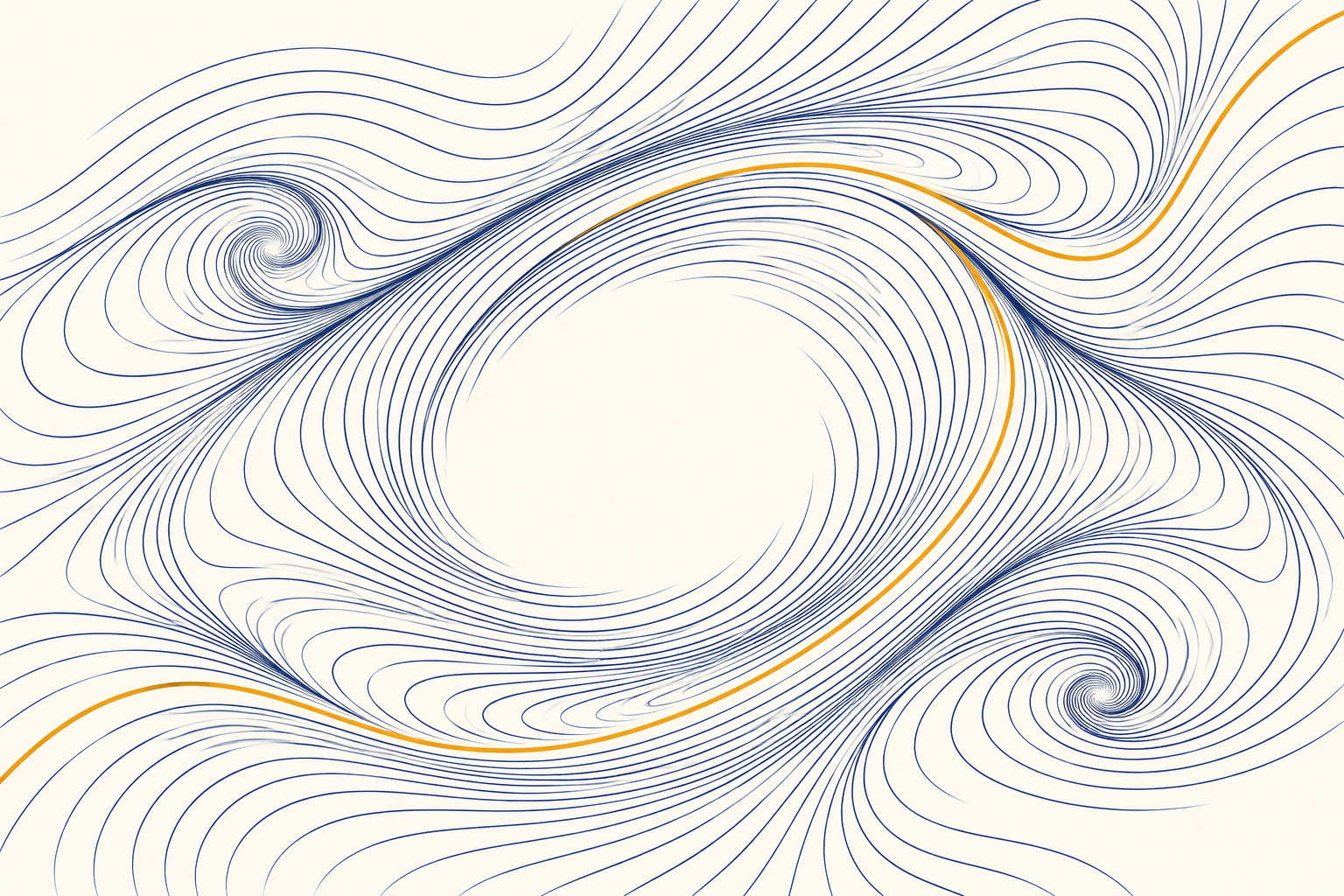
Original vector-field streamline art interpretation, fine continuous navy curves circulating around one open center, coherent neighboring trajectories, controlled spacing and generous ivory negative space, one amber accent route, no text.
Treat this as an artistic field, not measured flow data.
Split around an obstacle
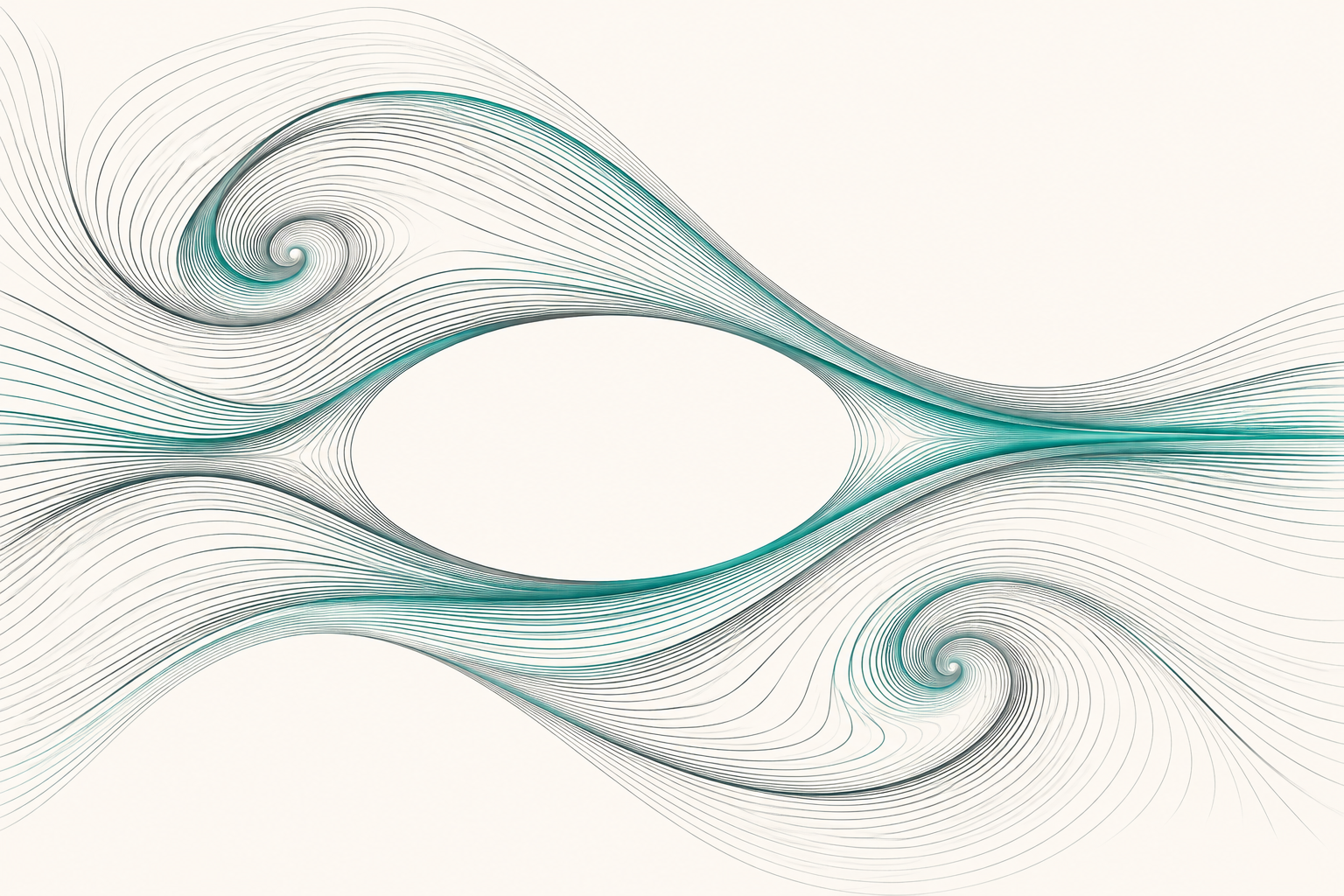
An original abstract composition of fine streamline-like curves separating around a quiet oval void and rejoining visually downstream, restrained teal and charcoal palette, smooth tangent continuity, no random line crossings, no labels.
Make the obstacle and directional behavior legible at thumbnail size.
Make a landscape from direction
Original artistic vector-field interpretation suggesting dunes through flowing line families, alternating dense and sparse passages, one broad calm interval, sand and indigo palette, coherent curvature and no photographic texture.
Line spacing is expressive emphasis unless a quantitative mapping is explicitly defined.
A smile from the studio
Jokes
The streamline refused to take a shortcut. 'I have to follow the local direction,' it explained. The art director suggested a dramatic intersection. The streamline asked for either a third dimension or a formal resignation from fluid mechanics.