
AOI original concept · Club culture, print & collective rhythm
Underground-Partyism turns a dance room into a living printed score. Bass becomes curved bands across the floor; borrowed architecture becomes a rhythmic frame; torn flyers carry the memory of other nights. At its center are people making a temporary world together. This is an AOI-developed visual concept, informed by real club cultures rather than presented as an established historical movement.
A visual introduction
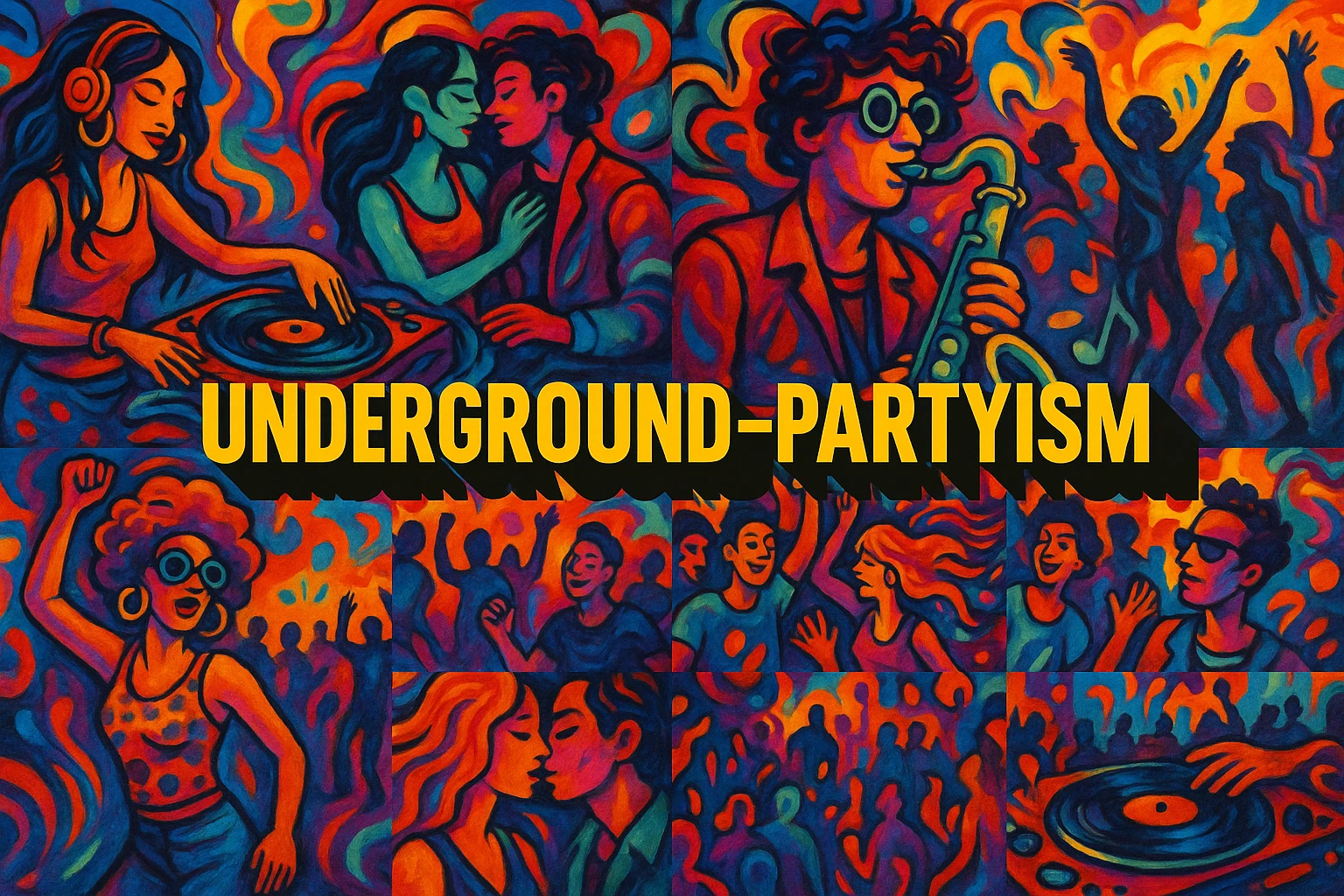
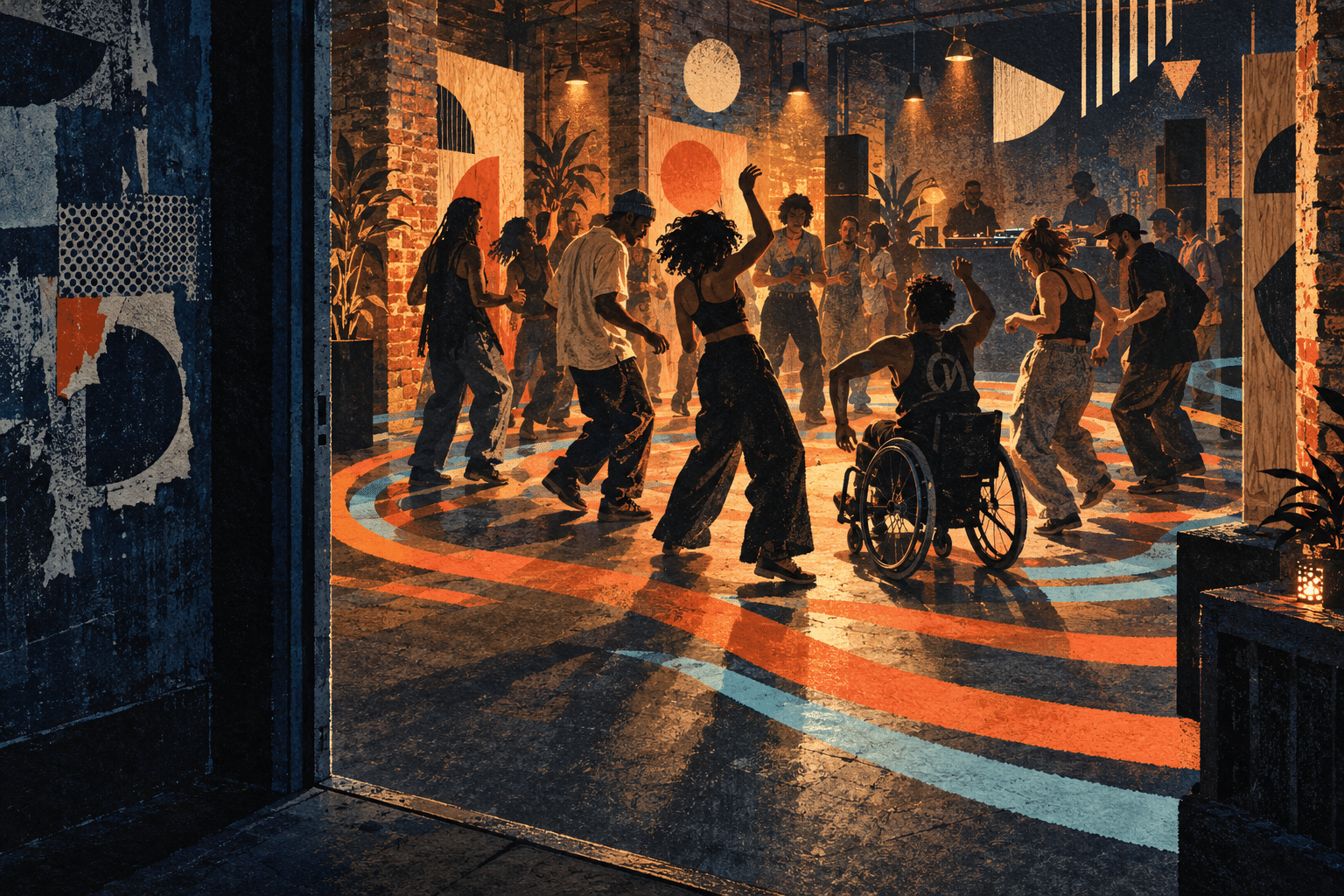
A new scene that develops the five visual signatures, alongside the retained centrally titled archive collage. Both are imaginative AI-generated interpretations.
Select an image for a closer look. Use the arrow keys or gallery controls to compare the two illustrations.
Creative toolbox · take this style further
Choose an input and a destination. Search sends your words to the chosen site; Copy & open puts them on your clipboard to paste there.
Create with AI
Turn your chosen input into an image prompt or a new creative direction.
ChatGPT
Copy your input and paste it into a ChatGPT conversation or image request.
Copy & open ChatGPT (new tab)Claude · Anthropic
Develop an image prompt or explore the style in a new Claude conversation.
Copy & open Claude · Anthropic (new tab)Midjourney
Paste your input into the Imagine bar on the Create page.
Copy & open Midjourney (new tab)Adobe Firefly
Copy your input, open Firefly, and paste it into the prompt field.
Copy & open Adobe Firefly (new tab)Leonardo.Ai
Copy your input, open Leonardo, and paste it into the generation field.
Copy & open Leonardo.Ai (new tab)Image search
Find visual references. Short, concrete keywords usually work best.
Lexica
Search AI images and prompts using your selected input.
Search with this input Lexica (new tab)Pexels
Search the photo and video library. Short keywords often work best.
Search with this input Pexels (new tab)Pixabay
Search photos, illustrations and other images.
Search with this input Pixabay (new tab)Unsplash
Search photographs using the style name or your own keywords.
Search with this input Unsplash (new tab)Wikimedia Commons
Search photographs, artworks and historical images. Check each file for its source and reuse terms.
Search with this input Wikimedia Commons (new tab)Art & research
Explore artists, collections and the ideas behind a style.
Wikipedia
Search for background reading. A style may not have its own article.
Search with this input Wikipedia (new tab)WikiArt
Copy your input into WikiArt’s search to explore artists and artworks.
Copy & open WikiArt (new tab)Europeana
Paste your keywords into the search to explore European museum, library and archive collections.
Copy & open Europeana (new tab)Inspiration
Discover portfolios and visual ideas from creative communities.
Instagram hashtags
Search a hashtag made from your input: spaces and punctuation are removed. Instagram may require sign-in.
Search with this input Instagram hashtags (new tab)ArtStation
Paste your input into artwork search for concept art, environments, characters and visual development.
Copy & open ArtStation (new tab)Behance
Paste your input into project search for illustration, design and visual storytelling.
Copy & open Behance (new tab)A closer look
Tactile ink, layered paper, strong architectural silhouettes, syncopated bands of color, expressive adult dancers and one quiet threshold. Warm amber and coral move through midnight blue, with selective cyan echoes. The defining relationship is between room, rhythm and community; neon is optional.
The room becomes the instrument
A good Underground-Partyism image lets you feel where the sound would travel. A low curved band can pull the eye from a doorway toward a circle of dancers. Repeated columns establish the beat; a missing interval makes it stumble and recover. Paper edges, floor reflections and raised arms answer one another across the composition. The result is part scene, part graphic score: a place that appears to have learned its own rhythm.
AOI develops the name here as an original creative framework. Its sources are real, but no historical founder, manifesto or established movement is claimed. Nor is it a political party. The earlier entry contained conflicting dates, unsupported artist affiliations and unrelated political assertions; those have been replaced with documented references and an explicit studio method.
Real connections: people, graphics and designed space
Community comes first. In WTTW’s Chicago Stories interviews, Donald Crossley recalls friends organizing spaces where young gay people could dance and be themselves. The account situates these gatherings in Chicago’s Black and gay communities and describes improvised interiors made with reused seating and dividers. This is a particular history, not a generic origin story for every club scene. For this AOI concept, it suggests a compositional principle: show people shaping a room together, with gestures of welcome and shared attention.
Graphic design can translate a place into a visual identity. Rick Banks’s selection for V&A Dundee includes Farrow’s reflective 1997 Haçienda anniversary poster and a Printworks identity that draws on the building’s printing heritage through type arranged around a cylinder. The useful connection is between material, site and image. Invent a graphic language for your fictional room instead of borrowing an existing club’s logo.
The V&A Dundee Night Fever resources describe the nightclub as a combination of architecture, graphics, fashion, lighting, performance and sound. The Design Museum’s Electronic exhibition also connected these disciplines, including 1024 architecture’s sound-reactive CORE and concert visuals by Smith & Lyall. Underground-Partyism translates that cross-disciplinary thinking into a still image. Its painted pulses are a visual metaphor; they do not measure or actually respond to sound.
Five signatures that make the style recognizable
1. A pulse with interruptions. Repeat a curved band, wedge or offset rectangle, then deliberately skip or stretch an interval. Give the pattern one clear direction through the picture. Uniform stripes feel like wallpaper; controlled variation suggests a groove.
2. Architecture that participates. Let a column, low ceiling, speaker enclosure or temporary screen echo the pulse. The room must remain readable, with a floor and a plausible route through it. A few convincing structures are stronger than a forest of random industrial props.
3. A surface that remembers. Build selected areas from torn-paper edges, coarse halftone, overprinted color and small registration slips. Concentrate this material detail around the perimeter or on one wall, leaving faces and important gestures clear.
4. A collective center. Arrange two or three small relationships: friends catching each other’s eye, someone making space, dancers answering a shared beat. Vary poses and silhouettes. A DJ may be present, but the crowd has agency rather than serving as anonymous decoration.
5. A quiet threshold. Keep one doorway, empty floor wedge or deep shadow comparatively still. It gives the viewer a place to enter and makes the energized area feel more alive. This interval is as important as the busiest marks.
Color, lettering and the art of restraint
Begin with midnight blue or charcoal as the anchor, amber or warm cream for people and light, and coral for the main pulse. Use cyan sparingly as a delayed visual echo. A two-ink version can work just as well: warmth, rhythm and material contrast matter more than a particular fashionable palette.
For a poster, draw the image first and set actual event information afterward in editable type. Use one compact display face and one legible text face, with generous margins. In a style collage, place the complete name at the center and let panels frame it. Lettering should organize the image, not compete with every dancer and beam of light.
Resist generic neon fog, copied club branding and automatic associations between underground culture and crime or despair. Chicago house, British rave and other scenes have distinct histories. Choose a reference deliberately, credit it, and make clear when an image is a fictional interpretation.
Reading the two illustrations
The new banner places us at a dark doorway looking into an invented brick-walled dance room. Coral and pale-cyan bands cross the floor; temporary screens repeat simple shapes; warm light connects the dancers. A wheelchair dancer belongs within the central group rather than appearing as an isolated symbol. The quiet left edge gives the eye somewhere to rest before joining the visual rhythm.
The retained, centrally titled collage offers a more exuberant archive interpretation: a DJ, dancers, a couple, a saxophonist and turntable details gathered in warm orange and cool blue. It remains useful as a collection of possible motifs, rather than evidence of a particular historical venue or event. Both images are AI-generated illustrations; neither documents real people at a real party.
A practical studio study: one room, three nights
Draw a simple room and keep its viewpoint fixed. In the first study, use broad intervals and a few figures arriving. In the second, tighten the pulse and build a small circle of dancers. In the third, leave scattered paper shapes and a thin band of morning light. Preserve one recurring architectural shape so the three images feel like the same place changing through time.
For a collage or digital painting, separate architecture, figures, rhythmic marks and print texture into editable layers. For image generation, describe the room, the human relationship, the pulse direction and the quiet area before adding surface effects. Generate a coherent scene first; add accurate typography separately when it carries information.
The framework suits fictional record sleeves, illustrated zines, stage-visual stills and cultural posters. Judge the result at thumbnail size: can you identify the room, the shared gesture and the direction of the pulse? Then inspect anatomy, overlaps and texture at full size. If the picture reads only as a colorful crowd, simplify until the five signatures become visible.
Pocket-sized facts
Underground-Partyism is developed here as an AOI creative concept, not an authenticated historical movement or political party.
Documented references connect club graphics, designed interiors and community; their creators are not described as members of this invented style.
Rhythmic bands in a static illustration are compositional metaphors, not acoustic measurements.
Technique notes
Keep architecture, people, rhythmic marks and texture on separate layers when editing.
Use one intentional gap in a repeated motif; compare it with an evenly repeated version.
For functional posters, add event details in editable type after generating the image.
Choose a specific cultural reference and credit it; do not merge distinct communities into an invented universal origin story.
A small poetic detour
Original words from the AOI studio.
Poetry
The doorway keeps a little night,
The floor unfolds a ribbon bright.
A borrowed wall, a paper seam,
A room rehearses how to dream.
No single hand can hold the beat;
It travels where our glances meet.
The prompt workshop
Original creative exercises. These prompts create new illustrations, not documentary evidence.
Start here · A room finds its beat
Underground-Partyism illustration of a fictional small dance room, three adult friends exchanging lively gestures under a warm pendant light. One coral curved band crosses the floor like a visible bass pulse; brick columns repeat its rhythm. Midnight-blue shadows, warm cream figures, selective cyan echo, tactile two-color screenprint texture. Preserve a quiet doorway on the left and clear human silhouettes. Original place, no logos, no readable text, no laser overload.
Richer scene · The floor belongs to everyone
An original Underground-Partyism panoramic record-sleeve illustration, viewed diagonally from a dark threshold into a welcoming fictional club. A loose circle of adult dancers, including a wheelchair dancer, creates the central gesture; a small DJ station sits behind them. Temporary plywood screens and brick piers echo interrupted coral and cyan bands across the floor. Amber light, midnight-blue shadows, torn-paper edges and selective halftone, believable expressive anatomy, strong negative space. Not a documentary reconstruction, no real venue branding, no lettering.
Graphic experiment · Print the pulse
Underground-Partyism abstract club-poster artwork with no text: construct a readable room from flat charcoal planes, cream doorway shapes and three tiny dancing silhouettes. A sequence of vermilion wedges crosses the floor with one deliberately missing interval. Pale cyan overprint creates a delayed echo. Rough paper fiber, small registration offsets, one broad quiet area; restrained two-ink print logic, clear focal hierarchy. No recognizable logos or psychedelic clutter.
After-hours variation · The room remembers
A quiet Underground-Partyism illustration of an invented dance room at dawn. Two adult friends collect paper flyers while a third rests by the open doorway. Repeated floor bands fade toward a pale apricot shaft of morning light; columns retain the rhythm of the earlier crowd. Deep indigo, dusty coral, cream, restrained cyan, tactile screenprinted grain and tender observational gestures. A warm shared aftermath, not urban despair; no readable text, no real venue identifiers.
Material study · A wall made of nights
An Underground-Partyism close-up composition: a layered wall of invented torn flyers, blank ticket shapes, hand-cut geometric marks and coarse halftone beside a narrow view into a warmly lit dance room. Paper edges form a syncopated pattern leading toward two adult dancers. Midnight blue, burnt orange and cream with a single cyan offset, rich tactile print surface, balanced quiet margins. All graphic motifs original; no copied posters, logos, dates or readable event text.
Collage study · Name at the center
Create a refined Underground-Partyism art-style collage with the complete exact title UNDERGROUND-PARTYISM prominently centered in beautifully legible handmade display lettering. Surround it with four coordinated views of one fictional club: a welcoming doorway, a small adult dance circle, a rhythmic architectural detail, and a quiet dawn scene. Interrupted coral floor bands connect the panels, warm amber people and midnight-blue shadows, selective cyan echoes, torn-paper print texture. Clear panel hierarchy, convincing anatomy, no real club logos or historical documentary claims.
Your next inspiration
Discover another art style
Follow a visual thread to the next subject.

A smile from the studio
Jokes
The bassline applied for planning permission. It wanted to move the walls.
Our flyer has excellent underground credentials: I found it beneath the printer.
The doorway asked for a solo. We gave it eight bars of negative space.