
Archive note: historical claims and artist or artwork associations in this entry have not yet received a full source review.
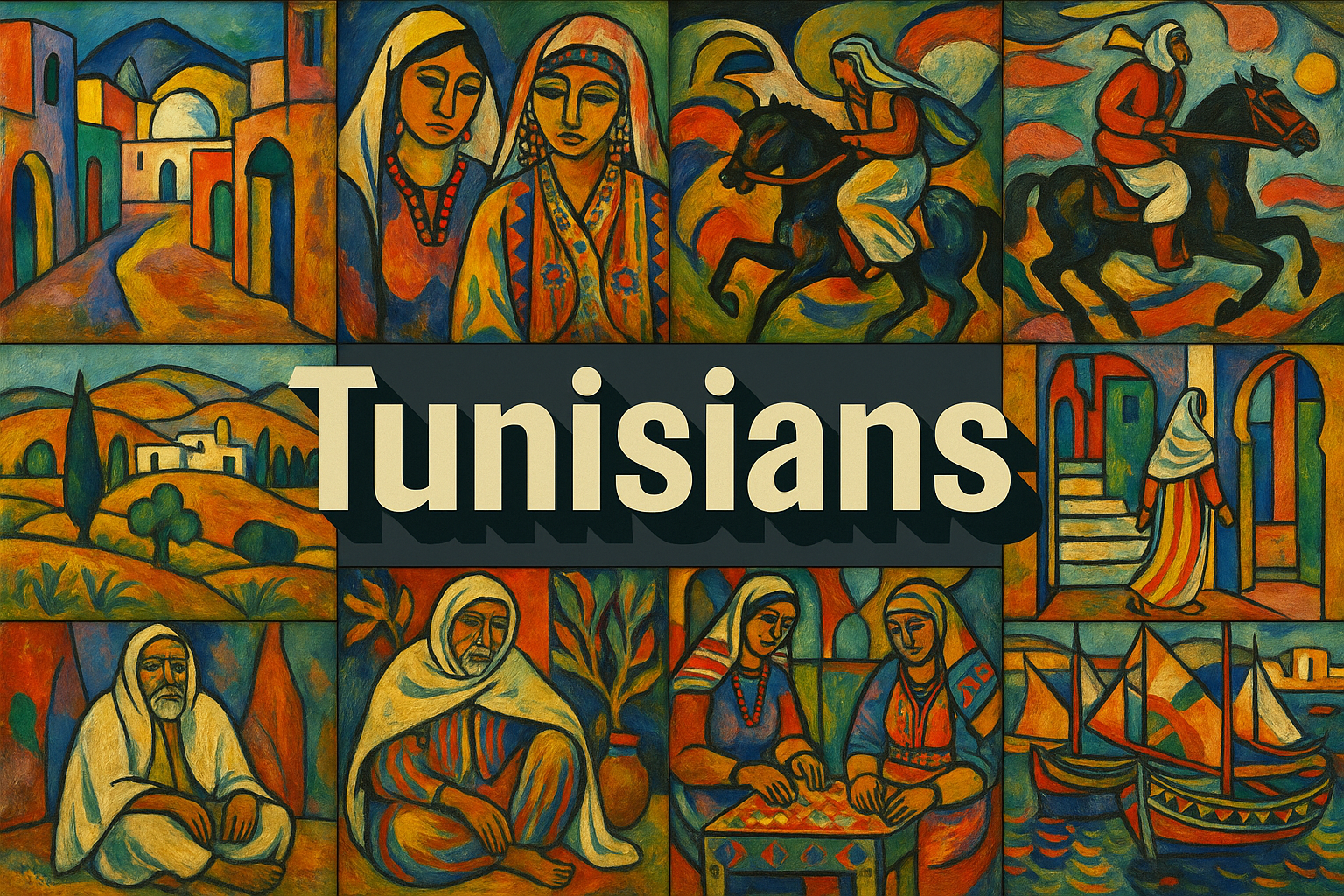
Tunisians
The art style of Tunisians is very colorful and intricate. Patterns are often geometric and symmetrical, and there is a lot of detail. Bright colors are used extensively.
AOI thinking about Tunisians [+_~]-/
Overview and quick facts
Tunisian art is a blend of Arab, Turkish, Italian, and French influences. The art is characterized by its use of bright colors and intricate patterns. Tunisian artists often use geometric shapes and Arabic calligraphy in their work.
Can understand it also, as:
Tunisians can also be referred to as Tunisian people or Tunisian citizens.
Categorize it as:
Impressionism, Modernism
Detailed description
Tunisian art is a reflection of the country’s rich history and culture. Tunisia has been home to many great artists, who have left their mark on the world. Tunisian art is characterized by its use of bright colors and bold patterns. Tunisian artists often use traditional motifs in their work, which can be seen in the paintings of Mohamed Chebaa and Hedi Turki. Tunisian art is also influenced by the country’s Arab and Islamic heritage. This can be seen in the work of artists such as Ahmed Ben Ali and Mouna Jmal. Tunisian art is a unique and vibrant expression of the country’s culture. It is a reflection of the Tunisian people’s history and their way of life.
Archive notes — claims to verify
ERROR: VALUE (interpolation)
Artists and works: references to check
(be aware, can be highly speculative)
Artists (be aware, speculation possible):
1. Nabil Kanso (born 1940) 2. Hedi Turki (1922-2012) 3. Ahmed Ben Bella (1916-2012) 4. Mohamed Larbi Ben M’hidi (1920-1957) 5. Habib Bourguiba (1903-2000) 6. Farhat Hached (1913-1952) 7. Tahar Haddad (1898-1934) 8. Abdelkrim el-Khattabi (1882-1963) 9. M’hamed Naceur (1921-1961) 10. Lamine Lotfi (1924-2013) 11. Larbi Ben M’hidi (1920-1957) 12. Habib Bourguiba (1903-2000) 13. Farhat Hached (1913-1952) 14. Tahar Haddad (1898-1934) 15. Abdelkrim el-Khattabi (1882-1963)
Artworks (be aware, speculation possible)
1. “The Hay Wagon” by Jules-Elie Delaunay (1828) 2. “The Death of Sardanapalus” by Eugène Delacroix (1827) 3. “The Battle of Jemappes” by Horace Vernet (1837) 4. “The Battle of Isly” by Horace Vernet (1844) 5. “The Landing of the French Army in Algeria” by Horace Vernet (1845) 6. “The Siege of Constantine” by Horace Vernet (1837) 7. “The Death of General Desaix” by Horace Vernet (1810) 8. “The Death of Marshal Ney” by Horace Vernet (1815) 9. “The Assassination of Marat” by Jacques-Louis David (1793) 10. “The Death of Socrates” by Jacques-Louis David (1787) 11. “Bonaparte Crossing the Alps” by Jacques-Louis David (1800) 12. “The Coronation of Napoleon” by Jacques-Louis David (1804) 13. “The Entry of Alexander into Babylon” by Charles-François Lebrun (1787) 14. “The Destruction of Tyre” by Charles-François Lebrun (1787) 15. “The Death of Caesar” by Vincenzo Camuccini (1804)
Epoch
The art style of Tunisians can be dated back to the 8th century.
Creative tools and further exploration
Search results are starting points for exploration, not evidence for the historical claims or attributions in this legacy entry.