
A researched introduction
Transavantgarde, or Transavanguardia, names an Italian painting tendency associated with the return to expressive figuration around 1980. It sits within a wider international revival of painting, but the Italian term and the broader label Neo-Expressionism should not be treated as interchangeable lists of artists.
A visual introduction
Open any image to look closer, then browse the examples.
Creative toolbox · take this style further
Choose an input, adjust it, then open a tool. Search links pass your text to the destination. Copy & open copies it for you to paste into the generator; you start generation there.
ChatGPT
Copy your input and paste it into a ChatGPT conversation or image request.
Copy & open ChatGPT (new tab)Claude · Anthropic
Develop an image prompt or explore the style in a new Claude conversation.
Copy & open Claude · Anthropic (new tab)Midjourney
Paste your input into the Imagine bar on the Create page.
Copy & open Midjourney (new tab)Adobe Firefly
Copy your input, open Firefly, and paste it into the prompt field.
Copy & open Adobe Firefly (new tab)Leonardo.Ai
Copy your input, open Leonardo, and paste it into the generation field.
Copy & open Leonardo.Ai (new tab)Lexica
Search AI images and prompts using your selected input.
Search with this input Lexica (new tab)Pexels
Search the photo and video library. Short keywords often work best.
Search with this input Pexels (new tab)Pixabay
Search photos, illustrations and other images.
Search with this input Pixabay (new tab)Unsplash
Search photographs using the style name or your own keywords.
Search with this input Unsplash (new tab)Wikipedia
Search for background reading. A style may not have its own article.
Search with this input Wikipedia (new tab)WikiArt
Copy your input into WikiArt’s search to explore artists and artworks.
Copy & open WikiArt (new tab)Instagram hashtags
Search a hashtag made from your input: spaces and punctuation are removed. Instagram may require sign-in.
Search with this input Instagram hashtags (new tab)A closer look
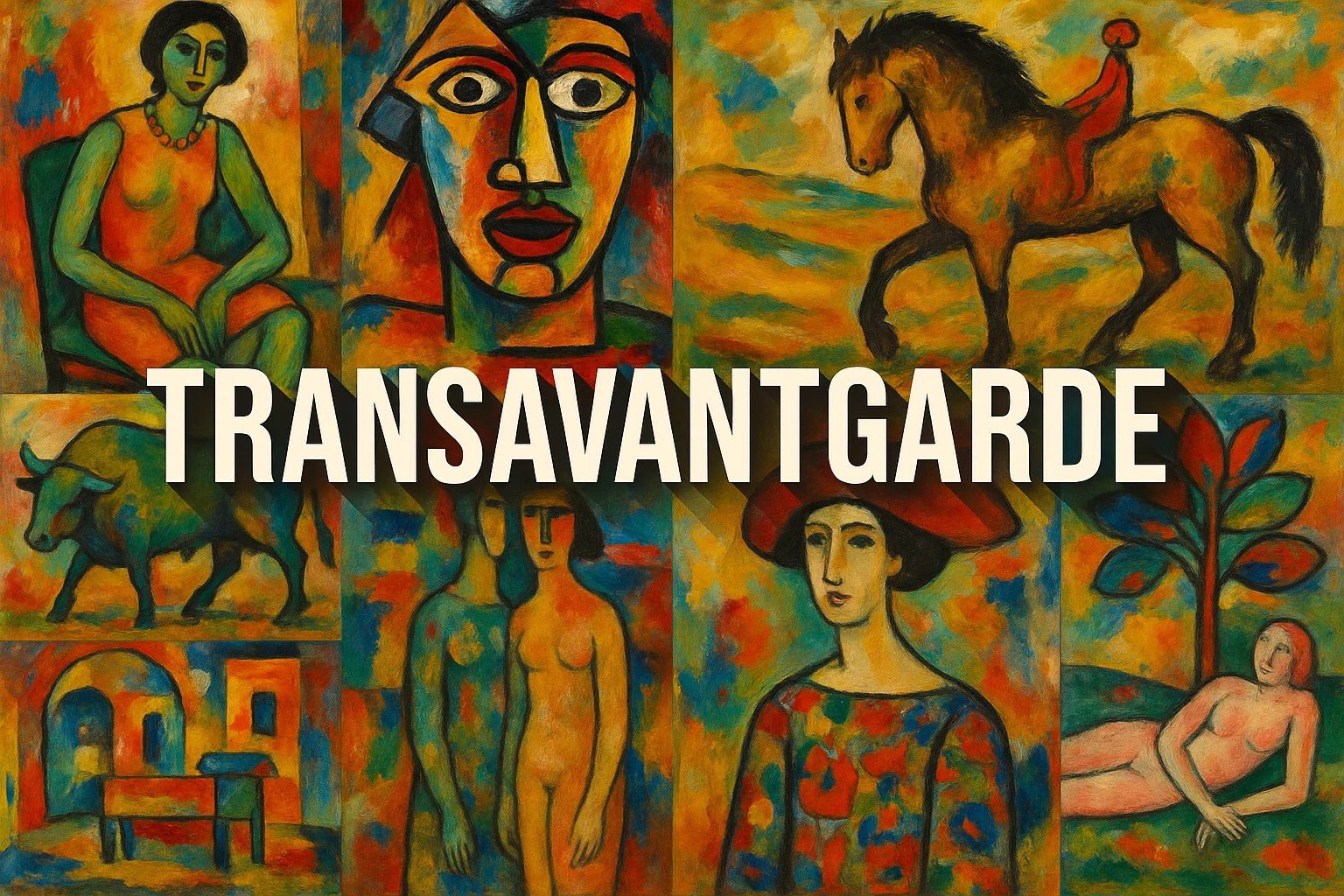
The AOI archive collage brings together isolated figures, a horse, a bull, a mask-like face and an architectural fragment. Warm orange fields meet blue-green passages and emphatic contours. These are generated interpretive examples, not paintings attributed to the historical movement.
A useful historical starting point
The Guggenheim’s account of Francesco Clemente’s Scissors and Butterflies links the Italian painting revival to the critic Achille Bonito Oliva’s term Transavanguardia. It describes a renewed use of the human figure, narrative, strong colour and gestural handling in the years around 1980. That institutional account provides a focused starting point for a subject often reduced to a vague instruction to paint expressively.
The same source places Clemente within an international shift that included other painters. This does not make every artist in that wider shift a member of the Italian grouping. Keep the scale of a claim clear: a shared period, a related tendency and a specific critical label are different relationships.
Expression is a set of decisions
In the collage, the horse and standing figure occupy fields that do not behave like continuous, measured space. Colour can connect separate motifs without explaining their physical location. The mask-like face confronts the viewer while other figures seem absorbed elsewhere. That mismatch offers a narrative possibility without supplying a complete story.
Observe how the thick contour changes the weight of a shape. A dark boundary can isolate a figure; a broken one can let the surrounding colour enter it. Neither effect is inherently more expressive. What matters is how the choice serves the image. Vigorous brushwork can be purposeful, but it can also be a decorative habit.
An example is not a template
Scissors and Butterflies dates to 1999, later than the emergence discussed above. The Guggenheim uses it to illuminate aspects of Clemente’s practice and the broader painting revival. Preserve that date distinction when studying it. A later work can clarify a continuing concern without becoming evidence of what every participant painted at the beginning.
Read the museum’s object account alongside the work itself. Then return to the AOI illustration and notice what a generic summary loses: a particular artist’s choices, the scale of a canvas and the specific relationships among its figures. Our collage is a doorway into questions, not a substitute for the documented object.
Try a narrative with one missing connection
Choose two ordinary motifs with a personal relationship: a coat and a doorway, a cup and a distant figure, a horse and an empty chair. Paint or generate them in one field without explaining the connection. Establish one dominant colour relationship and vary the contour. Resist adding symbols merely because they look mysterious.
Compare versions by asking what each visible decision contributes. Does the distortion change the emotional relation between the motifs? Does the colour hold the composition together? When the answer is no, simplify. The point is not to manufacture historical membership with a prompt. It is to discover what painting can say when observation, memory and invention occupy the same surface.
The prompt workshop
Original creative exercises. These prompts create new illustrations, not documentary evidence.
Two motifs, one unresolved story
Create an original expressive painting of an empty coat beside a doorway and a small distant figure. Flatten the space, use orange against deep blue-green, vary thick and broken contours, and leave the relationship unresolved. No copied composition, historical attribution, lettering or artist signature.
Sources and further exploration
Guggenheim — Francesco Clemente, Scissors and Butterflies (1999)