
Chinese painting traditions · materials, genres and historical contexts
Explore Chinese painting through brushwork, colour, landscape, bird-and-flower subjects and the unfolding handscroll, with museum references and distinct original visual studies.
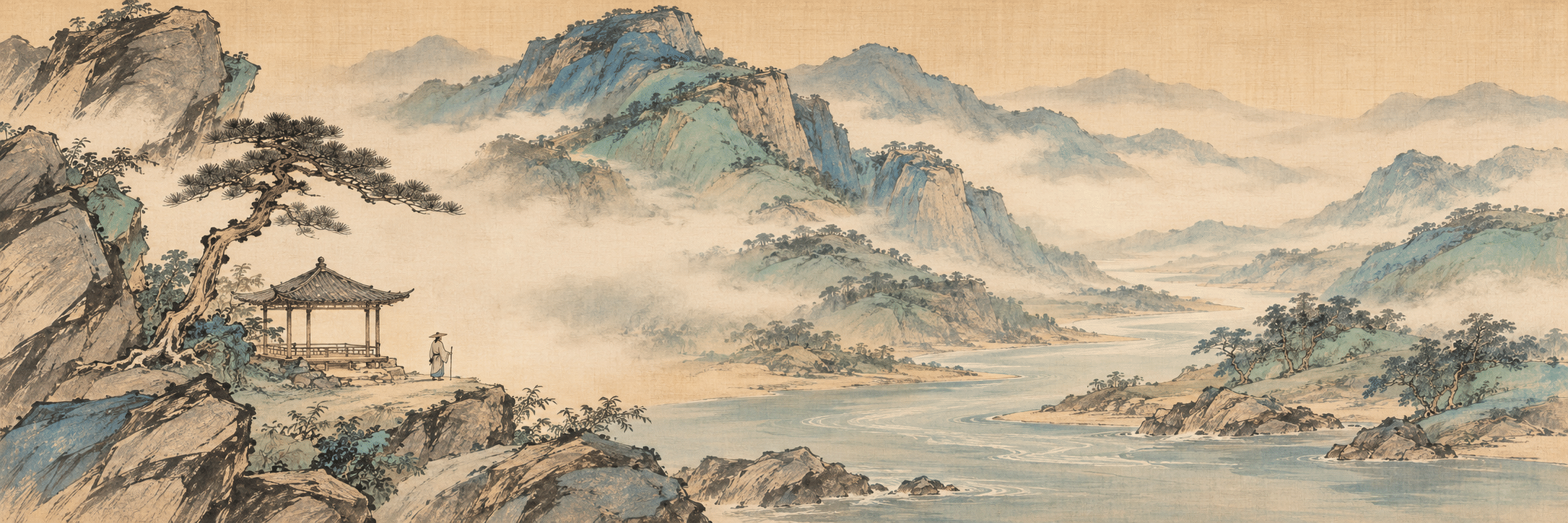
A visual introduction
Select an image for a closer look. Use the thumbnails, arrow keys or a swipe to compare examples. Zoom in to inspect details, or share the image that inspires you.
Creative toolbox · take this style further
Choose an input and a destination. Search sends your words to the chosen site; Copy & open puts them on your clipboard to paste there.
Create with AI
Turn your chosen input into an image prompt or a new creative direction.
ChatGPT
Copy your input and paste it into a ChatGPT conversation or image request.
Copy & open ChatGPT (new tab)Claude · Anthropic
Develop an image prompt or explore the style in a new Claude conversation.
Copy & open Claude · Anthropic (new tab)Midjourney
Paste your input into the Imagine bar on the Create page.
Copy & open Midjourney (new tab)Adobe Firefly
Copy your input, open Firefly, and paste it into the prompt field.
Copy & open Adobe Firefly (new tab)Leonardo.Ai
Copy your input, open Leonardo, and paste it into the generation field.
Copy & open Leonardo.Ai (new tab)Image search
Find visual references. Short, concrete keywords usually work best.
Lexica
Search AI images and prompts using your selected input.
Search with this input Lexica (new tab)Pexels
Search the photo and video library. Short keywords often work best.
Search with this input Pexels (new tab)Pixabay
Search photos, illustrations and other images.
Search with this input Pixabay (new tab)Unsplash
Search photographs using the style name or your own keywords.
Search with this input Unsplash (new tab)Wikimedia Commons
Search photographs, artworks and historical images. Check each file for its source and reuse terms.
Search with this input Wikimedia Commons (new tab)Art & research
Explore artists, collections and the ideas behind a style.
Wikipedia
Search for background reading. A style may not have its own article.
Search with this input Wikipedia (new tab)WikiArt
Copy your input into WikiArt’s search to explore artists and artworks.
Copy & open WikiArt (new tab)Europeana
Paste your keywords into the search to explore European museum, library and archive collections.
Copy & open Europeana (new tab)Inspiration
Discover portfolios and visual ideas from creative communities.
Instagram hashtags
Search a hashtag made from your input: spaces and punctuation are removed. Instagram may require sign-in.
Search with this input Instagram hashtags (new tab)ArtStation
Paste your input into artwork search for concept art, environments, characters and visual development.
Copy & open ArtStation (new tab)Behance
Paste your input into project search for illustration, design and visual storytelling.
Copy & open Behance (new tab)A closer look
A dry stroke can describe a rock’s texture; a pale wash can separate distances; precise outlines can hold coloured petals and feathers. These are different expressive choices within a long and varied field, not one compulsory misty landscape.
A family of traditions, not one timeless look
Traditional Chinese painting encompasses many periods, artists, settings and subjects. Landscape is prominent, but figure painting, portraits, animals, flowers and narrative scenes also matter. The Met’s survey includes ink on paper, ink and colour on silk, handscrolls, hanging scrolls and album leaves. Its examples immediately complicate a definition based only on monochrome mountains or universal serenity. [1]
The word “traditional” should prompt a question: which tradition, when, and for whom? Courtly production, scholarly exchange and other professional practices did not always have identical audiences or aims. Avoid explaining this entire history through a single philosophy. A particular painting may require religious, literary, political or personal context that its attractive surface alone cannot reveal.
Brushwork records decisions
The Smithsonian’s Chinese Arts of the Brush guide explains the close material relationship between painting and calligraphy. It also introduces Xie He’s critical principles and the idea of vitality in a work. This is useful historical context for treating a brush mark as more than an outline: its pressure, direction and changing ink can carry expressive force. [2]
For a practical exercise, make a small family of marks: a dry broken stroke, a saturated line, a pale wash and a tapered leaf. Compare their beginnings and endings. Then choose which marks can build one subject coherently. Do not sprinkle simulated ink splashes over a finished digital photograph and assume that the material logic has been retained.
Colour belongs in the discussion
A monochrome study asks ink values and intervals to do much of the work. A finely outlined bird-and-flower composition can use colour with a different kind of precision. The Met’s cited collection includes both possibilities, from Han Gan’s Night-Shining White, dated about 750, in ink on paper, to Ma Lin’s Orchids, a thirteenth-century album leaf in ink and colour on silk. These are reference points, not a complete chronology. [1]
When planning a new image, decide what colour is doing. Is it distinguishing a petal from a leaf, strengthening a spatial layer or becoming an expressive interruption? Keep that purpose consistent. “Delicate” does not mean uniformly pale, and “expressive” does not mean uncontrolled. A clear choice of material appearance helps the composition hold together.
A handscroll is encountered through time
The Met’s essay on handscrolls describes viewing by gradually unrolling from right to left, revealing a section at a time. A continuous image can therefore become a journey or narrative whose pace depends partly on the viewer. Inscriptions, seals and later commentaries can also become part of an object’s history. A screen-sized reproduction that displays everything at once changes that experience. [3]
For an original digital experiment, design several connected passages rather than one panoramic spectacle. Let a dense cluster lead into a quiet interval and then a different spatial event. A path, riverbank or repeated scale can guide attention, but it need not force a single photographic viewpoint. Describe the result as a format-inspired exercise; it is not equivalent to handling an actual scroll.
Landscape is constructed, not merely softened
Begin with near, middle and distant relationships. Darker textured rocks can anchor the foreground; a bend in water or a narrow path can lead toward another plane; unpainted intervals can separate masses. These are compositional options for our exercises. They should be tested against a specific historical painting before being presented as that artist’s method.
A common generated-image failure is a stack of interchangeable peaks with fog applied between them. Ask what makes each mass different: its angle, texture, scale, relation to a tree or the route through it. Keep buildings and tiny figures structurally plausible. Their smallness should establish a relationship to the landscape, not conceal incoherent construction.
Motifs, inscriptions and attribution need evidence
A bamboo, orchid or bird can invite associations, but those associations depend on a work’s context and inscriptions. Do not assign a universal moral meaning solely because an online list offers one. Read the museum record and identify whose interpretation you are repeating. The Smithsonian’s examples connect particular paintings, artists and inscriptions, making that distinction visible. [2]
For generated studies, omit invented Chinese writing and imitation ownership seals. Calligraphy is meaningful writing and a discipline of its own, not decorative noise. If a project needs a real inscription, use a verified text and appropriate expertise. Never present a synthetic image as an unearthed scroll, an authenticated work or proof of a historical technique.
Three new studies, three different tasks
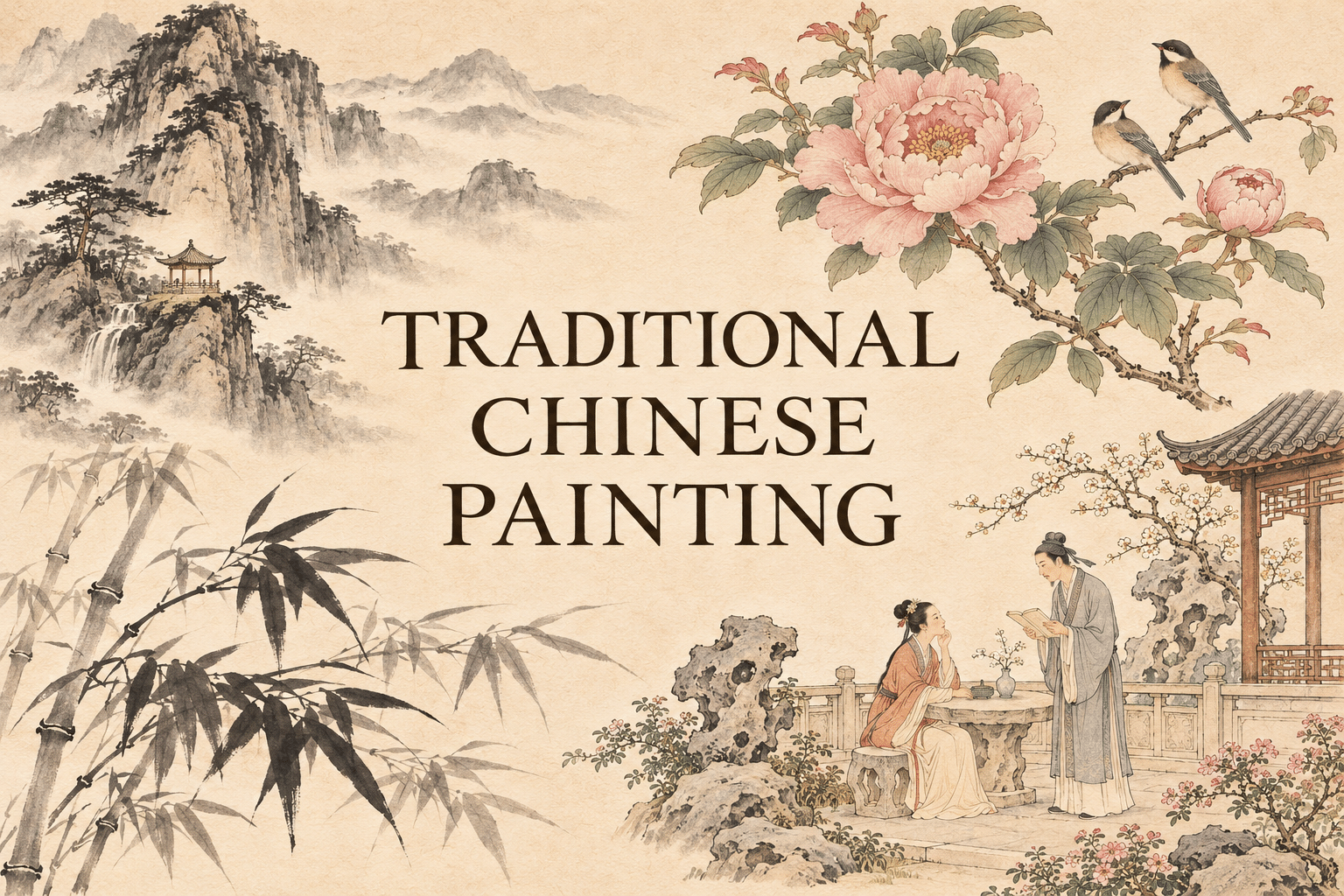
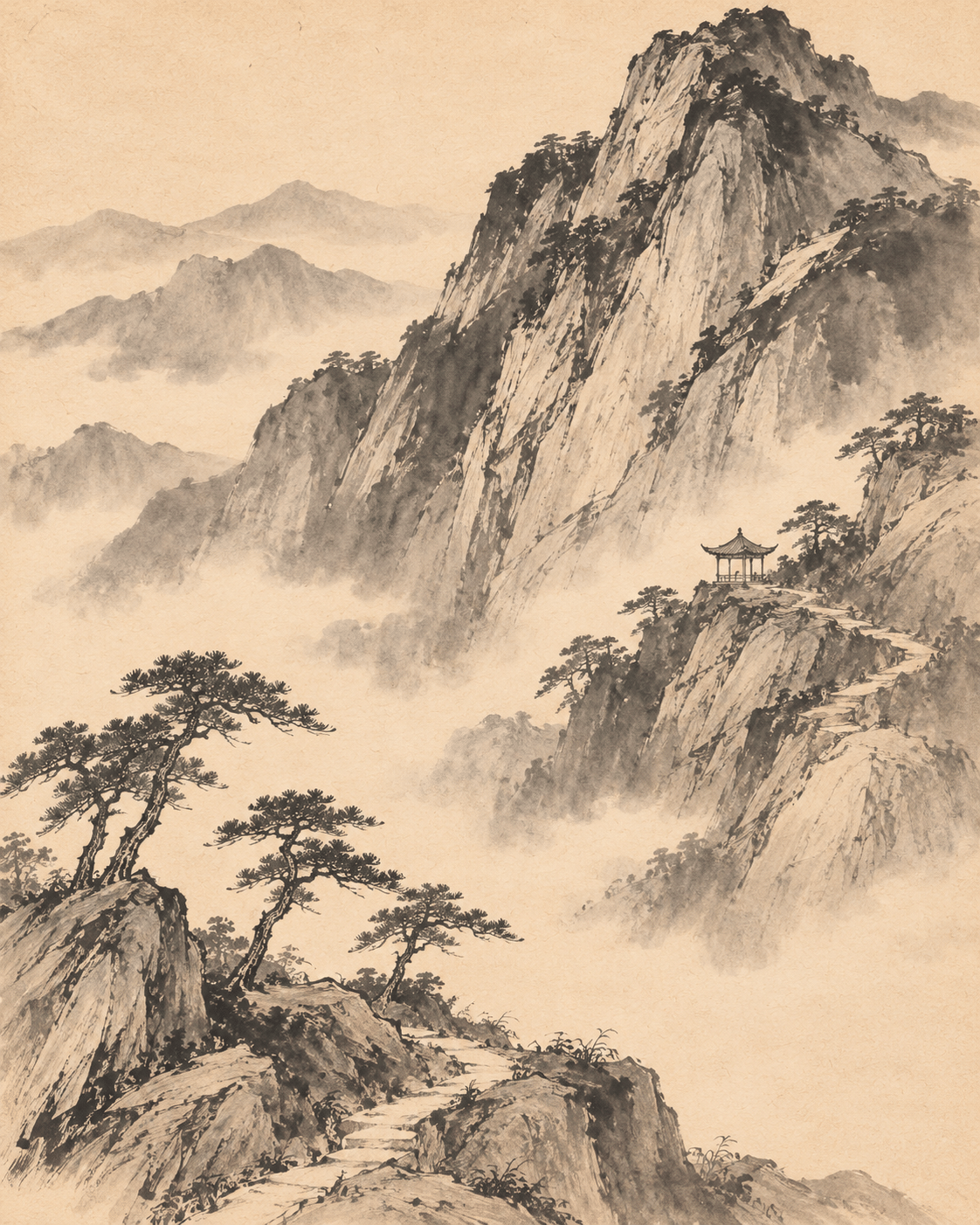
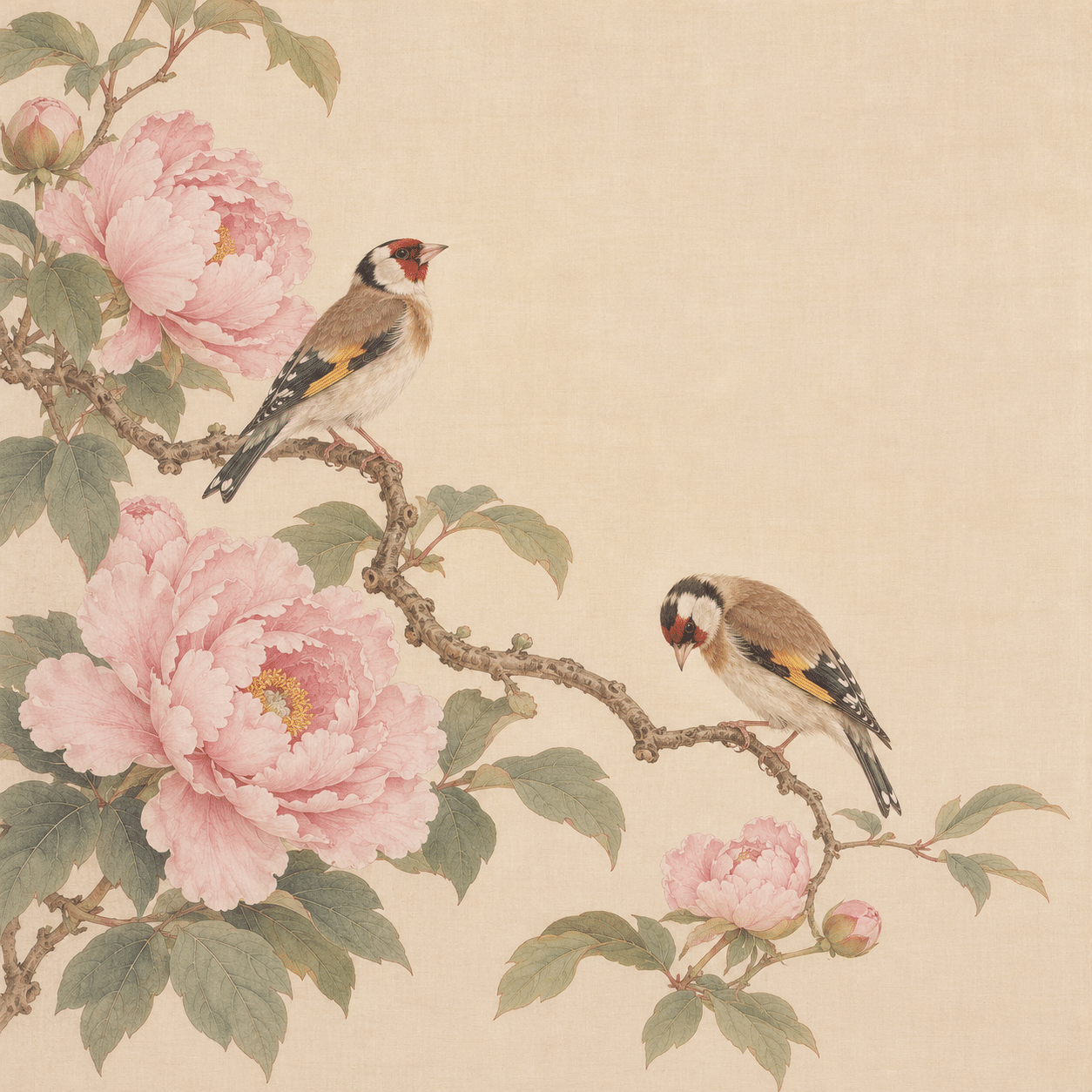
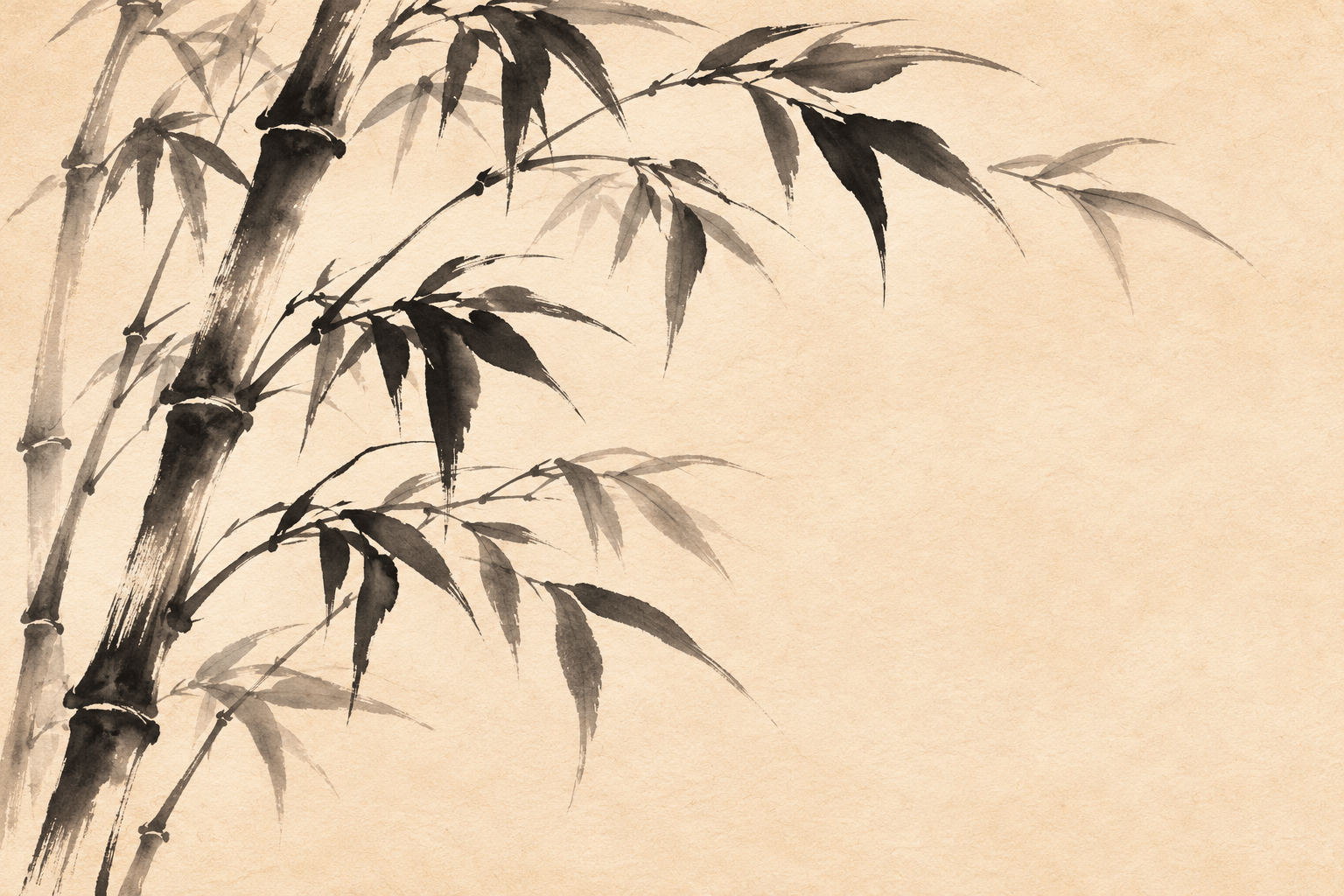
The landscape study examines textured mountain mass and open distance. The bird-and-flower study changes to a closely observed branch, controlled contours and restrained colour. The bamboo study tests directional groups of leaves and changes in ink density. The banner and titled collage introduce these contrasting approaches without claiming to summarise every painting tradition.
Review each image according to its task: rocks need structure, birds need plausible bodies and perches, bamboo leaves need convincing attachments and direction. The examples are original AI-generated interpretations. Return to the linked museum objects to study actual works, their materials and their histories.
A small poetic detour
Original words from the AOI studio.
Poetry
The brush arrives before the mountain.
A broken line becomes its weight.
Between two ridges, paper opens;
we let the unpainted distance wait.
A small bird turns upon a branch.
One leaf leans farther into air.
The scroll gives back another passage;
we find a pace by looking there.
The prompt workshop
Original creative exercises. These prompts create new illustrations, not documentary evidence.
Mass and interval
Create an original ink-on-paper mountain study with differentiated dry rock textures, pale distant washes, a small pavilion and generous unpainted intervals. Keep near, middle and far relationships clear. No pseudo-calligraphy, seals or imitation signature.
A controlled coloured branch
Create an original fine-line bird-and-flower study with two finches at different angles on a peony branch. Use precise contours, restrained colour and deliberate empty space. Check anatomy and branch attachment; do not copy a named historical composition.
A family of brush decisions
Create an original bamboo study with a few jointed stems and varied directional leaf groups, changing black and grey values and visible dry/wet contrast. Prioritise attachment and rhythm over abundance. No invented writing or seals.
People & works to explore
References discussed in this article. Consult the sources below for context.
Artists and practitioners
Han Gan — see the cited Met survey
Ma Lin — see the cited Met survey
Zhao Mengfu — see the Smithsonian brush-arts guide
Paintings and other works
Han Gan, Night-Shining White (ca. 750), ink on paper
Ma Lin, Orchids (second quarter of the thirteenth century), ink and colour on silk
A smile from the studio
Jokes
The mountain asked for more mist. The painter suggested that it first decide where to stand.