
Art in Thailand: context before visual shorthand
Thai is a broad cultural and geographic label. Specific periods, objects and artistic practices reveal much more than a formula of gold surfaces and pointed ornament.
A visual introduction
Compare the retained archive studies. The titled collage is modern editorial illustration; its panels are not reproductions of documented works.
Select an image for a closer look. Use the thumbnails, arrow keys or a swipe to compare examples. Zoom in to inspect details, or share the image that inspires you.


Creative toolbox · take this style further
Choose an input and a destination. Search sends your words to the chosen site; Copy & open puts them on your clipboard to paste there.
Create with AI
Turn your chosen input into an image prompt or a new creative direction.
ChatGPT
Copy your input and paste it into a ChatGPT conversation or image request.
Copy & open ChatGPT (new tab)Claude · Anthropic
Develop an image prompt or explore the style in a new Claude conversation.
Copy & open Claude · Anthropic (new tab)Midjourney
Paste your input into the Imagine bar on the Create page.
Copy & open Midjourney (new tab)Adobe Firefly
Copy your input, open Firefly, and paste it into the prompt field.
Copy & open Adobe Firefly (new tab)Leonardo.Ai
Copy your input, open Leonardo, and paste it into the generation field.
Copy & open Leonardo.Ai (new tab)Image search
Find visual references. Short, concrete keywords usually work best.
Lexica
Search AI images and prompts using your selected input.
Search with this input Lexica (new tab)Pexels
Search the photo and video library. Short keywords often work best.
Search with this input Pexels (new tab)Pixabay
Search photos, illustrations and other images.
Search with this input Pixabay (new tab)Unsplash
Search photographs using the style name or your own keywords.
Search with this input Unsplash (new tab)Wikimedia Commons
Search photographs, artworks and historical images. Check each file for its source and reuse terms.
Search with this input Wikimedia Commons (new tab)Art & research
Explore artists, collections and the ideas behind a style.
Wikipedia
Search for background reading. A style may not have its own article.
Search with this input Wikipedia (new tab)WikiArt
Copy your input into WikiArt’s search to explore artists and artworks.
Copy & open WikiArt (new tab)Europeana
Paste your keywords into the search to explore European museum, library and archive collections.
Copy & open Europeana (new tab)Inspiration
Discover portfolios and visual ideas from creative communities.
Instagram hashtags
Search a hashtag made from your input: spaces and punctuation are removed. Instagram may require sign-in.
Search with this input Instagram hashtags (new tab)ArtStation
Paste your input into artwork search for concept art, environments, characters and visual development.
Copy & open ArtStation (new tab)Behance
Paste your input into project search for illustration, design and visual storytelling.
Copy & open Behance (new tab)A closer look
Study the contour, gesture, material and purpose of a documented object; the archive images offer decorative interpretations rather than a complete national style.
An object has a period and a purpose
The Metropolitan Museum records a Standing Buddha from Nakhon Pathom Province in present-day Thailand, dated to the eighth–ninth century and identified with the Mon-Dvaravati period. It is bronze with traces of gilt. The museum discusses its teaching gestures in a specific iconographic context. This object is a useful reminder that religious imagery carries meanings that cannot be inferred from ornament alone.
That example does not stand for every period or practice in Thailand. A sculpture, a mural, a contemporary installation and a commercial illustration require different descriptions. Name the medium and context when possible, and distinguish an observed feature from an imagined design choice.
Separate interpretation from documentation
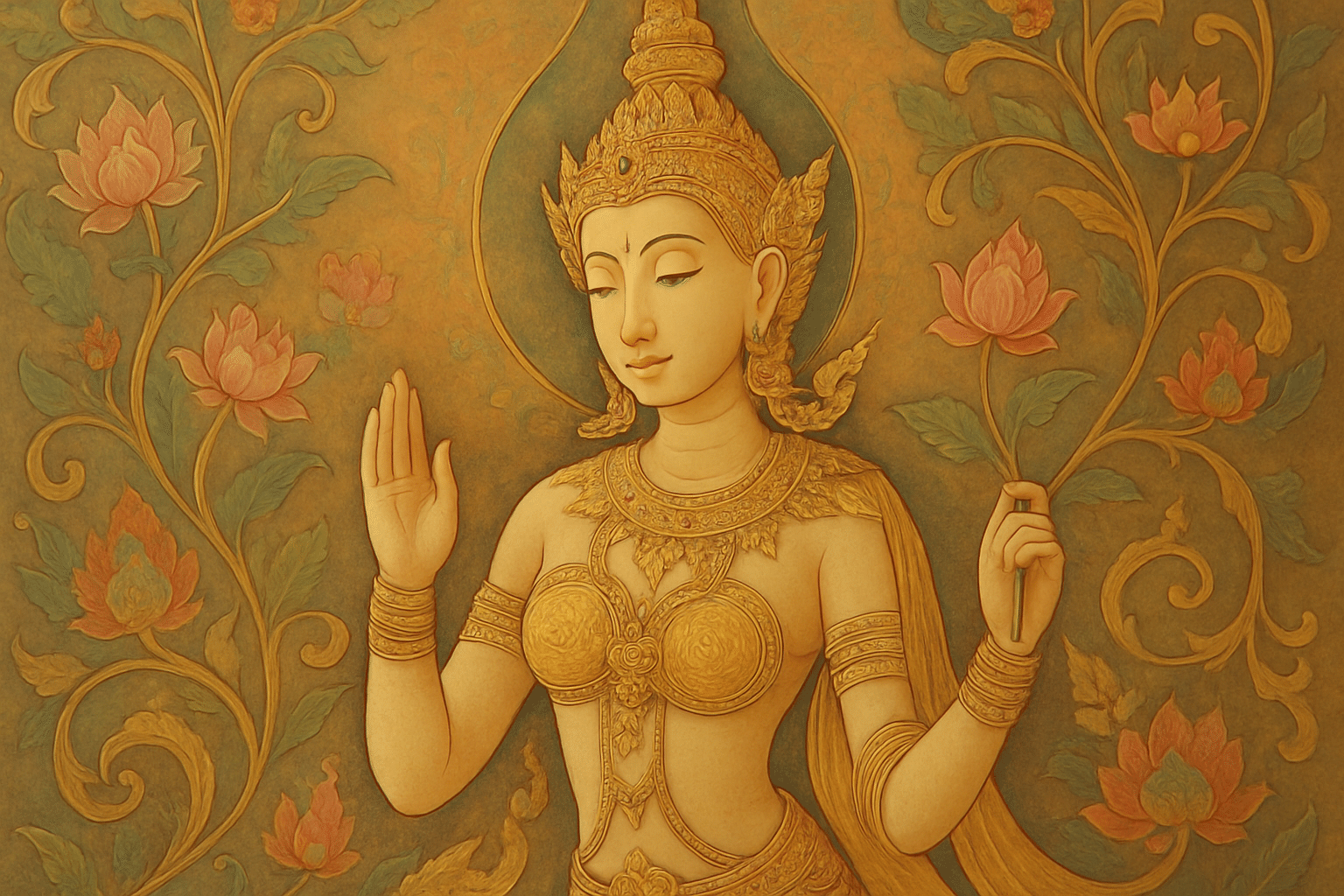
The retained figure illustration and titled collage use gold-toned contours, floral curves and devotional-looking motifs. They are modern archive interpretations, not photographs of temple paintings or reliable diagrams of religious iconography. The earlier unrelated European-square image is retained as an archive item with its mismatch identified, rather than presented as an example of Thai art.
For an original decorative exercise, work with non-sacred botanical forms: a curved stem, a pointed leaf and a repeating interval. Establish a clear central rhythm, then let smaller forms support it. If you study a religious image, use a documented reference and preserve its context instead of mixing gestures and attributes at random. Specificity makes both research and creative work stronger; a national adjective cannot substitute for it.
The prompt workshop
Original creative exercises. These prompts create new illustrations, not documentary evidence.
Botanical rhythm
Create an original decorative painting of curling lotus-like stems and pointed leaves on a muted green ground. Use restrained warm gold and rose accents, clear contours and an asymmetrical rhythm. No religious figures, text or claim of historical authenticity.
Material and light
Create an original study of a simple bronze vessel with worn gilded areas, photographed against a neutral background. Emphasize the contrast between patina, metal and reflected light. Invented object, no inscription or cultural attribution.
An ornament with space
Create an original botanical border study with repeated pointed leaves around a large quiet center. Vary the spacing subtly, use warm gold and muted red on dark green, and keep the contour legible. No lettering or sacred symbols.
Sources and further exploration
The Metropolitan Museum of Art: Standing Buddha, Mon-Dvaravati period