
AOI creative concept · Architecture and luminous atmosphere
Synthetic Aetherism pairs precise architecture with luminous mist. Compare a tidal pavilion, a glass chamber, a causeway and the original imagined city.
An A⊕I –[-.+] creαt¡ve c⊕ncept, n⊕t αn estαbl¡she∂ h¡st⊕r¡cαl m⊕vement.
A visual introduction
Four new AI-generated studies and the retained AOI city illustration. Compare containment in a chamber, passage through a frame and obscurity along a route.
Select an image for a closer look. Use the thumbnails, arrow keys or a swipe to compare examples. Zoom in to inspect details, or share the image that inspires you.
A closer look
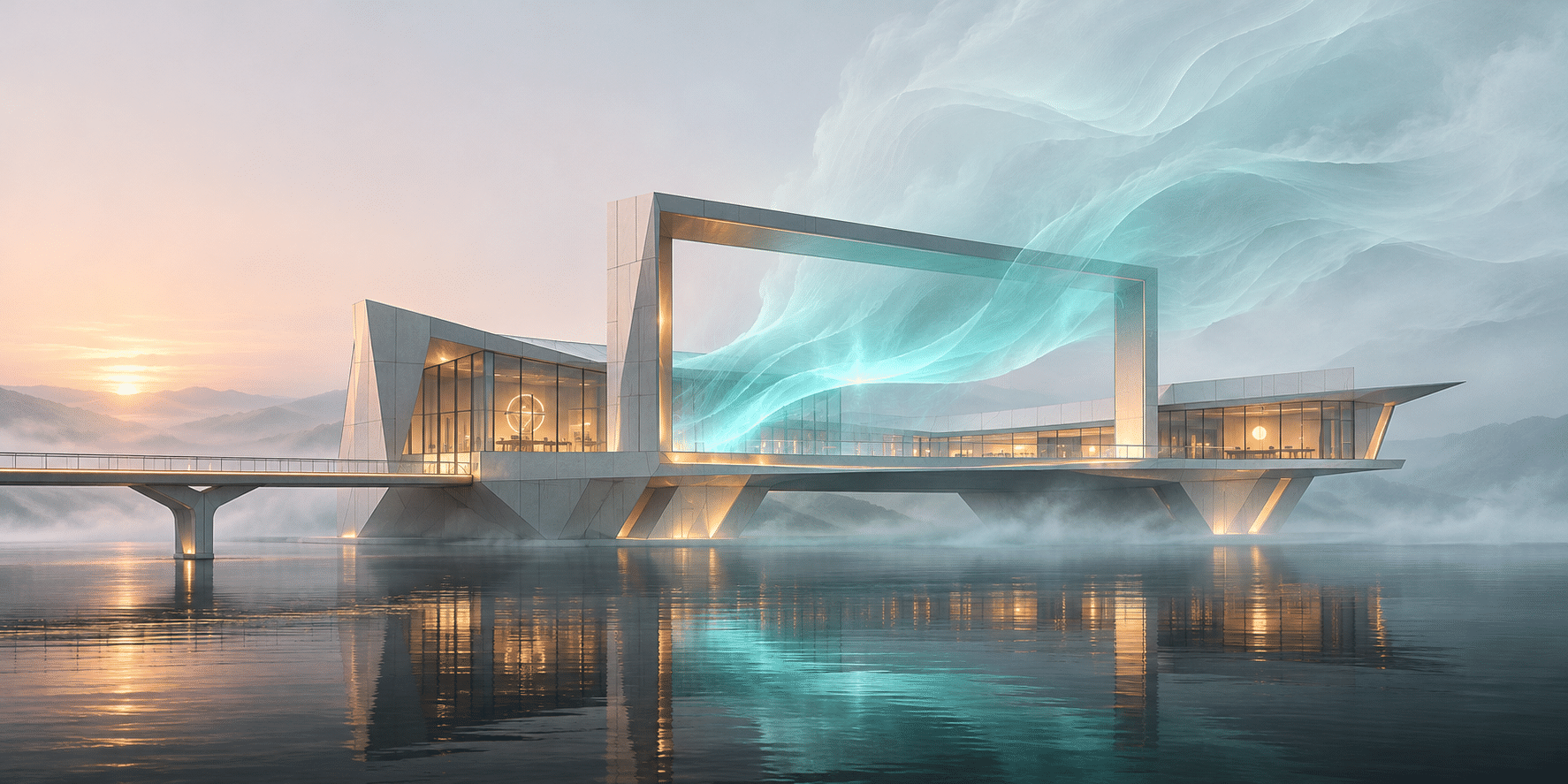
Follow a constructed edge until luminous atmosphere crosses it. A rail or window frame stays sharp in one place and fades at a different depth. Small warm openings and reflected light establish scale. The effect depends on seeing both the building and the air that interrupts it.
A bridge supplies the test
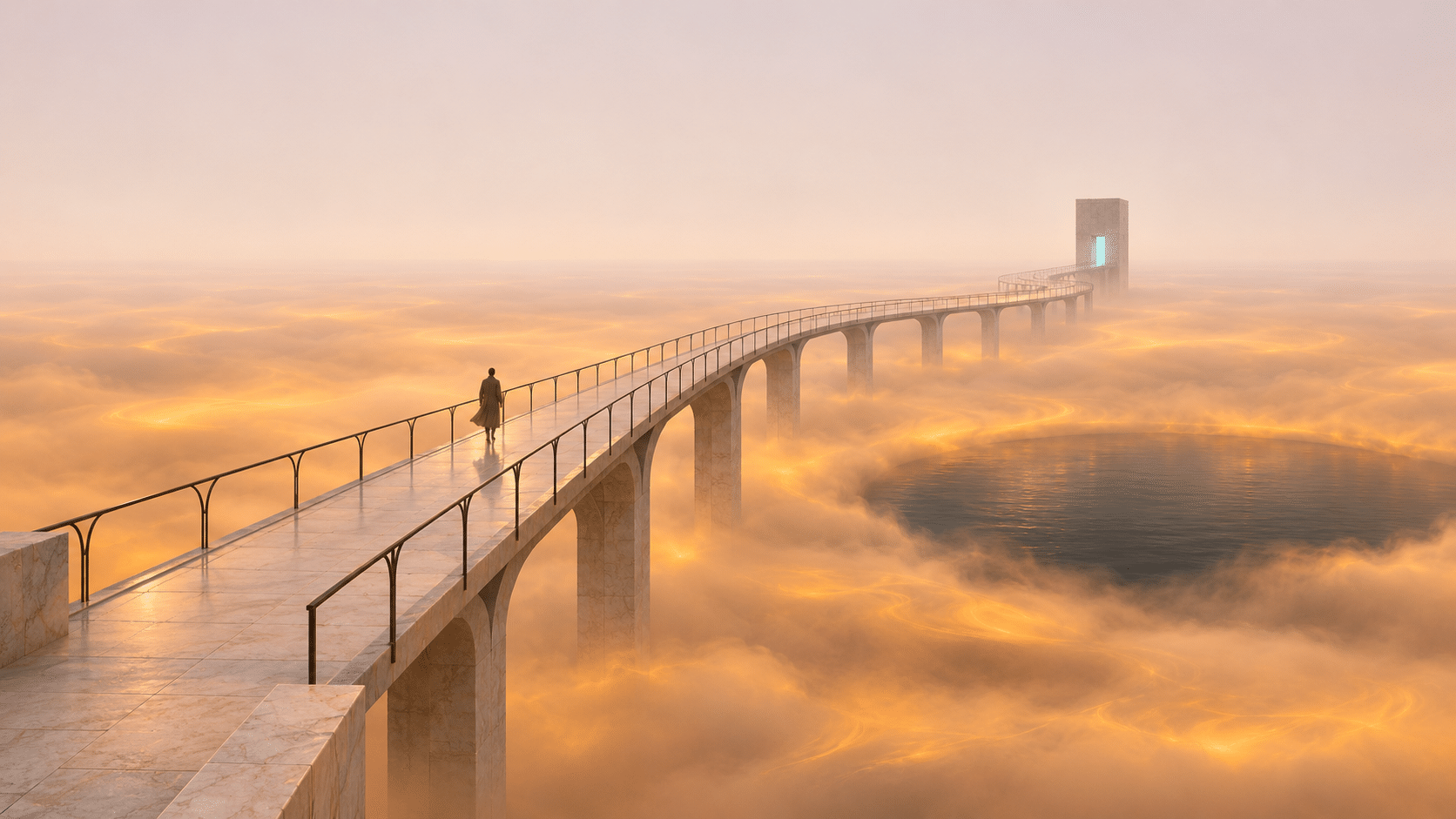
Look at the long causeway in the amber image. Its railing tells you where a person can walk. Its piers disappear into a bank of light; an opening in that bank lets you see water again. Remove the railing and the light becomes a cloudscape. Remove the cloud and you have an architectural perspective. Synthetic Aetherism is the AOI concept that holds those two readings together.
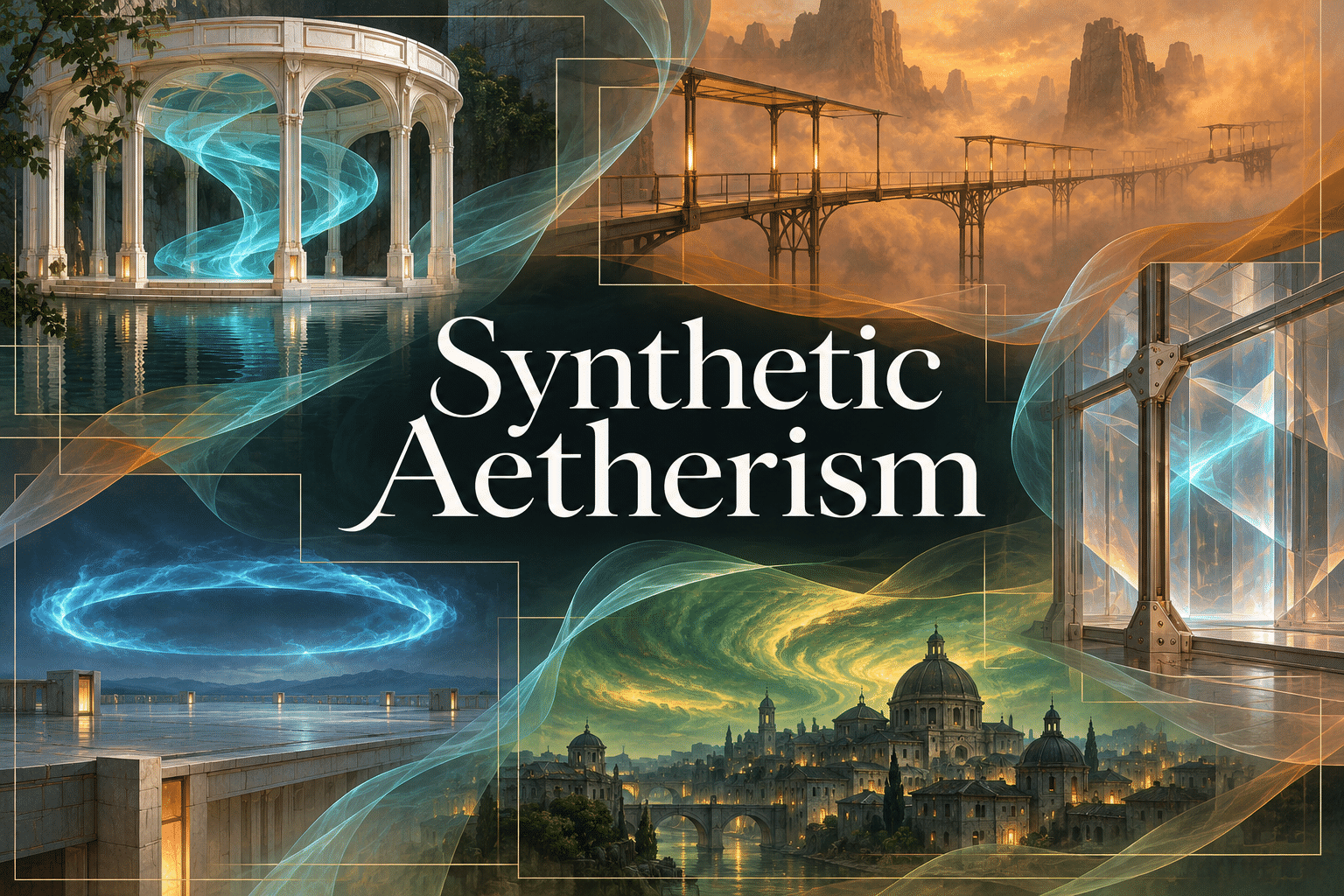
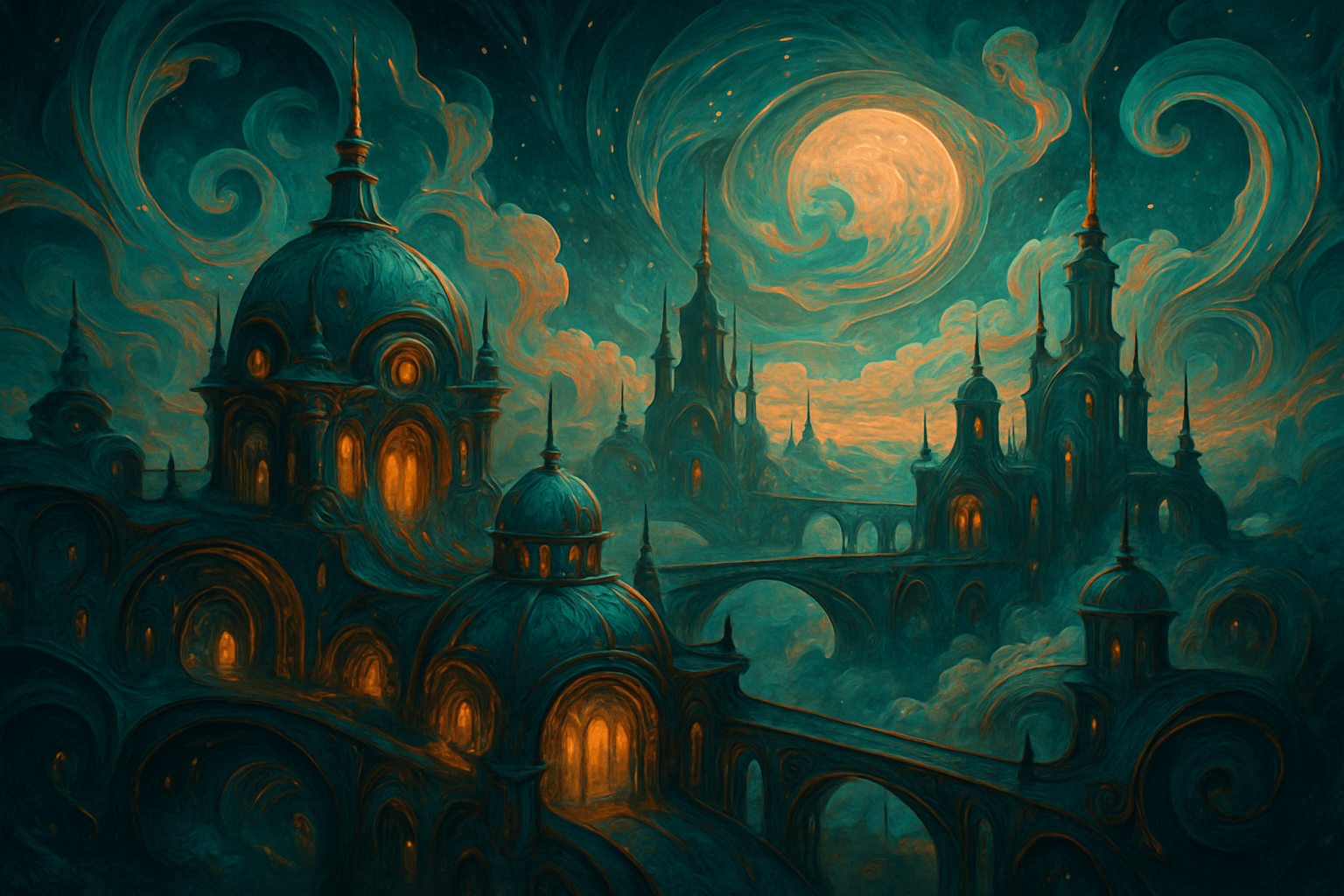
The earlier AOI illustration set a dark city beneath a curling green-gold sky. The present studies develop its contrast between construction and atmosphere at three scales: a room, a building and a route across a landscape. “Aether” names the invented luminous medium in these pictures. It does not identify a scientific substance or a documented historical school.
Make three kinds of edge
Choose one edge to remain exact. A doorway, a handrail or a corner joint lets the eye recover a measure of distance. Give another edge a transition: a drifting band can move from in front of a column to behind its neighbour. Leave a third contour almost lost. The three decisions make the air seem to occupy different places. Applying the same blur to everything simply makes a picture hard to see.
In the banner, the large rectangular opening makes an especially useful reference. The supports and bright windows hold their outlines while the cyan sheet lifts through and beyond the frame. On the water, a reflection lets the cool light appear a second time at lower contrast. Following those three appearances explains the space more clearly than a field of glowing particles would.
Two lights, two jobs
Compare the amber windows with the broad cyan sweep in the pavilion. One suggests the size of a room; the other spans a building. You do not need a full spectrum to make the atmosphere unusual. Choose a limited relationship and give each light an identifiable job. On a sketch, circle the smallest place where a warm accent matters. If every window glows equally, try quieting the rest.
The causeway reverses the roles. Amber fills the landscape while a single cyan opening holds the destination. A small walking figure makes the long interval between foreground and tower intelligible. The empty water opening is as important as the mist: it shows that something lies beneath the glow.
From an imagined instrument to a skyline
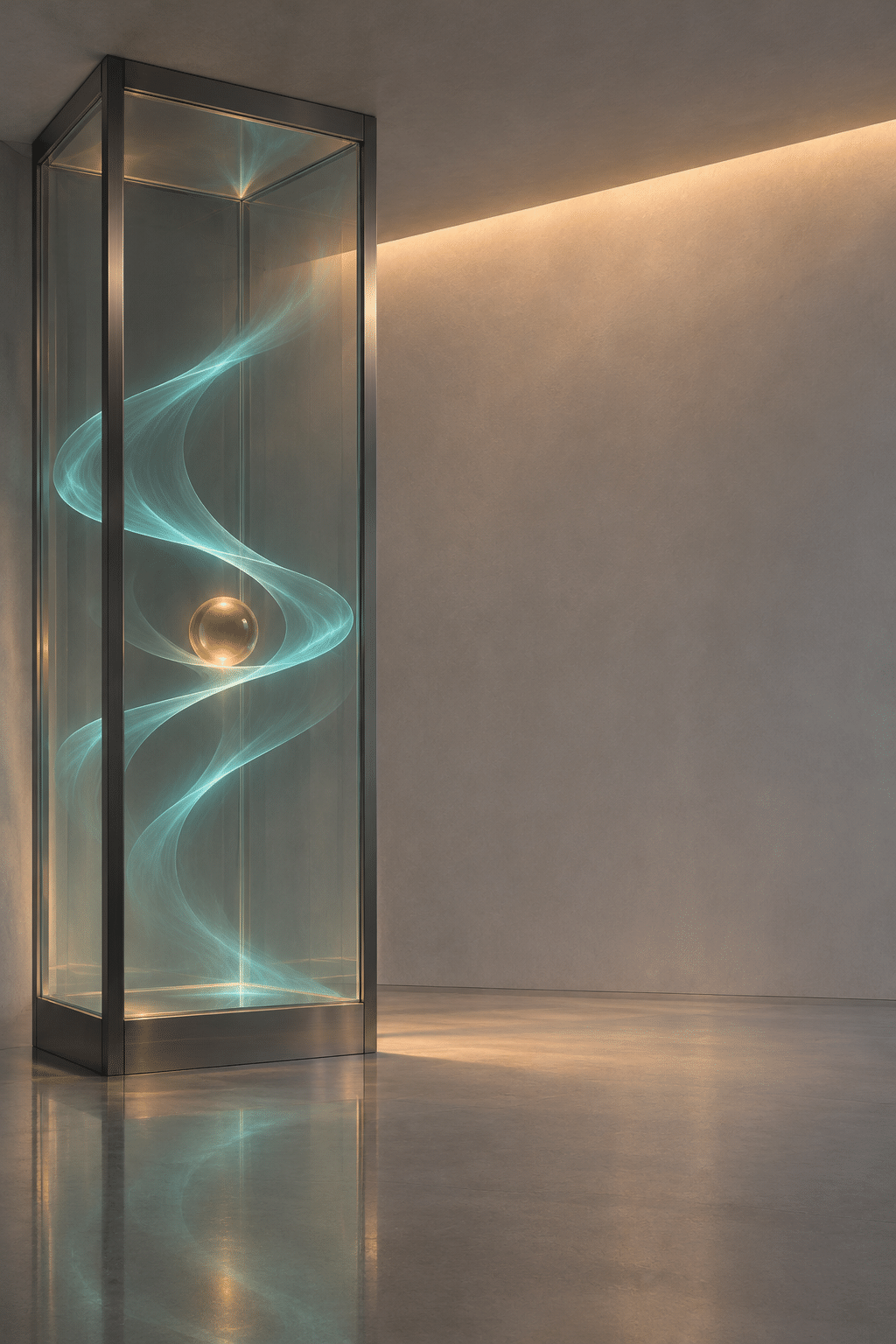
In the chamber study, a glass enclosure and dark frame occupy one side of a nearly empty room. A luminous ribbon curves around an amber sphere inside it. The frame gives the curve a boundary, while the broad wall provides a place to compare the warm and cool light. Nothing in this picture establishes how an instrument would actually work. Its subject is containment.
The retained city takes the other extreme: many domes and bridges sit beneath a revolving expanse of sky. Look for the warm openings first, then trace a bridge between two silhouettes. The detail makes the city richly inhabited in appearance, but the repeated towers can also make the middle distance hard to separate. The quieter new examples test how much of that architecture can be removed while the concept remains recognisable.
A drawing exercise before the prompt
Draw a doorway with a view beyond it. Make three small copies. In the first, place a pale band entirely behind the doorway. In the second, let it cross one upright. In the third, let it obscure the threshold while keeping the top corner clear. Which view still suggests you could enter? Mark that choice before describing a material, palette or atmosphere to an image system.
This exercise transfers to a book illustration, an imagined exhibition room or a game environment. For a background, keep the route quiet enough that a small foreground figure remains visible. For a standalone image, let the moment of crossing become the focal point. In either case, inspect supports, reflections and where the mist stops; impressive light can hide a missing connection.
Read the collage as a set of alternatives
The centrally titled collage moves from a colonnade to a raised walkway, a framed glass chamber, a rooftop and a distant city. The repeated fine frames connect the scenes, but their light behaves differently. Choose two areas and name the edge each uses to keep the space legible. That comparison is more useful than asking which one has the strongest glow.
All five illustrations are imagined AOI studies. The earlier city is retained to show where the visual idea started in this record. The newer compositions demonstrate possible directions, not the buildings of an actual architect or the output of a documented movement.
A small poetic detour
Original words from the AOI studio.
Poetry
The rail runs on until the air
borrows a little of its line.
A window the size of a thumbnail
holds an entire evening.
Across the water, its amber twin
comes loose with every ripple.
I lose one pier in the brightness
and find the next by its shadow.
The prompt workshop
Original creative exercises. These prompts create new illustrations, not documentary evidence.
Hold one edge in focus
An original imagined pavilion above a dark tidal basin. A thin cyan veil passes through one rectangular opening; keep the near upright sharply defined and let the far one soften. One amber room and its reflection establish scale. Wide calm dawn composition, no lettering.
Contain a luminous current
A dark metal frame encloses a tall glass chamber on one side of a quiet room. An amber sphere interrupts a cyan ribbon of luminous mist. Preserve the depth of the enclosure and leave the opposite wall almost empty. Make light, glass and air visually distinct.
Trade the colour roles
Draw a supported stone causeway crossing a low field of amber mist toward a single cyan doorway. Show a small figure, visible railings and an opening onto the water. Repeat the scene with cool air and one warm doorway; keep viewpoint and architecture unchanged and compare which route reads more clearly.
A smile from the studio
Jokes
Studio game: cover the mist with a slip of paper and follow the route. Now cover the bridge. If both versions give you exactly the same walk, one of them is not doing much work.