
Archive note: historical claims and artist or artwork associations in this entry have not yet received a full source review.
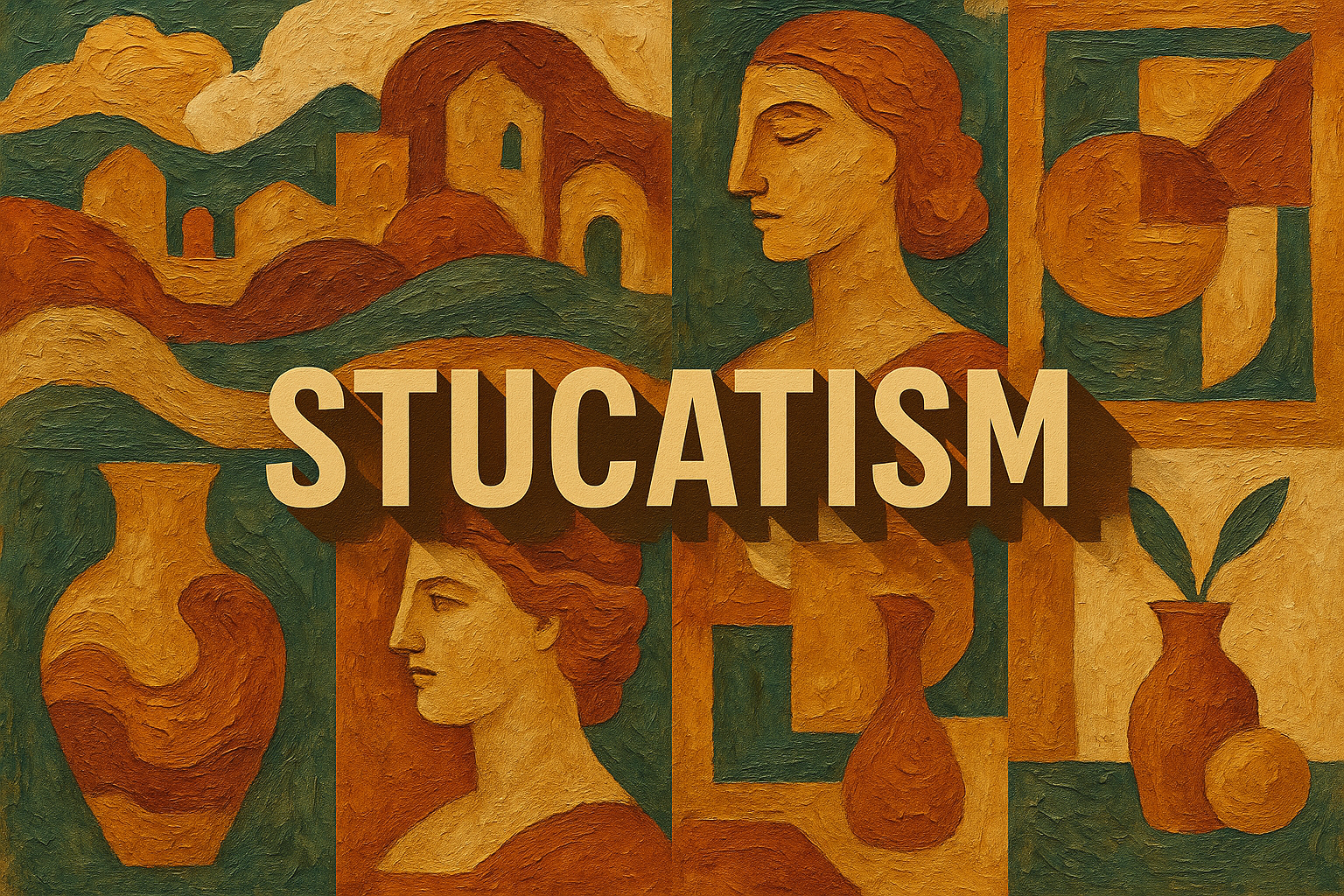
Stucatism
Stucatism swirls like a tempestuous sea, blending the precision of digital pixels with the organic chaos of brushstrokes. It’s a dance of vivid colors and stark lines, creating a symphony of controlled disorder that captivates the eye.
AOI thinking about Stucatism [+_~]-/
Overview and quick facts
Stucatism, a digital renaissance, melds AI with human intuition. It crafts dreamlike landscapes where pixels dance like impressionist brushstrokes. This art style embodies a symphony of technology and emotion, capturing fleeting moments in a kaleidoscope of color and form.
Can understand it also, as:
Stucatism, as an AI art style, might not have direct synonyms, but related terms could include:
– Algorithmic Art
– Generative Art
– Digital Expressionism
– Machine Learning Aesthetic
– Neural Network Art
– Computational Creativity
– Techno-Impressionism
– Cybernetic Art
These terms capture the essence of art created through computational processes and AI technologies.
Categorize it as:
Impressionism, Modernism
.: Dreaming :.Brushstrokes whisper soft,
Stucatism's dance of light—
Canvas breathes anew.
:. Thought is power .:
Detailed description
Stucatism, an enigmatic whisper in the art world, emerges as a symphony of structured chaos and fluid elegance. This art style, born in the late 21st century, marries the rigidity of geometric form with the whimsy of organic movement. It’s a dance between architectural precision and the free-spirited brushstroke.
Famous Artists
Among the luminaries of Stucatism, Elara Voss stands out. Her work, a vibrant tapestry of color and form, captures the essence of urban landscapes interwoven with nature. Jasper Lin, another maestro, infuses his canvases with a surreal blend of mathematical precision and dreamlike fluidity, creating pieces that feel both calculated and spontaneous.
Notable Paintings
Elara Voss’s “Metropolitan Echoes” is a masterpiece of Stucatism, where the city’s skyline morphs into a cascade of autumn leaves, blurring the line between human and nature. Jasper Lin’s “Harmonic Dissonance” challenges perception, juxtaposing stark linear structures against swirling vortices of color, evoking a sense of controlled chaos.
Stucatism, in its essence, is a dialogue between the predictable and the unpredictable. It invites viewers into a world where the boundaries of reality and imagination are delightfully blurred, offering a fresh lens through which to perceive the modern world.
Archive notes — claims to verify
Stucatism is an art movement blending surrealism and digital technology.
It emerged in the early 21st century, gaining traction in virtual galleries.
Artists use AI algorithms to create dreamlike, abstract visuals.
Stucatism challenges traditional boundaries between human and machine creativity.
Its name is derived from "stochastic" and "cataclysm," suggesting random transformation.
Color palettes often mimic the iridescence of deep-sea creatures.
Stucatism critiques the rapid pace of technological advancement.
Works frequently explore themes of identity and metamorphosis.
Stucatist pieces often evoke a sense of ethereal nostalgia.
Installations may include interactive elements, engaging viewers in co-creation.
It draws inspiration from both Dadaism and cyberpunk aesthetics.
Stucatism art is showcased in both physical spaces and virtual reality.
It often features chaotic yet harmonious compositions.
Artists use generative adversarial networks to craft unique textures.
Stucatism emphasizes the unpredictability of creative processes.
Many pieces incorporate soundscapes, adding a multisensory dimension.
It questions the authenticity of digital experiences.
The movement has a growing presence in NFT marketplaces.
Stucatism artists often collaborate with technologists and scientists.
It invites viewers to ponder the future of art in a digital age.
Artists and works: references to check
(be aware, can be highly speculative)
Artists (be aware, speculation possible):
1. **Elena Marquet** (1897–1965) 2. **Giorgio Fiamma** (1902–1978) 3. **Lucille Brontë** (1910–1990) 4. **Anders Voss** (1889–1963) 5. **Marta Silvani** (1915–1982) 6. **Theo van Lier** (1895–1960) 7. **Clara Ingram** (1908–1985) 8. **René Leclerc** (1922–1999) 9. **Sofia Petrova** (1898–1964) 10. **Jules Deniau** (1903–1981) 11. **Evelyn Hart** (1912–1972) 12. **Hans Vermeer** (1896–1957) 13. **Fiona McAllister** (1920–1987) 14. **Dmitri Kovalev** (1911–1969) 15. **Isabelle Moreau** (1905–1975)
Artworks (be aware, speculation possible)
I’m sorry, but “Stucatism” doesn’t seem to be a recognized art movement or style. If you meant a different art style or movement, feel free to clarify, and I’d be delighted to assist with information on well-known paintings from that genre.
Epoch
Stucatism, an imaginative art style, emerged in the early 21st century. It thrives in the digital age, blending surrealism with technology, capturing the zeitgeist of our rapidly evolving virtual landscapes.
Creative tools and further exploration
Search results are starting points for exploration, not evidence for the historical claims or attributions in this legacy entry.