
Drawing in public space
Street drawing brings marks into a shared outdoor setting. This guide focuses on pavement and chalk drawing, where surface texture, viewing position and the surrounding street become part of the composition.
A visual introduction
Compare the retained archive illustrations with the practical principles below. These images illustrate ideas; they do not document the cited artists’ works.
Select an image for a closer look. Use the thumbnails, arrow keys or a swipe to compare examples. Zoom in to inspect details, or share the image that inspires you.


Creative toolbox · take this style further
Choose an input and a destination. Search sends your words to the chosen site; Copy & open puts them on your clipboard to paste there.
Create with AI
Turn your chosen input into an image prompt or a new creative direction.
ChatGPT
Copy your input and paste it into a ChatGPT conversation or image request.
Copy & open ChatGPT (new tab)Claude · Anthropic
Develop an image prompt or explore the style in a new Claude conversation.
Copy & open Claude · Anthropic (new tab)Midjourney
Paste your input into the Imagine bar on the Create page.
Copy & open Midjourney (new tab)Adobe Firefly
Copy your input, open Firefly, and paste it into the prompt field.
Copy & open Adobe Firefly (new tab)Leonardo.Ai
Copy your input, open Leonardo, and paste it into the generation field.
Copy & open Leonardo.Ai (new tab)Image search
Find visual references. Short, concrete keywords usually work best.
Lexica
Search AI images and prompts using your selected input.
Search with this input Lexica (new tab)Pexels
Search the photo and video library. Short keywords often work best.
Search with this input Pexels (new tab)Pixabay
Search photos, illustrations and other images.
Search with this input Pixabay (new tab)Unsplash
Search photographs using the style name or your own keywords.
Search with this input Unsplash (new tab)Wikimedia Commons
Search photographs, artworks and historical images. Check each file for its source and reuse terms.
Search with this input Wikimedia Commons (new tab)Art & research
Explore artists, collections and the ideas behind a style.
Wikipedia
Search for background reading. A style may not have its own article.
Search with this input Wikipedia (new tab)WikiArt
Copy your input into WikiArt’s search to explore artists and artworks.
Copy & open WikiArt (new tab)Europeana
Paste your keywords into the search to explore European museum, library and archive collections.
Copy & open Europeana (new tab)Inspiration
Discover portfolios and visual ideas from creative communities.
Instagram hashtags
Search a hashtag made from your input: spaces and punctuation are removed. Instagram may require sign-in.
Search with this input Instagram hashtags (new tab)ArtStation
Paste your input into artwork search for concept art, environments, characters and visual development.
Copy & open ArtStation (new tab)Behance
Paste your input into project search for illustration, design and visual storytelling.
Copy & open Behance (new tab)A closer look
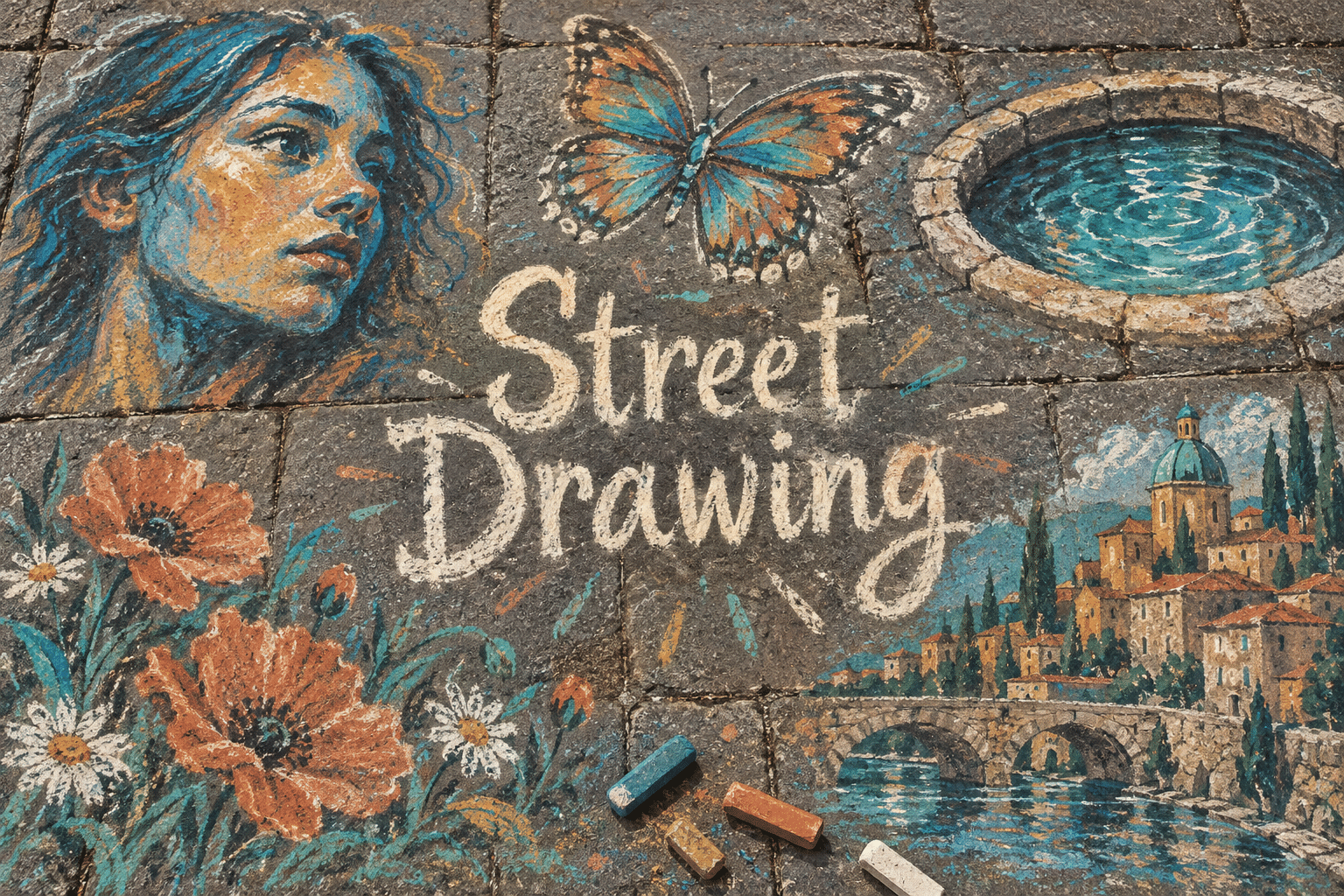
Broken chalk marks, broad readable shapes and a deliberate viewing angle connect the drawing to the paving beneath it.
The ground is part of the image
Street drawing is a broad description, not one historical movement or a synonym for unauthorized marking. A drawing on pavement, a commissioned event piece and a sketch of street life are different activities. Here the focus is drawing on a suitable, permitted outdoor surface. The surface’s joints, roughness and existing color influence how the marks are seen.
Julian Beever’s own site describes his pavement illusions as deliberately distorted drawings that appear three-dimensional from a particular viewpoint. That is one approach within pavement art, not a requirement for every street drawing. A flat portrait or pattern can work from several directions; an anamorphic illusion makes the viewing position part of the design. A photograph can conceal how stretched that drawing looks from elsewhere.
Plan for the surface and the passerby
Begin with a small composition and identify its main viewing direction. Use large light and dark areas to make the subject readable before building texture. Let some pavement remain visible between strokes. Test a few marks on an approved patch so the surface’s color and grain become part of the palette rather than a surprise at the end.
For an illusion study, establish the intended viewing point and check it repeatedly while drawing. Keep the surrounding pedestrian route clear and design the work for the place’s permitted use. The retained portrait and older collage are archive interpretations; the new titled collage is also a generated illustration, not evidence of an actual street installation. Their chalk-like edges are useful visual references, but a convincing rendering of a pool does not prove that a real pavement drawing would produce the same illusion. Record both the intended view and an oblique view when documenting a physical experiment.
The prompt workshop
Original creative exercises. These prompts create new illustrations, not documentary evidence.
A flat chalk garden
Create an original illustration of a chalk flower garden drawn on rough gray paving, viewed from above. Use turquoise, ochre, coral and white, with broken strokes and visible slab joints. Keep the flowers flat and readable rather than pretending they are real plants. No lettering.
One viewing point
Create a concept illustration of a shallow circular pool drawn in chalk on a permitted pavement art area, viewed from the intended low angle. Show the surrounding flat paving clearly and make the drawn illusion distinct from a physical hole. No people in danger, no text.
Portrait and pavement
Illustrate an original chalk portrait on rough paving using broad blue and orange hatching. Let the pavement show through between marks, preserve clear facial planes and use a restrained background. Imagined subject, no signature or lettering.
Sources and further exploration
Julian Beever: pavement drawings and viewpoint-dependent illusions