
Speculative design and cultural aesthetic
Steampunk imagines alternative technological worlds through references to historical machinery, craft and speculative invention. It is a contemporary creative practice, not documentation of devices that necessarily existed in the nineteenth century.
A visual introduction
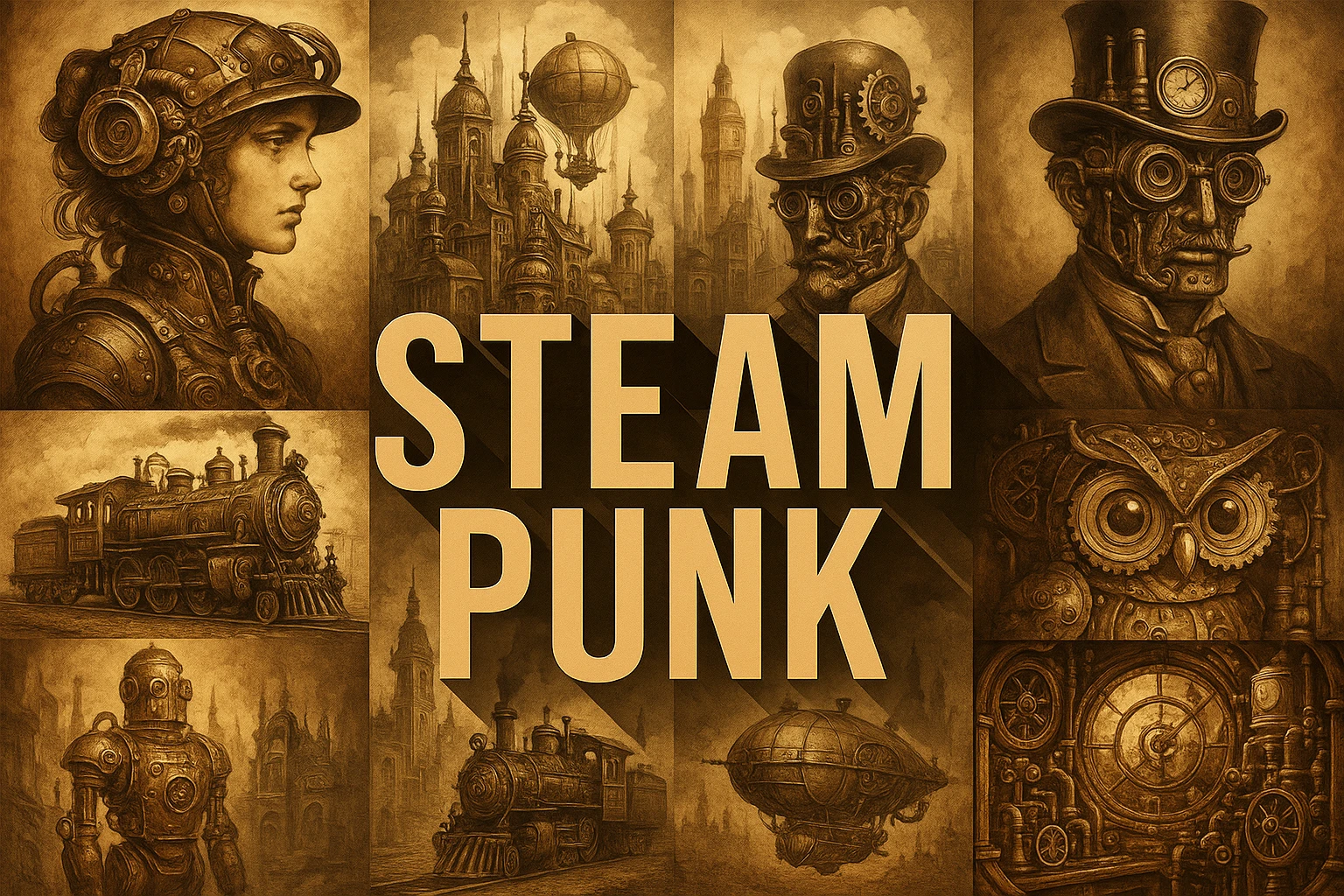
Select an image for a closer look. Use the thumbnails, arrow keys or a swipe to compare examples. Zoom in to inspect details, or share the image that inspires you.
Creative toolbox · take this style further
Choose an input and a destination. Search sends your words to the chosen site; Copy & open puts them on your clipboard to paste there.
Create with AI
Turn your chosen input into an image prompt or a new creative direction.
ChatGPT
Copy your input and paste it into a ChatGPT conversation or image request.
Copy & open ChatGPT (new tab)Claude · Anthropic
Develop an image prompt or explore the style in a new Claude conversation.
Copy & open Claude · Anthropic (new tab)Midjourney
Paste your input into the Imagine bar on the Create page.
Copy & open Midjourney (new tab)Adobe Firefly
Copy your input, open Firefly, and paste it into the prompt field.
Copy & open Adobe Firefly (new tab)Leonardo.Ai
Copy your input, open Leonardo, and paste it into the generation field.
Copy & open Leonardo.Ai (new tab)Image search
Find visual references. Short, concrete keywords usually work best.
Lexica
Search AI images and prompts using your selected input.
Search with this input Lexica (new tab)Pexels
Search the photo and video library. Short keywords often work best.
Search with this input Pexels (new tab)Pixabay
Search photos, illustrations and other images.
Search with this input Pixabay (new tab)Unsplash
Search photographs using the style name or your own keywords.
Search with this input Unsplash (new tab)Wikimedia Commons
Search photographs, artworks and historical images. Check each file for its source and reuse terms.
Search with this input Wikimedia Commons (new tab)Art & research
Explore artists, collections and the ideas behind a style.
Wikipedia
Search for background reading. A style may not have its own article.
Search with this input Wikipedia (new tab)WikiArt
Copy your input into WikiArt’s search to explore artists and artworks.
Copy & open WikiArt (new tab)Europeana
Paste your keywords into the search to explore European museum, library and archive collections.
Copy & open Europeana (new tab)Inspiration
Discover portfolios and visual ideas from creative communities.
Instagram hashtags
Search a hashtag made from your input: spaces and punctuation are removed. Instagram may require sign-in.
Search with this input Instagram hashtags (new tab)ArtStation
Paste your input into artwork search for concept art, environments, characters and visual development.
Copy & open ArtStation (new tab)Behance
Paste your input into project search for illustration, design and visual storytelling.
Copy & open Behance (new tab)A closer look
Mechanisms, housings, controls and crafted surfaces should form a coherent object; brass and gears are useful only when they contribute to its visual or imagined function.
Historical reference becomes speculation
Oxford's History of Science Museum presented a Steampunk exhibition bringing together artists and makers working with fantastical machines and transformed objects. The exhibition is a useful source for the variety of the practice, beyond a costume or a single decorative palette.
Choose the historical references deliberately. A scientific instrument, workshop tool and domestic appliance suggest different forms of handling and use. Explain where the new design departs from those references instead of presenting invention as recovered history.
Give the machine a task
An original device becomes more interesting when its purpose is understandable. Decide what enters it, what changes and what comes out. Controls, gauges and access panels can then follow that purpose rather than accumulating as ornament.
You do not need to prove that a fantasy machine works, but its visible parts should have an internally coherent relationship. A belt should connect plausible components; a handle should be reachable; a housing should leave room for the mechanism it appears to contain.
Materials should show use
Wood, leather, glass and metal can create rich contrasts. Vary their response to light and their signs of handling. Wear belongs at contact points and working surfaces, not as identical scratches pasted over every part.
Balance polished and rough areas according to the object's story. A carefully maintained measuring instrument may look different from a heavily used workshop machine. One restrained material distinction can communicate more than excessive corrosion.
Let the world extend beyond the object
Consider who made the device, who uses it and what resources its imagined society depends on. This can open the design beyond nostalgic images of luxury and empire. A speculative world is stronger when its social assumptions receive as much attention as its fittings.
For generated studies, use an original task and avoid copied branded props. Label the result as a concept. Evaluate its silhouette, human scale and visual logic before adding more gears; decoration cannot substitute for a design that can be understood.
The prompt workshop
Original creative exercises. These prompts create new illustrations, not documentary evidence.
A useful invention
Original steampunk concept of a portable mechanical seed sorter, readable input and output, reachable controls and coherent wood, glass and metal construction.
A maintained instrument
Original speculative brass-and-glass surveying device with restrained wear at handling points, clear silhouette and an intelligible support system.
A shared workshop
Original steampunk workshop scene centered on people repairing a communal water machine, purposeful mechanisms and varied materials, no random gear decoration.
Sources and further exploration
History of Science Museum, Oxford — Steampunk artists, objects and exhibition context