
Sicilian decorative and narrative craft tradition
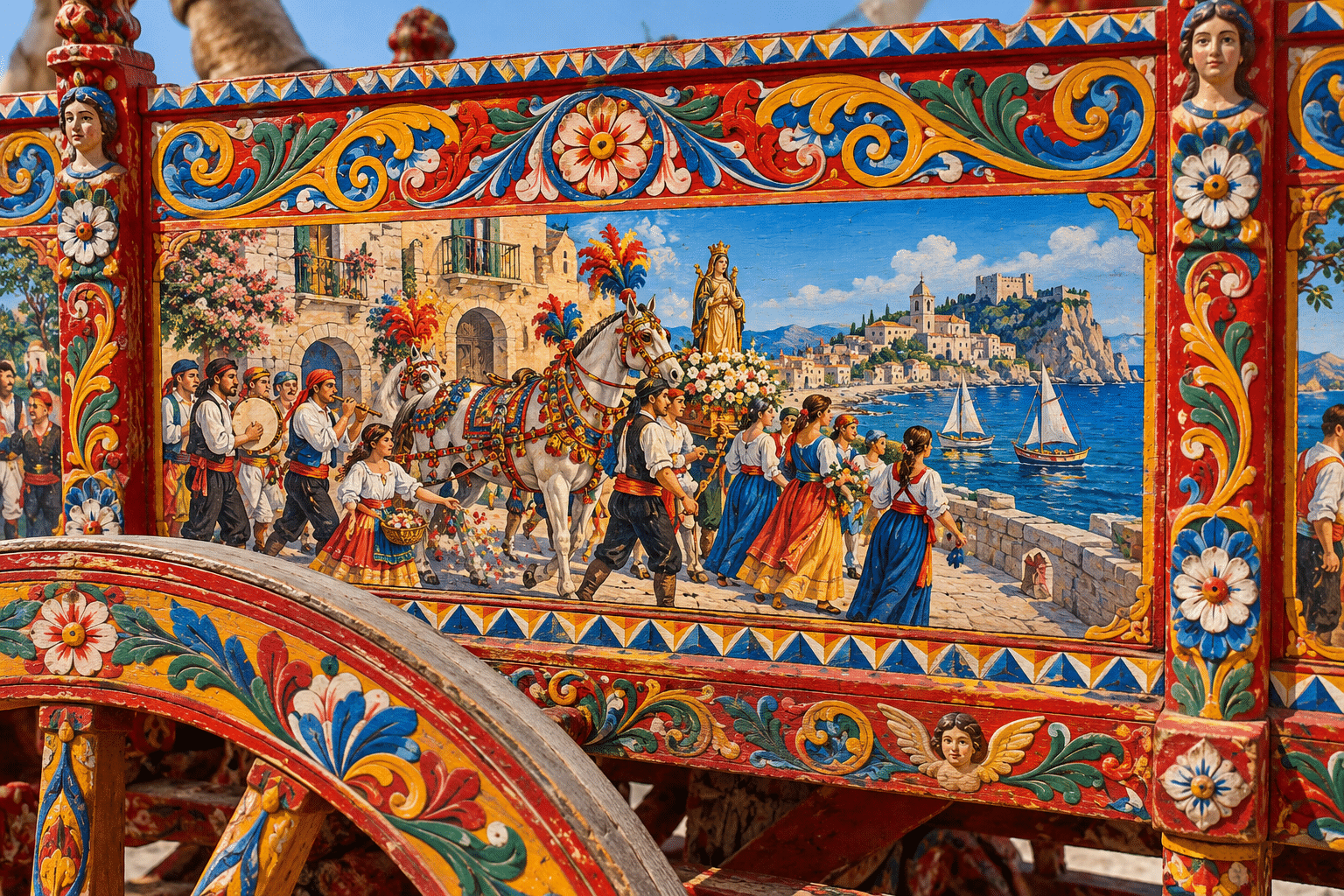
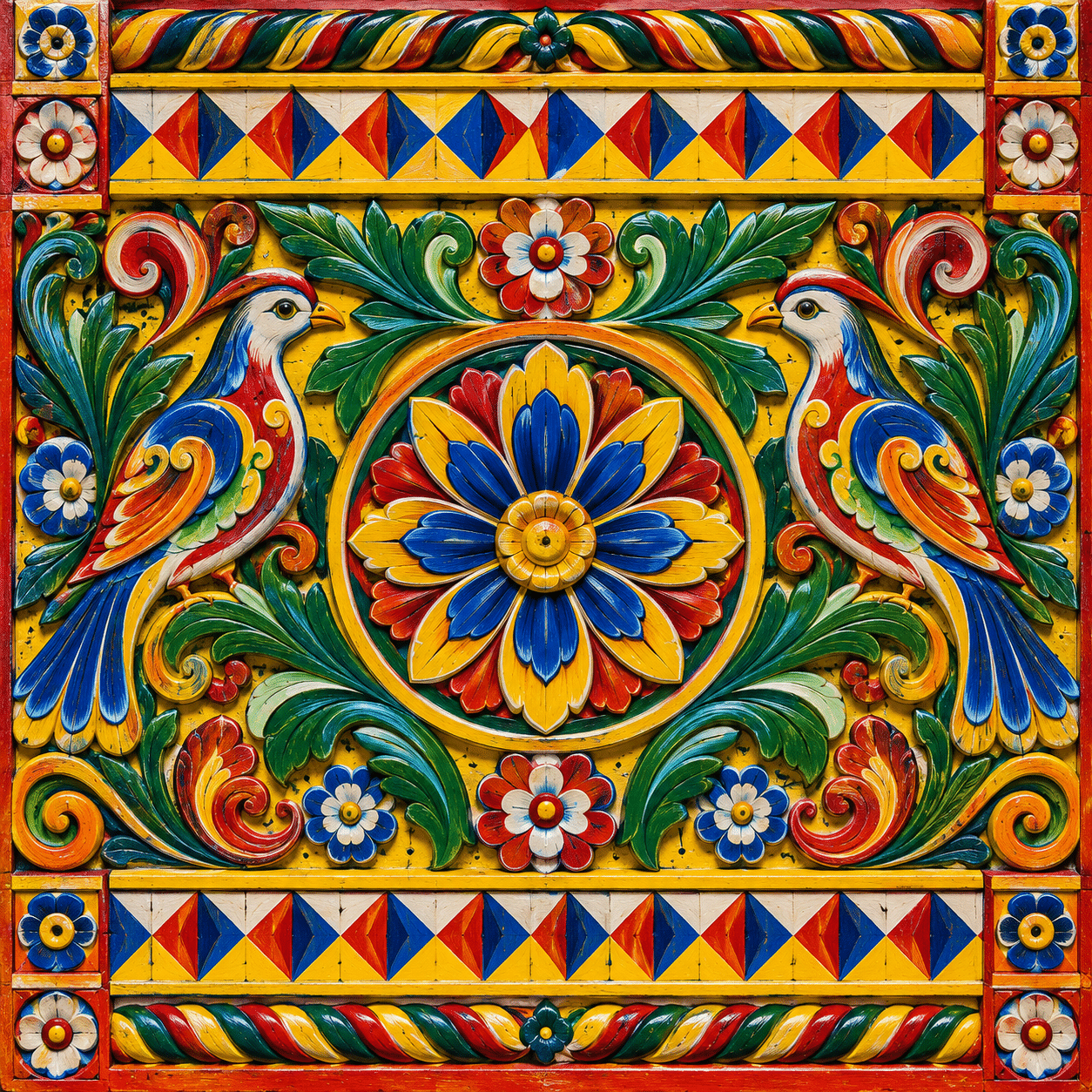
Sicilian cart painting transforms a working wooden vehicle into a richly decorated bearer of stories, ornament and local identity. Narrative panels, painted carving, wheels and structural details form an integrated visual whole.
A visual introduction
Select an image for a closer look. Use the thumbnails, arrow keys or a swipe to compare examples. Zoom in to inspect details, or share the image that inspires you.
Creative toolbox · take this style further
Choose an input and a destination. Search sends your words to the chosen site; Copy & open puts them on your clipboard to paste there.
Create with AI
Turn your chosen input into an image prompt or a new creative direction.
ChatGPT
Copy your input and paste it into a ChatGPT conversation or image request.
Copy & open ChatGPT (new tab)Claude · Anthropic
Develop an image prompt or explore the style in a new Claude conversation.
Copy & open Claude · Anthropic (new tab)Midjourney
Paste your input into the Imagine bar on the Create page.
Copy & open Midjourney (new tab)Adobe Firefly
Copy your input, open Firefly, and paste it into the prompt field.
Copy & open Adobe Firefly (new tab)Leonardo.Ai
Copy your input, open Leonardo, and paste it into the generation field.
Copy & open Leonardo.Ai (new tab)Image search
Find visual references. Short, concrete keywords usually work best.
Lexica
Search AI images and prompts using your selected input.
Search with this input Lexica (new tab)Pexels
Search the photo and video library. Short keywords often work best.
Search with this input Pexels (new tab)Pixabay
Search photos, illustrations and other images.
Search with this input Pixabay (new tab)Unsplash
Search photographs using the style name or your own keywords.
Search with this input Unsplash (new tab)Wikimedia Commons
Search photographs, artworks and historical images. Check each file for its source and reuse terms.
Search with this input Wikimedia Commons (new tab)Art & research
Explore artists, collections and the ideas behind a style.
Wikipedia
Search for background reading. A style may not have its own article.
Search with this input Wikipedia (new tab)WikiArt
Copy your input into WikiArt’s search to explore artists and artworks.
Copy & open WikiArt (new tab)Europeana
Paste your keywords into the search to explore European museum, library and archive collections.
Copy & open Europeana (new tab)Inspiration
Discover portfolios and visual ideas from creative communities.
Instagram hashtags
Search a hashtag made from your input: spaces and punctuation are removed. Instagram may require sign-in.
Search with this input Instagram hashtags (new tab)ArtStation
Paste your input into artwork search for concept art, environments, characters and visual development.
Copy & open ArtStation (new tab)Behance
Paste your input into project search for illustration, design and visual storytelling.
Copy & open Behance (new tab)A closer look
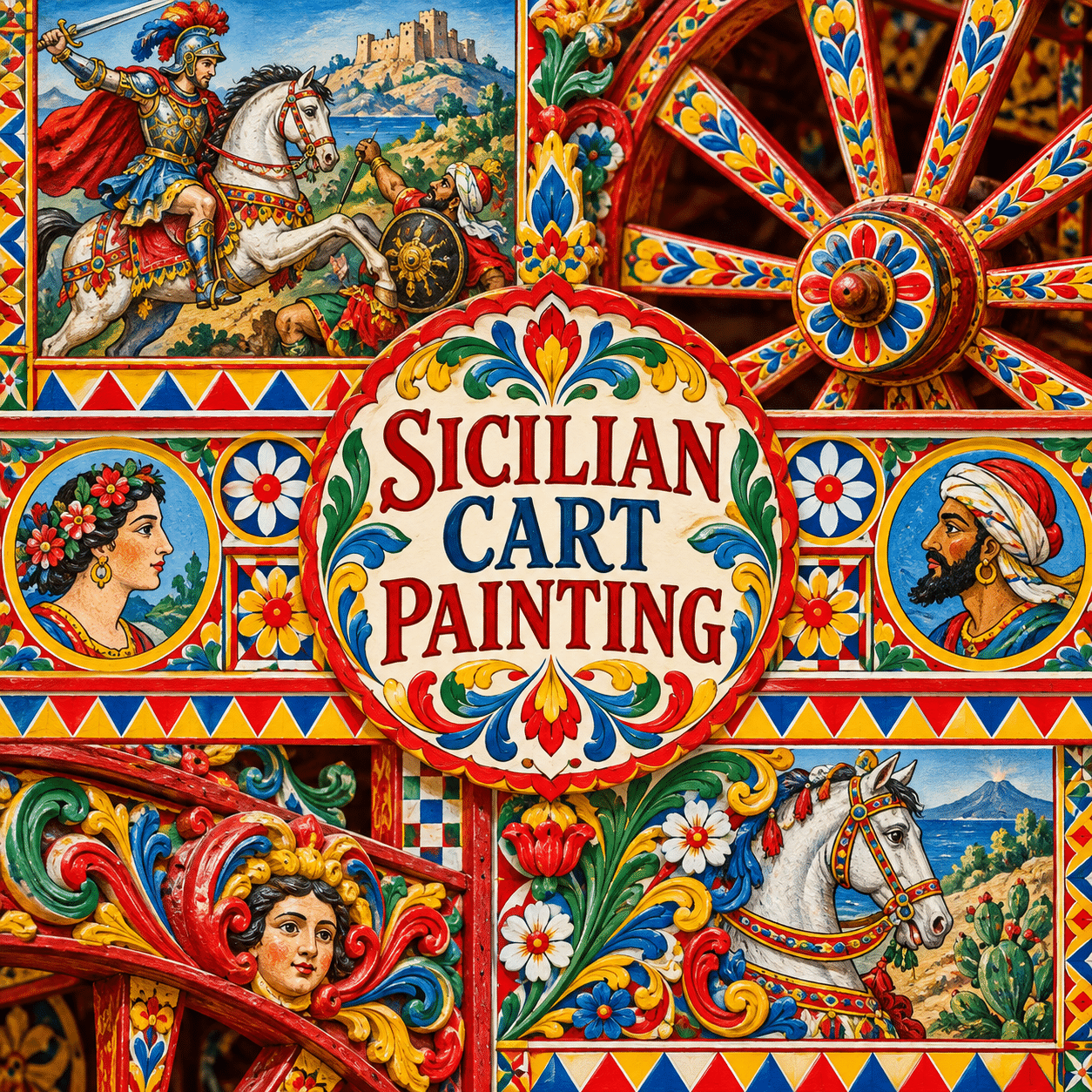
Saturated reds, yellows, blues and greens frame figural scenes with floral scrolls, rosettes and geometric bands, following the cart’s actual construction.
A painted object with a working history
The Sicilian cart is more than a convenient rectangular surface for bright pictures. Palermo’s Museo Pitrè places the spread of the cart in a nineteenth-century context and explains the relationship between decoration, protection of wood, devotional subjects and the owner’s public presentation. These functions overlap rather than reducing the object to either utility or ornament.
The Italian cultural heritage catalogue also emphasizes the cart as the product of several specialized crafts. Painting works alongside construction, carving and metalwork. When studying an individual example, look at the whole object and its documented place of production, not only a cropped narrative panel.
Regional differences deserve attention
The official heritage discussion distinguishes regional traditions, including differences between western and eastern Sicilian carts. These distinctions can involve construction and decorative organization as well as color. A general overview should introduce variety without pretending that one bright palette identifies every locality or workshop.
Museum records and local craft institutions provide a better basis for attribution than visual guesswork. The Aci Sant’Antonio cart museum’s history offers context for continuing craft practice. Use such resources to learn names and places rather than describing every decorated cart as an anonymous remnant of the past.
Narrative inside a frame
Painted side panels can carry episodes, figures and actions, while borders organize them into readable scenes. The Museo Pitrè account discusses subjects including saints and paladins. The meaning of a particular scene depends on its story and context; a knight in a colorful panel is not enough to identify a specific episode.
Begin by locating the main figures, their gestures and the direction of movement. Then examine how the border separates the scene from neighboring decoration. Strong frames allow a small narrative space to remain legible even when almost every surrounding surface is patterned.
Ornament follows construction
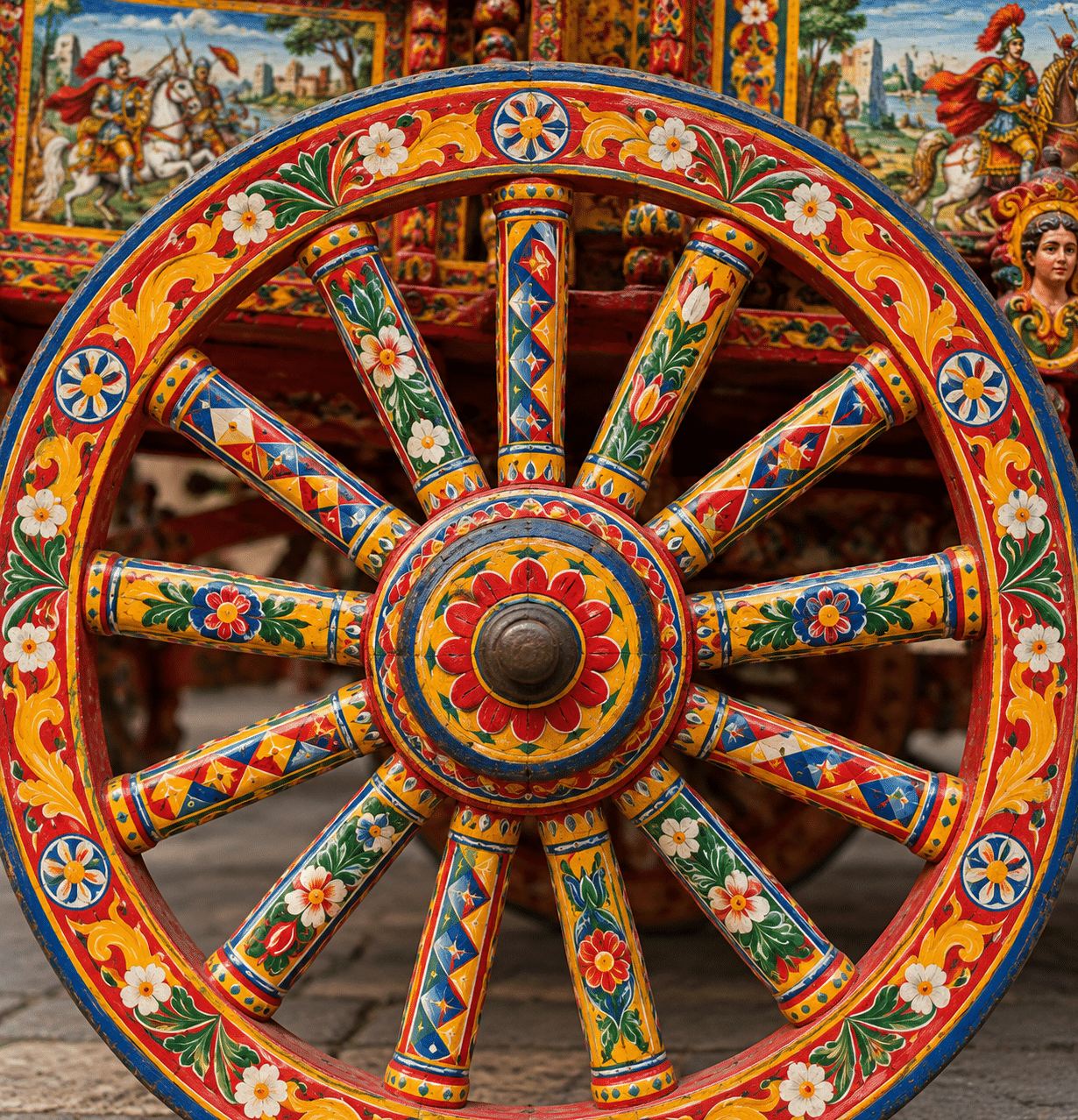
Spokes, hubs, rails and carved members create different shapes for the painter to address. A narrow strip invites repeated geometric units, a curved element supports scrolling foliage, and a broad panel can hold a narrative. The decoration feels integrated when it responds to these structural differences.
For a contemporary study, draw the object’s divisions before designing the ornament. Repeating the same motif at the same scale across every surface can flatten the hierarchy. Vary the density and let borders articulate joins, corners and changes of direction.
Color and visual rhythm
Saturated yellow, red, cobalt and green can establish a vivid field, while dark outlines and light accents keep details distinct. Color is relational: a small blue passage may cool a warm panel, and repeated yellow bands can connect separate parts of a wheel. Avoid treating saturation as a substitute for drawing.
At a distance, broad color groups should remain clear. Close up, brushwork and smaller motifs reward attention. This double scale is useful for illustration: first establish the large rhythm, then add detail only where it strengthens the frame, story or material character.
Contemporary interpretation without false provenance
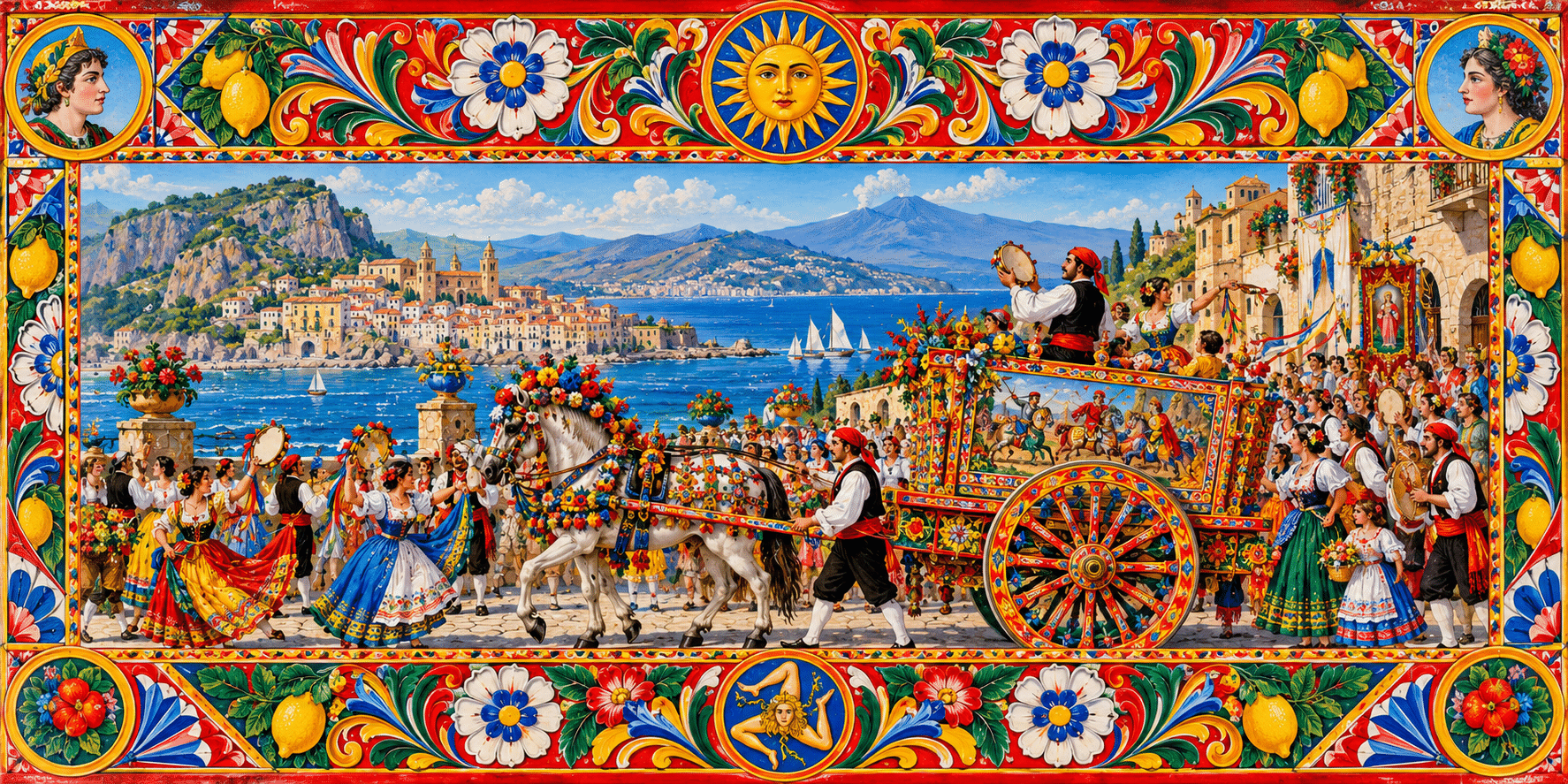
The new gallery contains AI-generated studies informed by selected decorative principles. Its coastal procession and ornamental panels are fictional compositions, not reproductions of documented carts or claims of authentic Sicilian craftsmanship. Generated detail cannot establish a workshop, date or regional attribution.
A respectful new design can learn from the relationship between structure and decoration while clearly identifying its own status. If reproducing a specific historical narrative, research the episode and the source object. If inventing a scene, describe it as invented rather than attaching an unsupported traditional meaning.
A practical design exercise
Make three connected studies: a wheel spoke, a narrow border and a narrative panel. Give them a shared palette but different motif scales. Compare how the border leads into the panel and how the spoke repeats around the wheel. This builds an integrated decorative vocabulary instead of an isolated pattern.
The approach is useful for studying painted wood, narrative framing and the relation between ornament and everyday objects. For deeper cultural understanding, the linked museums and heritage catalogue are essential companions to the visual exercises.
The prompt workshop
Original creative exercises. These prompts create new illustrations, not documentary evidence.
Structure and ornament
Create an original AI interpretation of a painted wooden cart wheel, alternating cobalt, red and yellow motifs follow spokes and hub, visible brushwork, no claim of historical authenticity.
A fictional narrative panel
Create a contemporary decorative panel informed by Sicilian cart painting, a fictional coastal procession framed by floral scrolls and geometric bands, saturated but organized palette.
Three connected surfaces
Create a coherent study of a narrative cart panel, a narrow painted rail and a decorated wheel segment, shared colors but different motif scales, clearly contemporary interpretation.
A smile from the studio
Jokes
The wheel asked for a quiet design. Every spoke had a story to tell.