
A researched introduction
This entry focuses on the Vienna Secession: the artists’ association founded in 1897 and its contribution to art and design around 1900. Its history involves exhibition-making, architecture, painting and graphic design. Reducing it to gold ornament and elegant portraits misses the institutional experiment behind the images.
A visual introduction
Open any image to look closer, then browse the examples.
Creative toolbox · take this style further
Choose an input, adjust it, then open a tool. Search links pass your text to the destination. Copy & open copies it for you to paste into the generator; you start generation there.
ChatGPT
Copy your input and paste it into a ChatGPT conversation or image request.
Copy & open ChatGPT (new tab)Claude · Anthropic
Develop an image prompt or explore the style in a new Claude conversation.
Copy & open Claude · Anthropic (new tab)Midjourney
Paste your input into the Imagine bar on the Create page.
Copy & open Midjourney (new tab)Adobe Firefly
Copy your input, open Firefly, and paste it into the prompt field.
Copy & open Adobe Firefly (new tab)Leonardo.Ai
Copy your input, open Leonardo, and paste it into the generation field.
Copy & open Leonardo.Ai (new tab)Lexica
Search AI images and prompts using your selected input.
Search with this input Lexica (new tab)Pexels
Search the photo and video library. Short keywords often work best.
Search with this input Pexels (new tab)Pixabay
Search photos, illustrations and other images.
Search with this input Pixabay (new tab)Unsplash
Search photographs using the style name or your own keywords.
Search with this input Unsplash (new tab)Wikipedia
Search for background reading. A style may not have its own article.
Search with this input Wikipedia (new tab)WikiArt
Copy your input into WikiArt’s search to explore artists and artworks.
Copy & open WikiArt (new tab)Instagram hashtags
Search a hashtag made from your input: spaces and punctuation are removed. Instagram may require sign-in.
Search with this input Instagram hashtags (new tab)A closer look
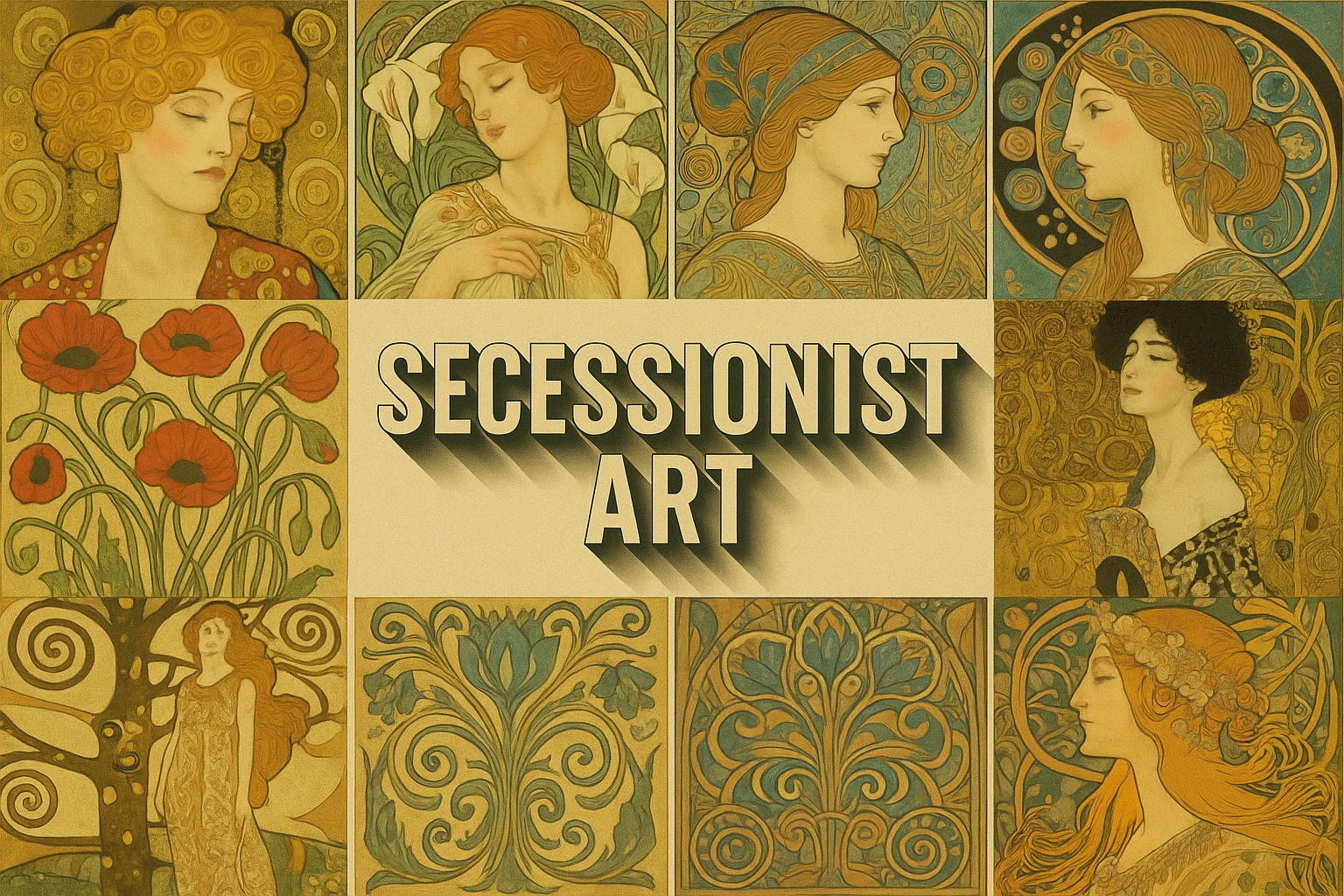
The AOI collage combines flat profile portraits, spiralling hair and botanical borders in ochre and green. It evokes a decorative vocabulary associated with art around 1900, but these generated illustrations are not reproductions of documented Secession artworks.
A break with an institution
The Secession’s own history records that a group around Gustav Klimt separated from Vienna’s conservative Künstlerhaus in 1897. Klimt became its first president. Joseph Maria Olbrich designed the exhibition building completed in 1898, while the journal Ver Sacrum gave the association another means of presenting its ideas. The organisation and its channels of display were part of the project.
Freedom was not distributed equally. The association’s history notes that women appeared in some early exhibitions but were not admitted as members until 1949. That distinction matters when celebrating an institution’s modernity. An adventurous visual language and an inclusive membership policy are different achievements.
Read the room as well as the picture
Olbrich’s building combines clear geometric masses with concentrated ornament. The Secession’s architectural account describes a structure whose relatively closed exterior gives way to exhibition spaces designed around light. The contrast suggests a useful viewing question: where does decoration intensify the form, and where does an undecorated surface make that intensity possible?
In a poster or painting, ask a similar question. Does a border frame the figure or compete with it? Does a repeated floral motif carry the eye through the page? Is the flatness deliberate, and how does it change the relationship between figure and ground? These questions are more useful than requesting a gold filter.
One documented exhibition to study
Klimt made the Beethoven Frieze for the Secession’s fourteenth exhibition in 1902. The institution describes the exhibition as a collaboration joining architecture, painting, sculpture and music around a shared subject. Max Klinger’s Beethoven statue occupied its centre, and Josef Hoffmann directed the exhibition arrangement.
The frieze is therefore a strong starting point for thinking about an artwork within an ensemble. Consult the official account and images rather than using our generated collage as evidence. The collage’s portraits demonstrate a broad decorative exercise; they cannot explain the particular narrative or original spatial relationships of Klimt’s work.
Borrow a principle, not a false attribution
For an original design, choose one organising principle: a restrained frame around a flat figure, a contrast between rectilinear structure and curved ornament, or an image conceived together with its typography. Develop the parts as a whole. Leave enough empty ground that the ornamental passages have a clear role.
If you use an image model, specify those relationships and label the result as a contemporary interpretation. Do not attach Klimt’s name as a signature or present a generated picture as a rediscovered historical work. The most productive lesson of this entry is that an artwork can include the conditions of its encounter: the wall, the room, the publication and the audience.
Sources and further exploration
Vienna Secession — Artists’ association and history