
Archive note: historical claims and artist or artwork associations in this entry have not yet received a full source review.
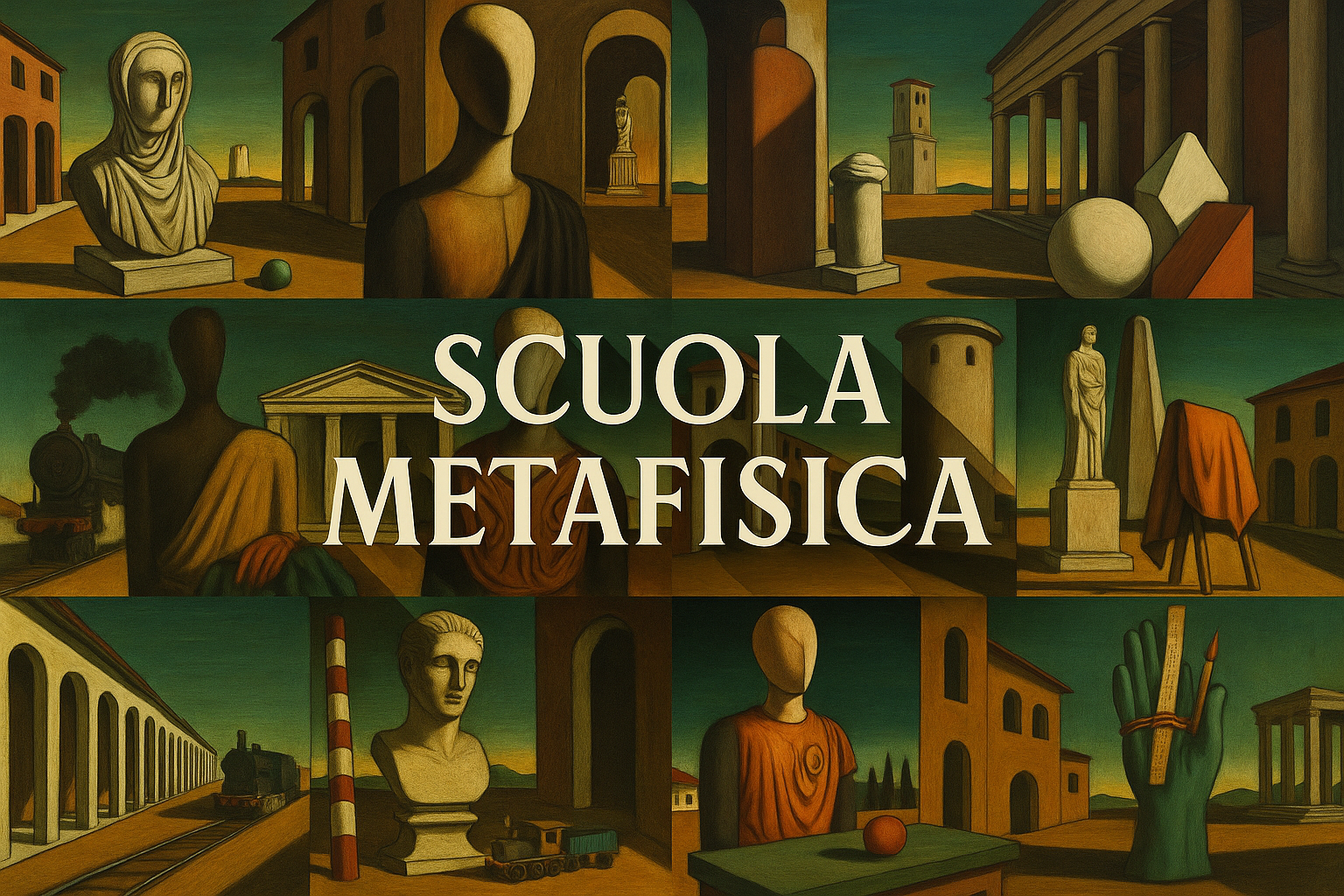
Scuola Metafisica
Stark, deserted cityscapes with long shadows, still life laden with enigma, and classical statues invoking unanswered questions—a visual conundrum wrapped in silence and shadows.
AOI thinking about Scuola Metafisica [+_~]-/
Overview and quick facts
Born in the shadowy corridors of early 20th-century Italy, Scuola Metafisica captures the uncanny; a realm where reality cracks open like the shell of a cosmic egg, and time stands eerily still.
Can understand it also, as:
Metaphysical Art, Pittura Metafisica
Categorize it as:
Surrealism, Modernism
.: Dreaming :.
Shadows stretch for miles,
time pauses with silent grace,
whispers in stillness.
:. Thought is power .:
Detailed description
Emerging from the Italian cultural landscape, Scuola Metafisica blends Renaissance clarity with surreal disquiet. The objects and architecture hover in ambiguity, seemingly plucked from reality yet stripped of context. Illogical perspectives and eerie serenity elicit a dreamlike introspection, teasing the line between perception and subconscious.
Archive notes — claims to verify
1. Giorgio de Chirico is the central figure and pioneer.
2. The style heavily influenced the Surrealists.
3. Contradictory perspectives create tension.
4. The art evokes a metaphysical poetry.
5. Often includes references to Greek and Roman antiquity.
Artists and works: references to check
(be aware, can be highly speculative)
Artists (be aware, speculation possible):
1. Giorgio de Chirico 2. Carlo Carrà 3. Giorgio Morandi 4. Alberto Savinio
Artworks (be aware, speculation possible)
1. “The Song of Love” by de Chirico 2. “The Tower” by Carrà 3. “Metaphysical Interior” by de Chirico 4. “The Enigma of the Hour” by de Chirico
Epoch
1910s-1920s
Creative tools and further exploration
Search results are starting points for exploration, not evidence for the historical claims or attributions in this legacy entry.