
Regional design traditions · furniture and everyday objects
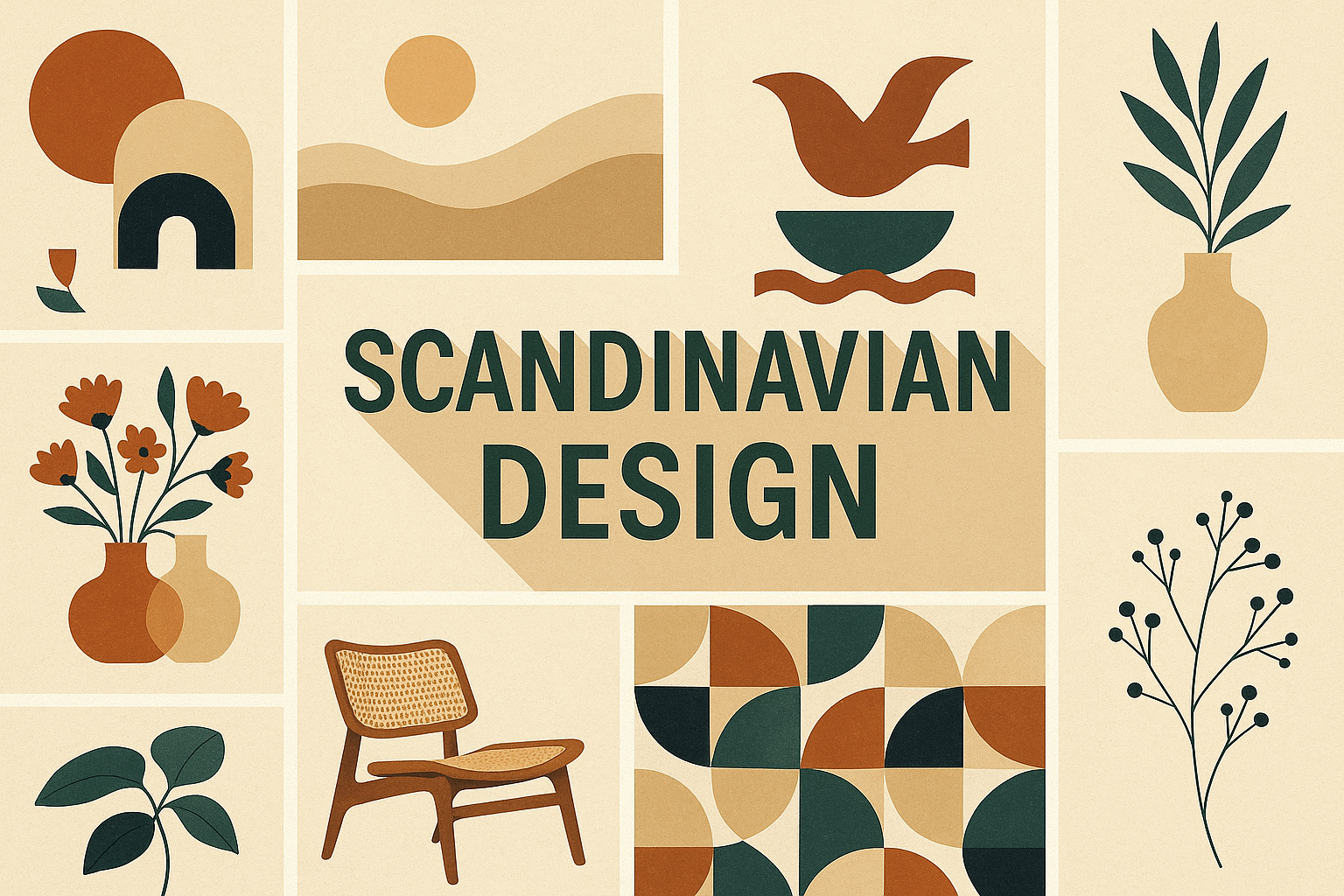
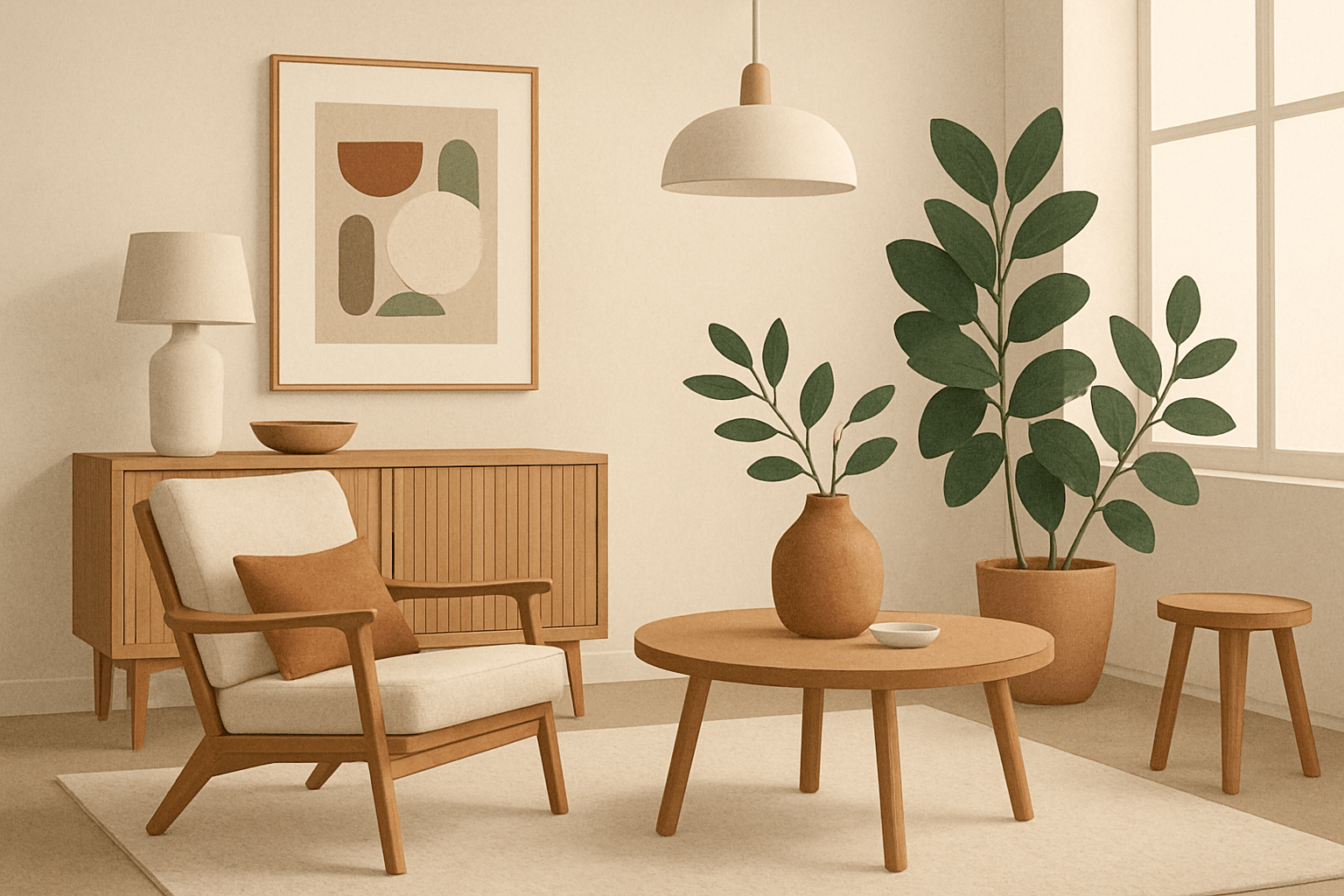
Scandinavian design is a broad label associated with design traditions in Denmark, Norway and Sweden, often discussed alongside the wider Nordic region. It includes craft, industrial production, furniture, lighting, textiles and everyday objects. Reducing it to pale wood and empty white rooms misses its range of materials, colours and approaches to use.
A visual introduction
Select an image for a closer look. Use the thumbnails, arrow keys or a swipe to compare examples. Zoom in to inspect details, or share the image that inspires you.
Creative toolbox · take this style further
Choose an input and a destination. Search sends your words to the chosen site; Copy & open puts them on your clipboard to paste there.
Create with AI
Turn your chosen input into an image prompt or a new creative direction.
ChatGPT
Copy your input and paste it into a ChatGPT conversation or image request.
Copy & open ChatGPT (new tab)Claude · Anthropic
Develop an image prompt or explore the style in a new Claude conversation.
Copy & open Claude · Anthropic (new tab)Midjourney
Paste your input into the Imagine bar on the Create page.
Copy & open Midjourney (new tab)Adobe Firefly
Copy your input, open Firefly, and paste it into the prompt field.
Copy & open Adobe Firefly (new tab)Leonardo.Ai
Copy your input, open Leonardo, and paste it into the generation field.
Copy & open Leonardo.Ai (new tab)Image search
Find visual references. Short, concrete keywords usually work best.
Lexica
Search AI images and prompts using your selected input.
Search with this input Lexica (new tab)Pexels
Search the photo and video library. Short keywords often work best.
Search with this input Pexels (new tab)Pixabay
Search photos, illustrations and other images.
Search with this input Pixabay (new tab)Unsplash
Search photographs using the style name or your own keywords.
Search with this input Unsplash (new tab)Wikimedia Commons
Search photographs, artworks and historical images. Check each file for its source and reuse terms.
Search with this input Wikimedia Commons (new tab)Art & research
Explore artists, collections and the ideas behind a style.
Wikipedia
Search for background reading. A style may not have its own article.
Search with this input Wikipedia (new tab)WikiArt
Copy your input into WikiArt’s search to explore artists and artworks.
Copy & open WikiArt (new tab)Europeana
Paste your keywords into the search to explore European museum, library and archive collections.
Copy & open Europeana (new tab)Inspiration
Discover portfolios and visual ideas from creative communities.
Instagram hashtags
Search a hashtag made from your input: spaces and punctuation are removed. Instagram may require sign-in.
Search with this input Instagram hashtags (new tab)ArtStation
Paste your input into artwork search for concept art, environments, characters and visual development.
Copy & open ArtStation (new tab)Behance
Paste your input into project search for illustration, design and visual storytelling.
Copy & open Behance (new tab)A closer look
Examine proportions, joints, surfaces and the relationship between an object and the body. Restrained forms are one possibility; sculptural shapes, strong colour and industrial materials also belong to the broader story.
Define the geographical scope
Scandinavian and Nordic are frequently used loosely in design marketing. In a more precise geographical usage, Scandinavia refers to Denmark, Norway and Sweden, while the Nordic region also includes Finland and Iceland. When discussing a particular designer or object, name its actual context instead of treating neighbouring traditions as interchangeable.
A regional label is a starting point for comparison, not a guarantee that every object shares one philosophy. Ask when it was designed, how it was produced and who could obtain it. A handmade chair, a mass-produced lamp and a retail interior may invoke the same label while involving very different decisions.
Function is visible in the details
Look at how a chair supports the body, how a handle meets the hand and how a lamp directs light. The most informative details may be a joint, a softened edge or the distance between two supports. An object can appear simple because many competing requirements have been resolved, rather than because little thought went into it.
For an original design study, draw the object in use as well as alone. A beautiful silhouette does not show whether knees fit under a table or whether a shade produces glare. Let the body's interaction with the object guide the proportions.
Materials are more than a palette
Wood grain, woven fibres, metal, glass and plastics each suggest different methods of construction and maintenance. Do not use a wood texture as a substitute for plausible joinery. Consider where parts meet, what bears weight and how a surface might age.
The Designmuseum Danmark exhibition Danish Modern follows Danish design across the twentieth century and explicitly includes organic pop design and later industrial approaches. Its account is a useful corrective to the idea that the tradition consists only of warm timber and muted neutrals. [1]
Colour and experimentation belong in the picture
Verner Panton's work provides a clear counterexample to the beige-room stereotype. The Vitra Design Museum presents his sculptural furniture, lighting, textiles and immersive colour environments as connected parts of his practice. That is a specific designer's contribution, not a replacement stereotype for the whole region. [2]
Compare a restrained timber object with a brightly coloured moulded form. Ask how each handles weight, contact and the surrounding space. The comparison becomes more useful when it identifies different solutions to a practical problem rather than ranking one as more authentically Scandinavian.
A room is a system of uses
In an interior study, begin with activities and circulation: reading, eating, storage, conversation. Place light where those activities occur and keep routes clear. Then choose a coherent family of materials and one or two deliberate contrasts. An empty room is not automatically a functional one.
Avoid claiming sustainability from appearance alone. Durability, repairability, sourcing and production require evidence about the actual object. A generated interior can explore proportions and atmosphere, but it cannot verify those properties. Describe it as a design concept and keep material claims proportionate to what is known.
A small poetic detour
Original words from the AOI studio.
Poetry
Nordic light cascades,\
Minimal whispers of wood,\
Serenity sings.
The prompt workshop
Original creative exercises. These prompts create new illustrations, not documentary evidence.
A room organised around use
Create an original compact reading-and-dining room with clear circulation, well-placed task lighting, plausible timber joinery and a restrained textile palette. Show how the furniture supports everyday activity; avoid an empty showroom appearance.
Colourful modern form
Design an original sculptural chair concept with a continuous coloured shell, readable support structure and a contrasting quiet setting. Study body contact and stability rather than treating bright colour as the only design idea.
One object, two constructions
Create two original side-table concepts with the same useful dimensions: one in joined timber and one in folded metal. Make the different construction logic visible, with neutral lighting and no invented sustainability claims.