
A researched introduction
Sacred geometry art is a broad label for geometric imagery associated with spiritual, symbolic or contemplative meanings. It is not a single movement with one origin or a universal symbol dictionary. A responsible reading separates the construction of a pattern from the meanings assigned to it in a particular setting.
A visual introduction
Open any image to look closer, then browse the examples.
Creative toolbox · take this style further
Choose an input, adjust it, then open a tool. Search links pass your text to the destination. Copy & open copies it for you to paste into the generator; you start generation there.
ChatGPT
Copy your input and paste it into a ChatGPT conversation or image request.
Copy & open ChatGPT (new tab)Claude · Anthropic
Develop an image prompt or explore the style in a new Claude conversation.
Copy & open Claude · Anthropic (new tab)Midjourney
Paste your input into the Imagine bar on the Create page.
Copy & open Midjourney (new tab)Adobe Firefly
Copy your input, open Firefly, and paste it into the prompt field.
Copy & open Adobe Firefly (new tab)Leonardo.Ai
Copy your input, open Leonardo, and paste it into the generation field.
Copy & open Leonardo.Ai (new tab)Lexica
Search AI images and prompts using your selected input.
Search with this input Lexica (new tab)Pexels
Search the photo and video library. Short keywords often work best.
Search with this input Pexels (new tab)Pixabay
Search photos, illustrations and other images.
Search with this input Pixabay (new tab)Unsplash
Search photographs using the style name or your own keywords.
Search with this input Unsplash (new tab)Wikipedia
Search for background reading. A style may not have its own article.
Search with this input Wikipedia (new tab)WikiArt
Copy your input into WikiArt’s search to explore artists and artworks.
Copy & open WikiArt (new tab)Instagram hashtags
Search a hashtag made from your input: spaces and punctuation are removed. Instagram may require sign-in.
Search with this input Instagram hashtags (new tab)A closer look
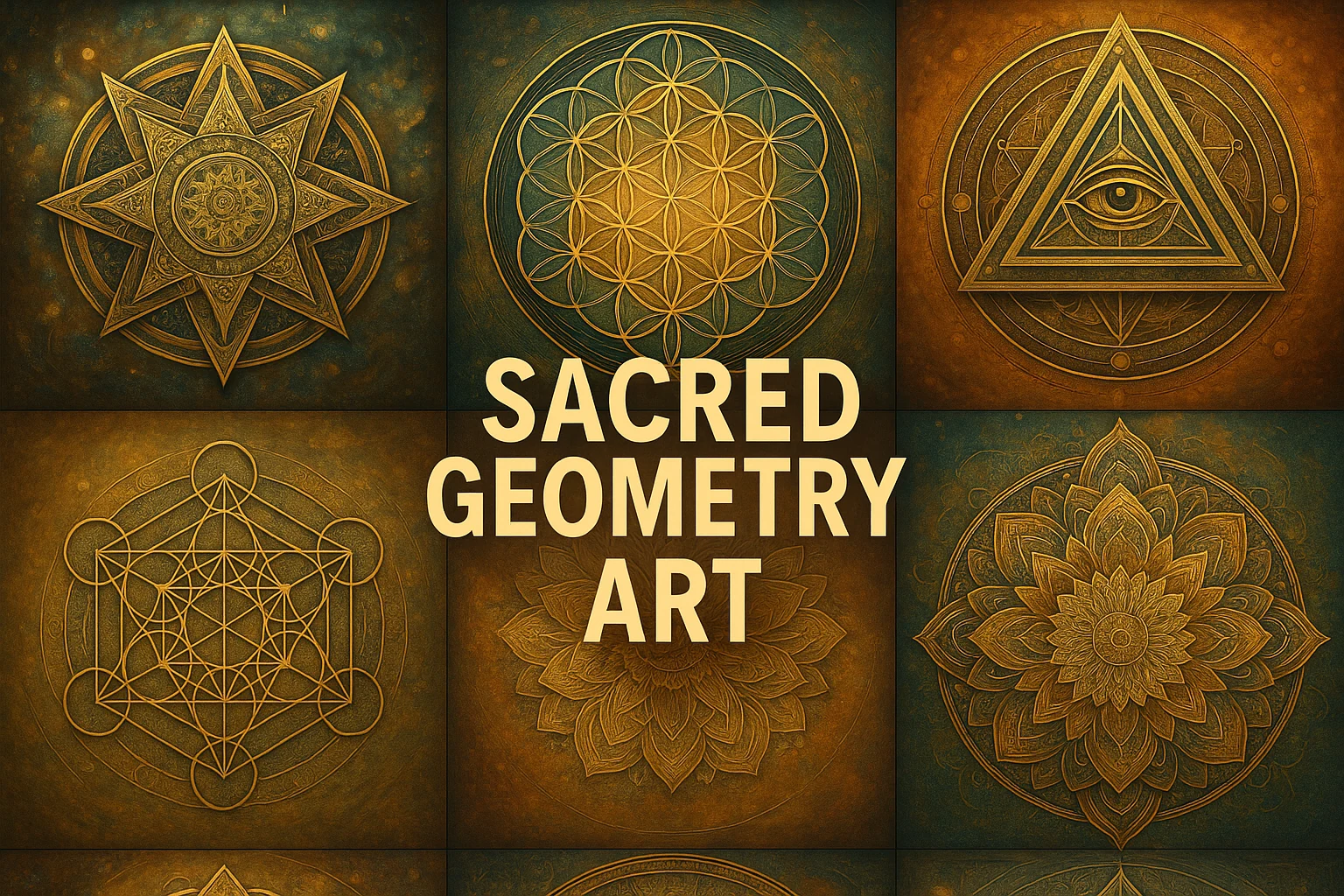
The archive collage combines gold circles, stars, interlaced lines, an eye within a triangle and a floral form against dark grounds. These motifs share a polished visual treatment, but the collage does not establish that they belong to one tradition or carry the same meaning.
Geometry is visible; meaning needs context
You can count a pattern’s divisions, trace its symmetries and describe its repetition without claiming to know its religious significance. Those formal observations are a good beginning. To go further, identify an object, its place and period, its use and the source explaining its imagery. A resemblance between two shapes is not sufficient evidence for a shared origin.
Our illustration is a modern synthetic combination. It should not be used as a historical chart of sacred symbols. The eye, flower-like arrangement and interlaced circles invite different associations, but those associations need to be researched separately. The adjective sacred belongs to a context of belief or practice; adding gold light does not supply that context.
A specific tradition offers a better lesson
The Metropolitan Museum of Art describes geometric pattern as one important component of Islamic ornament, alongside other forms of decoration. Its educational material explains how circles, squares, stars and polygons can be organised through repetition and interlacing. This is a concrete place to study construction rather than projecting a universal mystical explanation onto every pattern.
The museum’s teaching resource also draws attention to relationships among the units and the possibility of extending a pattern beyond its visible boundary. Study those relationships in the documented examples. Do not conclude that all Islamic art is geometric, that every geometric object has a religious function, or that one contemporary collage can stand in for diverse historical practices.
Construct before embellishing
Draw a circle and divide it into equal parts. Connect selected points, repeat the resulting unit and observe the shapes created in the gaps. Keep the construction lines on a separate layer. This lets you distinguish the rule that generates the pattern from the border, colour and texture applied afterwards.
For exact work, use a compass and straightedge or a vector application with snapping. Image models can make persuasive-looking interlace while breaking a line or changing the spacing halfway through. Inspect intersections individually when regularity matters. A convincing glow is not a substitute for a consistent construction.
Leave room for contemplation without inventing science
A repetitive drawing exercise may be meaningful or absorbing to its maker. That personal experience does not establish claims about healing frequencies, hidden physical laws or universal mathematical codes. Such claims would require their own evidence and are not made here.
For a contemporary design, you can work entirely with an original geometric system. Name the process, explain any symbolism you chose, and acknowledge cultural sources when you use them. The result can be beautiful without pretending to reveal the secret plan of the universe. Sometimes a circle deserves the dignity of simply being well drawn.
The prompt workshop
Original creative exercises. These prompts create new illustrations, not documentary evidence.
An original geometric study
Create an original decorative study of repeated circles and eight-pointed stars on a square grid, two restrained colours and generous margins. Keep all intersections consistent. No sacred inscriptions, claims of authenticity or pseudo-scientific labels. Present it as a contemporary pattern experiment.