
Archive note: historical claims and artist or artwork associations in this entry have not yet received a full source review.
Russian Futurism
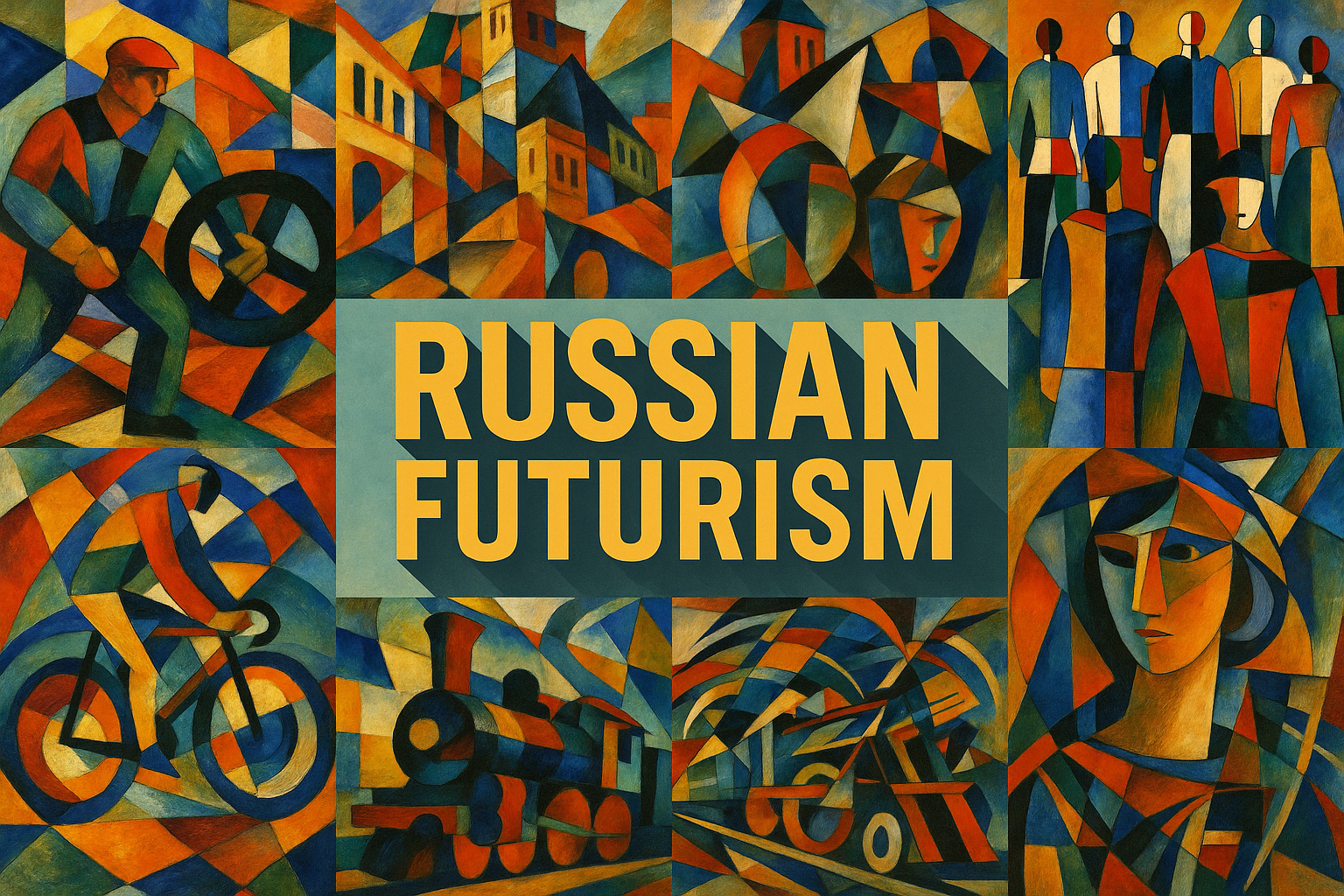
A cacophony of geometric forms striking against the canvas, colors clash like iron on iron. Whirring waves of cobalt and crimson, interrupted by interlocking shapes, reflect both industrial might and abstract dreams.
AOI thinking about Russian Futurism [+_~]-/
Overview and quick facts
Heralding from the cusp of revolution, Russian Futurism marries chaos with innovation, painting audacious dreams with industrial cadence. It blurs the lines between utopian aspiration and stark mechanical reality.
Can understand it also, as:
Russian Avant-Garde, Soviet Futurism
Categorize it as:
Avant-Garde, Modernism
.: Dreaming :.
Steel dreams take to flight,
Geometric whispers shout—
Future born in light.
:. Thought is power .:
Detailed description
Russian Futurism, born amidst a nation on the brink of transformation, offers an audacious vision of tomorrow. It breaks free from the constraints of the past, embracing speed, technology, and industrial power as its muses. The artworks reflect a world of perpetual motion, depicted through fragmented forms and bold color palettes. This movement doesn’t just depict a progressive society; it becomes the manifesto for it, dizzying in its celebration of kinetic energy, yet underlining with chilling clarity the alien mechanization looming over humanity.
Archive notes — claims to verify
1. Russian Futurism emerged in the early 1910s amidst a climate of social upheaval.
2. It aligns with the avant-garde to challenge tradition.
3. Poetry and visual art were its foundational vehicles.
4. Iconic for its experiments in typography.
5. It foresaw technology as transformative.
Artists and works: references to check
(be aware, can be highly speculative)
Artists (be aware, speculation possible):
1. Vladimir Mayakovsky (1893-1930) 2. Kazimir Malevich (1879-1935) 3. Natalia Goncharova (1881-1962) 4. Lyubov Popova (1889-1924) 5. Olga Rozanova (1886-1918)
Artworks (be aware, speculation possible)
1. “The Cyclist” by Natalia Goncharova (1913) 2. “Black Square” by Kazimir Malevich (1915) 3. “Death to the Oppressors!” by Vladimir Mayakovsky (1917)
Epoch
1910s – 1920s
Creative tools and further exploration
Search results are starting points for exploration, not evidence for the historical claims or attributions in this legacy entry.