
Historical artistic and cultural movement
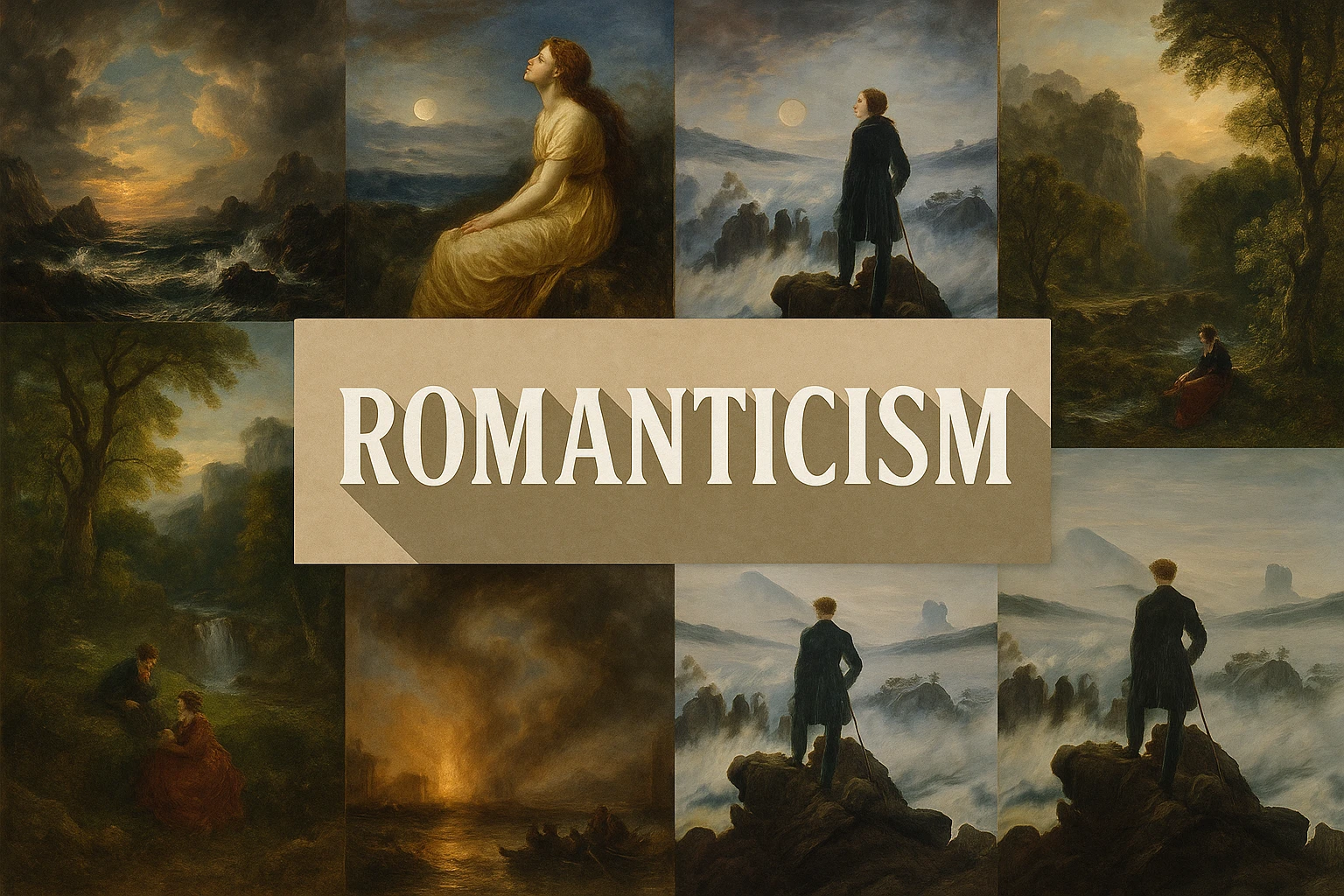
Romanticism is a broad movement in which imagination, emotion and individual experience became central artistic concerns. Its paintings vary greatly, from intimate contemplation to turbulent scenes of nature and history.
A visual introduction
Select an image for a closer look. Use the thumbnails, arrow keys or a swipe to compare examples. Zoom in to inspect details, or share the image that inspires you.
Creative toolbox · take this style further
Choose an input and a destination. Search sends your words to the chosen site; Copy & open puts them on your clipboard to paste there.
Create with AI
Turn your chosen input into an image prompt or a new creative direction.
ChatGPT
Copy your input and paste it into a ChatGPT conversation or image request.
Copy & open ChatGPT (new tab)Claude · Anthropic
Develop an image prompt or explore the style in a new Claude conversation.
Copy & open Claude · Anthropic (new tab)Midjourney
Paste your input into the Imagine bar on the Create page.
Copy & open Midjourney (new tab)Adobe Firefly
Copy your input, open Firefly, and paste it into the prompt field.
Copy & open Adobe Firefly (new tab)Leonardo.Ai
Copy your input, open Leonardo, and paste it into the generation field.
Copy & open Leonardo.Ai (new tab)Image search
Find visual references. Short, concrete keywords usually work best.
Lexica
Search AI images and prompts using your selected input.
Search with this input Lexica (new tab)Pexels
Search the photo and video library. Short keywords often work best.
Search with this input Pexels (new tab)Pixabay
Search photos, illustrations and other images.
Search with this input Pixabay (new tab)Unsplash
Search photographs using the style name or your own keywords.
Search with this input Unsplash (new tab)Wikimedia Commons
Search photographs, artworks and historical images. Check each file for its source and reuse terms.
Search with this input Wikimedia Commons (new tab)Art & research
Explore artists, collections and the ideas behind a style.
Wikipedia
Search for background reading. A style may not have its own article.
Search with this input Wikipedia (new tab)WikiArt
Copy your input into WikiArt’s search to explore artists and artworks.
Copy & open WikiArt (new tab)Europeana
Paste your keywords into the search to explore European museum, library and archive collections.
Copy & open Europeana (new tab)Inspiration
Discover portfolios and visual ideas from creative communities.
Instagram hashtags
Search a hashtag made from your input: spaces and punctuation are removed. Instagram may require sign-in.
Search with this input Instagram hashtags (new tab)ArtStation
Paste your input into artwork search for concept art, environments, characters and visual development.
Copy & open ArtStation (new tab)Behance
Paste your input into project search for illustration, design and visual storytelling.
Copy & open Behance (new tab)A closer look
Expressive scale, charged atmosphere, dramatic movement or deliberate stillness can place the viewer in a heightened relationship with a subject; there is no single mandatory palette.
A way of approaching experience
The Metropolitan Museum describes Romanticism's development around the turn of the nineteenth century and its varied relationship with Neoclassicism. It is too simple to divide the period into emotion on one side and reason on the other. Artists shared training, subjects and debates while taking different directions.
Romanticism also does not mean only romantic love. Literature, historical events, imagined worlds and the power of nature supplied important subjects. Identify the particular concern of a painting before assigning it a general mood.
Scale can change the stakes
A small figure beneath a vast sky creates a different relationship from a figure filling the frame. Strong diagonals can suggest instability; a broad uninterrupted horizon can sustain a quieter tension. Composition determines how the viewer encounters the subject.
For an original study, draw the same scene with three different ratios of person to environment. Notice when the setting becomes the dominant presence. Spectacle is useful only when it contributes to the emotional or intellectual question of the image.
Atmosphere needs structure
Cloud, spray, smoke and darkness should clarify or deliberately complicate the main forms. Establish a few readable masses before introducing turbulence. If every edge dissolves, the viewer may lose the relationships that make the event meaningful.
Color can reinforce that structure through contrasts of temperature, saturation or value. Avoid assuming that a highly saturated sky automatically produces depth of feeling. A restrained interval of light can carry more force when the surrounding composition prepares for it.
Read historical imagination critically
Romantic artists sometimes imagined places and peoples through unequal cultural assumptions. The Met's discussion of Orientalism makes this an important part of interpretation, not a reason to repeat exotic stereotypes in a new work.
Choose a specific viewpoint and acknowledge what the image invents. A contemporary response can explore uncertainty, vulnerability or wonder without dressing every subject in a generic past. Compare it with the separate German Romanticism article for a more focused discussion of landscape and inward experience.
The prompt workshop
Original creative exercises. These prompts create new illustrations, not documentary evidence.
Vast weather
Original Romanticism-inspired landscape of a small shelter beneath approaching weather, clear scale relationships, directional light and a restrained focal point.
Human vulnerability
Original painterly scene of two travelers facing a difficult river crossing, coherent gestures and turbulent but readable water, no copied historical painting.
Quiet uncertainty
Original landscape of a path entering a luminous mist, stable foreground forms and open distant space, subtle color and an unresolved destination.
Sources and further exploration
The Met — Romanticism, artistic diversity and historical imagination